On this page
でなくてなんだろう says that one label is inescapable: これが奇跡でなくてなんだろう means “If this is not a miracle, what is?” ではあるまいか uses another negative-looking question to advance a proposition more cautiously: 原因は制度にあるのではあるまいか means “Might the cause lie in the system?”
Both forms turn a question into an assertion, but they move in opposite rhetorical directions. The first closes alternatives and sounds convinced. The second opens a conclusion for the reader to consider, even when the writer clearly favors it.
Two questions that do not seek an answer
Compare a pair built around 愛:
相手の幸せを何より願うこの気持ちが、愛でなくてなんだろう。
あいての しあわせを なにより ねがう この きもちが、あいでなくて なんだろう。
“If this feeling of wishing for the other person's happiness is not love, what is?”
相手を思いやるこの気持ちは、愛ではあるまいか。
あいてを おもいやる この きもちは、あいでは あるまいか。
“Might this feeling of caring for the other person be love?”
The first speaker already treats 愛 as the only convincing name. The literal question “what is it?” rejects the possibility of a better label. The second speaker proposes 愛 while adopting the posture of inquiry. English can translate both with a question, but the stance differs.
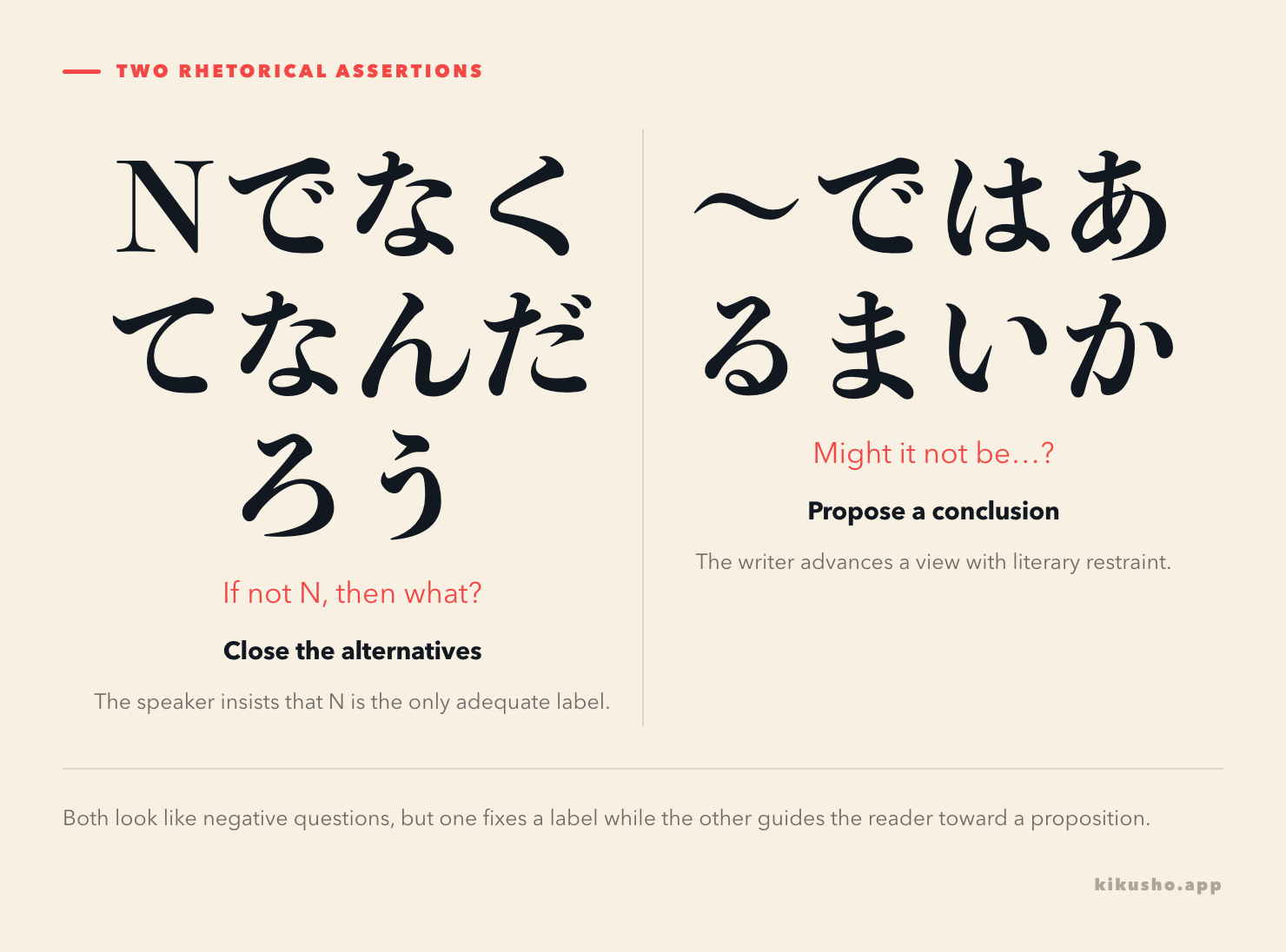
| Form | Literal path | Actual move | Typical English |
|---|---|---|---|
| Nでなくてなんだろう | if not N, then what? | insists that N is the only adequate label | what else could it be but N? |
| ~ではあるまいか | might it not be ~? | advances a conclusion with rhetorical restraint | might it not be that ~? |
This is why simply memorizing both as “isn't it?” causes mistakes. The noun after でなくて is the answer the speaker insists on. The material before ではあるまいか is a proposition the writer wants the audience to entertain.
でなくてなんだろう fixes the label
The reliable core is:
noun + でなくてなんだろう(か)
A situation comes first. The final noun evaluates or names that situation.
台風の中、彼は何度も海へ戻って人を助けた。これが勇気でなくてなんだろう。
たいふうの なか、かれは なんども うみへ もどって ひとを たすけた。これが ゆうきでなくて なんだろう。
“During the typhoon, he returned to the sea again and again to save people. What else could that be but courage?”
全員が無事に救出された。これが奇跡でなくてなんだろうか。
ぜんいんが ぶじに きゅうしゅつされた。これが きせきでなくて なんだろうか。
“Everyone was rescued safely. If that is not a miracle, what is?”
か may appear at the end, and the more literary なんであろう(か) also occurs. Neither addition turns the sentence into a genuine request for information. The context has already supplied the speaker's answer.
Bunpro's N1 entry identifies the formal register, noun attachment and rhetorical function. 毎日のんびり日本語教師 likewise explains that the form excludes other labels and asserts that the chosen one is exactly right. Both references place it at N1.
Because the form is evaluative and emphatic, it readily carries admiration, indignation, accusation or wonder:
実際には存在しない費用を請求する。これが詐欺でなくてなんだろう。
じっさいには そんざいしない ひようを せいきゅうする。これが さぎでなくて なんだろう。
“Charging for costs that do not exist: what is that if not fraud?”
The construction does more than report 詐欺だ. It presents the label as the unavoidable conclusion of the preceding facts. In a neutral incident report, the rhetorical heat may be inappropriate; a direct statement is safer.
ではあるまいか proposes a conclusion
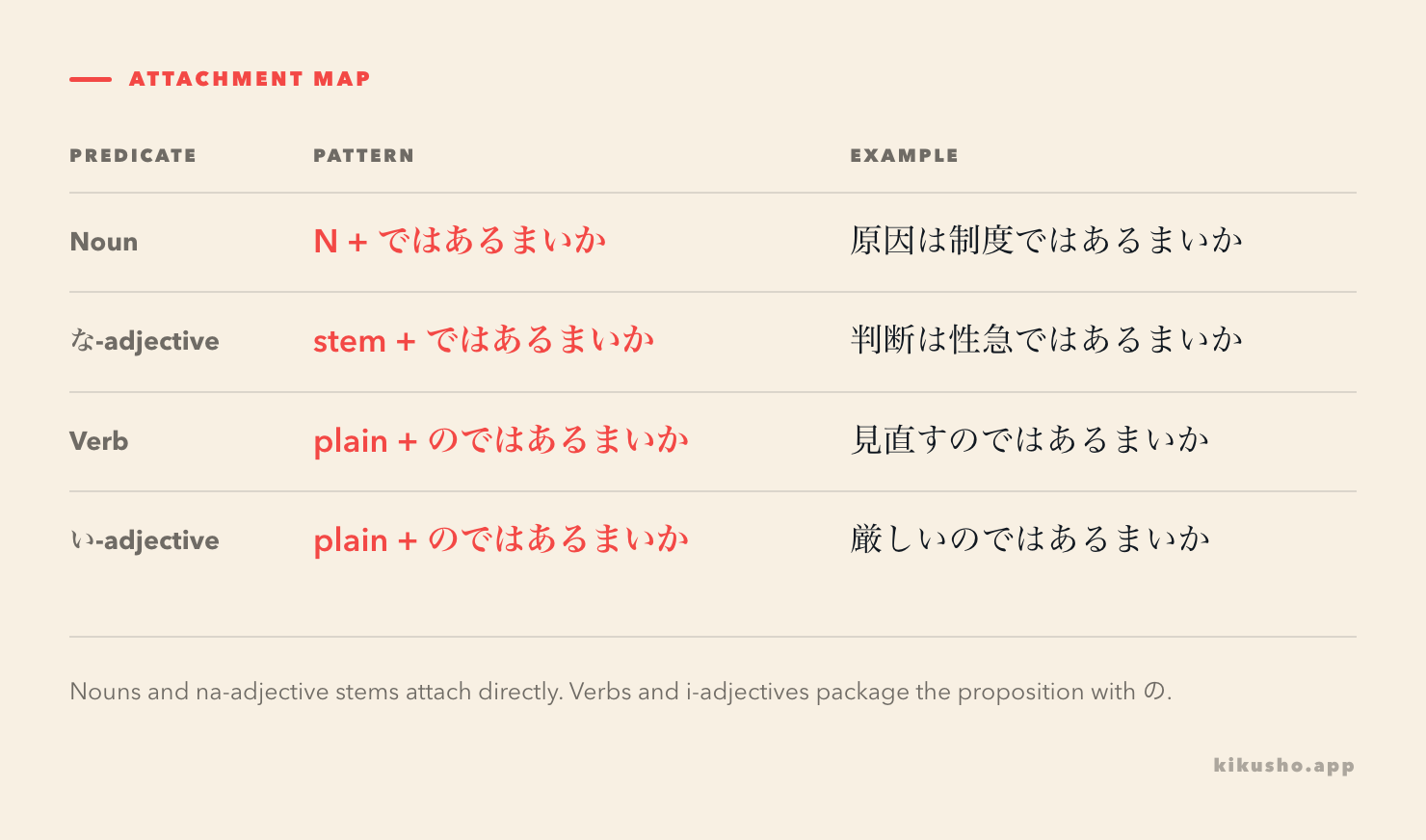
The core proposition can be a noun or な-adjective, or a full clause followed by の:
| Predicate type | Attachment | Example frame |
|---|---|---|
| noun | N + ではあるまいか | 原因は制度ではあるまいか |
| な-adjective | stem + ではあるまいか | この判断は性急ではあるまいか |
| verb | plain form + のではあるまいか | 見直す必要があるのではあるまいか |
| い-adjective | plain form + のではあるまいか | 条件が厳しいのではあるまいか |
今回の失敗は、計画そのものに原因があったのではあるまいか。
こんかいの しっぱいは、けいかく そのものに げんいんが あったのでは あるまいか。
“Might this failure have been caused by the plan itself?”
今必要なのは、速さより慎重さではあるまいか。
いま ひつようなのは、はやさより しんちょうさでは あるまいか。
“Might what we need now be caution rather than speed?”
この条件は、初めて応募する人には厳しすぎるのではあるまいか。
この じょうけんは、はじめて おうぼする ひとには きびしすぎるのでは あるまいか。
“Might this condition be too strict for first-time applicants?”
J-nihongo's supervised N1 explanation describes the form as literary and as a modest but firm presentation of the speaker's view. Its attachment table confirms direct noun and な-adjective attachment, with の after verbs and い-adjectives. JLPT Sensei independently records the same N1 placement and gives clause-level examples.
The question shape is a rhetorical strategy. The writer sounds less blunt than 原因は計画にあった, yet still directs attention toward that conclusion. It suits essays, speeches, criticism and formal argument. In ordinary conversation, のではないだろうか or んじゃないかな is usually less marked.
Attachment reveals which assertion you have
With でなくてなんだろう, identify the noun immediately before the pattern. That noun is the asserted label:
この結果が努力の成果でなくてなんだろう。
“What could this result be but the fruit of hard work?”
With ではあるまいか, recover the entire proposition. A preceding の packages a verb or い-adjective clause so the rhetorical question can evaluate it:
小さな改善を積み重ねることが、結局は最も確実な方法なのではあるまいか。
ちいさな かいぜんを つみかさねる ことが、けっきょくは もっとも かくじつな ほうほうなのでは あるまいか。
“Might steadily accumulating small improvements be the most reliable method after all?”
Do not remove の after an ordinary verb or い-adjective clause:
× この制度は見直す必要があるではあるまいか。
○ この制度は見直す必要があるのではあるまいか。
The direct pattern is available because 必要 is a noun in 必要ではあるまいか, but 見直す必要がある is a clause ending in the verb ある. The nominalizer connects that proposition to the following copular expression.
Keep three neighboring forms separate
ではないだろうか is the more neutral proposal
原因は制度にあるのではないだろうか。
“Could the cause lie in the system?”
This has much the same cautious argumentative shape as のではあるまいか, but it is common in present-day explanations and careful speech. のではあるまいか is more literary and deliberate. Choose it when the elevated rhetoric contributes to the passage, not simply because the topic is advanced.
The だろう and でしょう lesson covers the broader relationship among inference, prediction and confirmation. The ではないか and じゃないか lesson shows how a similar question form can check agreement or challenge a listener.
ではあるまいし gives a reason for a judgment
子どもではあるまいし、自分の予定は自分で管理しなさい。
こどもでは あるまいし、じぶんの よていは じぶんで かんりしなさい。
“You are not a child, so manage your own schedule.”
Here the speaker treats “not a child” as a premise and follows it with advice. There is no final か, no cautious proposal, and no invitation to consider whether the person might be a child. Confusing し and か reverses the sentence's job. The ではあるまいし and ともあろうものが comparison develops how this denied identity differs from invoking a real role whose standards were violated.
ようか~まいか expresses indecision over action
提案を受け入れようか受け入れるまいか、まだ迷っている。
“I am still unsure whether to accept the proposal.”
This pattern repeats a lexical action in positive-volitional and negative-volitional form. ではあるまいか does not present two action choices. The まい and ようか~まいか lesson develops that contrast and the independent uses of まい.
Compare certainty without flattening the register
Several N1 forms can assert a conclusion, but their route matters:
| Expression | Speaker's move | Example conclusion |
|---|---|---|
| Nでなくてなんだろう | excludes every other label | this is nothing but courage |
| Nにほかならない | identifies a cause or identity directly | this is precisely courage |
| ~に違いない | makes a strong inference | it must be courage |
| ~ではあるまいか | proposes a view for consideration | might this be courage? |
The に過ぎない and にほかならない comparison shows how direct assertion by limitation or identity works. にほかならない can often paraphrase the conclusion of でなくてなんだろう, but it lacks the latter's dramatic rhetorical question.
Register does not form a simple ladder from weak to strong. でなくてなんだろう is formally shaped and forceful. ではあるまいか is also formal, yet its force comes through restraint. On an N1 reading passage, ask whether the writer is closing the classification or cautiously guiding the reader toward a thesis.
N1 is the supported study placement
Bunpro and 毎日のんびり日本語教師 place でなくてなんだろう at N1. J-nihongo and JLPT Sensei place ではあるまいか at N1. Kikusho maps them to separate inventory items because they teach different attachments and rhetorical moves, even though this comparison makes the contrast easier to see.
The official JLPT FAQ says the post-2010 exam no longer issues its former “Test Content Specifications.” N1 here records the agreement among the checked references and Kikusho's study sequence; it does not predict a specific exam question.
Six questions before the explanations
Complete the entire set before opening the answer block.
Question 1
Which ending forcefully asserts that 奇跡 is the only adequate label?
- ア:奇跡ではあるまいか
- イ:奇跡でなくてなんだろう
- ウ:奇跡ではあるまいし
- エ:奇跡であろうと
Question 2
Choose the correct attachment: 今こそ制度を見直す必要がある( )。
- ア:でなくてなんだろう
- イ:ではあるまいし
- ウ:のではあるまいか
- エ:なくてなんだろう
Question 3
What stance does この数字には誤りがあるのではあるまいか take?
- ア:It firmly denies that the number contains an error.
- イ:It cautiously advances the possibility that the number contains an error.
- ウ:It asks the listener to choose whether to create an error.
- エ:It criticizes the listener because the number is not an error.
Question 4
Build “If going to the rescue without regard for danger is not courage, what is?” from all four pieces. Which piece belongs at ★?
__ __ ★ __。
- ア:危険を顧みず
- イ:救助に向かった
- ウ:その行動が
- エ:勇気でなくてなんだろう
Use every piece once and write the full sentence.
Question 5
A learner writes この条件は厳しすぎるではあるまいか. Repair the attachment without changing the intended cautious assertion.
Question 6
Select the pair that preserves both rhetorical moves.
全員が助かった。これが甲。だが、成功の理由は運だけではなく、日頃の訓練にもあった乙。
- ア:甲 奇跡でなくてなんだろう / 乙 のではあるまいか
- イ:甲 奇跡ではあるまいし / 乙 でなくてなんだろう
- ウ:甲 奇跡のではあるまいか / 乙 ではあるまいし
- エ:甲 奇跡であろうと / 乙 ようかまいか
Answers and explanations
1
イ:奇跡でなくてなんだろう. The noun 奇跡 supplies the label, and the rhetorical “if not a miracle, what?” excludes competing labels. ではあるまいか would present “miracle” more cautiously.
2
ウ:のではあるまいか. The proposition ends in the verb ある, so の packages the clause before the literary rhetorical assertion: 必要があるのではあるまいか.
3
イ. The writer is steering the reader toward the view that the number may contain an error. The negative question shape adds restraint; it does not reverse the proposition into a firm denial.
4
The complete sentence is 危険を顧みず救助に向かったその行動が勇気でなくてなんだろう。 The sequence is ア → イ → ウ → エ, so ウ:その行動が occupies ★. The modifying clause ends before その行動, and 勇気 is the label the rhetorical ending insists on.
5
Use この条件は厳しすぎるのではあるまいか。 An い-adjective-based clause or verb clause takes の before ではあるまいか. Here 厳しすぎる ends in the verb-like すぎる, so direct attachment is incorrect.
6
ア. 奇跡でなくてなんだろう emphatically fixes the label “miracle.” 日頃の訓練にもあったのではあるまいか cautiously proposes that regular training also explains the success.
Let the rhetoric determine the translation
When a negative-looking N1 question appears, do not decide its meaning from なくて or まい alone. Find what the question is doing. Nでなくてなんだろう makes N unavoidable; ~ではあるまいか gives a proposition room to sound considered. That distinction reveals whether the writer is ending the debate over a label or inviting the reader toward a conclusion.
Common questions
What does でなくてなんだろう mean?
It follows a noun and asks rhetorically, “If this is not X, what is it?” The speaker is not seeking a label; the question forcefully asserts that X is the only adequate label.
What does ではあるまいか mean?
It presents a proposition as a literary negative question, similar to “might it not be that...?” The speaker advances an opinion while leaving rhetorical room for the reader to consider it.
How do でなくてなんだろう and ではあるまいか differ?
でなくてなんだろう forcefully identifies something as a noun: “what else could it be but X?” ではあるまいか proposes a conclusion more cautiously: “could it not be X?” Their attachment and stance are different.
Is ではあるまいか the same as ではあるまいし?
No. ではあるまいか raises a proposition for consideration. ではあるまいし means roughly “since it is not X” and commonly introduces a judgment, criticism or advice in the following clause.