On this page
Use にとって to name the viewpoint from which something is important, difficult, useful, or harmful. Use として to name the role, capacity, classification, or function in which someone or something acts. 親にとって asks what matters to a parent; 親として asks what someone thinks or does in the role of a parent.
English can translate both with “for” or “as,” so the preposition is a poor guide. Ask whether the sentence evaluates B from A's position or places A into a role.
Ask whether A evaluates or serves
| Relationship | Pattern | Question to ask |
|---|---|---|
| B is judged from A's standpoint | A にとって B | How is B for A? |
| someone or something occupies role A | A として B | In what capacity does B happen? |
親にとって、子どもの健康が一番大切だ。
おやにとって、こどもの けんこうが いちばん たいせつだ。
For a parent, a child's health is the most important thing.
親として、子どもの安全を守りたい。
おやとして、こどもの あんぜんを まもりたい。
As a parent, I want to protect my child's safety.
The first sentence makes parents the people whose values are being described. The second presents parenthood as the speaker's role and grounds an intention in that role.
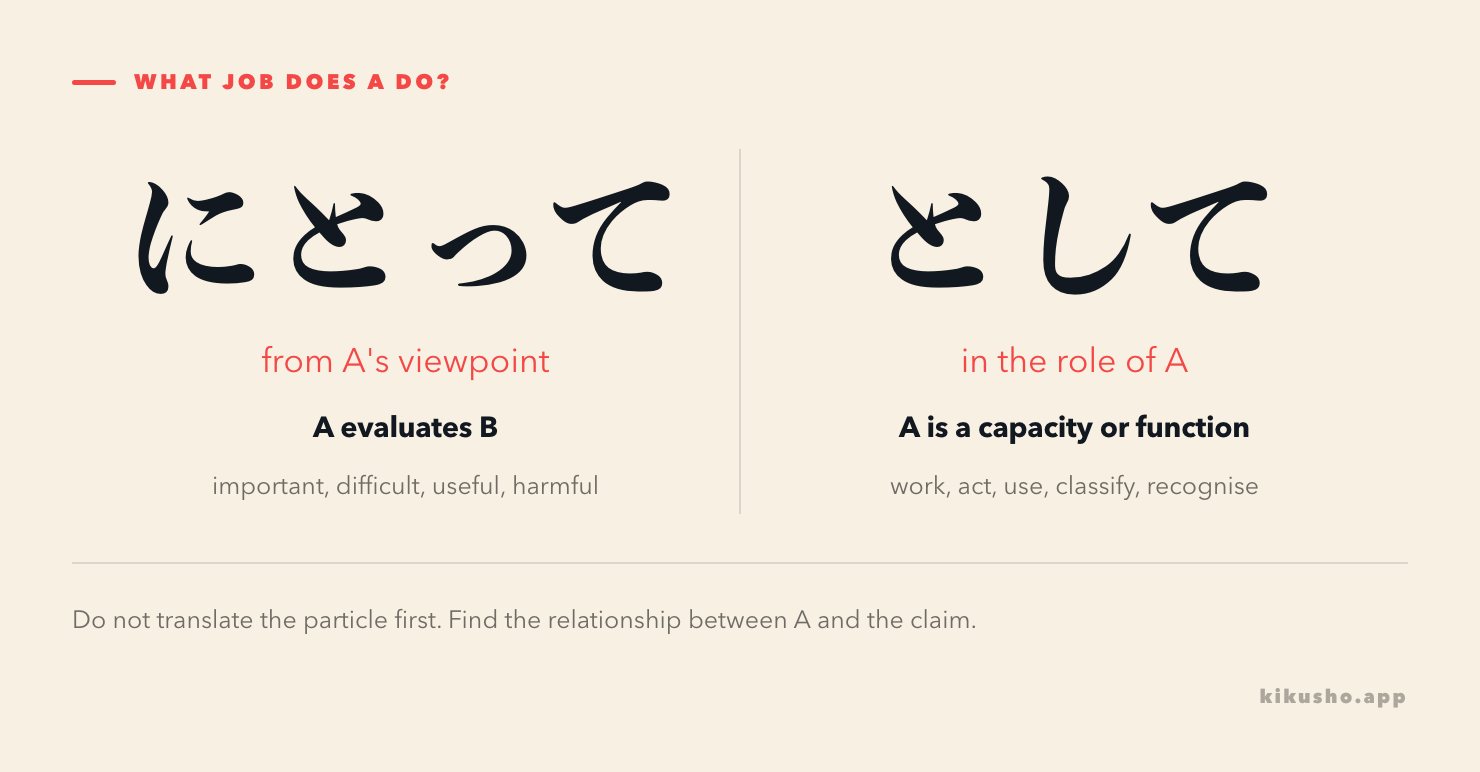
The Japan Foundation's にとって reference defines the pattern through a person's or organisation's position, interests, and perception. Its として reference instead lists roles, capacities, names, categories, and qualifications. That distinction gives the test above.
にとって supplies the evaluator
Attach にとって directly to a noun that can hold a viewpoint or be affected by the judgment. People and organisations are common, but the noun need not be one individual.
初心者にとって、この説明は少し分かりにくい。
しょしんしゃにとって、この せつめいは すこし わかりにくい。
For beginners, this explanation is a little hard to understand.
会社にとって、信頼を失うことは大きな問題だ。
かいしゃにとって、しんらいを うしなうことは おおきな もんだいだ。
For a company, losing trust is a major problem.
The material after にとって normally contains an evaluation or consequence: 大切だ, 難しい, 必要だ, 便利だ, 問題だ, 役に立つ, or 影響がある. にとって does not mark the person carrying out an action.
This makes the following sentence unnatural for the intended meaning:
× 私にとって会議で説明しました。
If the meaning is “I explained it at the meeting as the representative,” use 代表として説明しました. If the meaning is “The explanation was useful to me,” use 私にとって、その説明は役に立ちました.
Bunpro's にとって lesson describes the form as a viewpoint for an opinion or judgment and places it at N3. 日本語NET independently teaches the same N3 standpoint use with people and groups.
にとっては and にとっての
Add は when the viewpoint is the topic or contrasts with another one:
私にとっては簡単ですが、弟には難しいようです。
わたしにとっては かんたんですが、おとうとには むずかしいようです。
It is easy for me, but it seems difficult for my younger brother.
Before another noun, use にとっての + noun:
この町は、私にとっての第二の故郷です。
この まちは、わたしにとっての だいにの ふるさとです。
This town is a second home to me.
The の belongs to the noun-modifying form. 私にとって第二の故郷です is also possible when にとって modifies the full judgment rather than forming one noun phrase.
として assigns a role, capacity, or function
Attach として directly to the noun that supplies the role.
田中さんは通訳として働いている。
たなかさんは つうやくとして はたらいている。
Tanaka works as an interpreter.
店長として、お客様に謝りました。
てんちょうとして、おきゃくさまに あやまりました。
I apologised to the customer as the store manager.
The subject performs the action in the named capacity. The noun can describe a profession, family role, official position, purpose, classification, or function.
この箱を椅子として使った。
この はこを いすとして つかった。
I used this box as a chair.
京都は古都として知られている。
きょうとは こととして しられている。
Kyoto is known as an ancient capital.
The box does not hold an opinion about the action. It serves a function. Kyoto is classified or recognised in a particular identity. This is why translating として only as “from the viewpoint of” misses much of its range.
Bunpro's として lesson gives the N3 placement and role or function analysis. 日本語NET's N3 lesson likewise covers status, qualification, category, and use.
としては and としての
としては can focus or contrast a role:
親としては、その決定に賛成できません。
おやとしては、その けっていに さんせいできません。
Speaking as a parent, I cannot agree with that decision.
The opinion belongs to a role-based stance. This is close to viewpoint language, but the sentence selects the identity under which the speaker is responding. 私にとって、その決定は不利です instead evaluates how the decision affects the speaker.
Before another noun, use としての + noun:
教師としての責任
きょうしとしての せきにん
one's responsibility as a teacher
道具としての価値
どうぐとしての かち
value as a tool
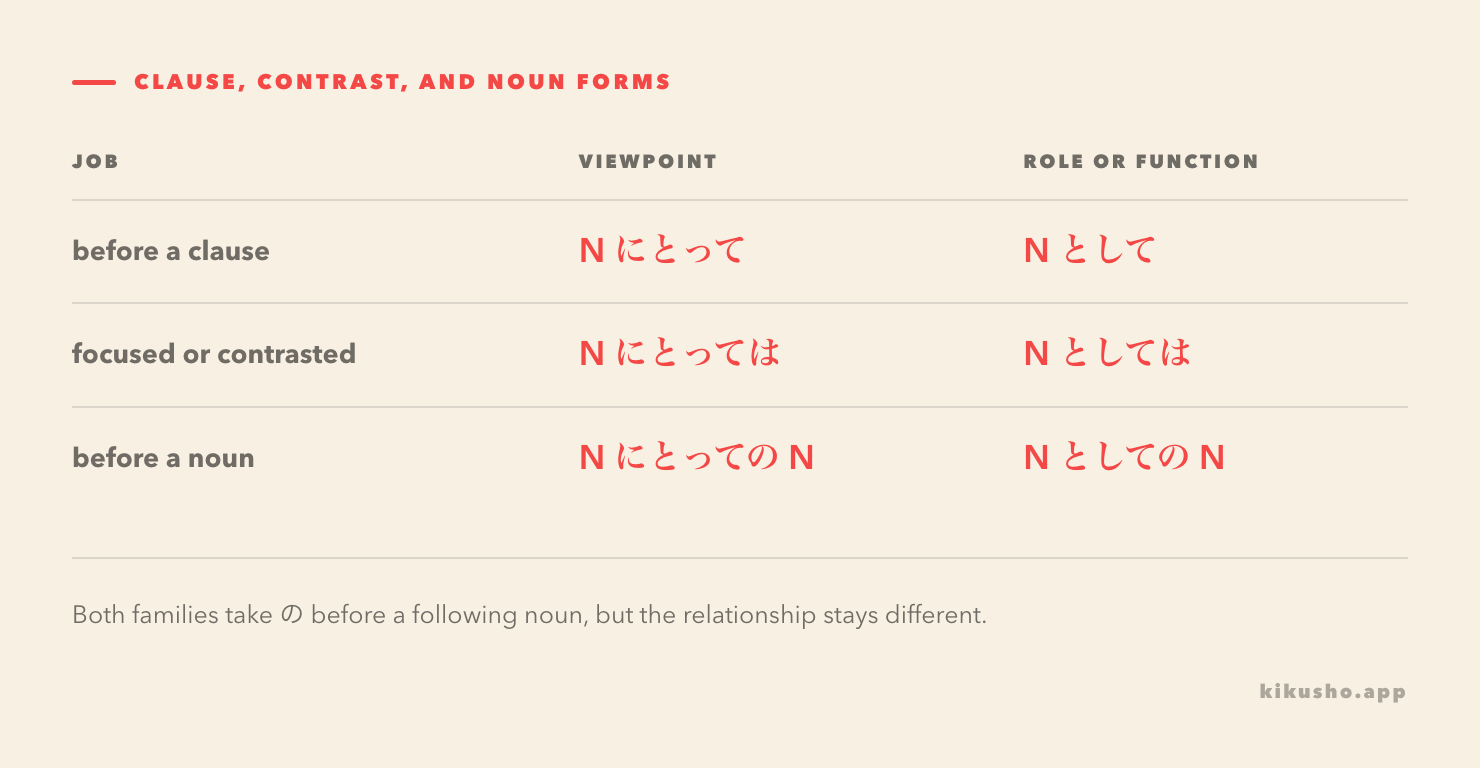
The same noun can produce two different arguments
Because a person can both hold a viewpoint and occupy a role, the same noun may fit either pattern.
学生にとって、学費は大きな負担だ。
がくせいにとって、がくひは おおきな ふたんだ。
Tuition is a major burden for students.
学生として、学費の問題について意見を述べた。
がくせいとして、がくひの もんだいについて いけんを のべた。
I expressed an opinion about tuition in my capacity as a student.
The first claim could be made by an observer describing students' interests. The second identifies why this speaker has a particular standing in the discussion.
This also separates both forms from the について and に関する topic markers. In the second example, 学生として names the speaker's capacity, while 学費の問題について names the content of the opinion. One sentence can need both relationships.
Choosing the wrong form changes who does what
An evaluation is not an occupation
この仕事は私にとって大切です。
This work is important to me.
私は責任者としてこの仕事をしています。
I do this work as the person responsible.
The first sentence says what the work means to the speaker. The second identifies the capacity in which the speaker performs it.
A target audience is a separate claim
初心者にとって分かりやすい本 is a book that beginners find easy to understand. 初心者向けの本 is a book created or presented for beginners. The 向け and 向き lesson separates intended audience from observed suitability. にとって adds the evaluator rather than proving who the maker targeted.
Do not replace にとって with について
日本語について話す means “talk about Japanese.” 私にとって日本語は大切だ means “Japanese is important to me.” The first names a topic; the second names the holder of a value judgment.
Register and N3 placement
Both forms are standard and common in speech and writing. にとって often appears in explanations that compare interests or experiences. として is especially useful for work, public positions, family responsibilities, classifications, and the function of an object. The polite にとりまして exists in formal business speech, but it is recognition material beyond the central choice here.
JLPT Sensei, Bunpro, JLPTPass, and 日本語NET place the target uses at N3. The Japan Foundation pages retain the older “Level 2” label from the pre-2010 test system, so that label should not be treated as a direct N2 verdict under the current five-level exam. Kikusho follows the current N3 references while treating all grammar levels as editorial study placements.
Practice
Complete all seven tasks before reading the solution block.
Question 1 — grammar choice. The sentence evaluates the difficulty from a beginner's viewpoint. Complete:
初心者( )、この説明は難しい。
- ア. として
- イ. にとって
- ウ. について
- エ. に関する
Question 2 — grammar choice. Tanaka performs the work in the role of interpreter. Complete:
田中さんは通訳( )働いている。
- ア. にとって
- イ. について
- ウ. として
- エ. にとっての
Question 3 — rebuild the role frame. Put these chunks in a natural order for “As a parent, I want to protect my child's safety.”
子どもの安全を / 親として / 守りたい
Question 4 — noun modification. Choose the form meaning “responsibility as a teacher”:
教師( )責任
- ア. にとって
- イ. としての
- ウ. として
- エ. にとっては
Question 5 — meaning choice. What relationship does にとって express here?
この町は私にとって大切な場所です。
- ア. The town employs me in a role
- イ. The town is important from my viewpoint
- ウ. I use the town as a tool
- エ. I am speaking about the town's history
Question 6 — rewrite. Change the role-based sentence 学生として意見を述べた into a sentence that says tuition is a burden from students' viewpoint. Use 学生, にとって, 学費, and 負担だ.
Question 7 — text grammar. Choose the pair that preserves both relationships.
この制度は会社( 甲 )重要だ。私は担当者( 乙 )、社員に説明しなければならない。
- ア. 甲: として / 乙: にとって
- イ. 甲: にとって / 乙: として
- ウ. 甲: について / 乙: にとっての
- エ. 甲: としての / 乙: について
Answers and explanations
Answer 1. イ. にとって. Beginners are the people from whose standpoint the explanation is judged difficult. として would present “beginner” as a role or classification in which someone acts.
Answer 2. ウ. として. Interpreter is Tanaka's working capacity. にとって would require a judgment about how something matters to an interpreter.
Answer 3. 親として、子どもの安全を守りたい。 親として supplies the role that grounds the speaker's intention. The object 子どもの安全を comes before 守りたい.
Answer 4. イ. としての. A following noun requires the noun-modifying form としての. The phrase identifies a responsibility attached to the teacher role.
Answer 5. イ. The town is important from my viewpoint. 私 is the evaluator, and 大切な場所 is the evaluation. Nothing in the sentence assigns the speaker a job or function.
Answer 6. One natural answer is 学生にとって、学費は負担だ。 (がくせいにとって、がくひは ふたんだ) The rewrite changes the relationship: students now hold the viewpoint from which tuition is evaluated.
Answer 7. イ. 甲: にとって / 乙: として. The policy is important to the company, so the company supplies the evaluative standpoint. 担当者 names the speaker's role and explains the duty to inform employees.
Save the noun with the claim it controls
A fragment such as 学生にとって leaves the evaluation invisible, while 学生として without its action hides the role's consequence. Keep enough of the sentence to recover the relationship: 学生にとって学費は負担だ or 学生として意見を述べた.
That extra clause is what makes a later card useful. It asks you to retrieve who evaluates what, or who acts in which capacity, instead of matching two forms to the same vague English word “for.” EOF
Common questions
What is the difference between にとって and として?
にとって names the person or group whose evaluation matters: 私にとって大切 means “important to me.” として names a role, capacity, classification, or function: 教師として働く means “work as a teacher.”
What comes before にとって and として?
Both attach directly to a noun. Use Nにとって for a viewpoint and Nとして for a role or function. Before another noun, use にとっての or としての.
Can the same noun take both にとって and として?
Yes, with different meanings. 親にとって asks how something affects or matters to a parent; 親として frames what someone thinks or does in the role of a parent.
Are にとって and として N3 grammar?
JLPT Sensei, Bunpro, JLPTPass, and Japanese-teacher references place both patterns at N3. Level lists are editorial estimates because the JLPT publishes no exhaustive grammar syllabus.