On this page
もう二度とあの店には行くまい is a decision: “I will never go to that shop again.” もう一度行こうか行くまいか迷っている leaves both choices open: “I am unsure whether to go again.”
The shared まい points toward not doing the action. Standalone Vるまい can settle on that negative side or predict it; VようかVるまいか balances “do” against “not do” and expresses indecision.
One negative side, or two open options
| Pattern | Decision state | Natural paraphrase |
|---|---|---|
| Vる + まい | negative side selected | I will not V / V probably will not happen |
| Vようか + Vるまいか | both sides still open | whether to V or not |
失敗しても、もう言い訳はするまい。> しっぱいしても、もういいわけはするまい。> Even if I fail, I will make no more excuses.
この仕事を引き受けようか引き受けまいか、まだ迷っている。> このしごとをひきうけようかひきうけまいか、まだまよっている。> I am still unsure whether to accept this job.
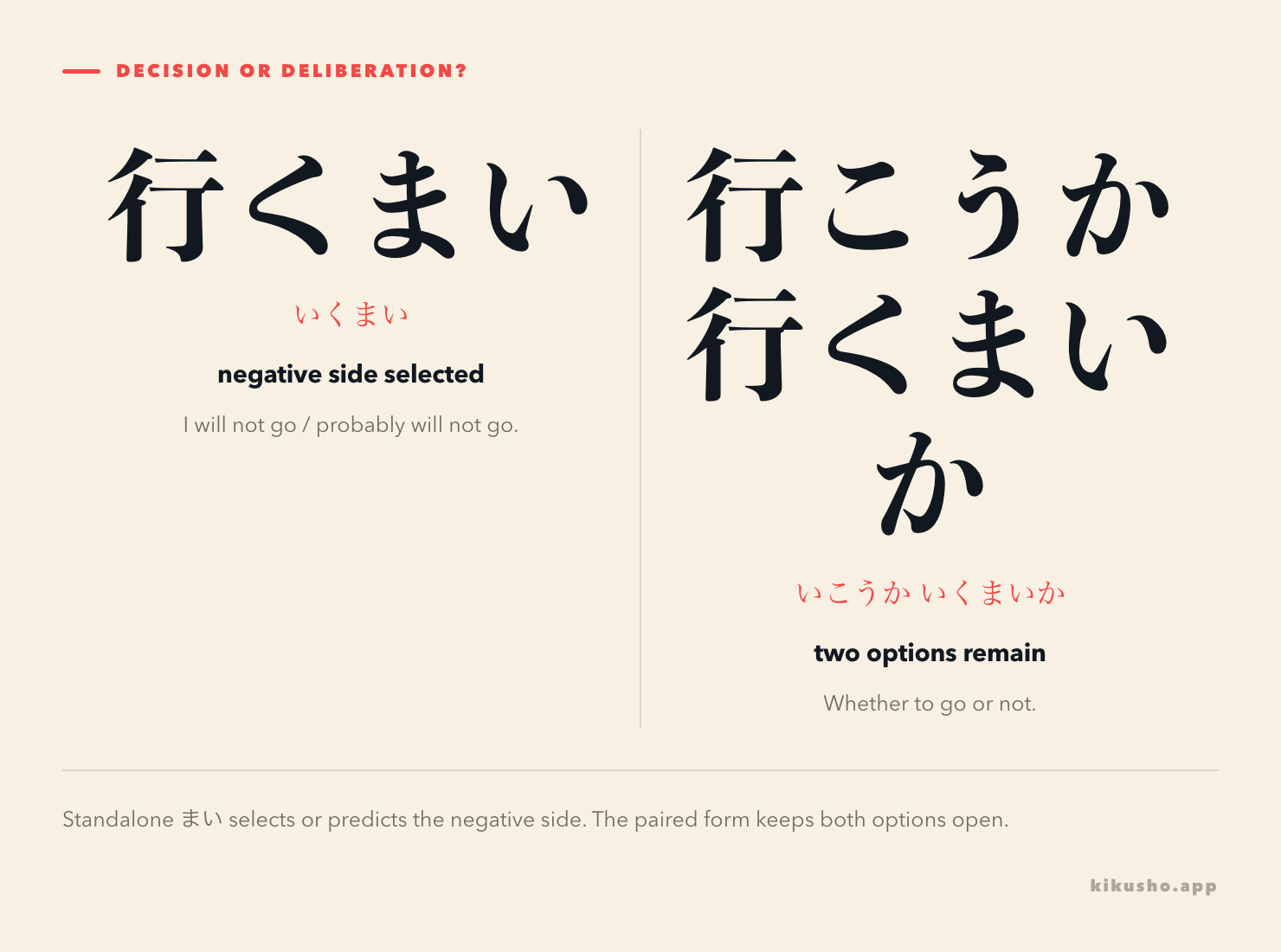
The second pattern is not built by adding uncertainty to a completed decision. Its first half actively restores the positive option with the volitional 行こう, then the second half supplies 行くまい as its negative counterpart.
Standalone まい has two readings
A firm negative intention
When the speaker controls the action, まい can mean “I am determined not to.” Words such as もう, 二度と and 絶対に often make that resolve visible.
同じ間違いは二度と繰り返すまい。> おなじまちがいはにどとくりかえすまい。> I will never repeat the same mistake.
どんなに誘われても、秘密は話すまいと決めた。> どんなにさそわれても、ひみつははなすまいときめた。> I decided not to reveal the secret, no matter how much I was pressed.
This volitional use naturally centers the speaker's own future conduct. A quotation can report someone else's resolve: 彼は二度と戻るまいと決心した, “He resolved never to return.” Japanese NET describes this as strong negative intention and contrasts it with the conjectural use.
A formal negative conjecture
When the subject is outside the speaker's control, まい commonly means “probably will not” or “surely cannot.”
この雪では、今夜中に列車は動くまい。> このゆきでは、こんやじゅうにれっしゃはうごくまい。> With this snow, the trains probably will not run tonight.
事情を知らない人には、この判断は理解できまい。> じじょうをしらないひとには、このはんだんはりかいできまい。> Someone who does not know the circumstances probably cannot understand this decision.
The speaker is not deciding what the train or another person will do. The sentence is a negative assessment, close to 動かないだろう or 理解できないだろう. This use is formal and can sound literary or old-fashioned in ordinary conversation.
Subject and control therefore matter more than the English word “will.” In 私はもう頼るまい, the speaker refuses to rely on someone. In 彼はもう頼るまい, context more readily supports a prediction about him, unless the sentence reports his own words or resolution.
Attach まい to the verb
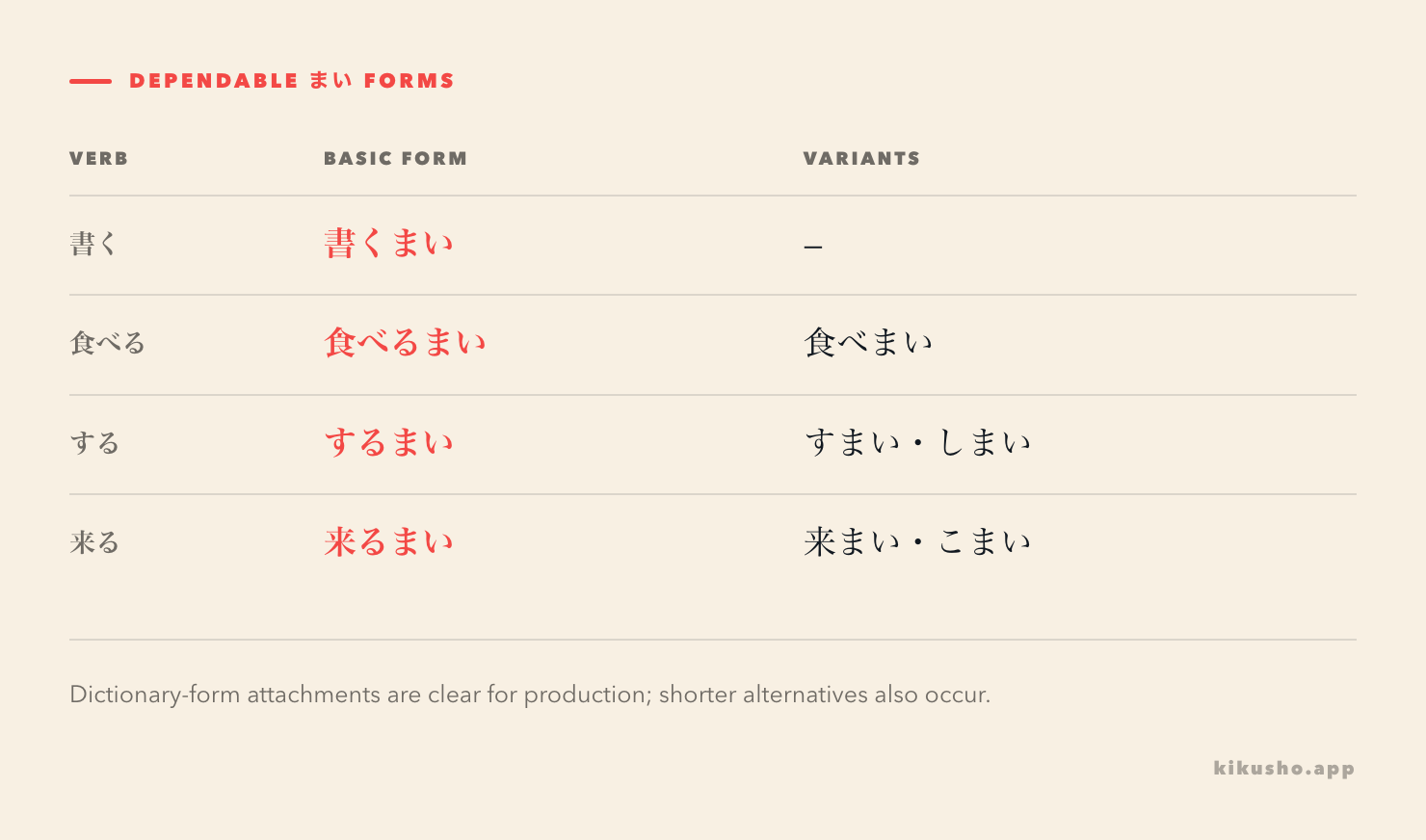
The dictionary form is the clearest productive attachment:
| Dictionary form | Basic まい form | Alternative forms you may meet |
|---|---|---|
| 書く | 書くまい | — |
| 食べる | 食べるまい | 食べまい |
| する | するまい | すまい, しまい |
| 来る(くる) | 来るまい(くるまい) | 来まい(きまい), こまい |
JLPT Sensei teaches dictionary form for godan verbs and the stem for ichidan verbs, with すまい and こまい as irregular forms. Bunpro records a wider modern range, including するまい, しまい, すまい, 来るまい, きまい and こまい. For production, dictionary-form 食べるまい, するまい and 来るまい are transparent and supported; recognize the shorter variants rather than forcing them into every sentence.
Adjectives and nouns usually appear through あるまい in negative conjecture:
この計画は簡単ではあるまい。> This plan is probably not simple.
今すぐ変更する必要はあるまい。> There is probably no need to change it immediately.
These belong to the formal conjectural side. They do not express a noun or adjective's “decision.”
Build ようか~まいか with the same verb twice
The full frame is:
V volitional + か + same V + まいか
| Verb | Positive option | Negative option | Complete frame |
|---|---|---|---|
| 行く | 行こうか | 行くまいか | 行こうか行くまいか |
| 食べる | 食べようか | 食べるまいか | 食べようか食べるまいか |
| する | しようか | するまいか | しようかするまいか |
| 来る | 来ようか(こようか) | 来るまいか(くるまいか) | 来ようか来るまいか |
留学しようかするまいか、家族と相談している。> りゅうがくしようかするまいか、かぞくとそうだんしている。> I am consulting my family about whether to study abroad.
本当のことを言おうか言うまいか、しばらく悩んだ。> ほんとうのことをいおうかいうまいか、しばらくなやんだ。> I wondered for a while whether to tell the truth.
The same lexical action must occupy both sides. ×行こうか帰るまいか does not mean “whether to go or not”; it switches from going to returning. If the actual alternatives are different actions, name them normally with か or それとも.
The frame often accompanies 迷う, 悩む, 考える, 決める or 検討する because those predicates describe deliberation. YaToMonkey's N2 explanation also notes that the undecided person is normally the speaker; a third person's uncertainty needs evidence or reporting, such as 彼は参加しようかするまいか迷っているようだ.
This is more formal than the everyday 行くかどうか迷っている. The かどうか lesson handles a broad embedded “whether”; ようか~まいか specifically stages a choice between acting and refraining.
Keep three similar endings separate
The following all contain まいか, but their sentence architecture differs.
| Form | Meaning | Example |
|---|---|---|
| VようかVるまいか | whether to act or not | 話そうか話すまいか迷う |
| ではあるまいか | might it not be; cautious opinion | 原因は別にあるのではあるまいか |
| VようがVるまいが | whether V or not, outcome unchanged | 雨が降ろうが降るまいが出発する |
The second is a rhetorical conjecture. 原因は別にあるのではあるまいか cautiously advances the opinion that the cause may lie elsewhere; it does not describe hesitation over performing ある. The third uses が, not か, and concedes that either possibility leaves the main result unchanged. It is a separate, usually more advanced pattern.
The punctuation is not the deciding factor. Look for repeated lexical verbs and a deliberation predicate. 行こうか行くまいか迷う has both. 正しいのではあるまいか has a proposition followed by a cautious rhetorical question.
Register and level labels
Standalone まい belongs comfortably in formal prose, inner resolve and deliberate speech. In casual conversation, もう行かない, 行かないつもりだ and 行かないだろう are more common. The paired pattern also feels careful; 行くかどうか迷っている is the ordinary alternative.
JLPT Sensei, Bunpro, Japanese NET and the teacher references used here place these uses at N2. The dated Tanos comparison list places まい at N3. That is a study-order disagreement, not an official boundary: the JLPT does not publish an exhaustive grammar list.
The contrast becomes easier to retain when a card preserves the decision state. In Kikusho, save 二度と行くまい with “negative resolve,” 彼は来るまい with “formal negative conjecture,” and the complete pair 参加しようか参加するまいか迷っている with “both options open.” A bare まい = will not card loses the subject and surrounding predicate that choose the reading.
Practice: read the decision state
Try every item before revealing the explanations collected after Question 6.
Question 1
The speaker has firmly decided never to repeat the mistake. Which completion fits?
同じ間違いは二度と繰り返す( )。
- まい
- ようか
- まいか迷う
- ではあるまいか
Question 2
Which sentence expresses uncertainty about whether to participate?
- 参加するまいと決めた。
- 参加しようか参加するまいか迷っている。
- 参加者は来るまい。
- 参加するのではあるまいか。
Question 3
Complete the conjecture about a train, then state whether it expresses intention or prediction.
この大雪では、最終列車も( )。With this heavy snow, the last train probably will not run either.
Question 4
Build one sentence meaning “I am thinking about whether to tell my manager.” Use 部長に話す, ようか~まいか and 考えている.
Question 5
Why does この方法が一番安全なのではあるまいか not express indecision about performing an action?
Question 6
Select the two forms that preserve the shift from resolve to hesitation.
昨日はひどく失敗したので、同じ準備不足を繰り返す( ① )と決めた。ただ、次の企画に参加し( ② )、まだ迷っている。
- ①まい/②ようか参加するまいか
- ①ようか/②まい
- ①まいか/②ではあるまいか
- ①ではあるまいか/②ようが参加するまいが
First identify the settled resolution, then locate the later unresolved choice.
Answers and explanations
The first clause in each solution is classified as resolve, conjecture or deliberation before its English gloss is considered.
Answer 1. Choice 1, まい. 二度と and the first-person decision context support strong negative intention: 繰り返すまい, “I will not repeat it.” Choice 3 would say the speaker is unsure whether not to repeat it, which contradicts the firm decision.
Answer 2. Choice 2. 参加しようか参加するまいか repeats the same action in positive-volitional and negative-volitional form, and 迷っている confirms that neither side has been chosen. Choice 1 is a settled refusal; choice 3 predicts someone will not come; choice 4 is a rhetorical conjecture.
Answer 3. 動くまい; prediction. The train does not control a personal resolution. この大雪では、最終列車も動くまい formally predicts that it probably will not run.
Answer 4. 部長に話そうか話すまいか考えている. The positive half uses 話そうか, the negative half repeats the dictionary form in 話すまいか, and 考えている keeps the choice open.
Answer 5. この方法が一番安全なのではあるまいか presents a cautious opinion, “Might this method be the safest?” It contains no repeated lexical verb with positive and negative options, and no deliberation predicate such as 迷う. The sequence ではあるまいか is a rhetorical conjecture.
Answer 6. Choice 1. 繰り返すまいと決めた records a settled intention not to repeat the mistake. 参加しようか参加するまいか、まだ迷っている then opens both participation choices. The passage moves from resolution about preparation to uncertainty about joining.
OpenAI Codex completed the final language pass. The agent checked every attachment, special form, translation and distractor against the cited sources; no human review is claimed.
Common questions
What does まい mean in Japanese?
After a verb, まい can express a firm intention not to do something or a formal conjecture that something probably will not happen. The subject and context distinguish the two readings.
How do you form ようか~まいか?
Repeat the same verb: first in the volitional form plus か, then before まいか. 行く becomes 行こうか行くまいか and 食べる becomes 食べようか食べるまいか.
What is the difference between まい and ようか~まいか?
Standalone まい rejects an action or predicts its non-occurrence. ようか~まいか keeps the positive and negative options open while someone considers which one to choose.
Is ではあるまいか the same as ようか~まいか?
No. ではあるまいか is a cautious rhetorical question similar to “might it not be…?” The paired pattern repeats one verb and means “whether to do it or not.”