On this page
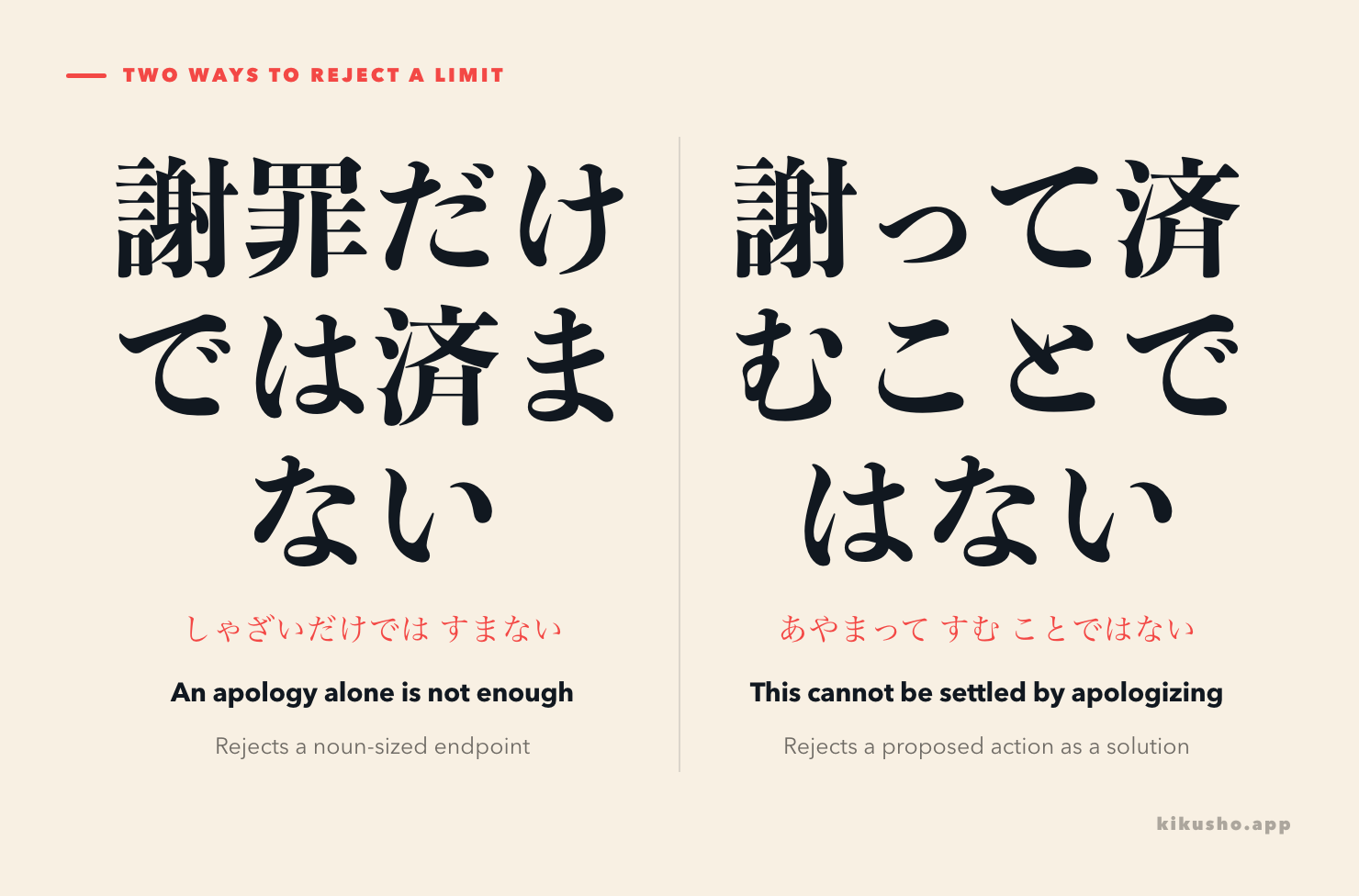
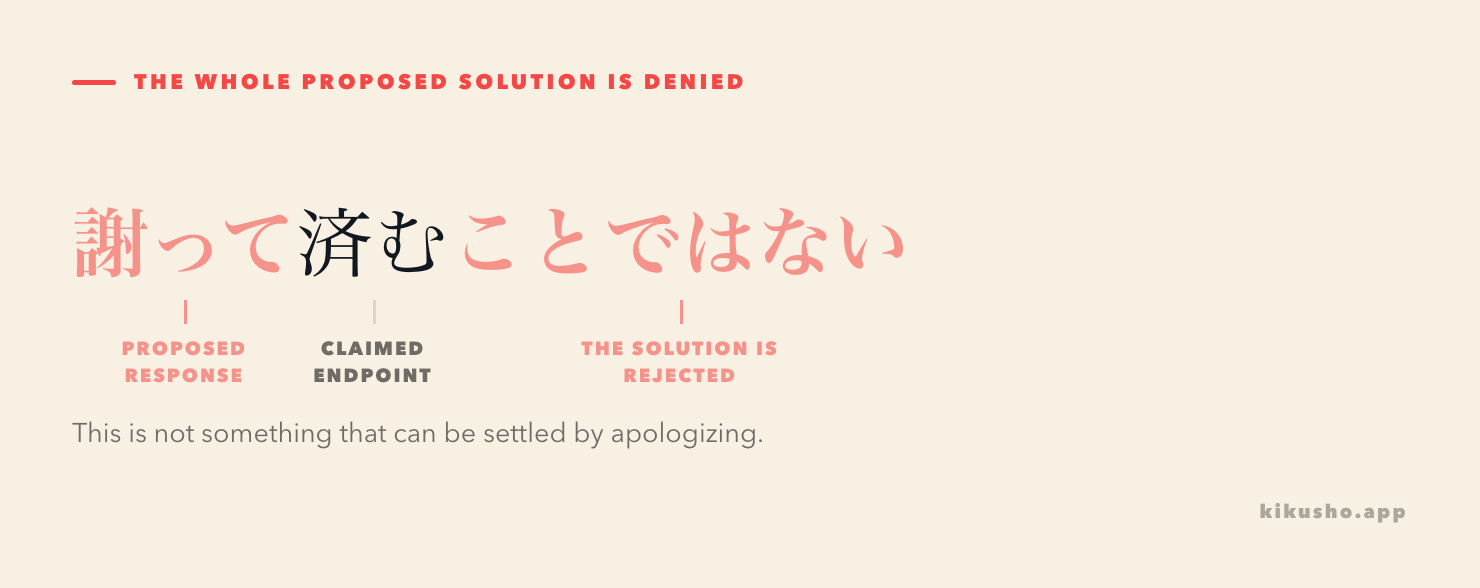
では済まない says that a proposed limit will not contain the consequences: 謝罪だけでは済まない means an apology alone will not be enough. て済むことではない makes the rejected solution explicit and more emphatic: 謝って済むことではない means “This is not something that can be settled by apologizing.”
The two forms overlap, but they do not build the sentence in the same way. First identify what the speaker is rejecting: a noun-sized limit, or the idea that one action could close the whole matter.
The test: name the inadequate limit or reject a proposed solution
Suppose confidential data has been leaked.
情報を流出させた以上、謝罪だけでは済まない。
じょうほうを りゅうしゅつさせた いじょう、しゃざいだけでは すまない。
“Now that confidential information has been leaked, an apology alone will not be enough.”
情報を流出させた以上、謝って済むことではない。
じょうほうを りゅうしゅつさせた いじょう、あやまって すむ ことではない。
“Now that confidential information has been leaked, this is not something that can be settled by apologizing.”
The first sentence places 謝罪だけ, “an apology alone,” before では済まない. The second builds a possible solution, 謝って済む, then denies that the case belongs to the class of things that solution could settle.
| Form | What comes before it | What the sentence rejects | Typical force |
|---|---|---|---|
| Nでは済まない | response, amount, label or result | N is an adequate endpoint | compact warning or judgment |
| V plain + (の)では済まない | a situation or course of action | that state can be left as it is | judgment that something further is required |
| Vて済むことではない | an action proposed as sufficient | doing V would resolve the matter | emphatic criticism |
| Nで済むことではない | a means or response | N could resolve the matter | emphatic criticism |
Both patterns grow from 済む(すむ), for a matter reaching an acceptable end. The earlier て済む lesson shows the positive relation: 電話一本で済む says one call is enough. This N1 pair turns that sufficiency down.
では済まない leaves the larger consequence open
The most transparent attachment is:
noun + では/じゃ + 済まない
The noun names the boundary that will be exceeded.
この事故は修理代だけでは済まないだろう。
この じこは しゅうりだいだけでは すまないだろう。
“This accident will probably involve more than repair costs.”
規則に違反すれば、口頭での注意では済まない。
きそくに いはんすれば、こうとうでの ちゅういでは すまない。
“If you violate the rules, a verbal warning will not be the end of it.”
Neither sentence states the exact next consequence. The first may involve compensation or legal responsibility; the second may involve a written warning or stronger disciplinary action. では済まない only says the named endpoint is too small.
It can also reject a label that would minimize the matter:
相手を傷つけた発言は、冗談では済まされない。
あいてを きずつけた はつげんは、じょうだんでは すまされない。
“A remark that hurt someone cannot be dismissed as a joke.”
Here the passive-shaped 済まされない puts social acceptability in view: other people or prevailing standards will not let “a joke” settle the issue. The active 済まない presents the matter itself as not ending there. They often overlap, so context carries more weight than an English active-passive contrast.
毎日のんびり日本語教師 gives noun, plain-clause and quoted-statement attachments and describes the pattern as saying that the prior state neither resolves the problem nor counts as acceptable. J-nihongo likewise treats V dictionary form or N + だけでは済まない and N + では済まない as responses that are too limited for the responsibility or problem.
A clause may be packaged before では済まない
The shorter form is not restricted to a bare noun. A plain clause can precede のでは済まない, while a quoted excuse can stand directly before では済まない.
同じミスを何度も繰り返すのでは済まない。対策を変える必要がある。
おなじ ミスを なんども くりかえすのでは すまない。たいさくを かえる ひつようが ある。
“We cannot let the same mistake keep happening. We need to change the measures.”
責任者が「知りませんでした」では済まされない。
せきにんしゃが「しりませんでした」では すまされない。
“It is unacceptable for the person in charge to leave it at ‘I didn't know.’”
In the first example, の packages the repeated behavior as the inadequate state. In the second, the quotation itself is treated like the excuse being rejected. This flexibility is one reason では済まない appears in warnings and commentary without always naming a proposed corrective action.
て済むことではない turns the action into the failed solution
The core attachments are:
verb て-form + 済むことではない/済む問題ではない
noun + で + 済むことではない/済む問題ではない
被害者にお金を返して済むことではない。
ひがいしゃに おかねを かえして すむ ことではない。
“Returning the victim's money is not enough to settle this.”
今回の不正は、一人の辞任で済む問題ではない。
こんかいの ふせいは、ひとりの じにんで すむ もんだいではない。
“This misconduct is not a problem that can be resolved by one person's resignation.”
こと keeps the description broad: this is not the kind of matter that doing V would settle. 問題 overtly calls it a problem. Both make the denial feel more fully stated than the compact では済まない ending.
毎日のんびり日本語教師's separate entry records both verb and noun attachments, the こと and 問題 variants, and explicitly describes this construction as a stronger emphasis than では済まない. JLPT Sensei also gives Vて + 済むことではない, the noun counterpart with で, and its frequent use for criticism or blame.
Do not attach the dictionary form directly: 謝る済むことではない is ungrammatical. Use 謝って済むことではない. For a noun, the linking particle is で: 謝罪で済むことではない.
Strength is real, but the forms still overlap
The longer construction is useful when the writer wants the rejected proposal to remain visible as a complete thought. Compare:
謝罪だけでは済まない。
“An apology alone will not be enough.”
謝って済むことではない。
“This is not something that can be settled by apologizing.”
The second is normally more emphatic, but it does not automatically describe a more serious event. A speaker can choose the compact form for a grave case, or the longer form to spell out an argument. Do not rank the real-world harm from grammar alone.
Both forms commonly carry criticism, warning or blame because they deny that a small response can discharge responsibility. That tone makes them unsuitable for routine inconveniences where a neutral statement would do. For “The application takes more than one email,” メール一通では済みません may be factual. Adding て済むことではない can sound as though somebody is minimizing a wrong.
The sentence also leaves the adequate remedy unspecified unless a following clause names it:
謝って済むことではない。原因を調べ、再発防止策を示す必要がある。
“An apology is not enough. The cause must be investigated and measures to prevent recurrence must be presented.”
The second sentence supplies the missing consequence. The grammar itself does not prove that punishment, payment or resignation is required.
Keep ないでは済まない on the other side of the line
The position of the negative changes the claim completely.
| Sentence | Negative scope | Meaning |
|---|---|---|
| 謝罪だけでは済まない | an apology is the rejected limit | an apology alone is insufficient |
| 謝って済むことではない | “apologize and settle it” is rejected | apologizing cannot resolve the matter |
| 謝らないでは済まない | not apologizing cannot stand | one must apologize |
| 謝らずには済まない | avoiding an apology cannot stand | one must apologize |
迷惑をかけたのだから、謝らないでは済まない。
めいわくを かけたのだから、あやまらないでは すまない。
“Since you caused trouble, you cannot avoid apologizing.”
重大な被害を出したのだから、謝って済むことではない。
じゅうだいな ひがいを だしたのだから、あやまって すむ ことではない。
“Since you caused serious damage, an apology cannot settle the matter.”
The first requires the apology. The second says more must follow it. Treating both as “an apology is unavoidable” erases the central N1 contrast.
This is also different from なくて済む and ずに済む, which describe relief because an unwanted action was unnecessary. It differs from わけにはいかない, which rules out an action because circumstances or responsibility make it unacceptable. The present pair evaluates whether a proposed endpoint is enough to close a matter.
Save the missing consequence, not only the fixed ending
On a flashcard, では済まない alone tests almost nothing. Keep the proposed boundary: 修理代だけでは済まない. For the longer form, preserve both the act and the problem: 一人が辞任して済む問題ではない.
When you capture a sentence in Kikusho, add a short note stating what remains open: compensation, investigation, changed procedure or another consequence supplied by the source. That note prevents a strong expression from turning into vague “bad situation” language during review.
Six questions before the explanations
Complete the full set before opening the answer block.
Question 1
A verbal warning is too small a consequence. Choose the best completion.
重大な規則違反なので、口頭での注意( )。
- A. では済まない
- B. て済むことだ
- C. ないで済んだ
- D. ではあるまいし
Question 2
Only one opening joins the action to 済むことではない. Select it.
人を傷つけておいて、( )済むことではない。
- A. 謝る
- B. 謝り
- C. 謝って
- D. 謝らない
Question 3
Which sentence means “Because you caused trouble, you have to apologize”?
- A. 謝罪だけでは済まない。
- B. 謝って済むことではない。
- C. 謝らないでは済まない。
- D. 謝らないで済んだ。
Question 4
Put the four fragments in order to say “This is not a problem that one person's resignation can resolve.” Which fragment occupies ★?
これは _ _ ★ _。
- A. 一人の辞任で
- B. 問題
- C. 済む
- D. ではない
Question 5
Which sentence rejects “a joke” as an acceptable label for a hurtful remark?
- A. 冗談で済んでよかった。
- B. 冗談では済まされない。
- C. 冗談を済ませた。
- D. 冗談を言わずに済んだ。
Question 6
Two rejected endpoints are missing from this leaked-data passage. Supply both.
顧客情報が外部に流出した。「知りませんでした」( )。また、担当者一人が辞任して( )。組織全体で原因を調べる必要がある。
- A. では済まされない/済む問題ではない
- B. で済んだ/済まないではない
- C. ではあるまいし/済まずに済んだ
- D. では済まないで/済むことだ
Fix both selections before exposing the explanations; changing either one changes the scope of the criticism.
Answers and explanations
Answer 1: A. 口頭での注意では済まない places the insufficient consequence before the compact ending. B asserts sufficiency, C says an action was avoided, and D belongs to a different pattern meaning “it is not as if.”
Answer 2: C. A verb connects to this pattern in its て-form: 謝って済むことではない. The dictionary form and stem cannot attach directly, while D would start a different negative construction.
Answer 3: C. 謝らないでは済まない rejects the possibility of not apologizing, so an apology becomes necessary. A and B say the apology is insufficient. D says the speaker avoided having to apologize.
Answer 4: B. The order is 一人の辞任で / 済む / 問題 / ではない. The ★ position is 問題. Noun 辞任 takes で before 済む, and 問題ではない denies that the case can be settled at that boundary.
Answer 5: B. 冗談では済まされない says the remark cannot be accepted or dismissed as a joke. A treats the joke as a sufficient outcome; C uses transitive 済ませる incorrectly with the intended meaning; D says telling a joke was avoided.
Answer 6: A. A quoted excuse can stand before では済まされない. The second blank needs 辞任して済む問題ではない, which rejects one resignation as a complete solution. The final sentence then names the further response: an organization-wide investigation.
N1 is the shared study placement
JLPT Sensei, J-nihongo and 毎日のんびり日本語教師 classify these forms as N1. The two inventory items have no recorded level disagreement. The official JLPT FAQ explains that the current test does not publish the former exhaustive content specifications, so N1 here records the checked teaching consensus rather than an official promise about a particular exam paper.
OpenAI Codex performed the AI language and curriculum review for this lesson. It checked the attachments, readings, translations, negative scope, register, comparison with neighbouring 済む forms, and all six question-answer mappings against the cited independent references. No human Japanese review is claimed.
Common questions
What does では済まない mean?
It says that a stated response, label, amount or outcome will not be enough to settle the matter. Depending on context, more action or a more serious consequence will follow.
What does て済むことではない mean?
It means that doing the action before て could not settle the matter. It often rejects a superficial response to a serious problem and sounds more emphatic than the shorter では済まない frame.
How do では済まない and て済むことではない differ?
Their meanings overlap. では済まない is compact and can reject a noun, label, amount or clause as sufficient; て済むことではない explicitly presents an action as a proposed solution and forcefully denies that it could resolve the matter.
Does 謝らないでは済まない mean an apology is insufficient?
No. 謝らないでは済まない means that one cannot avoid apologizing, so an apology is required. 謝って済むことではない instead says that apologizing is not enough.