On this page
Verb stem + もしないで means “without even doing” or “without so much as doing.” It presents an omitted action as an obvious minimum and often communicates the speaker's criticism, disbelief, disappointment or concern.
彼は説明を読みもしないで、製品が壊れていると決めつけた。
かれは せつめいを よみも しないで、せいひんが こわれていると きめつけた。
Without even reading the instructions, he decided that the product was broken.
Plain 読まないで would tell us that he did not read. 読みもしないで adds an “even”: reading the instructions was the least he should have done before reaching that conclusion.
This lesson verifies inventory item g-aca565bb26fe. JLPT Sensei gives the ます-stem attachment and identifies speaker dissatisfaction as part of the use. The Japanese-teacher resource にほんご部 likewise explains ~もしない as an emphatic “not at all” carrying dissatisfaction. Iku老師日文文法辭典 independently contrasts the critical form with neutral ないで and written ずに. These sources teach it with N1 material; some results label the broader ~もしない pattern N2, so the boundary should be treated as publisher guidance rather than an official item assignment.
Start from the ます-stem, not the dictionary form
Remove ます from the polite form, then add もしないで:
| Dictionary form | ます-form | Stem + もしないで |
|---|---|---|
| 読む | 読みます | 読みもしないで |
| 食べる | 食べます | 食べもしないで |
| 考える | 考えます | 考えもしないで |
| 来る | 来ます | 来もしないで |
その料理を食べもしないで、「嫌い」と言わないで。
その りょうりを たべも しないで、「きらい」と いわないで。
Do not say you dislike the dish without even tasting it.
The form is 食べもしないで, not 食べるもしないで. The dictionary form cannot sit directly before this focused も.
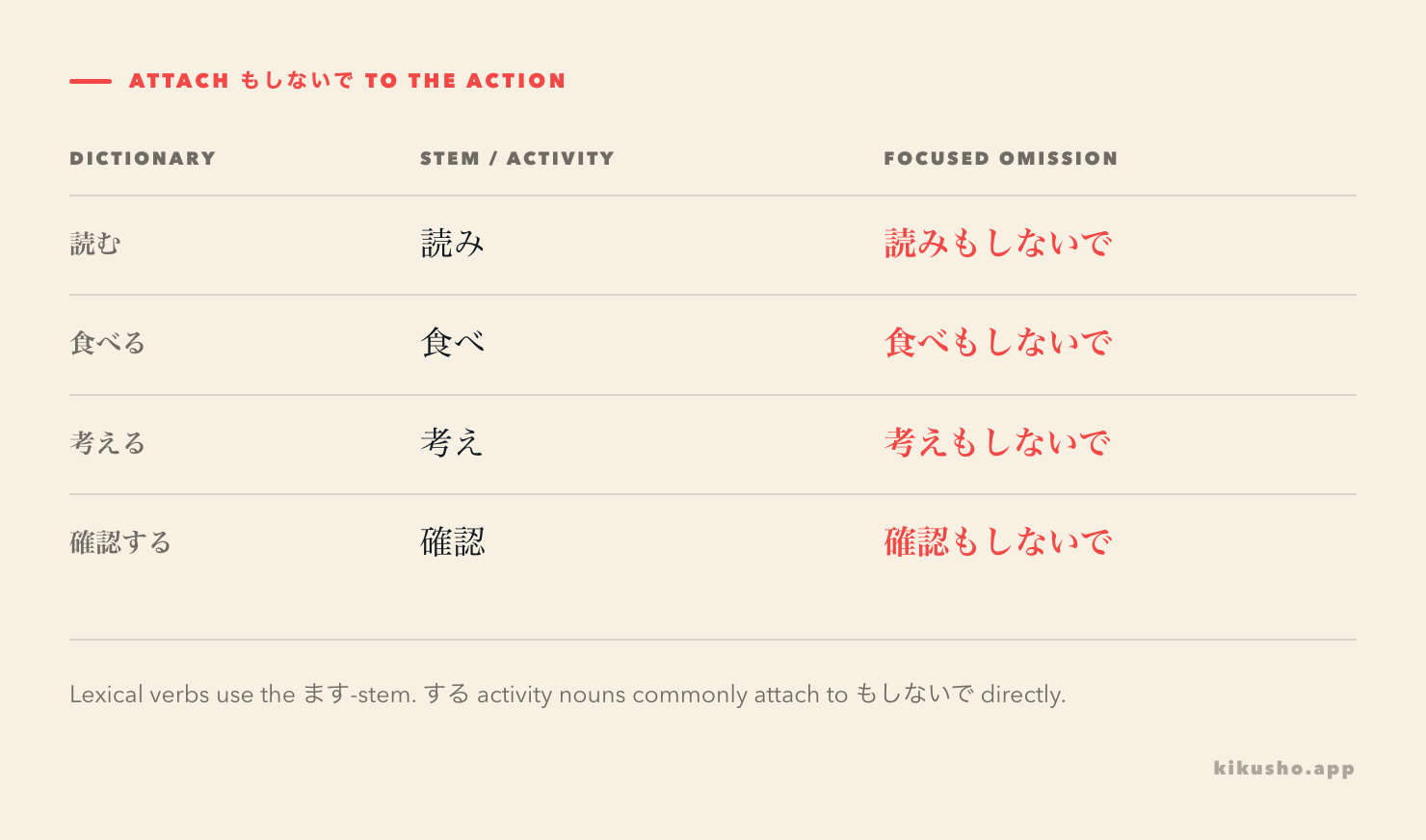
With many する activities, the practical form is the verbal noun plus もしないで:
担当者は事実を確認もしないで、記事を公開した。
たんとうしゃは じじつを かくにんも しないで、きじを こうかいした。
The person in charge published the article without even checking the facts.
彼女は挨拶もしないで、会議室を出ていった。
かのじょは あいさつも しないで、かいぎしつを でていった。
She left the meeting room without so much as saying goodbye.
確認 and 挨拶 can combine with する, so もしないで negates the activity directly. Do not insert を between the activity noun and focus particle: use 確認もしないで, not 確認をもしないで, in this standard frame.
The omitted action was expected
The pattern becomes natural when the missing action was basic, reasonable or necessary before what followed.
自分では一度もやりもしないで、「無理だ」と言うのは早い。
じぶんでは いちども やりも しないで、「むりだ」と いうのは はやい。
It is too soon to call it impossible without even trying it once yourself.
Trying once is the minimum evidence for the judgement. The speaker objects to the order of events: no attempt, then a confident conclusion.
医者に相談もしないで、薬をやめてはいけない。
いしゃに そうだんも しないで、くすりを やめては いけない。
You must not stop the medication without even consulting a doctor.
Here the tone is caution rather than anger. Consultation is a necessary step, so its complete omission is dangerous.
The construction frequently appears before actions such as criticising, deciding, refusing, leaving or complaining. Those following actions make the missing preliminary step feel especially unreasonable:
| Omitted minimum | Later action | Likely stance |
|---|---|---|
| 読みもしないで | 批判する | criticism of an uninformed judgement |
| 確認もしないで | 決める | concern about a careless decision |
| 謝りもしないで | 帰る | anger about missing courtesy |
| やりもしないで | できないと言う | frustration at no attempt |
If there is no expectation, も can sound needlessly dramatic. 今日は朝ご飯を食べないで出かけた is a neutral report. 食べもしないで出かけた invites a reason to care, such as worry about someone's health or surprise that they ignored the meal.
ないで reports; もしないで evaluates
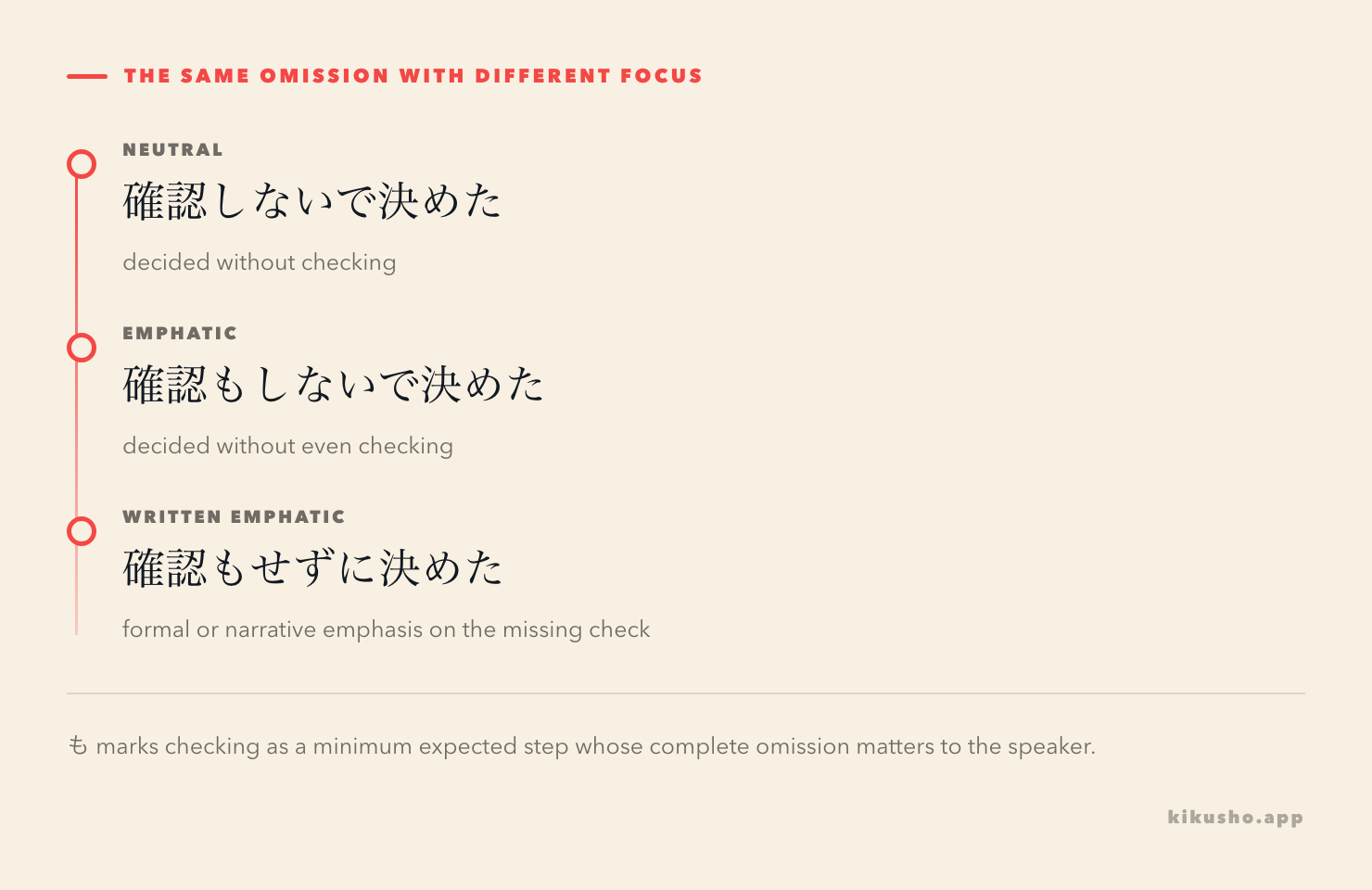
Compare the same event:
彼は返事をしないで部屋を出た。
かれは へんじを しないで へやを でた。
He left the room without replying.
彼は返事もしないで部屋を出た。
かれは へんじも しないで へやを でた。
He left the room without even replying.
The second sentence casts a reply as the minimum courtesy and highlights its absence. English “did not bother to reply” may fit an irritated context, but Japanese does not always claim deliberate refusal. The person may have forgotten, ignored the situation or been unable to respond; the speaker's evaluation of the omission is what remains constant.
~ずに is another “without doing” form and is common in writing:
内容を確認せずに署名した。
ないようを かくにんせずに しょめいした。
They signed without checking the contents.
Adding も produces a more emphatic written counterpart:
内容を確認もせずに署名した。
They signed without even checking the contents.
もしないで often feels direct and conversational; もせずに fits formal narrative and written criticism. Both can highlight a missing minimum. The ことなしに, なしに and なしで lesson covers more formal ways to state that something occurs without a prerequisite.
Do not misread 何もしないで
The surface string 何もしないで often belongs to a different structure:
休日は何もしないで過ごした。
きゅうじつは なにも しないで すごした。
I spent the day off doing nothing.
Here 何も combines with a negative predicate to mean “nothing.” The sentence may be calm and positive; it does not necessarily criticise a missing minimum.
The target pattern focuses a named action:
原因を調べもしないで、機械を捨てるのはもったいない。
げんいんを しらべも しないで、きかいを すてるのは もったいない。
It would be a waste to throw the machine away without even investigating the cause.
調べ tells us exactly which expected action was omitted. The ろくに~ない and 何も~ない lesson distinguishes inadequate action from complete absence.
もしないで is not ようともしない
These forms both express frustration, but they focus on different evidence.
彼は説明を聞きもしないで帰った。
He went home without even listening to the explanation.
The listening event did not occur before he left.
彼は説明を聞こうともしない。
He will not even try to listen to the explanation.
The volitional 聞こう plus ともしない says that he shows no willingness or attempt. The action may still be underway as a possibility; the speaker is judging his stance toward it. Review ~ようとする / ~ようとしない for attempts, imminent events and refusal to try.
The connecting で also matters. In the target construction, the omitted action sets up what follows: 調べもしないで批判した. A sentence can end with もしない when no following event is needed: 彼は手伝いもしない, “He does not even help.” That is the same focus mechanism in a different sentence shape.
Practice: decide whether the missing action is the minimum
Solve the seven prompts, then open the explanation panel beneath them.
Question 1. Build the correct form from 読む.
| Choice | Form |
|---|---|
| A | 読むもしないで |
| B | 読んでもしないで |
| C | 読みもしないで |
| D | 読まもしないで |
Question 2. Which sentence criticises someone for reaching a conclusion without even checking?
- 確認しないで帰った。
- 確認もしないで結論を出した。
- 確認しなくてもいい。
- 確認しないでください。
Keep the following event in view for the next choice.
Question 3. Complete the sentence naturally.
一度も( )、「できない」と言うな。
A. やりもしないで
B. やるもしないで
C. やってもしないで
D. やらないでも
Question 4. Which sentence is the most neutral report?
A. 朝ご飯を食べもしないで出かけた。
B. 朝ご飯を食べないで出かけた。
C. 朝ご飯を食べようともしない。
D. 朝ご飯を食べもせずに出かけるなんて。
Question 5. What does 休日は何もしないで過ごした most naturally mean without further context?
A. I spent my day off doing nothing.
B. I criticised someone for not checking.
C. I refused even to try taking a holiday.
D. I forgot how to do something.
Question 6. Choose the sentence that says someone showed no willingness even to listen.
A. 説明を聞きもしないで帰った。
B. 説明を聞こうともしない。
C. 説明を聞かずに帰った。
D. 説明を聞いてもしない。
The last task asks you to preserve emphasis while changing register.
Question 7. Write two sentences about an employee who published a report without checking the figures. Use 確認もしないで in a direct complaint, then rewrite the omission with the more written 確認もせずに.
Open the seven explanations about omitted actions
Question 1: C. 読む has the ます-form 読みます. Remove ます and attach もしないで to obtain 読みもしないで.
Question 2: 2. 確認もしないで結論を出した presents checking as the minimum step required before the conclusion. The other sentences express neutral omission, permission or a negative request.
Question 3: A. やる becomes the stem やり, followed by もしないで. 一度も reinforces that no attempt occurred even once.
Question 4: B. 食べないで出かけた simply reports leaving without breakfast. A and D add emphatic evaluation, while C focuses on unwillingness to try.
Question 5: A. In 何もしないで, 何も with a negative predicate means “nothing.” A quiet day doing nothing can be intentional and pleasant; the form does not automatically carry the target's criticism.
Question 6: B. 聞こうともしない contains the volitional form and judges absent willingness or effort. A says the person left without listening; C reports the same omission more neutrally.
Question 7 — sample answer: 数字を確認もしないで報告書を公開するなんて、無責任だ。数字を確認もせずに、担当者は報告書を公開した。 Both versions highlight the missing check; もせずに gives the second sentence a more written tone.
Look for the action that should have happened first. If the speaker treats it as the bare minimum and reacts to its total absence, the focused も belongs in the sentence.
Common questions
What does もしないで mean?
After a verb stem, もしないで means “without even doing” or “without so much as doing.” It stresses that an expected or minimal action was omitted completely, often expressing criticism, surprise or concern.
How do verbs attach to もしないで?
Use the ます-stem without ます, then add もしないで: 読む becomes 読みもしないで, 食べる becomes 食べもしないで and 確認する commonly becomes 確認もしないで.
How is もしないで different from ないで?
ないで can report a neutral omission: 朝ご飯を食べないで出た. Adding も produces 食べもしないで and presents eating as a minimum expected action that was not even performed.
Is 何もしないで an example of this N1 pattern?
Not necessarily. 何もしないで usually means “without doing anything,” where 何も forms a negative-polarity expression. The N1 pattern focuses a specific verb stem, as in 調べもしないで “without even checking.”