On this page
も~ば~も balances two facts as “both A and B”: この店は味もよければ、値段も安い means that the restaurant has good food and low prices. The ば form is visible, but this complete paired pattern normally coordinates facts rather than setting up a hypothetical “if.”
The two も particles turn ば into a parallel frame
Read the whole sentence before translating the first ば. In an ordinary conditional, 安ければ買います means “if it is cheap, I will buy it.” The first clause is a condition, and the second gives the result.
In この店は値段も安ければ、味もいい, both qualities already describe the restaurant. One does not cause the other. The two も particles place price and taste side by side, while the ば form closes the first half so the second can answer it.
| Shape | Relationship | Natural reading |
|---|---|---|
| 安ければ、買います | condition → result | If it is cheap, I will buy it. |
| 値段も安ければ、味もいい | fact A + fact B | The price is low and the food is good. |
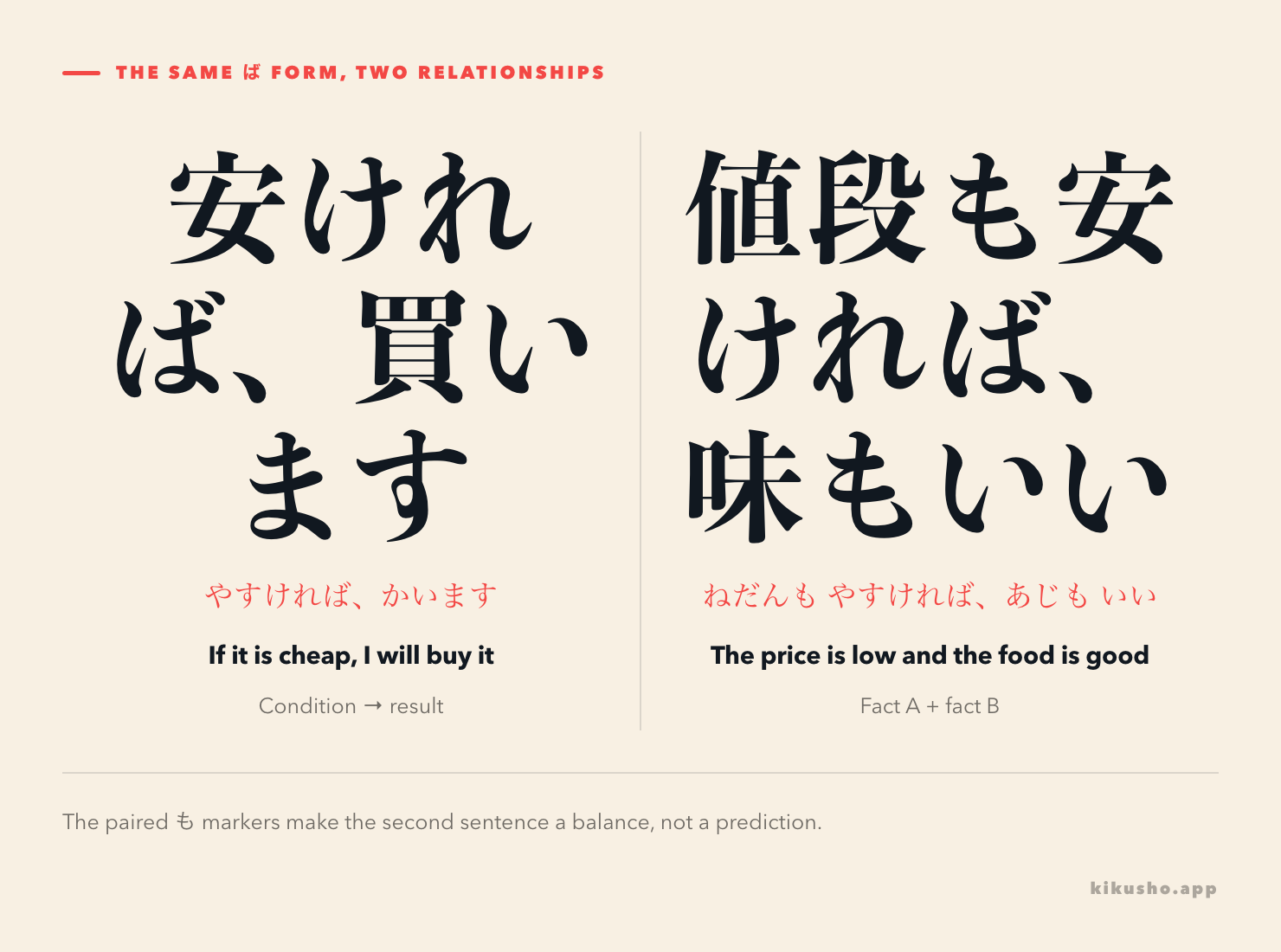
The N4 ば and なら lesson teaches conditions such as 練習すれば上手になる. Here the same ば morphology serves a different relationship. The reliable cue is the matching frame: one marked item before the ば predicate, then another marked with も in the second half.
The attachment changes with the predicate
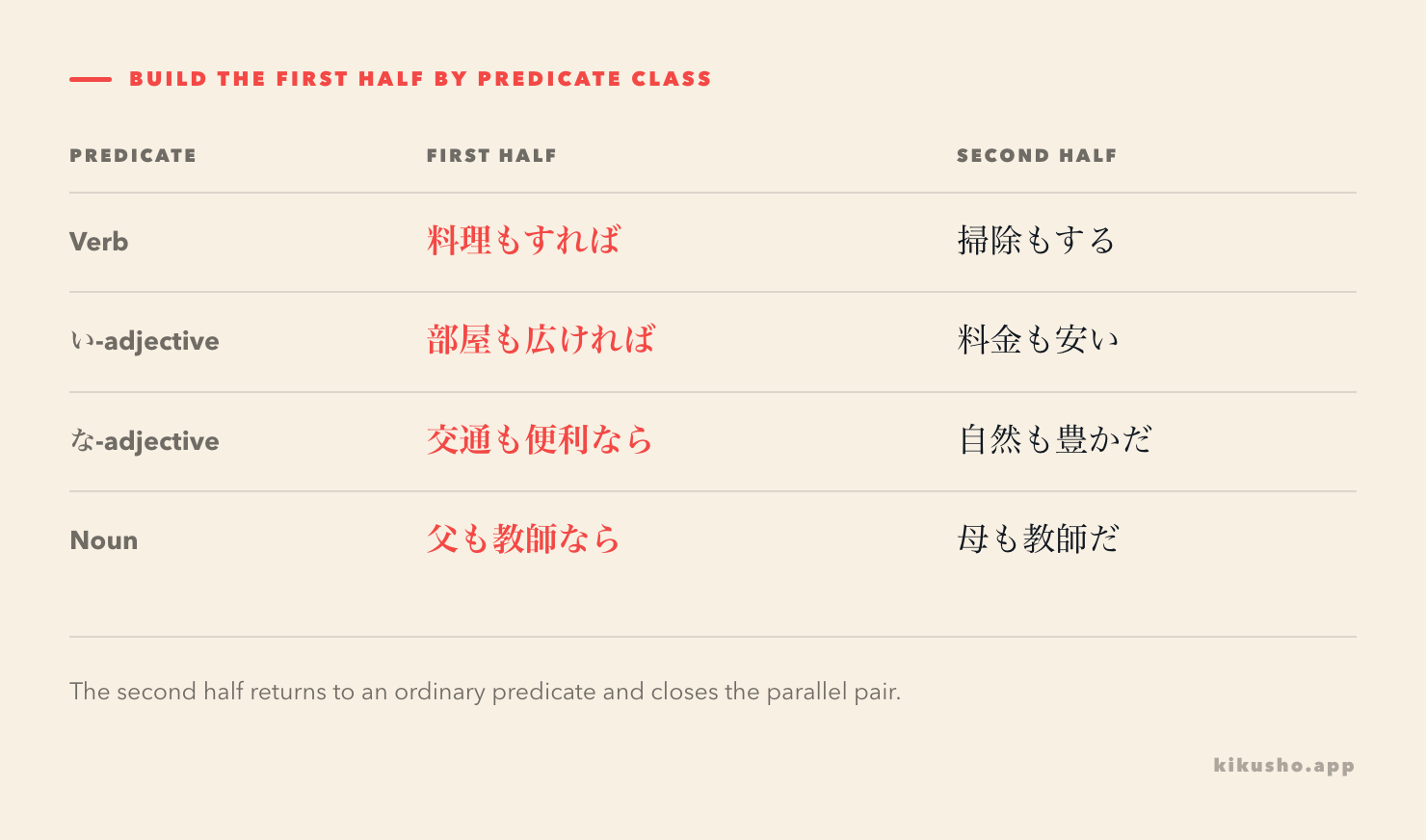
The first predicate takes the appropriate ば or なら form. The second predicate completes the parallel statement in an ordinary plain or polite form.
| First predicate | Pattern | Example |
|---|---|---|
| verb | N1も + Vば、N2も + V | 料理もすれば、掃除もする |
| い-adjective | N1も + Aければ、N2も + A | 部屋も広ければ、料金も安い |
| な-adjective | N1も + Aなら、N2も + Aだ | 交通も便利なら、自然も豊かだ |
| noun | N1も + Nなら、N2も + Nだ | 父も教師なら、母も教師だ |
These are the forms recorded by JLPT Sensei, Bunpro and J-nihongo. JLPT Sensei places the construction at N3. Bunpro and J-nihongo place it at N2. These are study-list estimates, since the JLPT publishes no exhaustive grammar syllabus. Knowing the ordinary ば forms is the practical prerequisite.
Politeness normally appears at the end of the sentence:
このホテルは部屋も広ければ、駅からも近いです。+> この ホテルは へやも ひろければ、えきからも ちかいです。+> This hotel has spacious rooms and is also close to the station.
The first half remains 広ければ, not a polite conditional form. The final 近いです sets the sentence's overall politeness.
Verbs and い-adjectives use their ば forms
A verb changes exactly as it does in an ordinary ば conditional.
兄は料理もすれば、掃除もする。+> あには りょうりも すれば、そうじも する。+> My older brother cooks and cleans.
The paired nouns are the objects of する. 料理もする becomes 料理もすれば in the first half; 掃除もする completes the second.
An い-adjective drops its final い and takes ければ:
この店は値段も安ければ、味もいい。+> この みせは ねだんも やすければ、あじも いい。+> This restaurant has low prices and good food.
The irregular-looking いい → よければ follows the ordinary conditional form of いい. That gives 味もよければ、値段も安い, another natural order for the same pair of qualities.
The two sides do not need the same verb or adjective. What matters is a meaningful parallel. 彼は撮影もできれば、編集もできる pairs two abilities; 今日は風も強ければ、雨も激しい pairs two weather conditions.
Nouns and な-adjectives use なら
For a な-adjective, place なら after the adjective stem:
この町は交通も便利なら、自然も豊かだ。+> この まちは こうつうも べんりなら、しぜんも ゆたかだ。+> This town has convenient transport and abundant nature.
For a noun predicate, なら follows the noun:
父も教師なら、母も教師です。+> ちちも きょうしなら、ははも きょうしです。+> Both my father and mother are teachers.
ならば is also possible, but なら is common in this paired construction. Do not insert な after a な-adjective: it is 便利なら, not 便利ななら. The な form belongs before a noun, as in 便利な町; なら attaches directly to the stem.
One idiomatic extension is 親が親なら、子も子だ, roughly “the parent is bad enough, and the child is no better.” The first marker is が rather than も, and the repeated noun carries a critical evaluation. Treat it as a recognizable evaluative pattern, not as the model from which to build every neutral example.
Negative predicates create neither A nor B
When both halves are negative, the pattern naturally means “neither A nor B.”
今週末は時間もなければ、お金もない。+> こんしゅうまつは じかんも なければ、おかねも ない。+> This weekend I have neither time nor money.
彼はたばこも吸わなければ、お酒も飲まない。+> かれは たばこも すわなければ、おさけも のまない。+> He neither smokes nor drinks.
Keep the polarity aligned. A negative first predicate does not automatically make the second negative: the sentence must state it. 時間もなければ、お金もある is grammatically imaginable as a deliberate contrast, but it defeats the ordinary paired evaluation. Use a contrastive connector when a good point and a bad point are meant to pull against each other.
The pattern can also show variation within a group:
本を読むのが好きな人もいれば、苦手な人もいる。+> ほんを よむのが すきな ひとも いれば、にがてな ひとも いる。+> Some people like reading, while others are not good at it.
Here the sentence does not assign two traits to one person. It says that both kinds of person exist. The parallel frame can therefore collect coexisting characteristics of one subject or contrasting members of a larger set. Context tells you which.
Balanced pairing is the limit of the construction
The two halves need a relationship a listener can recognize. Price and quality, time and money, cooking and cleaning, wind and rain all form natural pairs in their contexts. Random facts do not become a useful sentence merely because they fit the morphology.
The construction also asks the listener to hold the first half open. 味もよければ feels incomplete by itself in this use; the second も and its predicate close the balance. If the intended thought has only one fact, use an ordinary ば condition or remove the frame.
Compare two nearby ways to add information:
| Form | Information shape | Example |
|---|---|---|
| Aも~ば、Bも~ | A and B have balanced weight | 値段も安ければ、味もいい |
| Aし、B | flexible list, often reasons | 値段は安いし、味もいい |
| Aだけでなく、Bも | B is added beyond A | 値段が安いだけでなく、味もいい |
し is the easy conversational list. It can keep accumulating reasons and does not require such a visible two-part symmetry. だけでなく says “not only A but also B,” so B arrives as an addition beyond an already established A. The だけでなく and ばかりでなく lesson explains that additive focus and its attachment rules. も~ば~も gives the pair a more balanced, deliberate shape.
This balance is the reason to save the full sentence in Kikusho. Capturing only 安ければ would produce a conditional-looking fragment and erase the second も that resolves it. Keep 値段も安ければ、味もいい together so the two qualities remain visible when the phrase returns for review.
Practice the complete frame
Question 1: interpretation. Which reading fits この店は値段も安ければ、味もいい?
- If the price becomes low, the taste will improve.
- The restaurant has both low prices and good food.
- The food is good only when it is cheap.
- The restaurant used to be cheap but is now expensive.
Question 2: verb attachment. Complete: 彼は料理も__、掃除もします。
- するならば
- すれば
- したらも
- すると
Question 3: な-adjective attachment. Complete: この町は交通も__、自然も豊かです。
- 便利ければ
- 便利ななら
- 便利なら
- 便利でば
Question 4: negative pairing. Which sentence naturally means “I have neither time nor money”?
- 時間もあれば、お金もない。
- 時間もなくて、お金もある。
- 時間もなければ、お金もない。
- 時間がなければ、お金を使う。
Question 5: sentence composition. Write “She sings and composes music” using 彼女, 歌を歌う, 作曲する and も~ば~も.
Question 6: text grammar. Read: この会社には、海外で働く人もいれば、日本で働く人もいる。働き方もさまざまだ。 What does the paired pattern do?
- It says overseas work causes work in Japan.
- It says both kinds of employee exist in the company.
- It says every employee works in both places.
- It makes overseas work a condition for employment.
Question 7: form choice. You want to add “close to the station” as a second, extra selling point after saying a room is spacious. Which form most directly gives B additive focus?
- 部屋も広ければ、駅からも近い。
- 部屋が広いだけでなく、駅からも近い。
- 部屋が広ければ、駅から近い。
- 部屋は広いけれど、駅から遠い。
Answers and explanations
Answer 1. The restaurant has both low prices and good food. The two も markers and the parallel predicates present two existing qualities. No causal relationship is claimed.
Answer 2. すれば. The verb する takes its ば form in the first half: 料理もすれば、掃除もします. するならば would create a different conditional premise rather than the standard verb frame taught here.
Answer 3. 便利なら. A な-adjective takes なら directly after its stem. 便利ければ treats it as an い-adjective, while 便利ななら incorrectly keeps the noun-linking な.
Answer 4. 時間もなければ、お金もない。 Both predicates are negative, so the matched pair means neither time nor money. The final option is an ordinary condition and result, not parallel coordination.
Answer 5. 彼女は歌も歌えば、作曲もします。 The object 歌 takes the first も, 歌う changes to 歌えば, and 作曲もします completes the second parallel action. Plain 作曲もする is also correct.
Answer 6. Both kinds of employee exist in the company. 人もいれば、人もいる uses the pattern to show variation within one larger group; working abroad does not cause working in Japan.
Answer 7. 部屋が広いだけでなく、駅からも近い。 だけでなく establishes spaciousness and then adds proximity as B. The first option balances the two points; it is grammatical, but it does not give B the same “not only A, but also B” focus.
The pattern becomes easiest to recognize when you wait for its second half. The first も marks one member of a pair; the second tells you what kind of balance the sentence has built.
Common questions
What does も~ば~も mean in Japanese?
It presents two parallel facts as both A and B, as in 値段も安ければ、味もいい, “the price is low and the food tastes good.” It can also produce neither A nor B when both predicates are negative.
Is the ば in も~ば~も a real if-condition?
It uses the same ば form, but the complete paired construction usually coordinates facts that are already true. Translate the relationship as both…and rather than automatically forcing an if…then reading.
How do nouns and な-adjectives attach in も~ば~も?
They use なら or ならば: 交通も便利なら、自然も豊かだ and 父も教師なら、母も教師だ. Verbs use their ば form, while い-adjectives change い to ければ.
What is the difference between も~ば~も and し?
Both can list facts. も~ば~も gives the two parts a balanced, paired shape and often sounds more deliberate or written. し is the ordinary flexible choice for adding reasons or features in conversation.