On this page
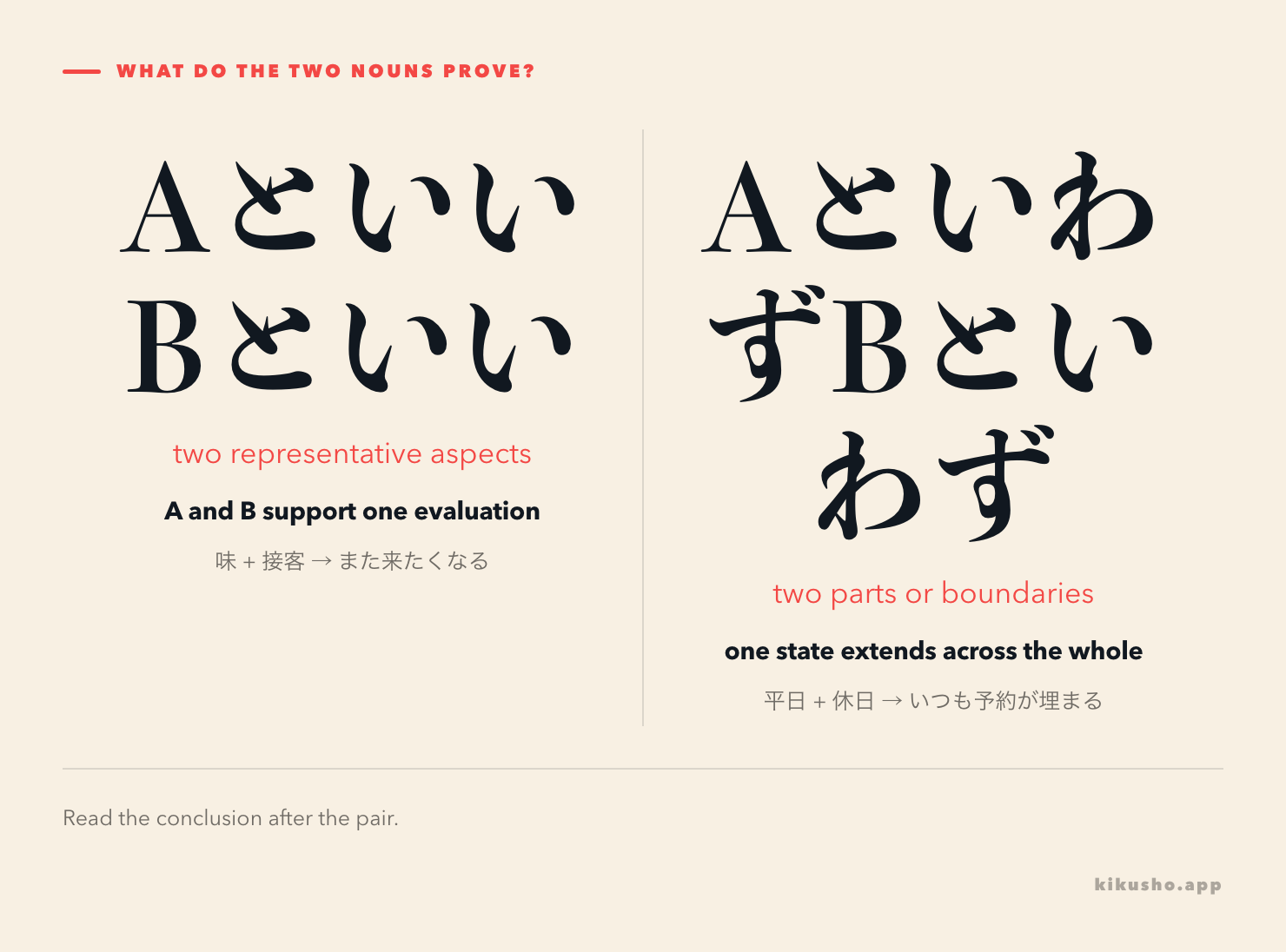
Use AといいBといい when A and B are two telling examples that support one evaluation. Use AといわずBといわず when A and B mark parts or limits of a larger whole and your statement crosses that distinction.
この旅館は眺めといい料理といい、申し分がない。
この りょかんは ながめと いい りょうりと いい、もうしぶんが ない。
This inn is beyond reproach, from the view to the food.
机の上といわず床といわず、資料が散らばっていた。
つくえの うえと いわず ゆかと いわず、しりょうが ちらばっていた。
Papers were scattered everywhere, across the desk and the floor alike.
The first sentence points to two strong features and arrives at a verdict about the inn. The second removes the desk-floor boundary: the mess extends through the room.
This lesson covers inventory item g-e2c2eac6d055, といい~といい, and g-9ae693cf36d7, といわず~といわず.
Decide whether the sentence evaluates or spreads
| Form | What A and B do | What follows | Core reading |
|---|---|---|---|
| AといいBといい、C | sample two prominent aspects | one judgment about the subject | judging by A and B |
| AといわずBといわず、C | mark two parts, times or limits of a whole | a state that applies across it | throughout A, B and beyond |
The two patterns both mention A and B, but neither is a plain list. AもBも merely includes both. These N1 constructions tell the reader how to generalize from them.
といい~といい selects evidence for a verdict
The attachment is compact: noun + といい + noun + といい. There is no だ after either noun.
| Evaluated subject | First aspect | Second aspect | Verdict |
|---|---|---|---|
| この旅館 | 眺め | 料理 | 申し分がない |
| あの学生 | 分析力 | 説明の明快さ | 研究発表に向いている |
| この製品 | 価格 | 耐久性 | よくできている |
あの学生は分析力といい説明の明快さといい、研究発表の代表にふさわしい。
あの がくせいは ぶんせきりょくと いい せつめいの めいかいさと いい、けんきゅうはっぴょうの だいひょうに ふさわしい。
That student is a fitting representative for the research presentation, considering both their analytical ability and the clarity of their explanations.
日本語NET describes the form as citing conspicuous points when evaluating a person or thing. Tanosuke's teacher reference likewise says that the speaker selects two especially noticeable features for emphasis. The evaluation can be favorable or critical:
この部屋は日当たりといい収納の少なさといい、長く住むには厳しい。
この へやは ひあたりと いい しゅうのうの すくなさと いい、ながく すむには きびしい。
This room would be difficult to live in for long, considering both its exposure to sunlight and its lack of storage.
The first noun need not be good merely because the kana read といい. This is a fixed listing pattern, not the adjective いい, “good.” It also differs from the lower-level wish 雨がやむといい, where a full predicate before と presents a desirable outcome. The といい and たらいい lesson covers that separate construction.
The two nouns should be revealing examples from the same target. If you only mean “the bag contains a notebook and a pen,” use an ordinary list. ノートといいペンといい、かばんに入っている forces the listener to search for an evaluation that the sentence never gives.
といわず~といわず removes the boundary
This pattern also attaches directly to nouns: noun + といわず + noun + といわず. A and B must form a coherent whole. They may be opposite times, separate surfaces, social groups, or representative locations.
平日といわず休日といわず、問い合わせが届く。
へいじつと いわず きゅうじつと いわず、といあわせが とどく。
Enquiries arrive on weekdays and holidays alike.
壁といわず床といわず、部屋じゅうに絵の具が飛び散っていた。
かべと いわず ゆかと いわず、へやじゅうに えのぐが とびちっていた。
Paint had splattered all over the room, on the walls and floor alike.
Bunpro explains that the statement is not limited to A or B but reaches everything in their logical group. JLPT Sensei notes that the paired nouns are often linked in time or space, or stand in opposition.
The result often describes an excessive, inconvenient or visually striking state: dirt everywhere, activity at all hours, or an effect across every group. That tendency is common rather than part of the literal meaning. A positive sentence is possible when the whole-range reading is clear:
子供といわず大人といわず、観客は演奏に聞き入っていた。
こどもと いわず おとなと いわず、かんきゃくは えんそうに ききいっていた。
Children and adults alike in the audience listened intently to the performance.
Because the form makes a broad assertion, the following clause is normally a description, report or generalization. A direct request after it is a poor fit. Use a simpler scope phrase such as 子供も大人も参加してください when you want to ask both groups to participate.
Test the implied remainder
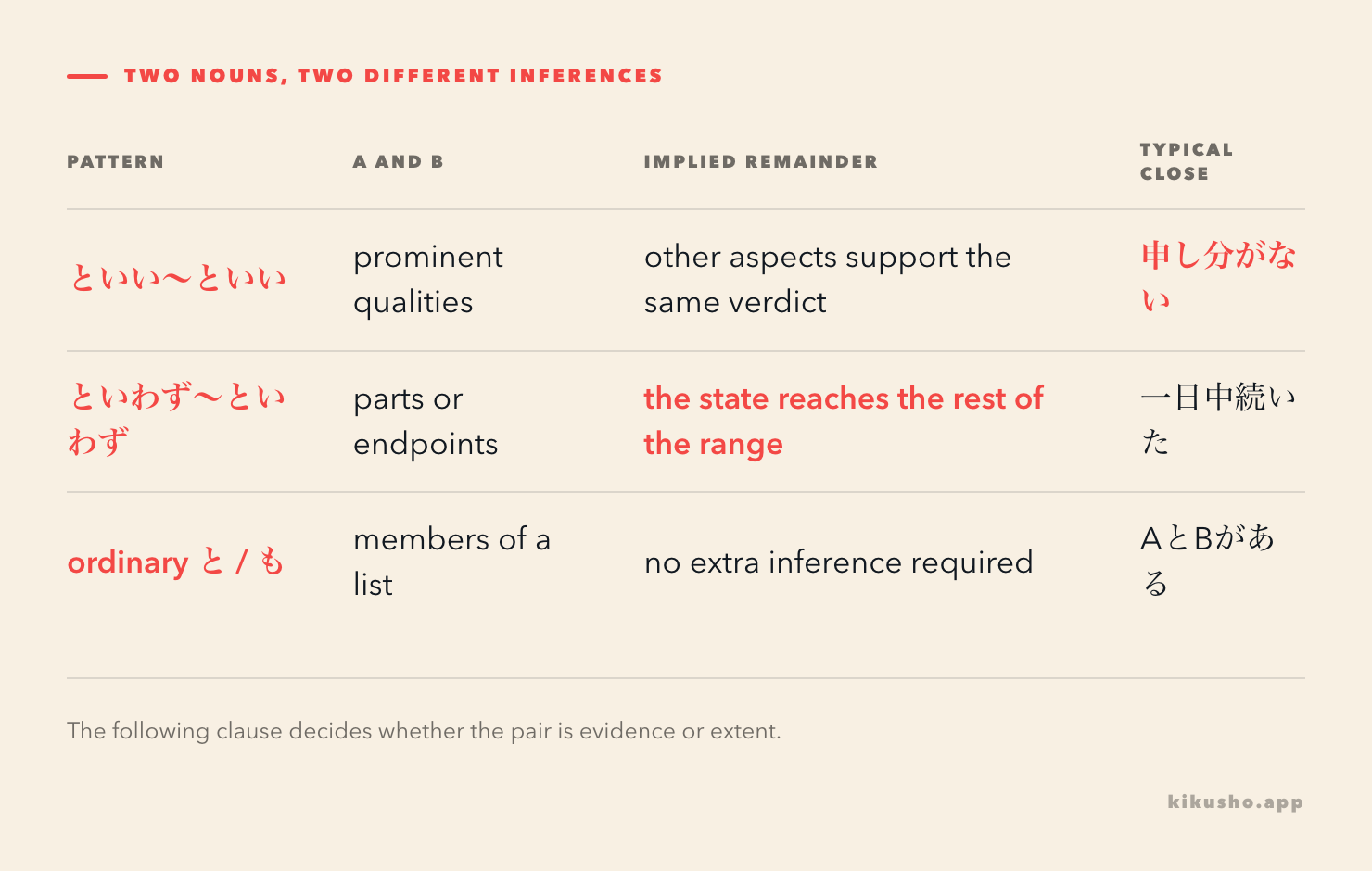
Try adding a silent phrase after A and B. If the intended thought is “these two aspects show what the subject is like,” choose といい~といい. If it is “and everywhere or everyone else in that range,” choose といわず~といわず.
この町は交通の便といい店の多さといい、暮らしやすい。
This town is easy to live in, considering its transport links and number of shops.
The town receives an evaluation. The sentence does not claim that one state spreads from transport to shops.
駅前といわず住宅街といわず、祭りの日は人であふれていた。
On the festival day, the area was crowded everywhere, from the station front to the residential streets.
The two locations sketch the extent of the crowd. 住宅街 is not evidence that “the town is good”; it is another boundary crossed by the same condition.
The neighboring でも, または, とか and など lesson handles ordinary examples and alternatives. AであれBであれ is broader still: it means the conclusion holds whichever hypothetical case applies. The であれ and たりとも comparison explains that concessive structure.
Level, register and limits
JLPT Sensei labels both patterns N1. 日本語NET, Tanosuke and J-nihongo also teach といい~といい at N1, while Bunpro and J-nihongo place といわず~といわず there as well. The two assigned inventory rows have no recorded level disagreement.
These are teaching-resource placements. The official JLPT FAQ explains that the post-2010 exam no longer supplies itemized vocabulary, kanji and grammar catalogues.
Both constructions are marked. You will meet them in written description, reviews, commentary and emphatic speech. といわず~といわず is especially formal and literary. In an ordinary conversation, 平日も休日も often says enough.
Keep the inference on the card
When you save one of these patterns in Kikusho, keep the conclusion with the two nouns. 味といい値段といい becomes useful only beside the evaluation it supports. 昼といわず夜といわず needs the state that continues across the whole day. The second half of the sentence is where the two forms stop looking alike.
Complete the full practice set before revealing the key.
Practice
Question 1 — evaluation or extent. Which sentence evaluates a camera through two representative qualities?
- A. このカメラは画質といい軽さといい、旅行に最適だ。
- B. このカメラは朝といわず夜といわず、旅行に最適だ。
- C. このカメラは画質といわず軽さといわず、旅行に最適だ。
- D. このカメラは画質といい軽さといわず、旅行に最適だ。
Question 2 — whole range. Complete the report.
犬は足( )背中( )、全身泥だらけだった。
- A. といい/といい
- B. といわず/といわず
- C. であれ/といい
- D. といわず/といい
Question 3 — explain the inference. In この店は味といい接客といい、また来たくなる, what job do 味 and 接客 perform?
Question 4 — reject a plain list. You only want to say that the bag contains a notebook and a dictionary. Which sentence is natural?
- A. かばんにはノートと辞書が入っている。
- B. かばんにはノートといい辞書といい、入っている。
- C. かばんにはノートといわず辞書といわず、入っている。
- D. かばんにはノートであれ辞書といい、入っている。
Question 5 — repair the range. Rewrite the sentence so it means that calls came at every hour, with morning and night as the boundaries:
× 朝といい夜といい、電話が鳴り続けた。
Question 6 — two blanks. Choose the pair that moves from an evaluation to a whole-range report.
この宿は立地( 1 )料金( 1 )、申し分がない。しかし繁忙期は平日( 2 )休日( 2 )、予約が埋まる。
- A. といい/といわず
- B. といわず/といい
- C. といい/といい
- D. といわず/といわず
Question 7 — compose and justify. Write one sentence with といい~といい to evaluate a book, course or place. Then state why といわず~といわず would change the intended relation.
Answers and explanations
1
The correct sentence is A. 画質 and 軽さ are two prominent qualities that support the conclusion 旅行に最適だ. B gives time boundaries unrelated to the evaluation, while C wrongly asks for one state extending across picture quality and lightness.
2
B, といわず/といわず. The paws and back identify parts of the dog's body, while 全身泥だらけ makes the intended extension explicit: the mud covers the whole animal.
3
They are representative evidence. The speaker selects taste and service as two revealing aspects of the restaurant, then uses their shared positive evaluation to support また来たくなる.
4
A. This is only an inventory of two objects, so ordinary と is enough. Neither N1 pattern belongs here because the sentence supplies no evaluation and no larger range over which one state extends.
5
Write 朝といわず夜といわず、電話が鳴り続けた。 Morning and night now mark the span across which the ringing continued, rather than serving as two qualities evaluated by a later judgment.
6
A, といい/といわず. Location and price support the favorable verdict about the inn. Weekdays and holidays divide the calendar, and the full-booking state ignores that division during the busy season.
7
One answer is この本は資料の豊富さといい説明の明快さといい、入門書として優れている。 The two nouns are evidence for an evaluation of the book. Replacing the form with といわず~といわず would suggest that one state spreads throughout a logical whole containing “abundance of sources” and “clarity of explanation,” but those are evaluative aspects rather than natural boundaries of a range.
The deciding evidence comes after the pair: a verdict turns two nouns into representative aspects, while a broad state turns them into the visible edges of a larger whole.
Every Japanese example, translation, question, answer and image in this lesson was reviewed by OpenAI Codex. This was an AI review, not a human language review.
Common questions
What is the difference between といい~といい and といわず~といわず?
といい~といい selects two representative aspects and uses them to support one evaluation. といわず~といわず names two parts, times or endpoints and says that the same state applies throughout the larger group without respecting that distinction.
How does といい~といい attach?
Put it directly after two nouns: N1といいN2といい. The following clause normally evaluates the person or thing through those two prominent aspects.
How does といわず~といわず attach?
It also follows two nouns directly: N1といわずN2といわず. The nouns must belong to a coherent range or whole, such as day and night, walls and floor, or children and adults.
Are both patterns JLPT N1 grammar?
JLPT Sensei, Bunpro, 日本語NET, Tanosuke and J-nihongo place these patterns at N1. These are study-resource estimates because the official exam supplies no itemized modern grammar catalogue.