On this page
Both patterns leave an answer open, but they do different work. か否か turns a proposition into a formal binary issue to check or decide; のやら, ものやら and ことやら let the speaker wonder, hesitate or react to uncertainty.
委員会は計画を続けるか否かを決定するが、現場がどうなることやら、私には見当もつかない。
いいんかいは けいかくを つづけるかいなかを けっていするが、げんばが どうなることやら、わたしには けんとうも つかない。
The committee will decide whether to continue the plan, but I have no idea what will become of the site.
The first clause belongs to a decision process. The second exposes a person's uneasy outlook. That contrast between institutional evaluation and speaker stance is more reliable than translating both with “whether” or “I wonder.”
This lesson covers g-879b3239912b, か否か; g-ad00c1e58160, のやら/ものやら/ことやら; and g-2263df78ea43, のやら~のやら. JLPT Sensei treats all three records as N1 material, while Bunpro independently labels か否か N1 and formal. These are study estimates because the JLPT publishes no exhaustive official grammar list.
The deciding test is whether anyone is evaluating an explicit yes-or-no proposition
Ask what the sentence is doing with the unknown.
| Form | Shape of the unknown | Typical setting | Speaker stance |
|---|---|---|---|
| A か否か | A or not A | policy, research, decisions, formal argument | held at a distance |
| question + のやら | what, why, where, whether | reflection, puzzlement, criticism | clearly present |
| どうしたものやら | what one should do | hesitation over a response | troubled or at a loss |
| どうなることやら | what will happen | uncertain future outcome | concern, resignation or wonder |
| A のやら B のやら | which of two alternatives is true | hard-to-read evidence or feelings | unable to distinguish |
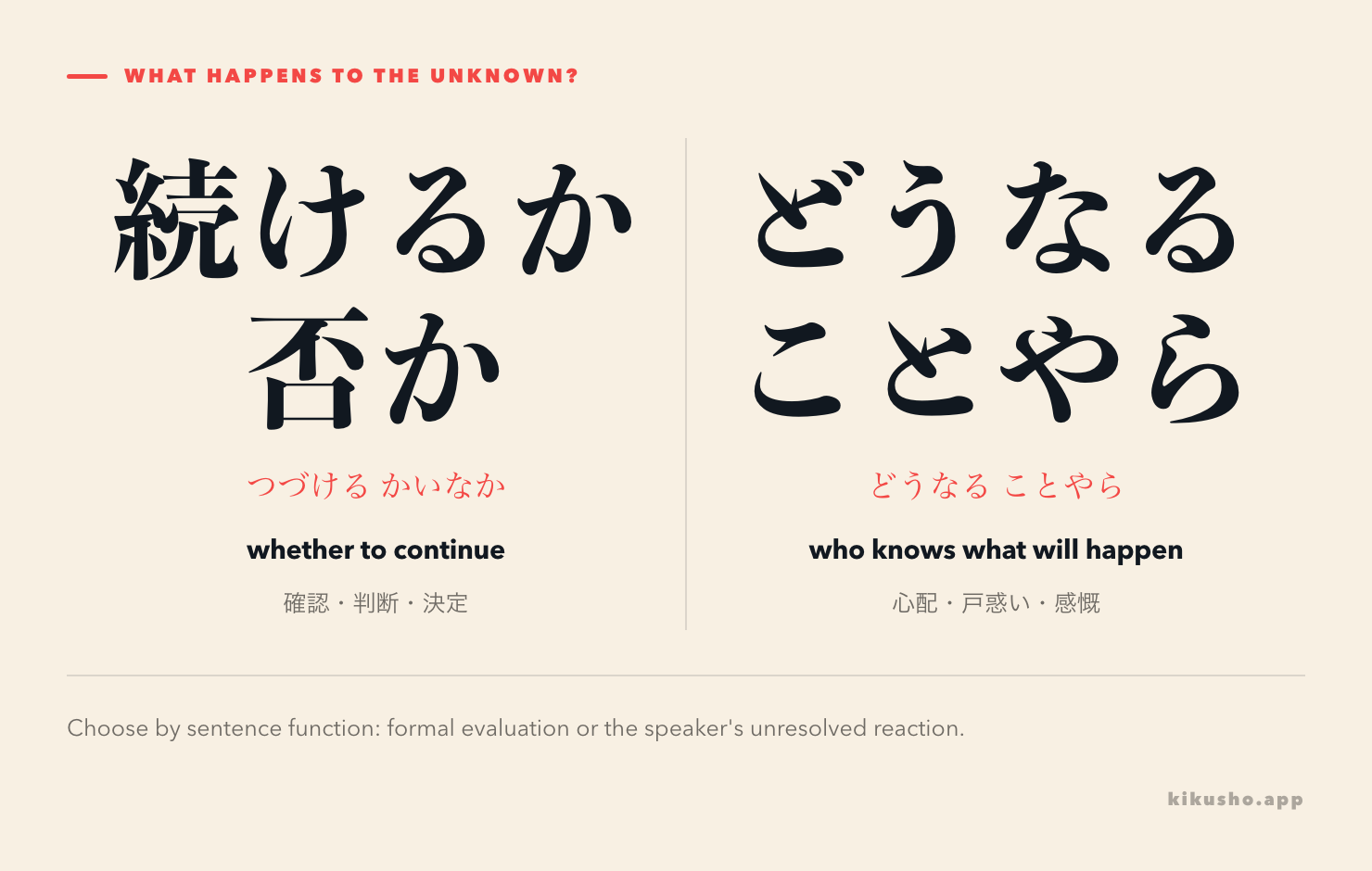
If the clause can sit under 確認する, 判断する, 検討する or 決定する, か否か is a strong candidate. If the clause sounds like an internal question and the surrounding context carries surprise, frustration or helplessness, the やら family is more likely.
か否か packages A and its negation for formal judgment
The core formation is:
| Before か否か | Formation | Example |
|---|---|---|
| verb | plain form + か否か | 実施するか否か |
| i-adjective | plain form + か否か | 正しいか否か |
| na-adjective | ~である + か否か | 適切であるか否か |
| noun | ~である + か否か | 会員であるか否か |
この証拠が判断に十分であるか否かを、慎重に検討する必要がある。
このしょうこが はんだんに じゅうぶんであるかいなかを、しんちょうに けんとうする ひつようが ある。
We must carefully consider whether this evidence is sufficient for a decision.
否 is read いな here and supplies the negative alternative without repeating the predicate. The whole clause behaves like an embedded question: it can take を, become the topic with は, or stand before によって and similar continuations.
制度を見直すか否かは、来月の調査結果によって決まる。
せいどを みなおすかいなかは、らいげつの ちょうさけっかによって きまる。
Whether the system is revised will depend on next month's survey results.
The ordinary alternative is かどうか. 参加できるかどうか教えてください is natural in an everyday message. Replacing it with 参加できるか否か makes the line sound administrative, analytical or deliberately severe. Formality is the reason to choose it, not extra uncertainty.
Do not confuse this form with や否や, which means “as soon as” in its classical N1 use. In 到着するや否や, the first action certainly occurs; no yes-or-no question remains.
のやら makes an unresolved question sound like the speaker's thought
のやら follows a plain clause. With nouns and na-adjectives, use な before it.
| Base | Attachment | Example |
|---|---|---|
| verb | plain + のやら | どこへ行ったのやら |
| i-adjective | plain + のやら | 何がそんなに面白いのやら |
| na-adjective | ~な + のやら | 本当に必要なのやら |
| noun | ~な + のやら | 誰の責任なのやら |
担当者は何を基準に選んだのやら、説明を読んでも分からない。
たんとうしゃは なにを きじゅんに えらんだのやら、せつめいを よんでも わからない。
Even after reading the explanation, I cannot tell what criteria the person in charge used.
JapaneseNET describes のやら as equivalent to のか or のだろうか and notes the speaker's doubt or exasperation. It also calls the expression old-fashioned and uncommon among younger speakers. That does not make it obsolete: you will still meet it in narration, commentary and speech that adopts a reflective or weary tone. It does make it a poor default for a neutral service question.
The doubt can remain sentence-final: いつ戻るのやら。 It can also feed an explicit predicate such as 分からない, 見当もつかない or 想像できない. The latter makes the uncertainty structurally obvious; the former lets the trailing ending carry more of the mood.
ものやら and ことやら favour different scenes
The three endings overlap, so avoid assigning each one a rigid English translation. Their recurring frames are more useful.
ものやら often presents a difficult course of action
事情を知らない家族に、どう説明したものやら迷っている。
じじょうを しらない かぞくに、どう せつめいしたものやら まよっている。
I am at a loss as to how I should explain it to the family, who do not know the circumstances.
The speaker is not asking for a factual yes-or-no answer. どう~たものやら or どう~たらいいものやら frames deliberation: what action would be appropriate? It often pairs naturally with 迷う or 分からない.
ことやら often looks toward an unknown result
引き継ぎもないまま担当者が辞めた。来月の締め切りまでにどうなることやら。
ひきつぎも ないまま たんとうしゃが やめた。らいげつの しめきりまでに どうなることやら。
The person in charge quit without a handover. Who knows what will happen by next month's deadline.
どうなることやら is a stable way to voice concern or resignation about what lies ahead. ことやら can also heighten an emotional indirect question, as in どれほど心配したことやら, “you cannot imagine how worried I was.” Context decides whether the unknown is genuinely unresolved or presented as an emphatic measure beyond words.
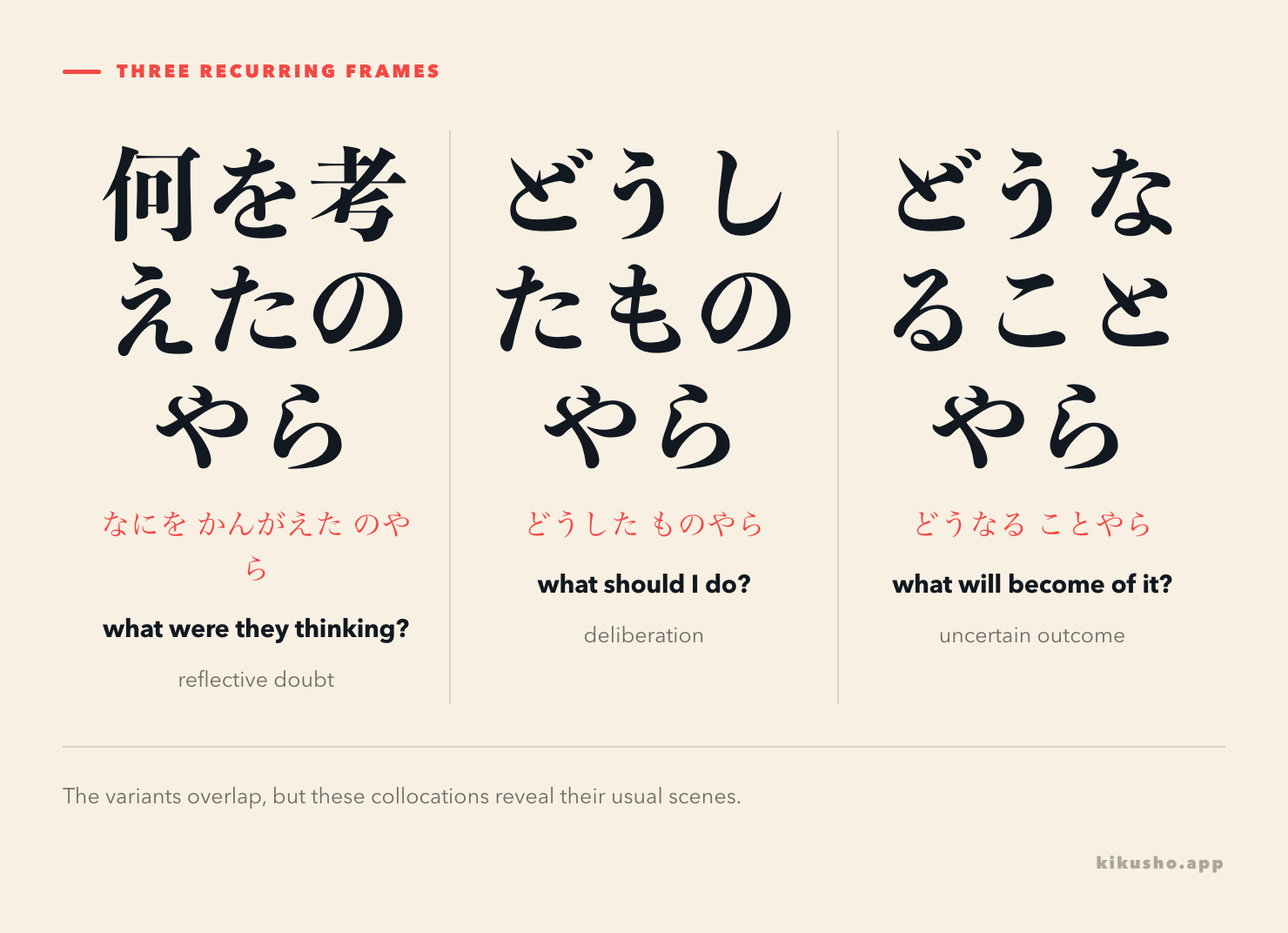
JLPT Sensei records the shared plain-form attachment and examples of all three variants. Treat the patterns above as strong collocational tendencies. Replacing もの with こと mechanically can change the established tone or produce a line that sounds forced.
Repeated のやら sets two alternatives against each other
Use A のやら B のやら when evidence does not let the speaker tell which alternative is true. The alternatives are normally parallel and often opposed.
あの返事では、賛成なのやら反対なのやら判断できない。
あのへんじでは、さんせいなのやら はんたいなのやら はんだんできない。
From that answer, I cannot tell whether they agree or disagree.
子どもは眠いのやら機嫌が悪いのやら、ずっと泣いている。
こどもは ねむいのやら きげんが わるいのやら、ずっと ないている。
I cannot tell whether the child is sleepy or in a bad mood; they have been crying continuously.
Tanosuke describes the construction as two opposing possibilities used when the speaker cannot judge the situation. The predicate may be explicit, as in 分からない or 判断できない, or recoverable from context.
This repeated form must be kept separate from やら~やら, which lists representative items or actions that can all belong to the same scene. The やら~やら lesson owns that N2 listing pattern. Compare:
- 泣くやら笑うやらで大騒ぎだった: crying, laughing and other reactions all occurred.
- 泣いているのやら笑っているのやら分からない: the observer cannot tell which reaction is occurring.
Register changes the sentence even when the facts do not
Consider one practical uncertainty: a proposal may be accepted.
提案が採用されるかどうか、まだ分かりません。
We do not yet know whether the proposal will be accepted.
This is neutral. 提案を採用するか否か、委員会が審議する moves the question into a formal institutional process. 提案が採用されるのやら、本人も不安そうだ presents uncertainty through a person's worried stance.
The forms therefore do not form a simple politeness ladder. か否か removes personal colouring for a formal contrast. のやら can sound literary or old-fashioned while remaining emotionally exposed. A formal-looking expression is not automatically more polite, and an older one is not automatically suitable for business writing.
The nearby adverb どうやら is also a different unit. It usually marks a tentative inference, “apparently” or “it seems.” The どうやら, 恐らく and 果たして lesson covers that evidence-based uncertainty. In どうやら間に合いそうだ, there is no trailing nominalizer plus やら.
For a useful Kikusho card, capture the words that govern the uncertainty. A card containing only 続けるか否か loses the institutional decision; どうなることやら without the failed handover loses the concern. The full sentence gives the same surface uncertainty a reason and a register.
Practice: identify the decision, the hesitation and the reaction
Question 1 — grammar choice. Complete the formal evaluation: この案が現実的である__、専門家が検討する。
① か否か
② のやら
③ ものやら
④ や否や
Question 2 — grammar choice. Which sentence naturally voices uncertainty about what action to take?
- ① 誰に相談したものやら、迷っている。
- ② 誰に相談するか否か、迷っている。
- ③ 誰に相談するや否や、迷っている。
- ④ 誰に相談やら、迷っている。
Question 3 — sentence composition. Use 来月, どうなる, and ことやら to express concern about an uncertain future result.
Question 4 — grammar choice. Choose the natural attachment for a na-adjective: その対策が本当に必要__、私には分からない。
① であるか否か
② だか否か
③ でのやら
④ なか否か
Question 5 — text grammar. In 彼は喜んでいるのやら困っているのやら、表情からは判断できない, are both reactions asserted to be happening? Explain what the repeated form does.
Question 6 — grammar choice. Which sentence sounds like a neutral everyday request rather than an institutional judgment or a weary reflection?
- ① 参加できるかどうか教えてください。
- ② 参加できるか否かを審査する。
- ③ 参加できるのやら、本人にも分からない。
- ④ 参加するや否や、連絡した。
Question 7 — sentence composition. Rewrite 委員会は計画を続けるかどうか決める with the formal N1 expression taught here.
Answers and explanations
Walkthrough 1
① か否か. The proposition 現実的である is being submitted to expert evaluation. や否や would mean “as soon as,” while the やら forms would add a speaker's wondering rather than package a formal binary question.
Walkthrough 2
① 誰に相談したものやら、迷っている。 The fixed deliberative frame presents the speaker as unsure what course to take. Choice ② asks whether to consult a particular person, not which person to consult; ③ changes the relation to “as soon as,” and ④ lacks a clause that can support the intended uncertainty.
Walkthrough 3
来月はどうなることやら、心配だ。 The question word and ことやら look toward an uncertain outcome. 心配だ makes the concern explicit, though 来月はどうなることやら。 can stand alone when the context supplies it.
Walkthrough 4
① であるか否か. A na-adjective can take the formal copula である before か否か. The other choices splice the two constructions incorrectly.
Walkthrough 5
No. 喜んでいる and 困っている are rival interpretations of the same expression. Repeated のやら places them side by side, and 判断できない states that the observer cannot select one.
Walkthrough 6
① 参加できるかどうか教えてください. かどうか is the ordinary neutral form for asking whether something is possible. Choice ② is formal and evaluative; ③ exposes personal uncertainty; ④ says that contact happened as soon as participation began or was decided, depending on context.
Walkthrough 7
委員会は計画を続けるか否かを決める。 The plain verb 続ける attaches directly to か否か, and を marks the entire embedded yes-or-no question as the object of 決める.
The safest choice comes from the action around the unknown. Use か否か when a formal process will settle A versus not A. Use the やら family when the line lets you hear the person who still does not know.
Common questions
What is the difference between か否か and のやら?
か否か frames a proposition as a formal yes-or-no issue to determine. のやら presents the speaker as wondering, puzzled or sometimes exasperated about an unresolved question.
What is the difference between か否か and かどうか?
Both can mean “whether or not,” but か否か is strongly associated with formal writing, decisions and evaluations. かどうか is the ordinary choice in neutral conversation and general prose.
How do のやら, ものやら and ことやら differ?
All can mark wondering. のやら is the broad form, ものやら often appears in deliberative questions such as どうしたものやら, and ことやら often looks ahead to an uncertain outcome, as in どうなることやら. These are tendencies rather than interchangeable endings in every sentence.
What does のやら~のやら mean?
It places two alternatives side by side when the speaker cannot tell which is true, as in 来るのやら来ないのやら分からない. It differs from やら~やら, which lists representative things or actions.