On this page
やら~やら names a few examples while leaving the full list loose: “things like A and B,” with more left unsaid. It often appears when those examples form a jumble, a run of problems, or mixed feelings, as in 引っ越しは荷造りやら手続きやらで忙しい, “Moving is busy with packing, paperwork, and everything else.”
This lesson covers inventory item g-97f14823b123, やら~やら. JLPT Sensei, Bunpro, Tanosuke, and Nihon no Kotoba to Bunka place it at N2. Their level agreement is useful study guidance, although the JLPT publishes no exhaustive official grammar list.
The two examples point beyond themselves
In a noun list, やら follows each representative item. The examples belong to the same broad situation, and the repeated marker suggests that the speaker could name more.
机の上には、領収書やらメモやらが散らばっている。
つくえの うえには、りょうしゅうしょやら メモやらが ちらばっている。
Receipts, notes, and other things are scattered across the desk.
The sentence does not claim that only receipts and notes are present. 散らばっている gives the list its untidy setting. Compare a calm inventory:
机の上には、領収書とメモがある。
There are receipts and notes on the desk.
Here と closes the list and adds no sense of a wider assortment. With やら~やら, the named items act as samples from a scene the speaker has not sorted into a neat catalogue.
The pattern is not restricted to complaints:
祭りでは、音楽やら踊りやらを楽しんだ。
まつりでは、おんがくやら おどりやらを たのしんだ。
At the festival, I enjoyed music, dancing, and all sorts of things.
This list is pleasant. The openness remains, but 楽しんだ replaces disorder with enjoyment. Treat the troublesome tone as a common context, not part of the dictionary meaning.
Nouns, dictionary verbs, and i-adjectives attach directly
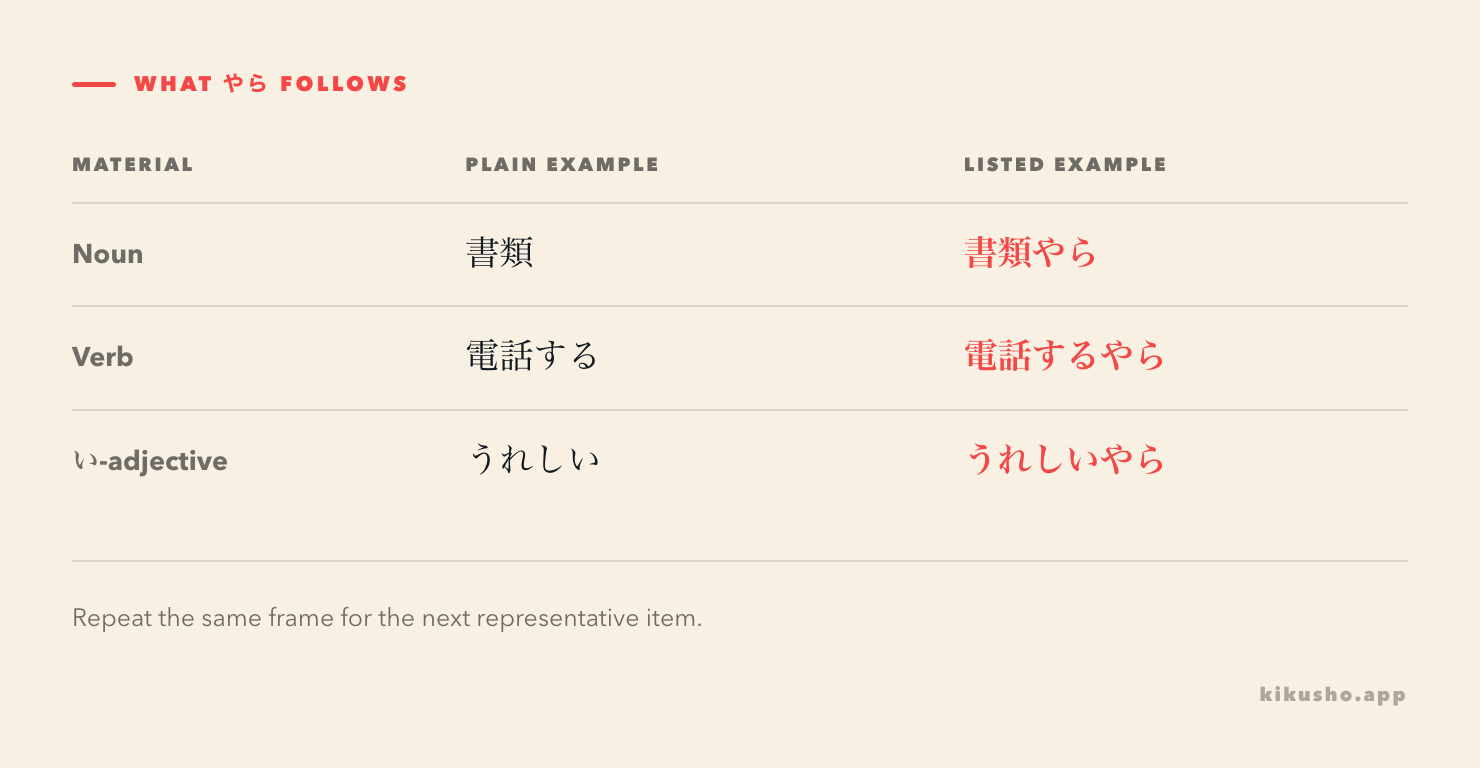
The core productive pattern has three common shapes.
| Listed material | Formation | Example |
|---|---|---|
| nouns | N + やら + N + やら | 書類やら箱やら |
| actions | V dictionary + やら + V dictionary + やら | 電話するやら運ぶやら |
| qualities or feelings | i-adjective + やら + i-adjective + やら | うれしいやら寂しいやら |
引っ越しの日は、電話するやら荷物を運ぶやらで、昼ご飯を食べる暇もなかった。
ひっこしの ひは、でんわするやら にもつを はこぶやらで、ひるごはんを たべる ひまも なかった。
On moving day I was calling people, carrying boxes, and doing so much else that I had no time for lunch.
Use the dictionary forms 電話する and 運ぶ. Unlike たり~たり, this construction does not begin with a past-form base. 電話したり運んだり is well formed in its own construction; 電話したやら運んだやら does not reproduce the target example-list pattern.
合格の知らせを聞いて、うれしいやら信じられないやらで、しばらく言葉が出なかった。
ごうかくの しらせを きいて、うれしいやら しんじられないやらで、しばらく ことばが でなかった。
When I heard that I had passed, I was happy, unable to believe it, and so overwhelmed that I could not speak for a while.
This sentence mixes an i-adjective and a verb phrase because both name reactions inside one confused emotional state. Matching grammatical categories are common and easiest to build, but the larger coherence of the list matters more than mechanical symmetry.
The predicate after the list reveals the speaker's reaction
やら~やら selects examples; it does not by itself say why they matter. The predicate that follows often tells you how to read the whole assortment.
| Ending after the list | Likely reading of the list |
|---|---|
| ~で忙しい | many tasks create pressure |
| ~で大変だ | the situation is difficult |
| ~で散らかっている | the objects form a mess |
| ~で複雑な気持ちだ | the feelings pull in different directions |
| ~を楽しんだ | the variety was enjoyable |
発表の前日は、資料を直すやら練習するやらで、ほとんど眠れなかった。
はっぴょうの ぜんじつは、しりょうを なおすやら れんしゅうするやらで、ほとんど ねむれなかった。
The day before the presentation, I was revising the handout, practising, and doing so much else that I hardly slept.
The repeated actions explain the resulting lack of sleep. で often links the assortment to a consequence, but it is not a mandatory part of やら~やら. A case particle can instead attach to the completed noun list: 本やら雑誌やらを箱に入れた.
や and たり give quieter lists
Choose や when you only need representative nouns. Choose たり~たり when you want neutral example actions or alternating states.
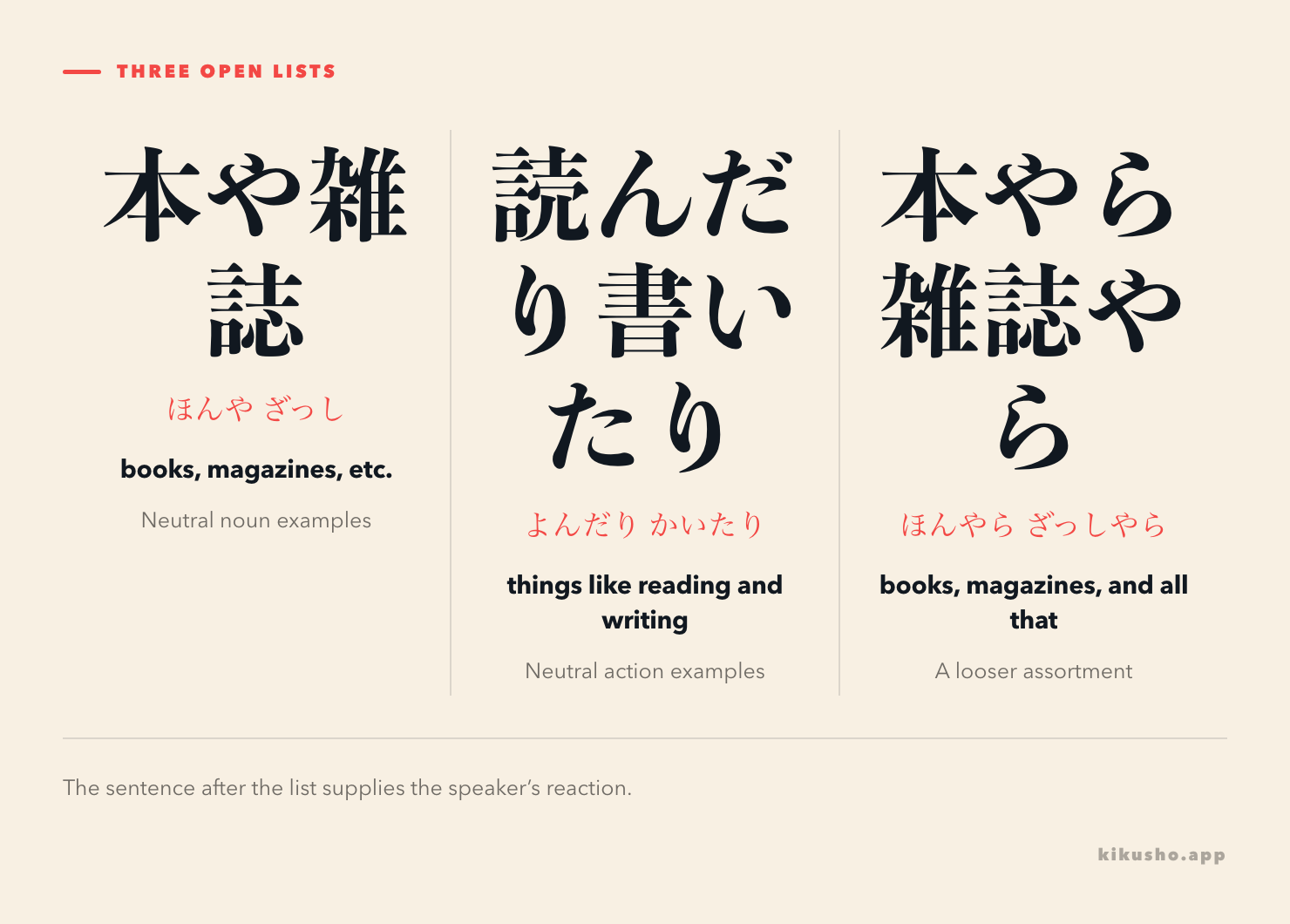
| Sentence | What it does |
|---|---|
| 本や雑誌を箱に入れた | neutral open noun list |
| 本を読んだり、音楽を聞いたりした | neutral examples of activities |
| 本やら雑誌やらを箱に詰めた | samples from a looser assortment |
| 読むやら書くやらで忙しかった | sample actions inside a busy situation |
The と, や, and も lesson covers the ordinary noun-list boundary. The たり~たり lesson shows why its actions use た-form + り and why the final predicate carries tense.
For casual example lists, とか~とか can also be neutral: 週末は映画とかドラマとかを見る. やら~やら makes the group feel less settled or more varied. That difference is a tendency shaped by the sentence, not a rule that とか is always cheerful or やら always negative.
だの sounds more openly critical
だの~だの can also list nouns, clauses, and remarks. It more readily carries impatience, criticism, or distance, especially when repeating somebody's excuses or demands.
彼は時間がないだの、資料が足りないだのと言い訳している。
かれは じかんが ないだの、しりょうが たりないだのと いいわけしている。
He piles up excuses about lacking both time and sufficient materials.
By contrast, 時間がないやら資料が足りないやらで困っている can present the conditions as a mixed set of problems without foregrounding quoted complaints.
The だの~だの and やれ~やれ lesson maps those stronger N1 listing forms. Use it when you need to show who is voicing the claims or how one burden after another is being staged.
のやら~のやら asks which possibility is true
A similar-looking construction uses のやら to present uncertainty between alternatives.
彼が来るのやら来ないのやら、まだ分からない。
かれが くるのやら こないのやら、まだ わからない。
I still do not know whether he is coming or not.
This is not an assortment of representative actions. 来る and 来ない are competing possibilities, and 分からない says the speaker cannot decide which is true.
Compare the boundary directly:
- 泣くやら笑うやらで大騒ぎだった: crying, laughing, and other reactions all occurred in a commotion.
- 泣いているのやら笑っているのやら分からない: the speaker cannot tell whether the person is crying or laughing.
The inserted の nominalizes each possibility, while the final uncertainty expression completes the reading. Do not add の to an ordinary representative list merely because the listed material is a verb.
A useful list has a shared frame, not random variety
The examples should belong to one scene or judgment. 書類やら箱やらで部屋が狭い works because both items contribute to the crowded room. A list such as 書類やら泳ぐやら offers no shared frame unless an unusual context supplies one.
The list also remains grammatically inside the larger sentence. After nouns, attach the case particle once to the end of the series:
倉庫から椅子やら机やらを運び出した。
そうこから いすやら つくえやらを はこびだした。
We carried chairs, desks, and other things out of the storeroom.
Writing 椅子をやら机をやら breaks the normal frame because each noun has been closed with を before やら. Build the listed units first, then let the final particle govern the entire set.
When you save a real やら~やら sentence in Kikusho, keep the result clause with the list. A card containing only 資料を直すやら練習するやら preserves the form but loses the reason the speaker chose it. The full line with ほとんど眠れなかった restores the pressure and makes the marker easier to distinguish from a neutral activity list during review.
Practice: recover the larger scene behind the list
Question 1 — grammar choice. Complete the messy noun list: 床には服__本__が散らかっている。
① やら / やら
② と / と
③ たり / たり
④ のやら / のやら
Question 2 — grammar choice. Which sentence correctly lists sample actions in a busy situation?
- ① 電話したやらメールしたやらで忙しい。
- ② 電話するやらメールを書くやらで忙しい。
- ③ 電話したりやらメールしたりやらで忙しい。
- ④ 電話するのやらメールを書くのやらをした。
Question 3 — sentence composition. Use うれしい, 寂しい, and 複雑な気持ちだ to describe mixed feelings with やら~やら.
Question 4 — grammar choice. Which sentence is the neutral example list of weekend activities?
① 週末は本を読んだり、料理をしたりする。
② 週末は本を読むやら料理するやらで大変だ。
③ 週末は本だの料理だのと文句を言う。
④ 週末は読むのやら読まないのやら分からない。
Question 5 — sentence composition. Make a sentence saying that receipts, notes, and similar things are scattered across the desk. Use 領収書, メモ, and 散らばっている.
Question 6 — text grammar. In 準備やら連絡やらで、朝から落ち着かない, are 準備 and 連絡 the complete list? What does the final predicate contribute?
Question 7 — grammar choice. Choose the sentence that expresses uncertainty between two possibilities rather than an assortment that occurred.
- ① 子どもたちは泣くやら笑うやらで大騒ぎだった。
- ② 子どもが泣いているのやら笑っているのやら分からない。
- ③ 子どもは泣いたり笑ったりして遊んだ。
- ④ 子どもは泣くと笑う。
Answers and explanations
Sort the scene before choosing the marker: the explanations below separate open examples, neutral activities, quoted complaints, and unresolved alternatives.
Answer 1: ①, やら / やら. Each noun takes やら, and が after the second item governs the whole open list. The sentence presents clothes, books, and other things as part of the disorder.
Answer 2: ②, 電話するやらメールを書くやらで忙しい. The target construction takes dictionary-form verbs 電話する and 書く. Choice ① incorrectly uses past forms; ③ mixes two constructions; ④ uses のやら without a coherent uncertainty predicate.
Answer 3: うれしいやら寂しいやらで、複雑な気持ちだ。 Both plain i-adjectives take やら directly. The final predicate names the mixed emotional result.
Answer 4: ①. 読んだり、料理をしたりする neutrally gives example activities. Choice ② is grammatical but frames the actions as part of a difficult assortment; ③ creates a complaint-report setting; ④ presents uncertainty about whether reading occurs.
Answer 5: 机の上には、領収書やらメモやらが散らばっている。 Build the noun list first, then attach が once after the second やら.
Answer 6: They are representative examples, not necessarily the complete list. 朝から落ち着かない shows the speaker's resulting restlessness and helps the assorted preparations and messages feel like an unsettled workload.
Answer 7: ②. Repeated のやら presents crying and laughing as alternatives the speaker cannot distinguish, and 分からない completes that uncertainty. Choice ① says both kinds of reaction formed a commotion; ③ is a neutral action list.
When a translation offers only “A and B,” look past the conjunction. The repeated やら says that A and B are samples, and the rest of the sentence tells you whether the unnamed remainder felt messy, demanding, delightful, or hard to read.
Common questions
What does やら~やら mean in Japanese?
やら~やら lists representative examples from a larger, loosely bounded set: “things like A and B” or “A, B, and so on.” It often appears when the whole situation feels busy, disorderly, difficult, or emotionally mixed.
What can come before やら?
The core N2 pattern takes nouns, dictionary-form verbs, and plain i-adjectives directly: 本やら服やら, 電話するやら片づけるやら, and うれしいやら寂しいやら.
What is the difference between やら~やら and たり~たり?
たり~たり forms a neutral example list from past-form bases and closes with する or another predicate. やら~やら uses dictionary-form verbs and often presents the examples as part of a larger, less orderly situation.
Is やら~やら always negative?
No. It can simply mark a loose representative list. Negative, troublesome, or complicated contexts are common, but the surrounding predicate determines whether the speaker sounds burdened, amused, pleased, or merely descriptive.