On this page
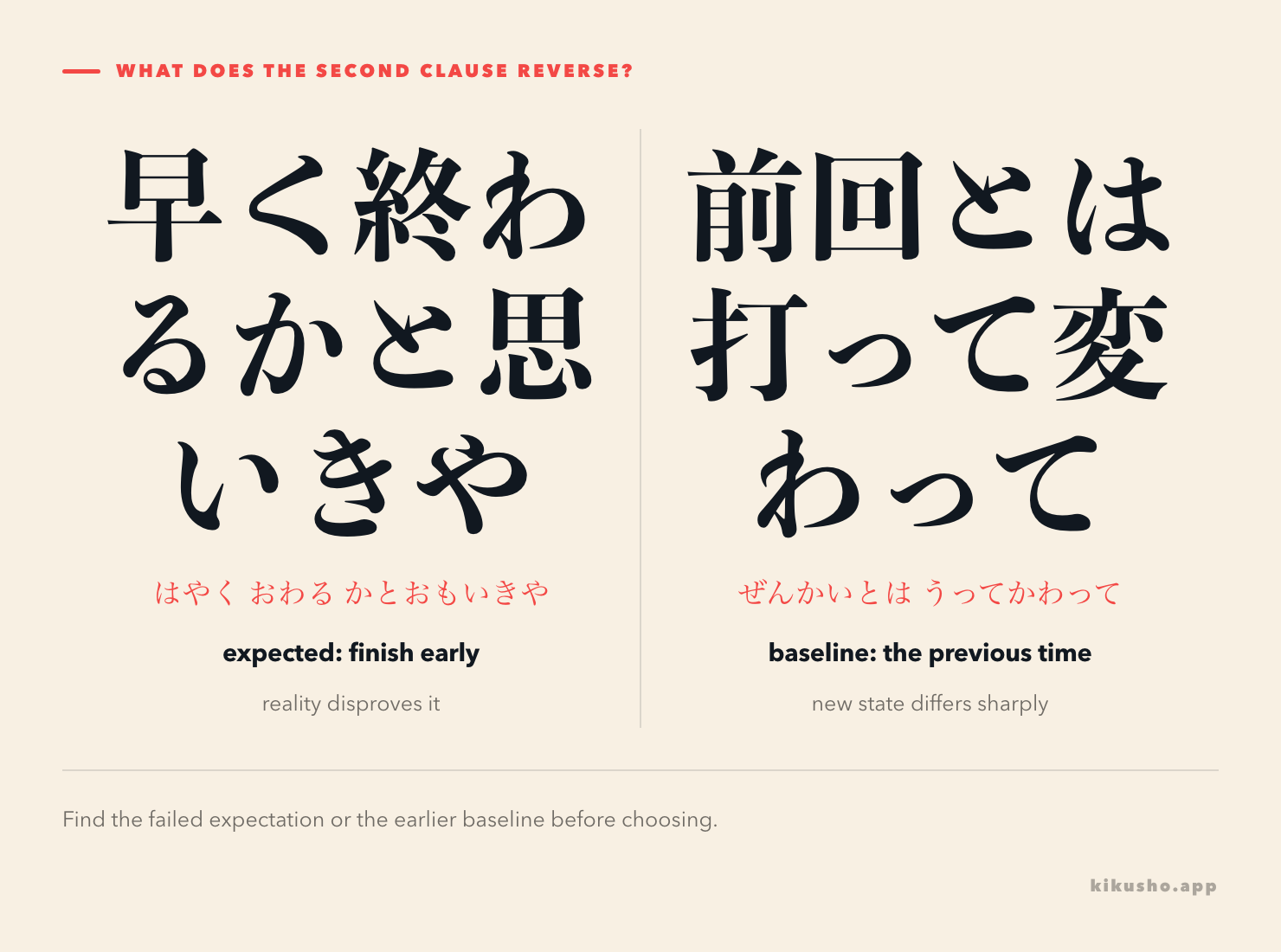
These forms reverse different things. かと思いきや overturns what someone expected; とは打って変わって places a new state against an earlier baseline and stresses how thoroughly it has changed.
会議はすぐ終わるかと思いきや、三時間も続いた。前回とは打って変わって、今回は意見が激しく対立した。
かいぎは すぐ おわるかとおもいきや、さんじかんも つづいた。ぜんかいとは うってかわって、こんかいは いけんが はげしく たいりつした。
I expected the meeting to end quickly, but it lasted three hours. In sharp contrast to the previous meeting, opinions clashed intensely this time.
The first reversal needs a mental forecast. The second only needs two comparable states. If you can point to the expectation that failed, choose かと思いきや; if you can name the old version after とは, choose とは打って変わって.
This lesson covers g-218bc4a565e3, かと思いきや, and g-a7020ffe304c, とは打って変わって/とは打って変わり. JLPT Sensei places both at N1. Benri Japan also labels 思いきや N1, while some teaching sites place it at N2 or outside the numbered levels. No official inventory settles those provider labels: the test organization does not release a complete grammar syllabus.
One form breaks a prediction; the other replaces a comparison point
| Question to ask | Choose | Relationship |
|---|---|---|
| What did someone expect, and what proved it wrong? | A かと思いきや B | expectation → contrary fact |
| What earlier time, state or version is B unlike? | N とは打って変わって B | baseline → strikingly different state |
かと思いきや contains a viewpoint. The reader first accepts A as a plausible belief, then B removes it. とは打って変わって can stay entirely descriptive: last week was warm; this week is bitterly cold. Nobody needs to have predicted the weather incorrectly.
The two forms may describe the same event from different angles:
新作も静かな物語かと思いきや、激しいアクション映画だった。
I assumed the new work would also be a quiet story, but it was an intense action film.
前作とは打って変わって、新作は激しいアクション映画だ。
In sharp contrast to the previous work, the new one is an intense action film.
The first sentence stages the speaker's mistaken assumption. The second compares two works directly.
かと思いきや makes the expectation clause part of a reveal
The common frames are:
| Base before the expression | With か | Without か |
|---|---|---|
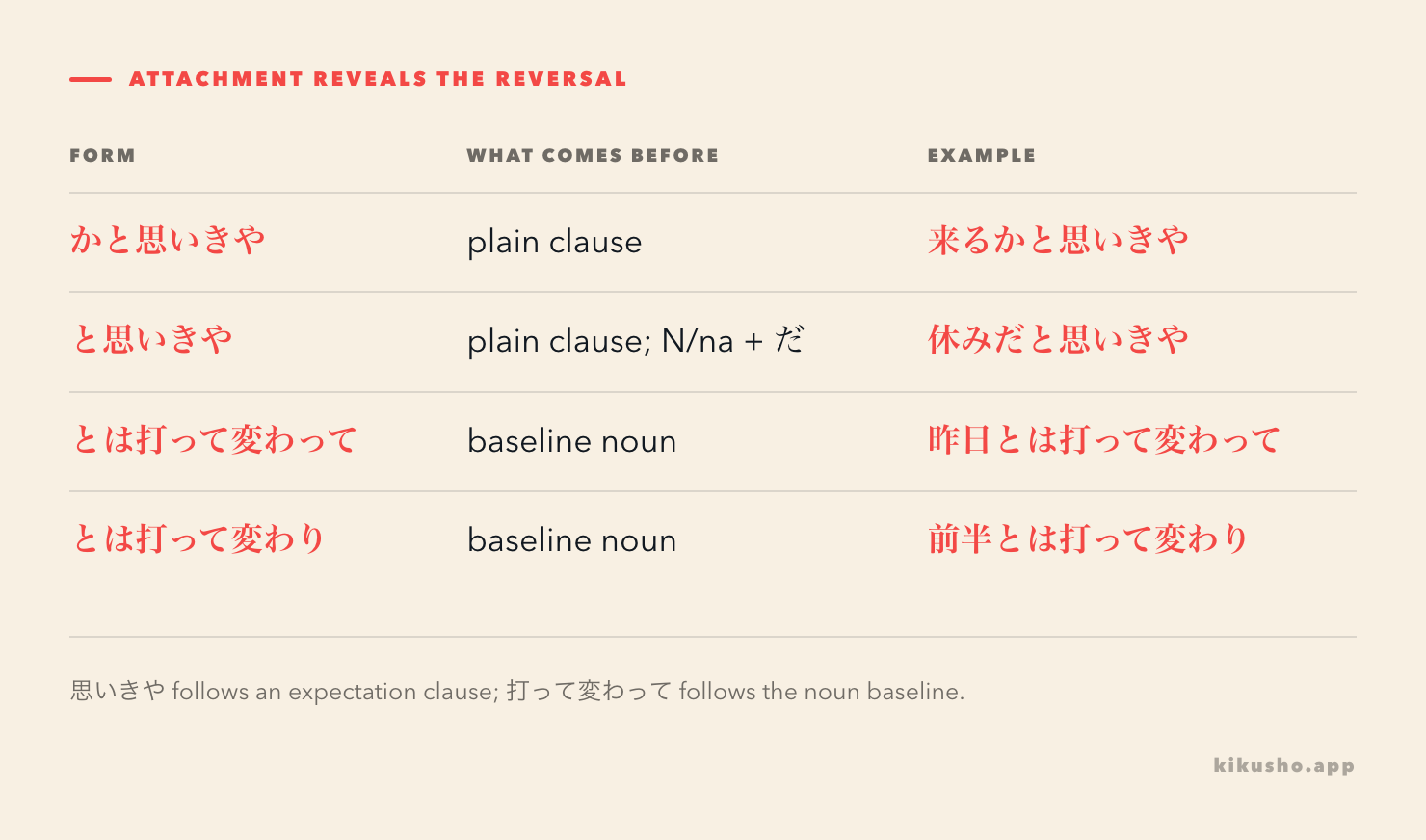
| verb | 来るかと思いきや | 来ると思いきや |
| i-adjective | 難しいかと思いきや | 難しいと思いきや |
| na-adjective | 静かかと思いきや | 静かだと思いきや |
| noun | 休みかと思いきや | 休みだと思いきや |
新しい制度で手続きが簡単になるかと思いきや、入力項目が前より増えていた。
あたらしい せいどで てつづきが かんたんに なるかとおもいきや、にゅうりょくこうもくが まえより ふえていた。
I expected the new system to simplify the procedure, but it had more fields than before.
Clause A must be plausible as an expectation. Clause B then supplies the fact that defeats it. A mere unrelated continuation does not complete the pattern:
新しい制度で簡単になるかと思いきや、説明会に参加した。△
Attending an explanation session does not by itself prove the system difficult. Replace B with evidence such as かえって作業が増えた, “the work increased instead.”
Benri Japan describes the form as a subjective inference overturned by an objective fact and notes its written, literary force. Janguage independently documents both the version with か and the version without it, including N/na-adjective + だと思いきや when か is absent.
The following clause normally reports what proved true. A command, invitation or intention does not serve as the surprising evidence:
雨が降るかと思いきや、傘を持って行こう。×
Here 傘を持って行こう is a decision, not the reality that overturned the forecast. 雨が降るかと思いきや、雲が切れて晴れた completes the reveal.
The surprise is logical, not necessarily immediate
かと思いきや does not require B to happen one second after A. The expectation may survive for days before later facts overturn it.
交渉は一日でまとまるかと思いきや、合意まで一か月かかった。
こうしょうは いちにちで まとまるかとおもいきや、ごういまで いっかげつ かかった。
The negotiations looked likely to conclude in a day, but agreement took a month.
By contrast, Vたかと思ったら often foregrounds a rapid observed change:
子どもは泣いたかと思ったら、もう笑っている。
The child had just started crying, and then was already laughing.
The かと思ったら and か~ないかのうちに lesson develops that timing boundary. The N1 思いきや form needs a contradicted expectation, even when the contradiction arrives immediately. Its slightly literary rhythm makes it useful in essays, news commentary and anecdotes where the writer deliberately leads the reader toward a false conclusion.
とは打って変わって attaches to the baseline being replaced
The structure is compact:
N + とは打って変わって/とは打って変わり + new state
The noun identifies the earlier comparison point. Time words, previous versions, phases and habitual states fit naturally:
| Baseline | New description |
|---|---|
| 昨日とは打って変わって | 今日は暖かい |
| 前半とは打って変わり | 後半は攻撃的だった |
| 以前とは打って変わって | 彼はよく話すようになった |
| いつもとは打って変わり | 厳しい表情を見せた |
前半とは打って変わり、後半は両チームが積極的に攻めた。
ぜんはんとは うってかわり、こうはんは りょうチームが せっきょくてきに せめた。
In sharp contrast to the first half, both teams attacked aggressively in the second.
The baseline does not have to be a time expression. 前作, 行き, 普段 and いつも can all supply a recognizable earlier state. What matters is that the new description belongs on the same comparison axis.
Japanese Language Education explains that both 打って変わって and 打って変わり follow a noun and gives previous times and events as typical anchors. JLPT Sensei likewise describes a complete change from an earlier time or state. The variant 打って変わり is the continuative stem. It connects more tightly and often feels at home in concise written narration; the core meaning does not change.
A small difference is too weak for 打って変わって
The expression announces a striking contrast. If yesterday was 20°C and today is 19°C, 昨日とは打って変わって exaggerates the change unless the context makes that one degree meaningful.
昨日とは打って変わって、今日は雪が降っている。○
昨日より、今日は一度だけ気温が低い。○
The second sentence needs an ordinary comparison with より, not a dramatic reset. Likewise, two unrelated objects do not automatically form a before-and-after pair. 東京とは打って変わって、この本は難しい fails because the sentence gives no shared property on which a city and a book could contrast.
The form also differs from に反して. 予想に反して explicitly says reality violated a forecast, while 前回とは打って変わって says the new state differs from the old one. The に反して and にしては lesson separates contrary results from judgments against a category.
The surrounding sentence reveals which reversal matters
Three clues settle most difficult cases:
- A thinking verb or implied forecast: words such as さぞ, てっきり, 当然 or an obviously plausible assumption support 思いきや.
- A named earlier point: 昨日, 前回, 以前, 前半 or いつも before とは supports 打って変わって.
- The kind of B clause: evidence that disproves A completes 思いきや; a description on the same axis as the baseline completes 打って変わって.
Do not decide from the English word “but.” Ordinary が, のに, ところが and 一方で cover many contrasts without the special structure of either N1 form. These two earn their place only when the text supplies the failed prediction or the replaced baseline.
For a Kikusho card, keep both sides of the reversal. With 思いきや, label the assumption and the fact that broke it. With 打って変わって, underline the baseline noun and the property that changed. The review cue then preserves the relation that a short gloss such as “contrary to expectations” cannot show.
Practice: locate the expectation or the baseline
Question 1 — grammar choice. Complete the failed prediction: 新商品はすぐ売り切れる__、一週間たっても在庫が残っていた。
① かと思いきや
② とは打って変わって
③ か否か
④ や否や
Question 2 — grammar choice. Complete the comparison: 前回__、今回の発表は落ち着いた雰囲気だった。
① かと思いきや
② とは打って変わって
③ と思うと
④ に限って
Question 3 — build the reversal. Combine 簡単だ, と思いきや, and 複雑だった so that the first judgment fails.
Question 4 — text grammar. In 春になれば暖かくなるかと思いきや、四月に入って雪が降った, what is the expectation, and what fact defeats it?
Question 5 — grammar choice. Which sentence uses とは打って変わって naturally?
- ① 昨日とは打って変わって、今日は朝から激しい雪だ。
- ② 東京とは打って変わって、この辞書は厚い。
- ③ 昨日とは打って変わって、今日は一度だけ低い。
- ④ 晴れるとは打って変わって、傘を買った。
Question 6 — grammar choice. Which sentence is chiefly about a rapid observed sequence rather than a disproved forecast?
- ① 赤ちゃんは泣いたかと思ったら、もう笑っていた。
- ② 会議は短いかと思いきや、三時間続いた。
- ③ 前半とは打って変わり、後半は静かだった。
- ④ 簡単だと思いきや、専門知識が必要だった。
Question 7 — sentence composition. Rewrite 前回と違って、今回は全員が賛成した with とは打って変わって.
Answers and explanations
Walkthrough 1
① かと思いきや. The plausible expectation is that the product will sell out quickly. Remaining stock a week later disproves it. や否や marks immediate sequence, and か否か embeds a yes-or-no question.
Walkthrough 2
② とは打って変わって. 前回 is a noun naming the earlier baseline, and the present atmosphere differs sharply from it. 思いきや would require a clause that states an expectation.
Walkthrough 3
簡単だと思いきや、実際は複雑だった。 Without か, the na-adjective uses だ before 思いきや. The second clause presents the reality that overturns the first judgment.
Walkthrough 4
The expectation is 春になれば暖かくなる, that spring will bring warmer weather. 四月に入って雪が降った is the observed fact that defeats that forecast. The reversal is logical, not merely a quick sequence.
Walkthrough 5
①. Yesterday and today are comparable time baselines, and clear weather versus heavy snow is a striking change. Choice ② lacks a shared comparison axis, ③ is too small a contrast as written, and ④ incorrectly puts a finite prediction where the pattern needs a baseline noun.
Walkthrough 6
①. 泣いたかと思ったら presents crying followed almost immediately by laughter. Choices ② and ④ overturn expectations; choice ③ compares the second half with the first.
Walkthrough 7
前回とは打って変わって、今回は全員が賛成した。 前回 supplies the baseline before とは, and the unanimous agreement describes the sharply different present result.
In a dense reading passage, circle the material before the marker. A full proposition points toward an expectation waiting to fail. A noun such as 前回 or 以前 gives you the old state that the next description will replace.
Common questions
What is the difference between かと思いきや and とは打って変わって?
かと思いきや sets up an expectation and reveals a contrary reality. とは打って変わって names an earlier time, state or version as a baseline and says that the new one is strikingly different.
Can か be omitted from かと思いきや?
Yes. Both かと思いきや and と思いきや occur. With か, nouns and na-adjectives can appear directly before it; without か, they normally use だ before と思いきや.
Is かと思いきや the same as かと思ったら?
No. かと思いきや centres on an expectation disproved by reality and has a literary, dramatic tone. かと思ったら often presents one observed event followed quickly by another surprising scene.
What is the difference between 打って変わって and 打って変わり?
The meaning is the same. 打って変わって uses the te-form to connect to the new description, while 打って変わり uses the continuative stem and is especially at home in compact written narration.