On this page
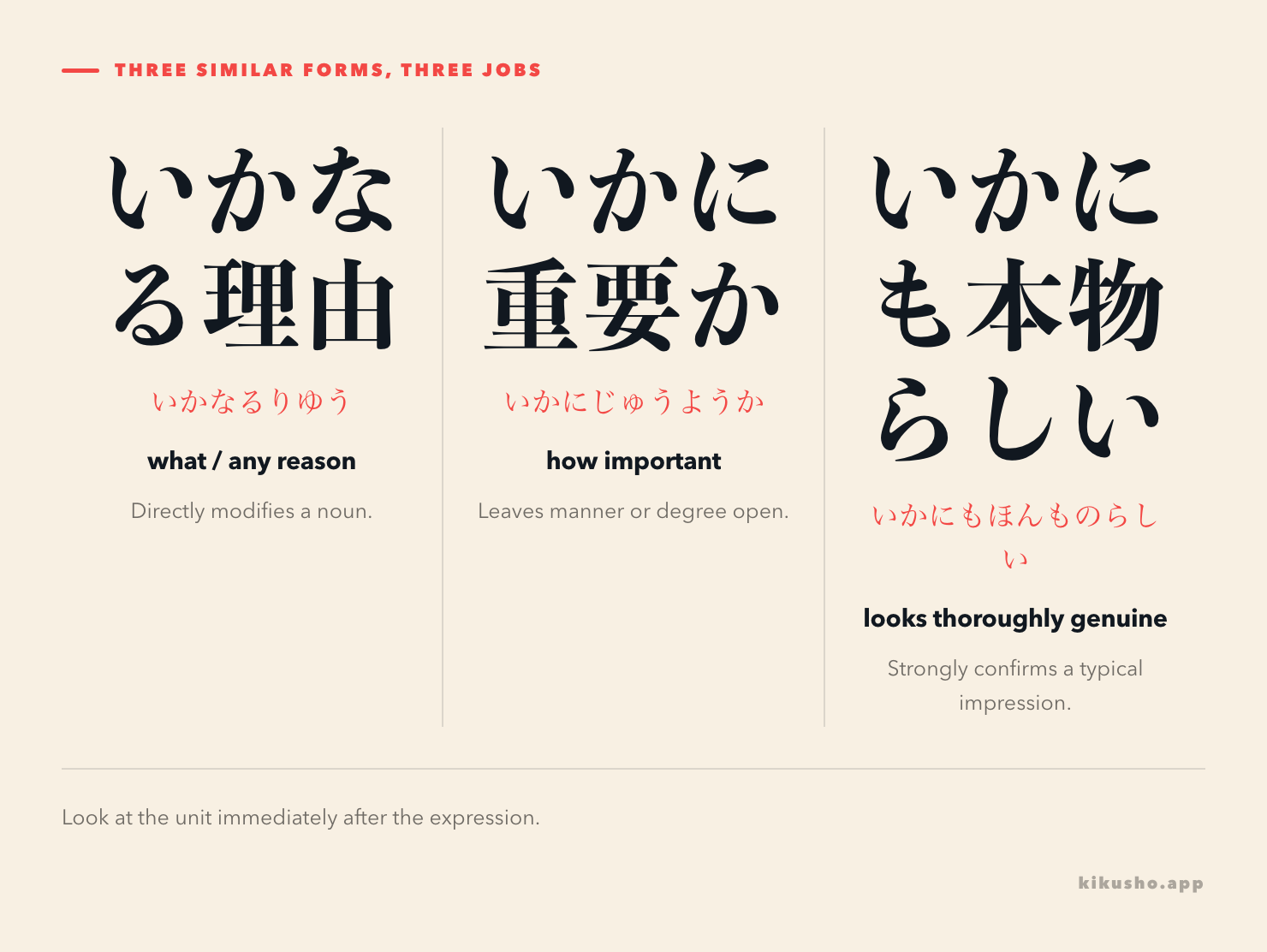
Three similar-looking forms divide three different jobs. いかなる stands before a noun, いかに asks “how?” or “to what degree?”, and いかにも says that something is indeed so or fits an expected image perfectly.
調査では、事故がいかなる状況で起き、原因がいかに広がり、現場がいかにも危険そうに見えたのかを確認した。
ちょうさでは、じこがいかなるじょうきょうでおき、げんいんがいかにひろがり、げんばがいかにもきけんそうにみえたのかをかくにんした。
The investigation checked under what circumstances the accident occurred, how the cause spread, and why the site looked unmistakably dangerous.
The spellings overlap because the expressions share a history. Their present sentence positions give a more reliable test than translating each one with a loose English “how.”
First ask what comes immediately after the form
| Form | Immediate attachment | Main job |
|---|---|---|
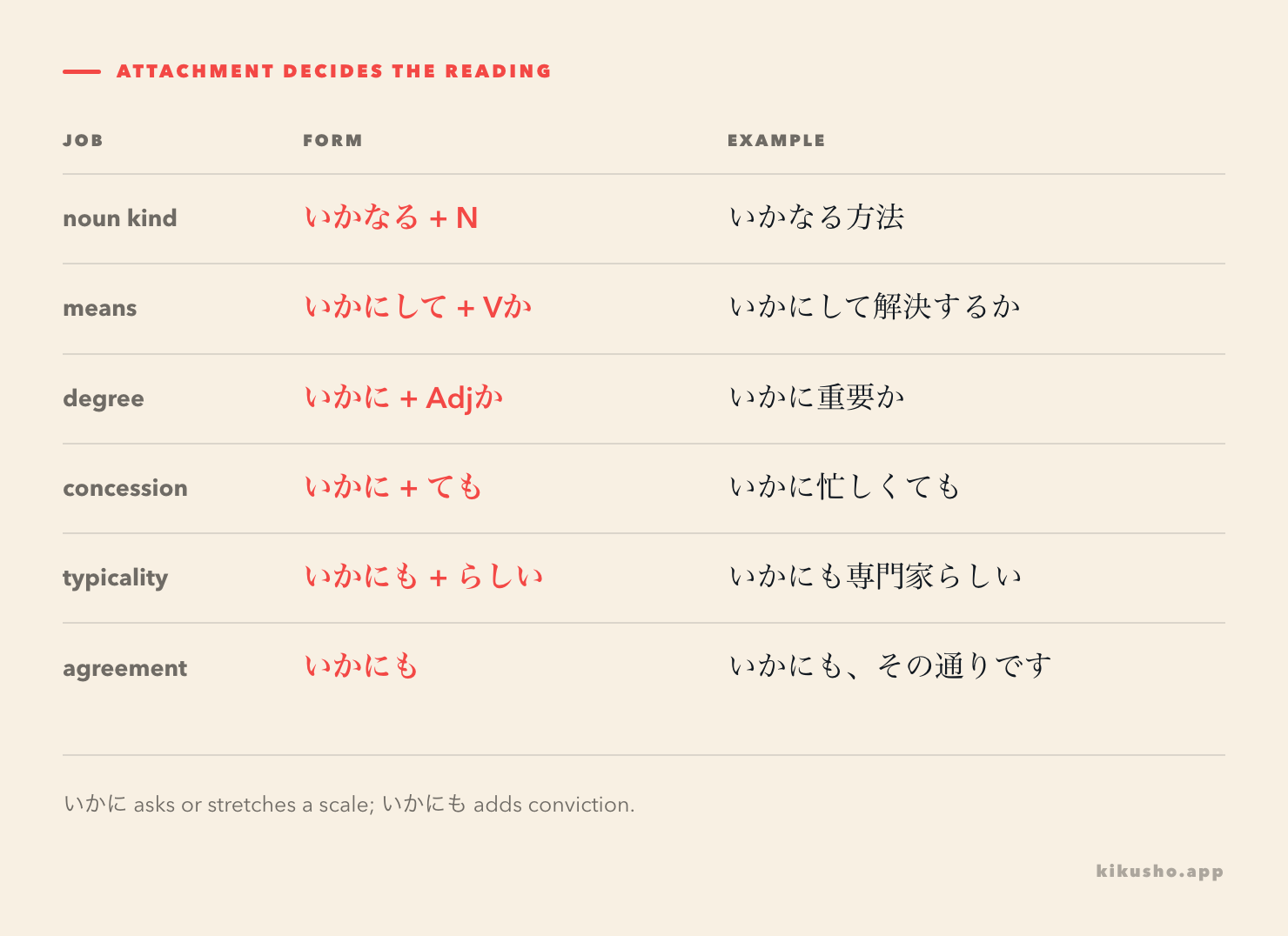
| いかなる + noun | いかなる理由 | selects or ranges over a kind of noun |
| いかに + clause | いかに重要か | asks or emphasizes manner and degree |
| いかに + concessive predicate | いかに忙しくても | makes the result hold however extreme A becomes |
| いかにも + description | いかにも本物らしい | emphatically matches an appearance or expectation |
Only いかなる behaves like a prenominal modifier. Only いかにも has the common modern reading “indeed” or “exactly as one would expect.” いかに keeps the open question about manner or degree.
JLPT Sensei lists the three forms separately at N1 and gives their distinct roles: noun modification for いかなる, manner or degree for いかに, and emphatic truth or likeness for いかにも. Digital Daijisen independently records いかに as an adverb for manner, degree and strengthened concession and いかにも as emphatic conviction, agreement or typicality.
いかなる puts a formal “what kind of” before a noun
The formation is fixed:
いかなる + noun
委員会は、いかなる方法を採るべきか検討している。
いいんかいは、いかなるほうほうをとるべきかけんとうしている。
The committee is considering what approach it should take.
Here いかなる方法 is a formal version of どのような方法 or, depending on context, どんな方法. It belongs naturally in reports, policy language, formal questions and literary prose. In relaxed conversation, the modern alternatives usually sound less ceremonious.
The same form often receives a universal reading when the rest of the sentence removes exceptions:
いかなる理由があっても、記録を改ざんしてはならない。
いかなるりゆうがあっても、きろくをかいざんしてはならない。
Whatever the reason, the records must not be altered.
当社はいかなる第三者にも個人情報を提供しません。
とうしゃはいかなるだいさんしゃにもこじんじょうほうをていきょうしません。
Our company will not provide personal information to any third party.
The ても, にも and negative predicates help create “whatever,” “any” or “no” in translation. いかなる itself still modifies the noun. Bunpro verifies the formal register, direct noun attachment and both interrogative and no-exception readings. JLPT Sensei likewise records the frequent いかなる場合でも pattern.
いかに opens a formal question about manner or degree
いかに functions adverbially. It can ask how something is done:
限られた予算でいかにして質を保つかが課題だ。
かぎられたよさんでいかにしてしつをたもつかがかだいだ。
The challenge is how to maintain quality with a limited budget.
いかにして emphasizes means or method. In an embedded question, the clause commonly closes with か. A direct conversational どうやって質を保つの? asks much the same basic question in a different register.
The open scale can instead concern degree:
この記録は、初期の判断がいかに重要だったかを示している。
このきろくは、しょきのはんだんがいかにじゅうようだったかをしめしている。
This record shows just how important the initial judgment was.
Nothing is being selected before a noun. 重要だった supplies the degree whose magnitude the sentence highlights. JLPT Sensei's いかに entry documents both the manner question and the いかに~か degree frame.
With a concessive ending, the scale can stretch without changing the result:
いかに忙しくても、最終確認を省いてはならない。
いかにいそがしくても、さいしゅうかくにんをはぶいてはならない。
No matter how busy you are, you must not omit the final check.
いかに技術が進歩しようと、判断の責任は人に残る。
いかにぎじゅつがしんぽしようと、はんだんのせきにんはひとにのこる。
However far technology advances, responsibility for judgment remains with people.
This is the formal relative of どんなに~ても. The どんなに, いくら and たとえ lesson explains the ordinary degree, amount and hypothetical cues. いかに shifts the degree frame toward written argument, public speech and elevated commentary.
いかにも confirms that the impression fits
In its common modern use, いかにも is not an open “how?” It adds conviction: the description fits the object strikingly well.
その説明はいかにも専門家らしく、要点が整理されていた。
そのせつめいはいかにもせんもんからしく、ようてんがせいりされていた。
The explanation was thoroughly characteristic of an expert, with its main points well organized.
古い箱はいかにも重そうだったが、中は空だった。
ふるいはこはいかにもおもそうだったが、なかはからだった。
The old box looked for all the world as though it were heavy, but it was empty.
Common partners include らしい, そうだ, ようだ and descriptive predicates. いかにも学生らしい says the person strongly matches an image associated with a student. It does not ask to what degree the person is a student.
As a response, いかにも can strongly confirm another person's statement:
「あなたがこの報告書を書いたのですか。」
「いかにも、私が書きました。」
“Did you write this report?” “Indeed, I did.”
This answer is stiff, emphatic and sometimes theatrical in present-day conversation. A neutral exchange would more often use はい、そうです. Bunpro's dictionary entry for いかにも records both the adverbial “truly, just like” reading and the interjection of firm agreement.
One added も closes the question instead of widening it
Compare the pair:
その作業がいかに難しいか、担当者に聞いた。
I asked the person in charge how difficult the task was.
その作業はいかにも難しそうだ。
The task certainly looks difficult.
The first sentence leaves degree open and embeds it under か. The second commits to a strong appearance. Treating も as a detachable decoration would miss the change in stance.
The same principle separates いかなる人 from both. It asks or ranges over a kind of person, and the noun 人 must immediately follow. Forms such as いかに人 and いかにも人 cannot replace it.
The そう, よう, らしい and みたい comparison supplies the evidence markers that frequently follow いかにも. Here the target is the adverb's conviction that the evidence matches a recognizable type.
Formality is part of the meaning you deliver
The inventory and all inspected JLPT teaching references place these three items at N1. Digital Daijisen confirms that the uses themselves belong to standard Japanese beyond exam preparation. The JLPT publishes no exhaustive grammar list, so N1 remains a supported study estimate rather than an official inventory.
Register still differs within the family. いかなる and question-forming いかに are strongly at home in formal prose. Descriptive いかにも appears in speech as well, especially when someone wants a vivid “that is so like X” judgment. Its stand-alone agreement use sounds markedly formal.
For a Kikusho card, keep the expression after the target. いかなる needs its noun, いかに needs the clause that defines manner or degree, and いかにも needs the description being endorsed. The visible attachment is a better recall cue than three English glosses beginning with “how.”
Practice
Seven questions come first. The shared disclosure below contains every solution and explanation.
Question 1 — noun attachment
Choose the form that means “under any circumstances” in this formal rule.
____状況でも、非常口をふさいではならない。
ア. いかに
イ. いかなる
ウ. いかにも
エ. いかにして
Question 2 — degree in an embedded question
Complete the sentence meaning “The data shows how serious the shortage is.”
このデータは、人手不足が____深刻かを示している。
ア. いかなる
イ. いかに
ウ. いかにも
エ. いかなるに
Question 3 — a typical appearance
The building strongly looks like an old school. Choose the best expression.
その建物は____昔の学校らしい外観だ。
ア. いかなる
イ. いかにして
ウ. いかにも
エ. いかに~ても
Question 4 — arrange the formal method question
Arrange every part to mean “The issue is how to reduce the burden on staff.”
__ __ __ __。
- 課題だ
- 職員の負担を
- いかにして
- 減らすかが
Question 5 — no matter how
Choose the pair that makes the conclusion hold despite any amount of careful explanation.
____丁寧に説明し____、全員の同意を得るのは難しい。
ア. いかなる/ても
イ. いかに/ても
ウ. いかにも/か
エ. いかにして/らしい
Question 6 — repair the attachment
Correct the underlined words while keeping the meaning “We must prepare for any outcome.”
いかに結果にも備えなければならない。
Question 7 — choose all three in context
審査では、応募者が( ① )経験を持つか、その経験を( ② )生かすかを確認する。田中さんの説明は具体的で、( ③ )実務家らしかった。
ア. ①いかなる / ②いかに / ③いかにも
イ. ①いかに / ②いかにも / ③いかなる
ウ. ①いかにも / ②いかなる / ③いかに
エ. ①いかなるに / ②いかにしても / ③いかなる
Answers and explanations
Walkthrough 1
イ. いかなる. The target directly modifies 状況, creating the formal noun phrase いかなる状況. でも then removes exceptions across possible circumstances.
Walkthrough 2
イ. いかに. いかに深刻か embeds an open question about degree: the data reveals just how serious the shortage is. いかにも深刻 would assert that it certainly appears serious instead.
Walkthrough 3
ウ. いかにも. The phrase いかにも昔の学校らしい says the appearance matches the expected image of an old school. No noun is waiting directly after the blank, and the sentence is not asking about a method.
Walkthrough 4
3 → 2 → 4 → 1: いかにして職員の負担を減らすかが課題だ。 いかにして opens the formal question of means, か closes the embedded question, and が課題だ evaluates that whole question.
Walkthrough 5
イ. いかに/ても. いかに丁寧に説明しても stretches the degree of careful explanation while the difficulty of obtaining unanimous agreement remains. The other pairs either violate attachment or change the sentence into a different stance.
Walkthrough 6
Use いかなる結果にも備えなければならない. いかなる must sit directly before the noun 結果; the particle にも follows the complete noun phrase.
Walkthrough 7
ア. ①いかなる / ②いかに / ③いかにも. The first blank modifies 経験. The second asks how the applicant uses that experience. The third commits to the impression that Tanaka's concrete explanation was thoroughly characteristic of a practitioner.
The family becomes easier when you stop memorizing three definitions and inspect the next grammatical unit. A noun, an open clause and a confirmed description lead to three different choices.
Common questions
What is the difference between いかなる, いかに and いかにも?
いかなる modifies a following noun, いかに asks about manner or degree and can introduce “no matter how,” while いかにも strongly affirms something or marks it as exactly matching a typical appearance.
What comes after いかなる?
A noun follows directly, as in いかなる理由, いかなる場合 and いかなる方法. Particles belong after that noun phrase, not between いかなる and the noun.
How is いかに used with か?
In formal indirect questions, いかに can mark manner or degree before a clause ending in か, as in いかに重要か and いかにして解決するか.
Does いかにも mean “how”?
Usually no in modern Japanese. いかにも commonly means “indeed,” expresses firm agreement, or emphasizes that something looks or sounds exactly as expected, often with らしい or そうだ.