On this page
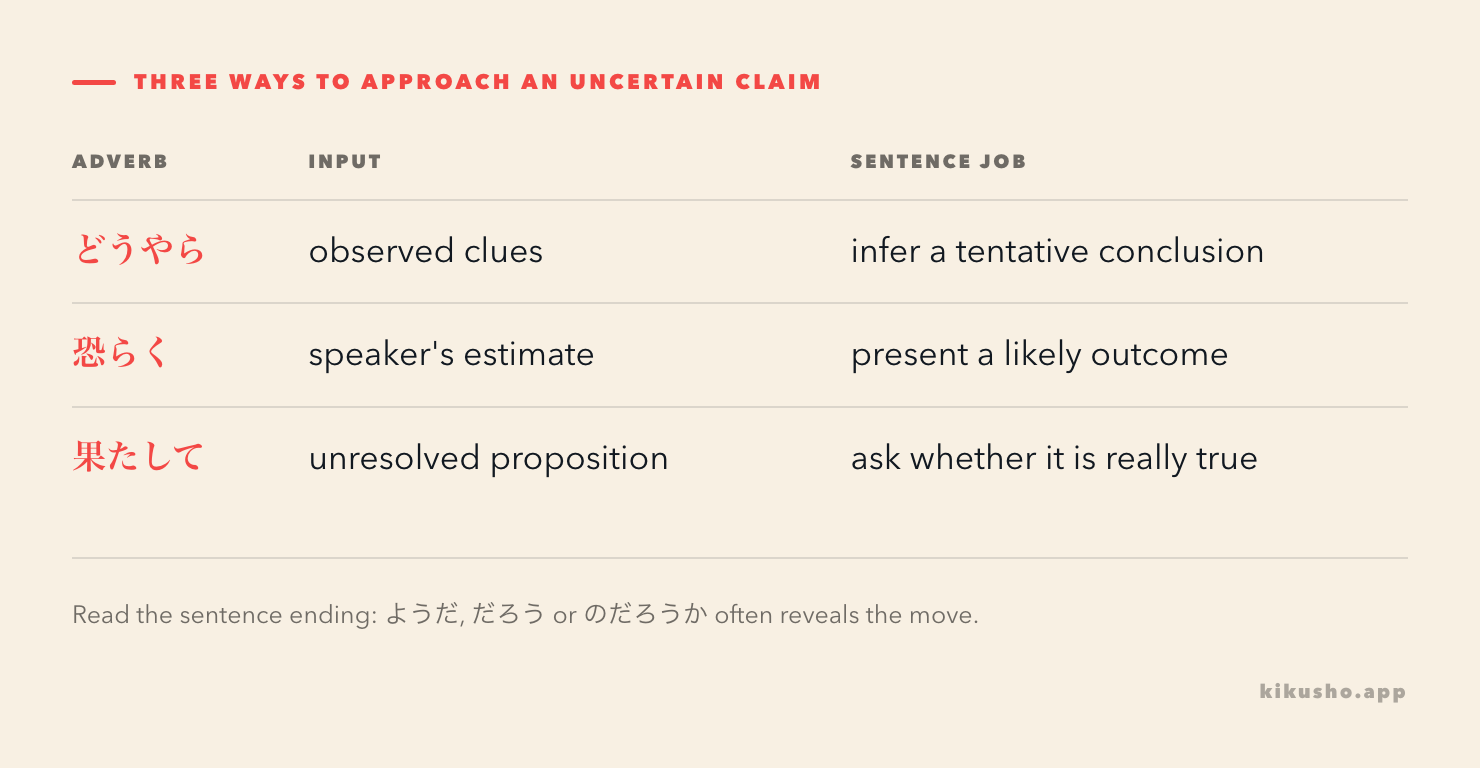
A few clues point toward a conclusion, a forecast feels likely, and one decisive question remains. Japanese gives those three mental moves different adverbs: どうやら for a conclusion emerging from evidence, 恐らく(おそらく) for a probability estimate, and 果たして(はたして) for asking whether the proposition really holds.
The test: clue, estimate or open question?
Choose by asking what the sentence is doing before you translate the adverb.
| Sentence job | Choose | Natural partners | Core effect |
|---|---|---|---|
| infer a conclusion from signs or context | どうやら | ようだ, らしい, みたいだ, そうだ | “the clues seem to indicate...” |
| state what the speaker considers likely | 恐らく | だろう, でしょう, と思う | “probably, in all likelihood” |
| examine whether a claim is really true | 果たして | だろうか, でしょうか, のか | “will it really...?” |
All three are adverbs. They usually modify the whole proposition rather than attach to one conjugated form:
- どうやら + conclusion: どうやら道を間違えたようだ
- 恐らく + estimate: 恐らく一時間はかかるだろう
- 果たして + question: 果たして間に合うのだろうか
The final expression in the clause often reveals the choice. A sentence ending in ようだ presents an appearance or inference. だろう leaves an estimate open. のだろうか turns the proposition into something the speaker is examining rather than asserting.
どうやら lets the clues form a conclusion
Use どうやら when available signs or surrounding information lead you toward a tentative reading of the situation.
ホームに人が集まっている。どうやら電車が遅れているようだ。
ホームに ひとが あつまっている。どうやら でんしゃが おくれているようだ。
People are gathering on the platform. It seems the train is delayed.
The crowd is the clue. The speaker has not merely chosen a probability in the abstract; they are interpreting what they can observe.
どうやら frequently appears with ようだ, らしい, みたいだ or そうだ. Bunpro's どうやら reference describes these pairings and treats the adverb as strengthening a tentative inference. Kotobank records the same uncertain “apparently” sense.
The dictionary also lists a different meaning: どうやら完成した can mean “somehow managed to finish” or “finished after a fashion.” That is the なんとか sense. This lesson teaches the inference use; do not assume every どうやら introduces a guess.
恐らく states a likely estimate
Use 恐らく, commonly written おそらく, when the speaker presents an outcome or explanation as likely.
復旧には恐らく一時間以上かかるでしょう。
ふっきゅうには おそらく いちじかんいじょう かかるでしょう。
Restoration will probably take more than an hour.
The speaker is estimating the duration. Evidence may support the estimate, but 恐らく does not itself point to a particular visible clue. Its contribution is the speaker's degree of commitment.
Kotobank's entry for 恐らく describes a high-confidence supposition and gives the familiar pairing with だろう. The word is somewhat more formal than everyday たぶん, yet both can express “probably.” The earlier たぶん, おそらく and きっと comparison develops that probability ladder and explains why no fixed percentage belongs to any of them.
The kanji 恐 does not make the prediction frightening. 恐らく成功するでしょう is a favorable forecast. Kana is common, and the pronunciation remains おそらく in either spelling.
果たして holds the proposition up for examination
In its question use, 果たして asks whether something is really the case. It often works with だろうか, でしょうか, のか, かどうか or a question word.
果たして今日中に運転を再開できるのだろうか。
はたして きょうじゅうに うんてんを さいかいできるのだろうか。
Will service really be able to resume today?
This is not a prediction that resumption is likely. The speaker places the claim under scrutiny. The adverb can sound reflective, rhetorical or skeptical, so it is common in essays, commentary, headlines and narrated questions.
Bunpro verifies both the question pattern and its frequent partners. Kotobank distinguishes the doubt-strengthening question use from the affirmative “as expected” use.
That second use reverses the surface mood:
雨になると言われていたが、果たして午後から降り出した。
あめに なると いわれていたが、はたして ごごから ふりだした。
Rain had been forecast, and sure enough it began in the afternoon.
Here the result confirms what was expected. Read the sentence ending before deciding whether 果たして opens doubt or closes it.
One delay can produce three different sentences
Hold the train situation steady and change the speaker's mental move:
アナウンスがなく、人が増えている。どうやら電車が遅れているようだ。
There is no announcement and the crowd is growing. The clues suggest a delay.
事故の影響なら、恐らく一時間は動かないだろう。
If this is because of the accident, the train will probably not move for an hour.
果たして終電までに復旧するのだろうか。
Will service really recover before the last train?
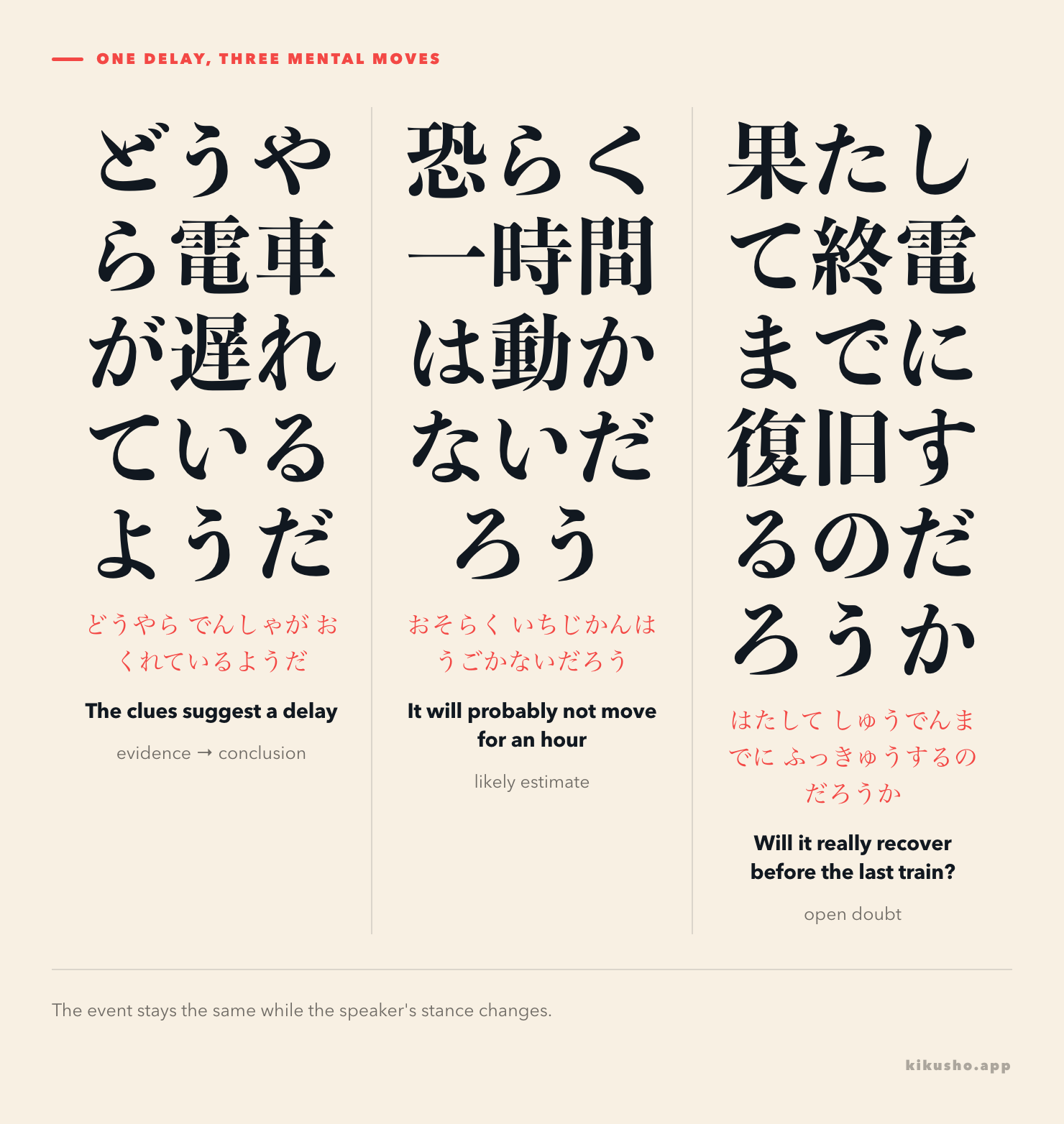
The first conclusion leans on current signs. The second predicts a likely duration. The third refuses to settle the outcome. That is why replacing one adverb with another can produce a grammatical sentence while changing its logic.
This also separates the trio from sentence-final uncertainty. かもしれない and でしょう shape how a proposition is presented at the end of the clause; the かもしれない and でしょう lesson compares those endings directly. The adverbs here tell you why or how the speaker approaches the proposition before the ending lands.
When a sentence is worth saving in Kikusho, keep the evidence or ending with the adverb. A card containing only どうやら = apparently removes the clue-to-conclusion relation. どうやら遅れているようだ preserves it, and 果たして間に合うのだろうか preserves the question that makes 果たして doubtful.
The N2 boundary is a study estimate
JLPT Sensei and Bunpro place all three expressions in N2 material. The Tanos grammar comparison places どうやら at N3, creating a real disagreement about teaching order.
The test maker does not assign every construction to a public level. These labels therefore remain publisher estimates. Kikusho groups the trio at N2 because their different roles matter in longer reading passages, while recording that learners may meet どうやら earlier. Its inference use stays the same wherever a textbook introduces it.
Practice: identify the sentence's job
1 · Read the evidence
You see wet umbrellas and water on the floor. Complete the inference: __、外は雨が降っているようだ。
A. 恐らく
B. 果たして
C. どうやら
D. 二度と
2 · Give a likely estimate
Choose the natural update: 修理には__二日ほどかかるでしょう。
A. 果たして
B. 恐らく
C. どうやらこうやら
D. 再び
3 · Keep the question open
Which sentence asks whether the plan can really succeed?
A. どうやら計画は成功したようだ。
B. 恐らく計画は成功するだろう。
C. 果たして計画は成功するのだろうか。
D. 計画はとっくに成功していた。
4 · Distinguish the other どうやら
In 時間はかかったが、どうやら完成した, what does どうやら most naturally mean?
A. It was apparently completed, based only on hearsay.
B. It was somehow completed, though perhaps not perfectly.
C. It will probably be completed tomorrow.
D. The speaker wonders whether completion is possible.
5 · Change assertion into doubt
Rewrite 恐らく彼が選ばれるだろう with 果たして so the speaker asks whether he will really be chosen.
6 · Follow the whole report
Read: 入口が閉まっていて、中にも人がいない。どうやら今日は休みらしい。恐らく明日も開かないだろう。果たして次はいつ来ればいいのだろうか。 Which account is accurate?
A. The clues suggest the place is closed today, the speaker predicts it will remain closed tomorrow and wonders when to return.
B. The speaker knows it is open today, promises it will close tomorrow and announces a return time.
C. The place barely closed, reopened long ago and will certainly open tomorrow.
D. The speaker reports three equally confident facts without any inference or doubt.
Answers and explanations
1 · C, どうやら. The umbrellas and water are observable clues, and ようだ states the tentative conclusion drawn from them. 恐らく would give a probability estimate without foregrounding that clue-to-conclusion relation.
2 · B, 恐らく. The sentence offers a likely duration and ends with でしょう. 果たして would normally turn attention toward whether the estimate is really true, especially in a question.
3 · C, 果たして計画は成功するのだろうか. 果たして and のだろうか hold success open as a question. A reports an apparent completed result, while B predicts success as likely.
4 · B. This is the separate なんとか sense of どうやら: completion was achieved somehow or after difficulty. There is no ようだ or らしい conclusion and no question frame.
5 · 果たして彼が選ばれるのだろうか. The rewritten sentence no longer predicts selection as likely. It asks whether the selection will really happen.
6 · A. どうやら interprets the closed entrance and empty interior, 恐らく gives the forecast for tomorrow, and 果たして opens the unresolved question about the next visit.
The useful skill is not ranking three words from weak to strong. It is noticing when a writer moves from evidence to estimate and then stops at a question that the passage has not answered yet.
Common questions
What is the difference between どうやら, 恐らく and 果たして?
どうやら introduces a tentative conclusion drawn from clues, 恐らく gives the speaker's probability estimate, and 果たして often intensifies a question about whether something is really true or will happen.
Does どうやら need ようだ or らしい?
It often appears with ようだ, らしい, みたいだ or そうだ because those endings state the inferred conclusion. This is a strong pairing rather than one fixed attachment rule.
Is 恐らく negative because it contains 恐?
No. 恐らく can introduce favorable or unfavorable predictions. In modern use it expresses a likely estimate and does not mean that the speaker is afraid.
Can 果たして mean sure enough?
Yes. With an affirmative result it can mean sure enough or as expected. With a question such as 果たして成功するのだろうか, it emphasizes unresolved doubt.