On this page
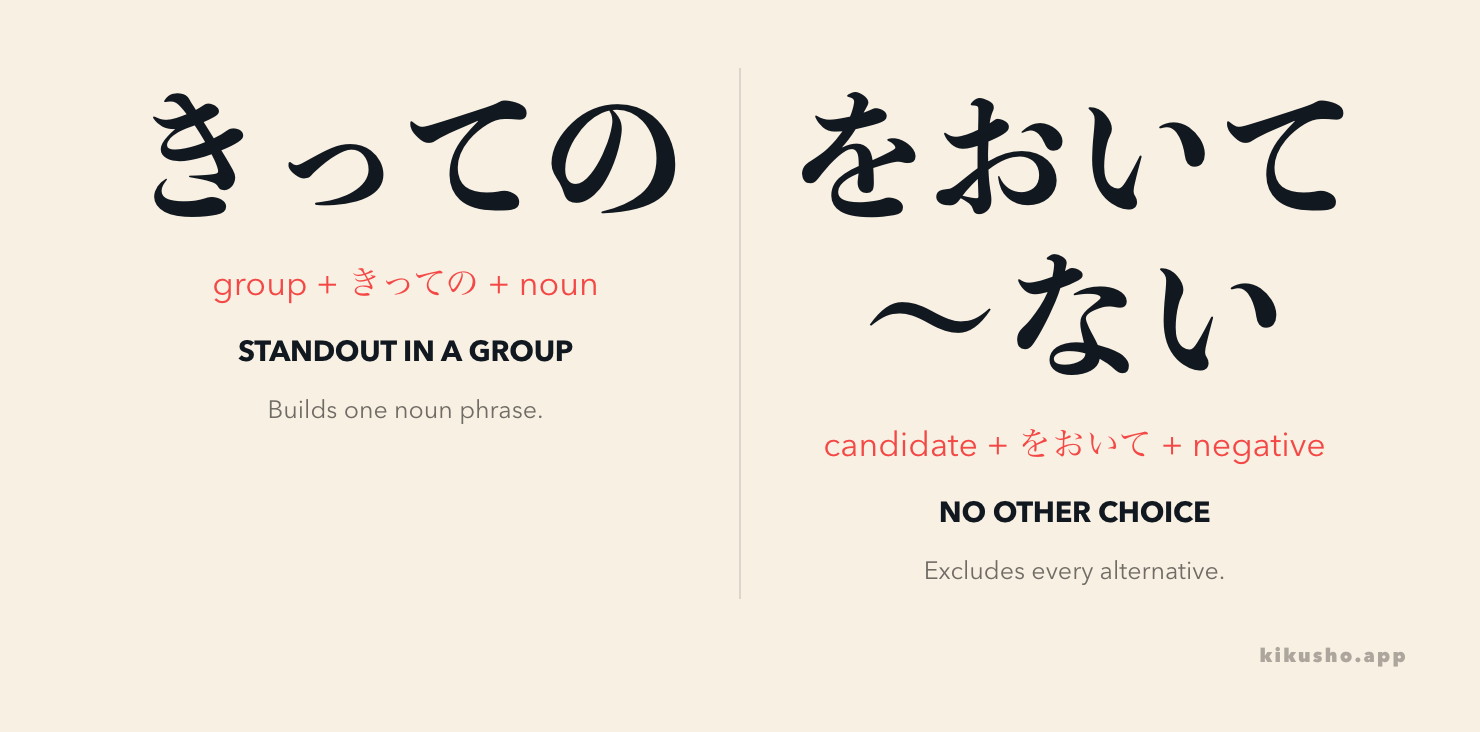
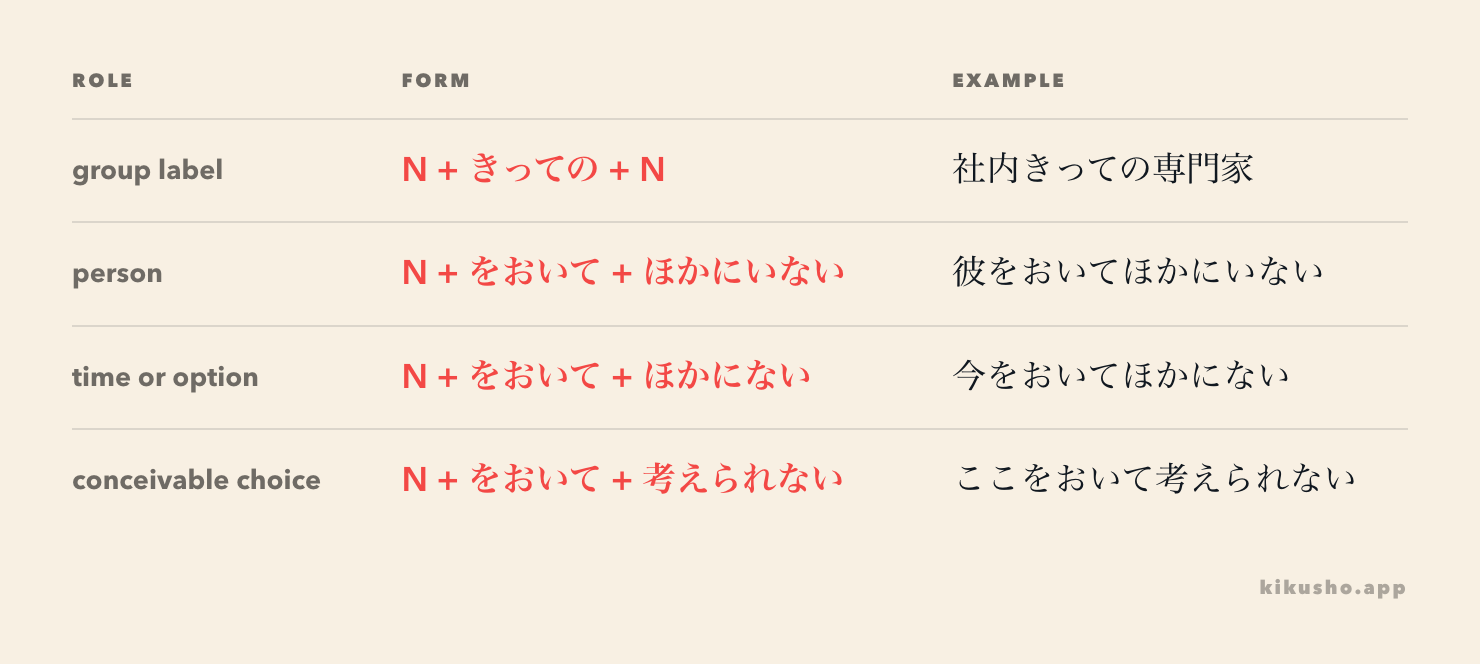
きっての places someone or something at the leading edge of a named group: 研究所きっての分析官 is the institute's foremost analyst. をおいて~ない makes an exclusive claim: この分析を任せられるのは彼女をおいてほかにいない says nobody but her can be entrusted with the analysis.
One form builds a noun phrase. The other needs a negative clause that removes every alternative.
Ask whether you are labelling a standout or excluding alternatives
| Meaning structure | Form | Example | Central claim |
|---|---|---|---|
| standout inside a group | group + きっての + member/category | 部内きっての交渉役 | foremost negotiator in the department |
| no acceptable alternative | candidate + をおいて + negative clause | 彼をおいて適任者はいない | no one else is suitable |
佐藤さんは社内きっての企画担当者だ。
さとうさんはしゃないきってのきかくたんとうしゃだ。
Ms Sato is the company's foremost planner.
この新事業を率いるのは、佐藤さんをおいてほかに考えられない。
このしんじぎょうをひきいるのは、さとうさんをおいてほかにかんがえられない。
I cannot imagine anyone other than Ms Sato leading this new venture.
The first sentence ranks her within the company. The second argues that the position has no viable alternative. Both can praise the same person, but they package the judgment differently.
きっての puts the comparison group first
Attach きっての directly to a noun naming the domain in which the comparison holds. A second noun follows and identifies the standout person or thing.
| Domain before きっての | Whole phrase | Reading in context |
|---|---|---|
| organization | 会社きっての営業担当 | the company's top salesperson |
| place | 町きっての老舗 | the town's foremost long-established shop |
| era | 当時きっての人気作家 | one of the era's leading popular writers |
| group | チームきっての俊足 | the fastest runner on the team |
The order matters. In 大学きっての研究者, 大学 supplies the comparison set and 研究者 names the role in which the person stands out. The pattern does not mean “the best university researcher everywhere”; its claim is bounded by that university.
彼女は劇団きっての歌い手として知られている。
かのじょはげきだんきってのうたいてとしてしられている。
She is known as the theatre company's leading singer.
これは工房きっての職人が仕上げた器です。
これはこうぼうきってのしょくにんがしあげたうつわです。
This vessel was finished by the workshop's foremost craftsperson.
毎日のんびり日本語教師 describes the pattern as selecting the most outstanding member within a place, group, organization or era. 日本語NET independently records the noun attachment and N1 study placement.
Outstanding does not always mean admirable
The pattern identifies the strongest example on the scale supplied by the following noun. The scale can be negative.
彼はクラスきってのいたずら者だった。
かれはクラスきってのいたずらものだった。
He was the biggest prankster in the class.
その事件は近年きっての難事件とされている。
そのじけんはきんねんきってのなんじけんとされている。
The case is regarded as one of the most difficult cases of recent years.
Praise is common because roles such as expert, athlete and craftsperson invite positive ranking. Yet 問題児, いたずら者 or 難事件 makes the distinction undesirable. Translate the relationship, not a fixed word such as “best.” Depending on the noun, “foremost,” “leading,” “greatest” or “most notorious” may fit.
The expression is compact and often appears in profiles, introductions and narrative description. In casual speech, このチームで一番速い選手 states the same basic ranking more transparently. きっての sounds more written or presentational and treats the status as a recognized distinction.
をおいて~ない sets one candidate apart
With をおいて~ない, a noun before を identifies the candidate retained after the speaker mentally sets every alternative aside. The later negative clause completes the exclusivity claim.
| Candidate | Frequent continuation | Complete claim |
|---|---|---|
| person | ほかに~いない | この役は彼をおいてほかに務まる人はいない |
| thing or method | ほかに~ない | 解決策はこの方法をおいてほかにない |
| time | ほかに~ない | 始めるなら今をおいてほかにない |
| place | ~は考えられない | 会場はここをおいて考えられない |
この精密な修復を任せられるのは、山本さんをおいてほかにいない。
このせいみつなしゅうふくをまかせられるのは、やまもとさんをおいてほかにいない。
There is nobody other than Mr Yamamoto who can be entrusted with this delicate restoration.
計画を始めるなら、資金がそろった今をおいてほかにない。
けいかくをはじめるなら、しきんがそろったいまをおいてほかにない。
If we are going to start the project, there is no time other than now, when the funding is ready.
日本語教師のまる得 explains Nをおいて as excluding N from all other candidates and emphasizes the “nothing else” continuation. Bunpro independently gives the N1 placement, noun attachment and positive evaluation of a uniquely suitable person or option.
The negative ending is structural
The pattern is conventionally paired with a negative expression. Common endings include:
- ほかにいない for people;
- ほかにない for things, occasions or methods;
- ~人はいない/~ものはない when the relevant category is stated;
- 考えられない when alternatives are inconceivable.
この地域の魅力を案内できる人は、地元で育った彼女をおいてほかにいない。
このちいきのみりょくをあんないできるひとは、じもとでそだったかのじょをおいてほかにいない。
Nobody but her, who grew up locally, can guide people through this area's attractions.
Do not use this grammar as a positive sequence meaning “put N down and then do something.” The おいて in the fixed expression corresponds to 措いて, “set aside” or “leave aside,” although it is usually written in hiragana. 資料を机に置いて帰った uses the ordinary verb 置く and describes physically placing documents on a desk. Its later clause does not need a negative.
The exclusivity is strong. 彼をおいてほかにいない presents the speaker's choice as effectively unrivalled, not merely preferable. When several good candidates remain, 彼が一番適任だと思う or 彼が有力な候補だ leaves more room for alternatives.
Compare the two forms in one hiring decision
森さんは部署きっての調整役だ。
もりさんはぶしょきってのちょうせいやくだ。
Ms Mori is the department's leading coordinator.
This sentence gives her a recognized standing within 部署. It does not explicitly say that nobody else could do a particular job.
複数の部署をまとめられる責任者は、森さんをおいてほかにいない。
ふくすうのぶしょをまとめられるせきにんしゃは、もりさんをおいてほかにいない。
There is nobody other than Ms Mori who can lead several departments together.
Now the sentence defines a requirement and eliminates every other candidate. The claim is tied to that responsibility, not to a general ranking across every skill.
The earlier だけで and の中で lesson shows how の中で merely supplies a comparison group: 三人の中で森さんが一番経験豊富だ. きっての compresses a recognized superlative into one noun phrase, while をおいて~ない argues unique suitability through negation. The を除いて and 以外 lesson handles ordinary exceptions without necessarily praising the retained member.
Preserve both the domain and the role in review cards
For きっての, save the whole phrase 研究所きっての分析官. Omitting 研究所 loses the group; omitting 分析官 loses the scale on which the person stands out.
For をおいて~ない, keep the negative ending: この任務を任せられるのは彼をおいてほかにいない. A fragment ending at 彼をおいて hides the exclusivity that defines the construction.
Practice: identify the ranking structure
Answer all seven questions before opening the explanation panel.
Question 1 — group superlative. Complete “the laboratory's foremost researcher.”
研究所__研究者
- ア. をおいて
- イ. きっての
- ウ. きってに
- エ. のおいて
Question 2 — sole candidate. Complete the sentence: “Nobody but Ms Kato can negotiate this agreement.”
この契約を交渉できるのは、加藤さん__ほかにいない。
- ア. きっての
- イ. において
- ウ. をおいて
- エ. をきって
Question 3 — negative distinction. Which sentence naturally means “He was the school's most notorious troublemaker”?
- ア. 彼は学校きっての問題児だった。
- イ. 彼は学校をおいて問題児だった。
- ウ. 彼は学校きってに問題児だった。
- エ. 彼をおいて学校は問題児ではない。
Question 4 — sentence composition. Rebuild this recommendation from the three chunks: “If we act, there is no opportunity other than now.”
- 今をおいて
- 行動するなら
- ほかに機会はない
Question 5 — required polarity. Which continuation completes the fixed exclusivity pattern?
この仕事を任せられるのは彼をおいて__。
- ア. ほかにもいる
- イ. ほかにいない
- ウ. 彼が一番だ
- エ. すぐ始める
Question 6 — physical 置く or exclusivity. Which sentence uses the ordinary verb “put,” rather than をおいて~ない?
- ア. 会場はここをおいてほかにない。
- イ. 指揮者は彼をおいて考えられない。
- ウ. 荷物を入口に置いて、中へ入った。
- エ. 始める時期は今をおいてほかにない。
Question 7 — connected text. Choose the pair that first labels a standout in a team and then says nobody else can lead the final match.
林さんはチーム__司令塔だ。決勝で全員をまとめられるのは、彼女__ほかにいない。
- ア. をおいて/きっての
- イ. きっての/をおいて
- ウ. きってに/において
- エ. の中で/きっての
Answers and explanations
Answer 1. イ, きっての. 研究所 names the comparison group, and the complete phrase modifies 研究者. をおいて would require a later negative clause.
Answer 2. ウ, をおいて. 加藤さん is retained as the sole suitable person, while ほかにいない excludes every alternative.
Answer 3. ア. きっての can mark the strongest negative distinction as well as praise. 学校 supplies the domain and 問題児 supplies the undesirable category.
Answer 4. 行動するなら今をおいてほかに機会はない. 今 is singled out as the only suitable opportunity, and the negative ending completes the exclusive claim.
Answer 5. イ, ほかにいない. The construction needs a negative expression denying another suitable person. ア explicitly says alternatives exist and reverses the intended meaning.
Answer 6. ウ. 入口に置いて is the て-form of the ordinary verb 置く and describes placing luggage. The other sentences use the fixed pattern that sets alternatives aside.
Answer 7. イ, きっての/をおいて. The first phrase ranks Hayashi within the team as its standout playmaker. The second selects her as the only person able to lead the final and ends with ほかにいない.
Common questions
What does きっての mean in Japanese?
Nきっての describes someone or something as the foremost, most outstanding or most representative member within N. It modifies a following noun, as in 社内きっての技術者.
What does をおいて~ない mean?
Nをおいて~ない means that apart from N, nobody or nothing satisfies the stated condition. The later clause must be negative, often 他にいない, 他にない or 考えられない.
What is the difference between きっての and をおいて~ない?
きっての places a standout member inside a named group and forms one noun phrase. をおいて~ない selects a candidate, sets every alternative aside and completes the claim with a negative clause.
Is きっての always praise?
No. It marks the strongest or most notable member on the relevant scale. That can be praise, as in 腕利きの職人, or a negative distinction, as in 学校きっての問題児.