On this page
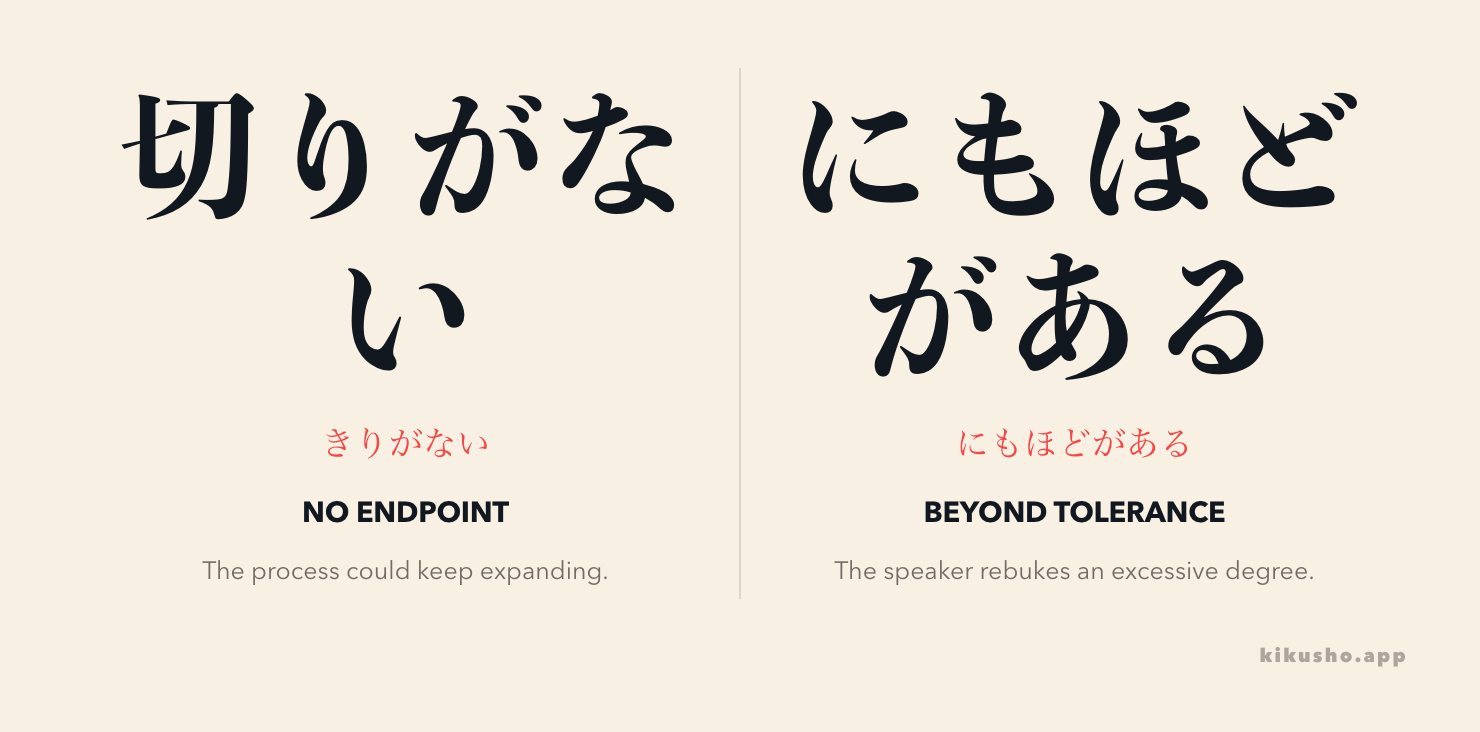
切りがない(きりがない) says that continuing an action, list or discussion would reveal no practical end. にもほどがある delivers a rebuke: an action or quality has crossed the limit of what the speaker considers acceptable.
改善点を挙げれば切りがない。\ かいぜんてんをあげればきりがない。\ If we start listing possible improvements, there will be no end to them.
会議を三時間も延長するなんて、慎重にもほどがある。\ かいぎをさんじかんもえんちょうするなんて、しんちょうにもほどがある。\ Extending the meeting by three hours is taking caution much too far.
The first speaker abandons an endless path. The second sets a social or personal boundary and says the situation has passed it.
Ask whether the problem is stopping or tolerance
Both forms can describe “too much,” but they locate the limit differently.
| Form | Limit at issue | Speaker's move | Typical English rendering |
|---|---|---|---|
| Vたら/Vば/Vと + 切りがない | no natural stopping point | stops or summarizes an endless process | there is no end to it |
| Xにもほどがある | acceptable degree of X | criticizes X for going too far | there is a limit; beyond excessive |
Compare two sentences about complaints:
不満を一つずつ聞いていたら切りがない。\ ふまんをひとつずつきいていたらきりがない。\ If we listen to every complaint one by one, it will never end.
小さなミスまで毎日責めるなんて、文句を言うにもほどがある。\ ちいさなミスまでまいにちせめるなんて、もんくをいうにもほどがある。\ Criticizing even tiny mistakes every day is taking complaints too far.
The first sentence evaluates the process as open-ended. It does not accuse the complaints of being morally unacceptable. The second directly censures the amount or manner of complaining.
切りがない removes the endpoint
The noun 切り can refer to a break, limit or stopping point. In this expression, 切りがない says that no useful endpoint is visible. It commonly follows a conditional clause that imagines starting or continuing something.
| Frame | Example | Focus |
|---|---|---|
| Vたら + 切りがない | 調べ始めたら切りがない | once started, it keeps expanding |
| Vば + 切りがない | 欠点を探せば切りがない | repeating the action yields more |
| Vと + 切りがない | 細部まで説明すると切りがない | doing it fully would take forever |
| Nには + 切りがない | 人の欲望には切りがない | the thing itself feels endless |
古い写真を整理し始めたら切りがないので、今日は一箱だけにした。\ ふるいしゃしんをせいりしはじめたらきりがないので、きょうはひとはこだけにした。\ Once I start sorting old photographs, there is no end to it, so I limited myself to one box today.
この制度の例外を細かく説明すると切りがない。\ このせいどのれいがいをこまかくせつめいするときりがない。\ If I explain every exception to this system in detail, the explanation will go on forever.
谷子塾's 切りがない reference identifies “no end” and “no limit” as the core meaning and notes the frequent ~し出したら/し出せば/し出すと切りがない frames. おにぎり君の日本語発音教室 independently describes a process that would continue without an endpoint and records the conditional attachments.
The pattern often justifies a practical cutoff: choose a few examples, change the subject or stop checking. It can sound resigned, but it is not automatically angry. 面白い話をし始めたら切りがない may simply say the conversation could happily continue all night.
にもほどがある says the acceptable boundary was crossed
The literal logic is “even X has a limit.” In use, the speaker presents the present degree as plainly beyond that limit. The expression therefore carries criticism, disbelief or exasperation.
連絡もせずに二時間待たせるなんて、失礼にもほどがある。\ れんらくもせずににじかんまたせるなんて、しつれいにもほどがある。\ Making someone wait two hours without contacting them is beyond rude.
締め切りを三度も変えるとは、計画性がないにもほどがある。\ しめきりをさんどもかえるとは、けいかくせいがないにもほどがある。\ Changing the deadline three times shows an utterly unacceptable lack of planning.
Attach the expression directly to the plain form that names the criticized action or quality:
| Before にもほどがある | Pattern | Example |
|---|---|---|
| verb, non-past | Vる/Vない + にもほどがある | 忘れるにもほどがある |
| い-adjective | Aい + にもほどがある | 遅いにもほどがある |
| な-adjective | stem + にもほどがある | 無責任にもほどがある |
| noun | N + にもほどがある | 冗談にもほどがある |
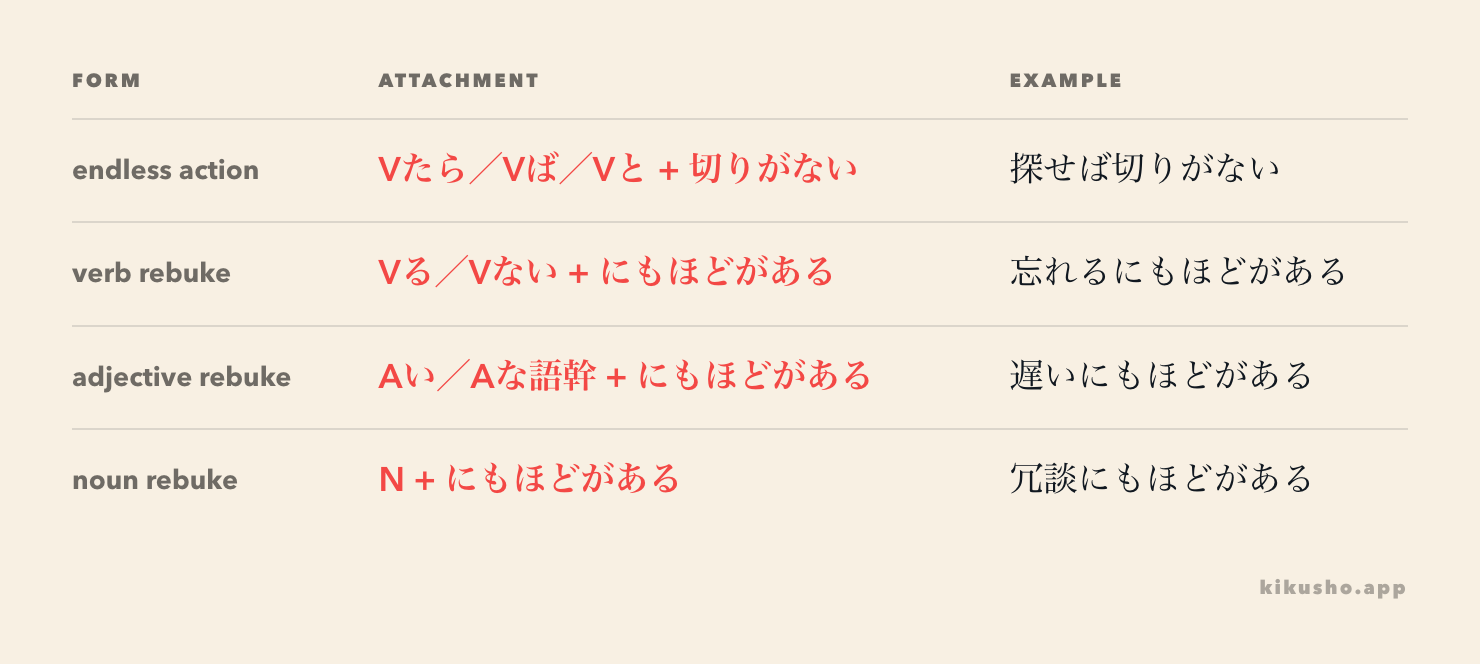
Do not insert だ or な after a noun or な-adjective stem. Say 無責任にもほどがある, not 無責任だにもほどがある. A verb may be affirmative or negative when either behavior can be criticized: 確認するにもほどがある rebukes excessive checking, while 確認しないにもほどがある rebukes an unacceptable failure to check.
日本語NET gives the verb, い-adjective, な-adjective and noun attachments and defines the use as criticism when behavior passes a limit. Bunpro's にもほどがある page independently places the expression at N1 and shows its strongly reproachful force.
Context supplies the boundary
にもほどがある does not state a number that applies to everyone. The listener infers the boundary from expectations, social norms and the evidence in the sentence.
十分の遅刻だけならまだしも、二時間遅れて謝らないとは、図々しいにもほどがある。\ じゅっぷんのちこくだけならまだしも、にじかんおくれてあやまらないとは、ずうずうしいにもほどがある。\ Ten minutes late would be one thing, but arriving two hours late without apologizing is shameless beyond belief.
Details such as 二時間, 三度も, 連絡もせずに and とは/なんて make the rebuke interpretable. Without a shared reason, a bare judgment can sound abrupt or unfair. The pattern is ill-suited to neutral measurement in a report. A report can say 処理時間が基準を二秒超えた; 遅いにもほどがある turns that observation into a speaker's complaint.
Politeness changes the ending but not the criticism: にもほどがあります is grammatically polite, yet still sharp. In direct conversation, it can threaten the other person's face. It is common in forceful commentary, complaints and quoted reactions; use a factual alternative when diplomacy matters.
切りがない can lead to a decision; にもほどがある delivers a verdict
The surrounding clause often reveals the intended form.
候補を全部比較していたら切りがないから、三つに絞ろう。\ こうほをぜんぶひかくしていたらきりがないから、みっつにしぼろう。\ Comparing every candidate would never end, so let us narrow the list to three.
The から clause gives a practical response to an endless task. With にもほどがある, the response is already an evaluation:
相手の話を一度も聞かずに決めるとは、独断にもほどがある。\ あいてのはなしをいちどもきかずにきめるとは、どくだんにもほどがある。\ Deciding without hearing the other side even once is taking unilateral judgment far too far.
This form can be followed by a demand or consequence, but it does not need one. 独断にもほどがある is already a complete rebuke.
The related あまりにも and ほど lesson separates direct intensity from a degree measured through a result. あまりにも遅い evaluates slowness as excessive; 遅いにもほどがある adds an explicit “this crosses the limit” reproach. The 放題 and まくる lesson handles a different question: whether an action is freely available or actually repeated with unusual intensity.
Keep the full trigger when making a card
For 切りがない, save the conditional action and the cutoff it motivates: 全部調べていたら切りがないから、重要な項目に絞る. The ending alone does not tell you what could continue forever.
For にもほどがある, preserve the evidence for the rebuke: 連絡せずに二時間待たせるなんて、失礼にもほどがある. A card containing only 失礼にもほどがある tests a translation, while the full scene tests whether you can identify the crossed boundary.
Practice: find the kind of limit
Answer all seven prompts before opening the explanation panel.
Question 1 — endless process. Complete the sentence: “If we start discussing every detail, there will be no end to it.”
細部まで議論し始めたら、__。
- ア. 切りがない
- イ. 議論にもほどがある
- ウ. 切りにもほどがある
- エ. ほどがない
Question 2 — direct rebuke. A colleague repeatedly changes agreed plans without notice. Which response says the behavior has gone too far?
- ア. 変更を数えたら切りがない。
- イ. 勝手にもほどがある。
- ウ. 勝手を始めたら切りがない。
- エ. 変更ほどがある。
Question 3 — attachment. Choose the natural sentence.
- ア. 無責任なにもほどがある。
- イ. 無責任だにもほどがある。
- ウ. 無責任にもほどがある。
- エ. 無責任の切りがない。
Question 4 — sentence composition. Arrange the chunks to mean “If we list every possible cause, there will be no end.”
- 切りがない
- 原因をすべて挙げれば
- ので、三つに絞ろう
Question 5 — affirmative or negative verb. Complete the rebuke: “Failing to confirm even once is beyond careless.”
一度も__にもほどがある。
- ア. 確認しない
- イ. 確認しなかった
- ウ. 確認しなく
- エ. 確認しないで
Question 6 — register and function. Which sentence is the neutral report rather than an emotional rebuke?
- ア. 処理時間が基準を二秒超えた。
- イ. 処理が遅いにもほどがある。
- ウ. 二秒も超えるとは、遅いにもほどがある。
- エ. この遅さは冗談にもほどがある。
Question 7 — connected text. Choose the pair that first ends an open-ended search and then criticizes an excessive demand.
例外を全部探していたら__ので、代表例だけ確認した。さらに全資料を今日中に読めと言うなんて、要求__。
- ア. にもほどがある/は切りがない
- イ. 切りがない/にもほどがある
- ウ. 切りがある/のほどがない
- エ. ほどがある/に切りがない
Answers and explanations
Answer 1. ア, 切りがない. The conditional clause imagines starting an activity whose endpoint would keep receding. The sentence does not rebuke the act of discussion.
Answer 2. イ, 勝手にもほどがある. 勝手 names the unacceptable quality and にもほどがある condemns its degree. ア only says that the changes are too numerous to finish counting.
Answer 3. ウ, 無責任にもほどがある. A な-adjective stem attaches directly. Neither な nor だ appears before にもほどがある.
Answer 4. 原因をすべて挙げれば切りがないので、三つに絞ろう. The ば-clause opens the potentially endless enumeration, and the final clause imposes a practical cutoff.
Answer 5. ア, 確認しない. The plain non-past negative form can name the criticized behavior. The past, conjunctive and ないで forms do not fit this attachment here.
Answer 6. ア. It records a measurable fact without judging the person or situation. The other three word the observation as exasperation or blame.
Answer 7. イ, 切りがない/にもほどがある. Searching all exceptions is treated as an endless task, so the writer narrows it. The demand to read everything today is then condemned for crossing an acceptable limit.
Common questions
What does 切りがない mean in Japanese?
切りがない means that an action, list or discussion has no practical end. It often follows a conditional form such as 話し出したら切りがない or 数えれば切りがない.
What does にもほどがある mean?
にもほどがある means that even something has a limit and the present case has gone too far. It expresses criticism or exasperation rather than a neutral measurement.
What is the difference between 切りがない and にもほどがある?
切りがない says a process could continue indefinitely, so the speaker sees no useful stopping point. にもほどがある says behavior or a quality has crossed an acceptable boundary and deserves criticism.
How do you form にもほどがある?
Attach it to a plain non-past verb, an い-adjective, a な-adjective stem or a noun: 待たせるにもほどがある, 遅いにもほどがある, 無責任にもほどがある and 冗談にもほどがある.