On this page
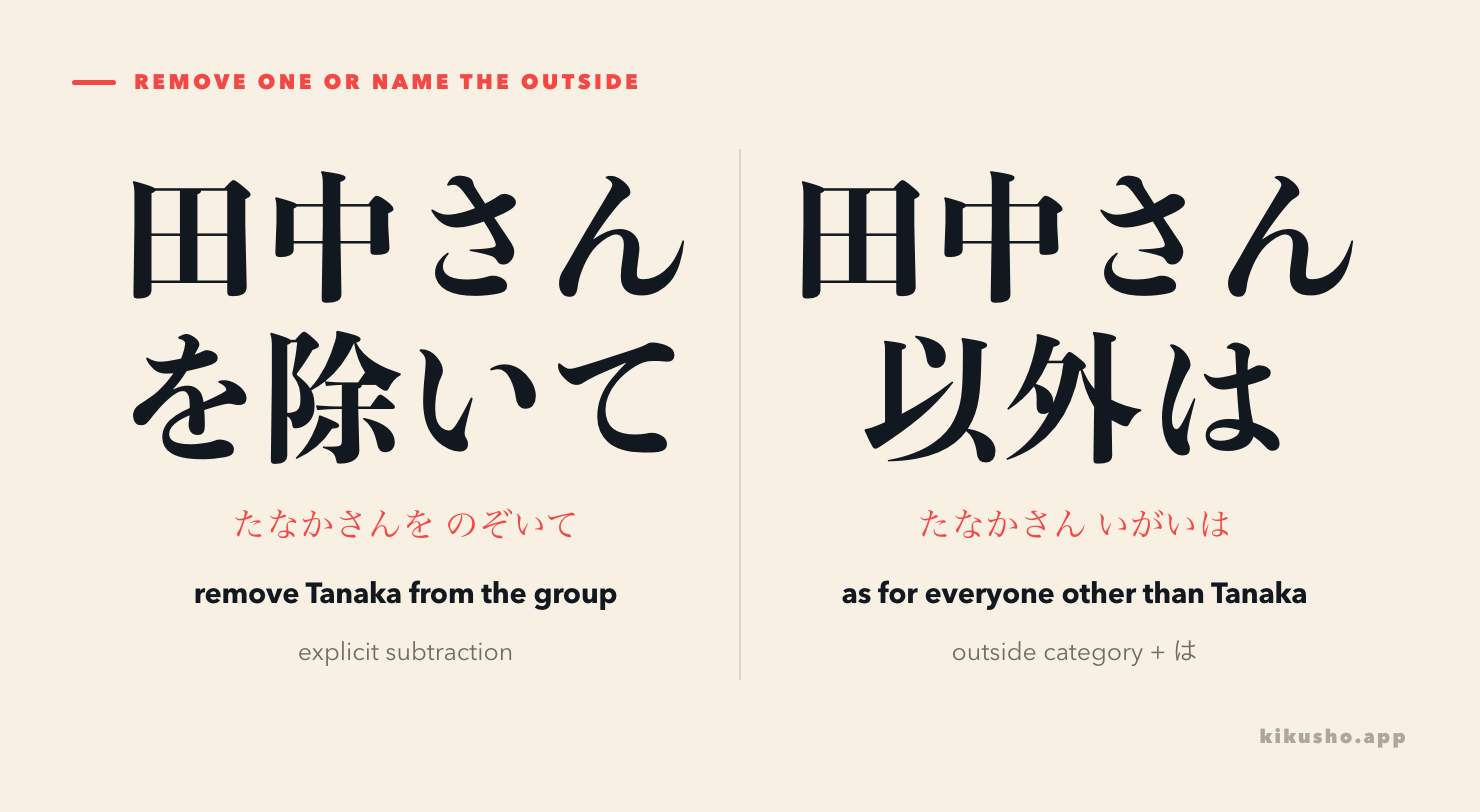
Use Nを除いて when you explicitly take N out of a set and describe what remains. Use N以外 when you name the category outside N: other people, other things or other choices.
Ask whether the sentence removes one member or names the outside
The two forms often produce the same practical result, but they build it from opposite directions.
田中さんを除いて、全員が賛成した。
たなかさんを のぞいて、ぜんいんが さんせいした。
Everyone except Ms Tanaka agreed.
The sentence begins with the full group and subtracts Ms Tanaka. を除いて makes that exclusion an explicit operation.
田中さん以外は、全員が賛成した。
たなかさん いがいは、ぜんいんが さんせいした。
Everyone other than Ms Tanaka agreed.
Here 田中さん以外 is a category: all people outside Ms Tanaka. は marks that category as the topic. In this context, the two sentences report the same division. Their grammar still differs.
| Question to ask | Form | View of the exception |
|---|---|---|
| Which member is being removed from an established set? | Nを除いて | subtract N, then describe the remainder |
| Which people or things fall outside N? | N以外 | name the outside category |
| Does the expression need の, は, に or another particle? | N以外 + particle | let the category fill a noun or particle slot |
を除いて makes the subtraction visible
除く(のぞく) is a transitive verb. In this construction, the noun before を is the member excluded from a range, rule, schedule or total.
日曜日を除いて、毎日営業しています。
にちようびを のぞいて、まいにち えいぎょうして います。
We are open every day except Sunday.
一部の地域を除いて、電車は通常どおり運行しています。
いちぶの ちいきを のぞいて、でんしゃは つうじょうどおり うんこうして います。
Trains are running normally except in some areas.
緊急の場合を除いて、この入口は使用できません。
きんきゅうの ばあいを のぞいて、この いりぐちは しようできません。
This entrance may not be used except in an emergency.
The remainder is usually broad: every day, the other regions, all ordinary cases. That is why the expression is common in notices, conditions, reports and statistics. It sounds more explicit and often more formal than a plain 以外 phrase.
The useful written shapes come from the same verb:
| Shape | Job | Example |
|---|---|---|
| Nを除いて + clause | ordinary connective | 祝日を除いて営業する |
| Nを除き + clause | compact formal connective | 祝日を除き営業する |
| Nを除く + noun | modifies a noun | 祝日を除く平日 |
| Nを除けば + clause | makes the exception a condition | 雨の日を除けば歩いて行ける |
The N2 point is the exclusion sense of 除く. The verb can also mean physically removing something, as in weeds from a garden, but that is a lexical use rather than the set-making frame taught here. A Nagoya University linguistic analysis separates physical removal from exclusion and documents を除く, を除いて and を除き in clauses that describe the remainder. Bunpro and JLPT Sensei both place the construction at N2. These level labels are study estimates because the test maker publishes no exhaustive grammar list.
以外 creates a category that can move through the sentence
以外(いがい) follows a noun directly. The result acts like “what is outside N” or “other than N,” so it can take whatever particle its role requires.
関係者以外は入れません。
かんけいしゃ いがいは はいれません。
People other than authorised personnel may not enter.
英語以外の言語も勉強しています。
えいご いがいの げんごも べんきょうして います。
I am also studying languages other than English.
この方法以外に解決策はありません。
この ほうほう いがいに かいけつさくは ありません。
There is no solution other than this method.
| Shape | What follows | Meaning in context |
|---|---|---|
| N以外は | topic or contrast | as for those outside N |
| N以外の + noun | a modified noun | a noun other than N |
| N以外に + negative | an alternative slot | there is no other N |
| N以外も | an added outside member | something besides N too |
The particle matters. 日本語以外は話せない says that languages other than Japanese cannot be spoken, leaving Japanese as the exception. 日本語以外も話せる says that languages besides Japanese can also be spoken. The same 以外 category combines with は and も, but the larger sentence points in a different direction.
There is also a common choice frame:
電車が止まっているので、歩く以外に方法がない。
でんしゃが とまって いるので、あるく いがいに ほうほうが ない。
The trains have stopped, so there is no choice but to walk.
Here a dictionary-form verb precedes 以外にない. The sentence treats “walking” as the sole remaining option. Do not put を before 以外: ×歩くを以外に方法がない is malformed.
JLPT Sensei's 以外 reference records the N2 estimate and the attachments 以外の, 以外は and 以外に. The Digital Daijisen entry defines 以外 as what remains apart from the named range. That category meaning explains why the expression can occupy several grammatical positions.
The noun after の is the clearest dividing line
When 以外 directly modifies another noun, use の:
山田さん以外の参加者は、もう到着しました。
やまださん いがいの さんかしゃは、もう とうちゃくしました。
The participants other than Mr Yamada have already arrived.
を除いて cannot simply take の in the same slot. Use the attributive verb form instead:
山田さんを除く参加者は、もう到着しました。
やまださんを のぞく さんかしゃは、もう とうちゃくしました。
The participants excluding Mr Yamada have already arrived.
The first is neutral and easy in conversation. The second makes the deliberate exclusion more visible and suits administrative prose. If a test blank is followed by a noun, inspect the choices: 以外の + noun and を除く + noun are complete; を除いての + noun is not the normal form for this meaning.
Negation can reverse which member remains
Exceptions become harder when the predicate is negative. Read the scope before translating.
佐藤さんを除いて、誰も答えられなかった。
Except for Ms Sato, nobody could answer.
The sentence removes Ms Sato from the group governed by 誰も答えられなかった. It therefore implies that she could answer.
佐藤さん以外は、誰も答えられなかった。
Nobody other than Ms Sato could answer.
This version sets 佐藤さん以外 against the negative predicate and reaches the same result. Yet 佐藤さん以外も答えられなかった would mean that someone besides Ms Sato also could not answer. The change from は to も changes the information structure.
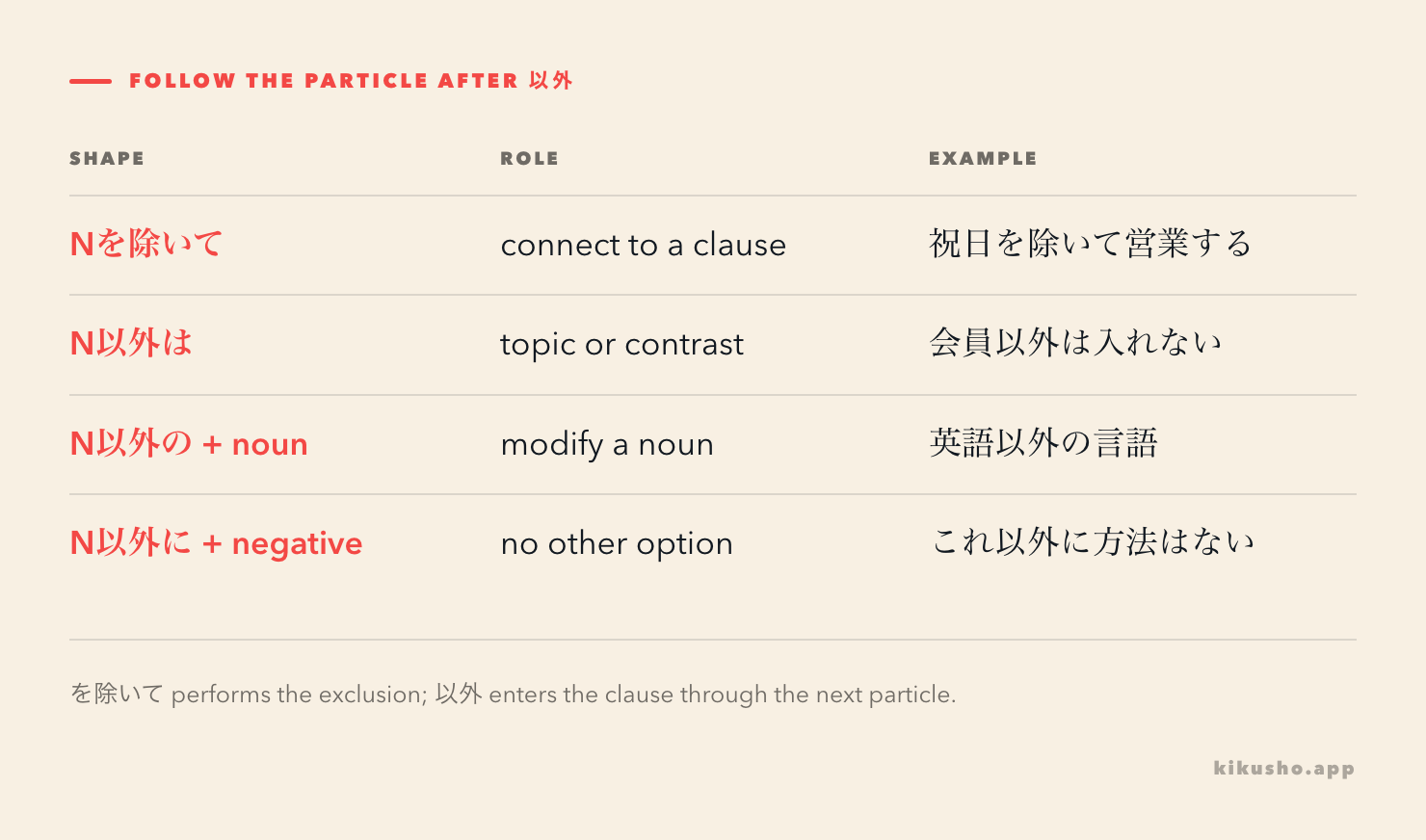
Do not reduce 以外 to one English word. Depending on the predicate, “except,” “other than,” “besides” and “the only option” may all be natural translations. The Japanese structure stays stable: begin with a reference point, then speak about what lies outside it.
Keep neighbouring exception forms separate
Nを除いて names an omitted member. It differs from Nを抜きにして, which often means proceeding without an expected ingredient or setting something aside for the discussion. 冗談を抜きにして話す means “speak without joking”; it does not describe all members of a set except jokes.
に限る, に限り, に限らず and に限って build recommendations, restrictions and exceptional cases from 限る. They can occupy similar notices, but their clause logic is different. 会員に限り入場できます restricts entry to members; 会員以外は入場できません excludes non-members. The practical boundary matches, while the sentence chooses an inside or outside view.
When you save one of these contrasts in Kikusho, keep the group expression and the predicate together. 日曜日を除いて毎日営業する preserves the remainder after subtraction. この方法以外に解決策はない preserves the negative frame that turns one method into the sole option. A card containing only 以外 cannot tell you which particle or scope produced the meaning you met.
Practice: solve the set before reading the answers
Question 1 — schedule exception. Which form completes 年末年始__、この図書館は毎日開いています?
- 以外の
- を除いて
- 以外に
- を除くの
Question 2 — build a noun phrase. Complete 鈴木さん__社員は、全員研修を終えました with the meaning “The employees other than Ms Suzuki have all finished the training.”
- を除いての
- 以外の
- 以外に
- を除きの
Question 3 — sole option. Complete: 終電が出たので、タクシーで帰る__方法がない。
- を除いて
- 以外に
- 以外の
- を除くは
Question 4 — particle and meaning. Explain the difference between 日本語以外は話せない and 日本語以外も話せる.
Question 5 — text grammar. Read: この施設は、祝日__毎日利用できます。ただし、会員__利用者は受付で手続きが必要です。 Supply each blank, using both target forms once.
Question 6 — produce both views. Express “Everyone except Mori attended” twice: first subtract Mori from the group, then make “people other than Mori” the topic.
Answers and explanations
Answer 1: 2, を除いて. 年末年始を除いて explicitly subtracts the New Year holiday period from the days when the library is open. 以外の needs a following noun, and the other choices do not fit this connective slot.
Answer 2: 2, 以外の. 鈴木さん以外の社員 forms the noun phrase “employees other than Ms Suzuki.” Before a noun, the comparable verb form would be 鈴木さんを除く社員, not を除いての or を除きの.
Answer 3: 2, 以外に. タクシーで帰る以外に方法がない says no method exists other than going home by taxi. The dictionary-form verb attaches directly to 以外 in this fixed choice frame.
Answer 4. 日本語以外は話せない places languages other than Japanese under the negative predicate, so Japanese is the one language the person can speak. 日本語以外も話せる uses も to add languages outside Japanese, so the person can speak Japanese and at least one other language.
Answer 5. この施設は、祝日を除いて毎日利用できます。ただし、会員以外の利用者は受付で手続きが必要です。 The first sentence removes holidays from an operating schedule. The second uses 会員以外の to modify 利用者, creating the category of users who are not members.
Answer 6. A model pair is 森さんを除いて、全員が出席した。森さん以外は、全員が出席した。 The first sentence subtracts Mori before describing the remainder. The second makes the people outside Mori the topic with は. In this context, both report the same attendance pattern.
Common questions
What is the difference between を除いて and 以外?
Nを除いて explicitly removes N from a set before describing what remains. N以外 names the people or things outside N and can take particles such as は and に or modify a noun with の.
How does を除いて attach?
Put a noun before を除いて, as in 日曜日を除いて毎日営業しています. Written variants include Nを除き before a clause, Nを除く before a noun and Nを除けば when the exception is framed conditionally.
How does 以外 attach?
Put 以外 directly after a noun, then add the particle required by the clause: 関係者以外は, 関係者以外に and 関係者以外の人. The frame Vる以外にない means that no option exists other than doing V.
Are を除いて and 以外 interchangeable?
They often describe the same set, as in 田中さんを除いて全員 and 田中さん以外は全員. They are not interchangeable in every structure because を除いて links an excluded item to a clause, while 以外 behaves like an outside category that can modify a noun or combine with particles.