On this page
A label on a simple appliance says このボタンだけで動きます: this button alone is enough to make it work. A review says 三つの中でこれがいちばん使いやすい: within a group of three, this one is easiest to use. だけで limits the input that produces a result; の中で limits the place, circumstances, or group in which a statement holds.
Ask whether the phrase supplies an input or a boundary
The final で looks identical, but the phrase before it performs a different job.
| Test | だけで | の中で |
|---|---|---|
| What question does it answer? | What alone was enough? | Inside or among what? |
| Basic shape | N/plain verb + だけで + result | N + の中で + event or judgment |
| What is limited? | the input, means, cue, or condition | the physical or abstract domain |
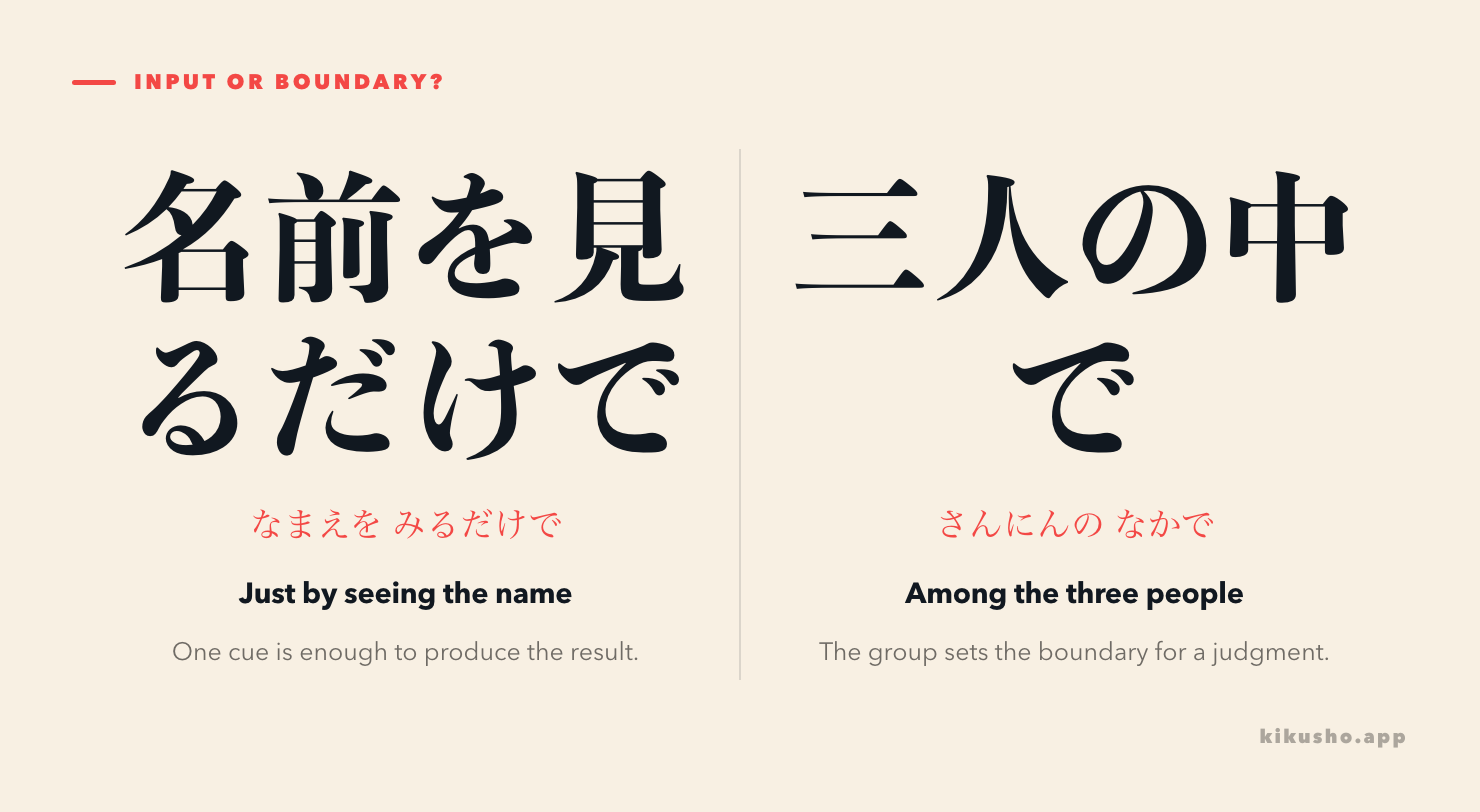
| Example | 名前を見るだけで思い出す | 三人の中で兄がいちばん背が高い |
名前を見るだけで、その店を思い出します。
なまえを みるだけで、その みせを おもいだします。
Just seeing the name makes me remember the shop.
三人の中で、兄がいちばん背が高いです。
さんにんの なかで、あにが いちばん せが たかいです。
Among the three, my older brother is the tallest.
In the first sentence, seeing the name is presented as the sole trigger needed for the memory. In the second, the three people form the boundary for the comparison. No event inside the group causes the brother to be tall.
だけで says one thing is enough for the result
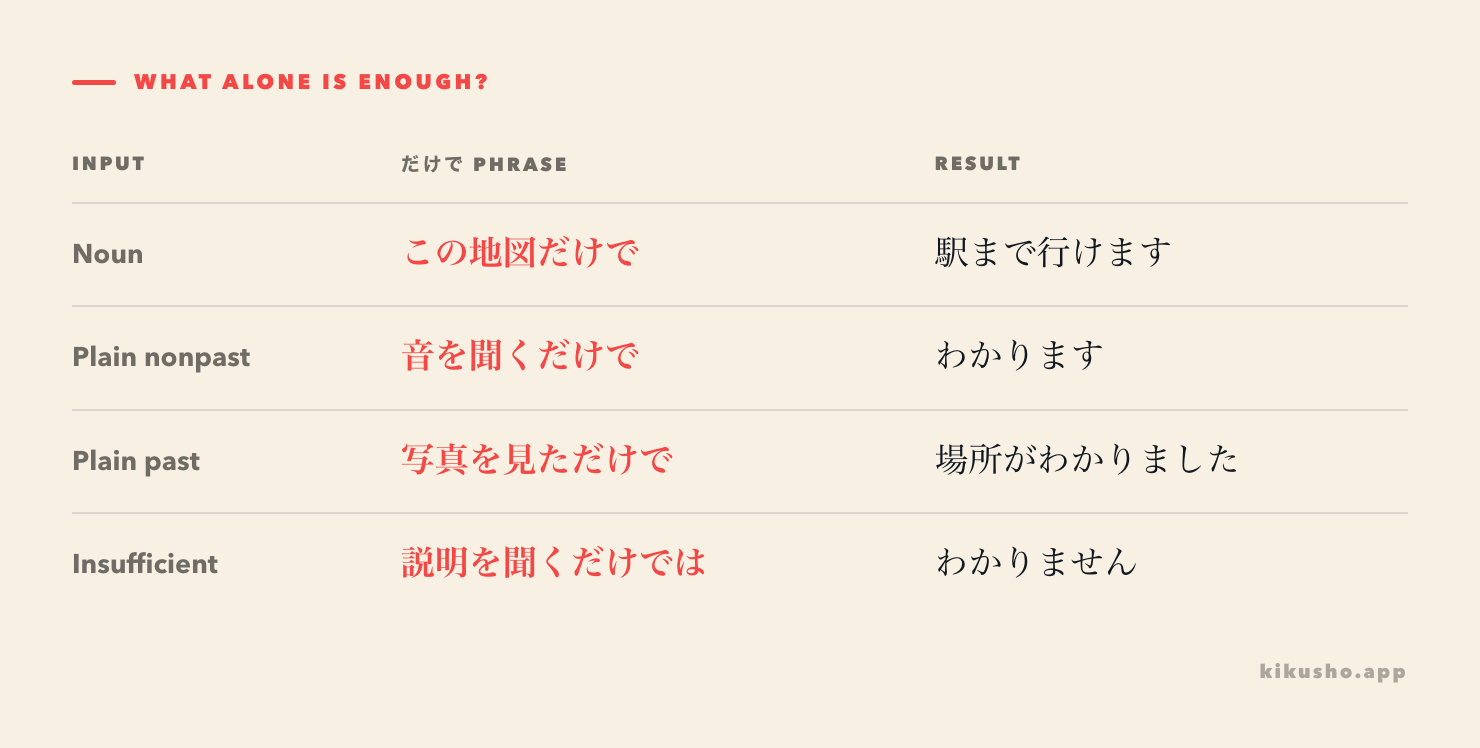
Attach だけで directly to a noun or to a verb in a plain form. The clause after it supplies the result.
| Attachment | Example | Relationship |
|---|---|---|
| N + だけで | この地図だけで駅まで行けます | this map alone is sufficient |
| Vる + だけで | 音を聞くだけでわかります | merely hearing supplies the cue |
| Vた + だけで | 写真を一枚見ただけで場所がわかりました | one completed look supplied the cue |
| N/V + だけでは | 説明を聞くだけではわかりません | that input alone is insufficient |
Do not put ます before だけで. Use 聞くだけで, not 聞きますだけで. A past event can remain plain before the pattern: 見ただけで places one completed look before the result. The final predicate carries the main tense and politeness.
この地図だけで、駅まで行けます。
この ちずだけで、えきまで いけます。
I can get to the station with this map alone.
The sentence does more than say that only a map exists. It makes the map the sufficient means. Bunpro's N4 account describes the pattern as だけ plus the case particle で: “with only A” leads to B. JLPT Sensei likewise gives noun and plain-verb attachments.
The relationship may be a practical means, a piece of evidence, an emotional trigger, or a minimal condition:
- このカードだけで入れます。 This card alone lets you enter.
- 声を聞くだけで安心します。 Just hearing the voice reassures me.
- 一度話しただけで、名前を覚えてくれました。 After speaking once, they remembered my name.
These sentences present A as enough in the described situation. They do not prove a universal law. 名前を見るだけで思い出しました reports what triggered one memory; it does not guarantee that every name will always have that effect.
Plain だけ stops at the limit; だけで leads onward
The basic だけ lesson teaches how the particle limits a noun, action, quality, or amount. Compare where the sentence stops:
説明を読むだけです。
I will only read the instructions.
説明を読むだけで使えます。
You can use it just by reading the instructions.
In the first sentence, 読むだけ is the restricted activity and です closes the statement. In the second, 読むだけで becomes the input for 使えます. Translating both with English “just” hides the structural difference.
Adding は often marks that limited input as insufficient:
説明を聞くだけでは、使い方がわかりません。
せつめいを きくだけでは、つかいかたが わかりません。
Listening to the explanation alone is not enough to understand how to use it.
The negative predicate makes the insufficiency explicit. By contrast, これだけでいいです says that this alone is fine or sufficient; いい supplies the positive judgment.
Do not split だけでなく by reading its で as this sufficient-means marker. ~だけでなく and ~ばかりでなく form the connector “not only A but also B.” 写真を見るだけでわかる and 写真を見るだけでなく、説明も読む make different relationships even though the same characters meet at the seam.
The Japan Foundation's teaching material for だけ confirms the limiting function and shows that だけ can combine with で in different particle orders. Its example 日本語だけで話します limits the language used; whether a second result is present determines whether the larger sentence has the “just by A, B” relationship taught here.
の中で places the statement inside a domain
中(なか)is a noun meaning an inside. Nの中 names whose or what inside; で then marks that inside as the setting for an action or judgment.
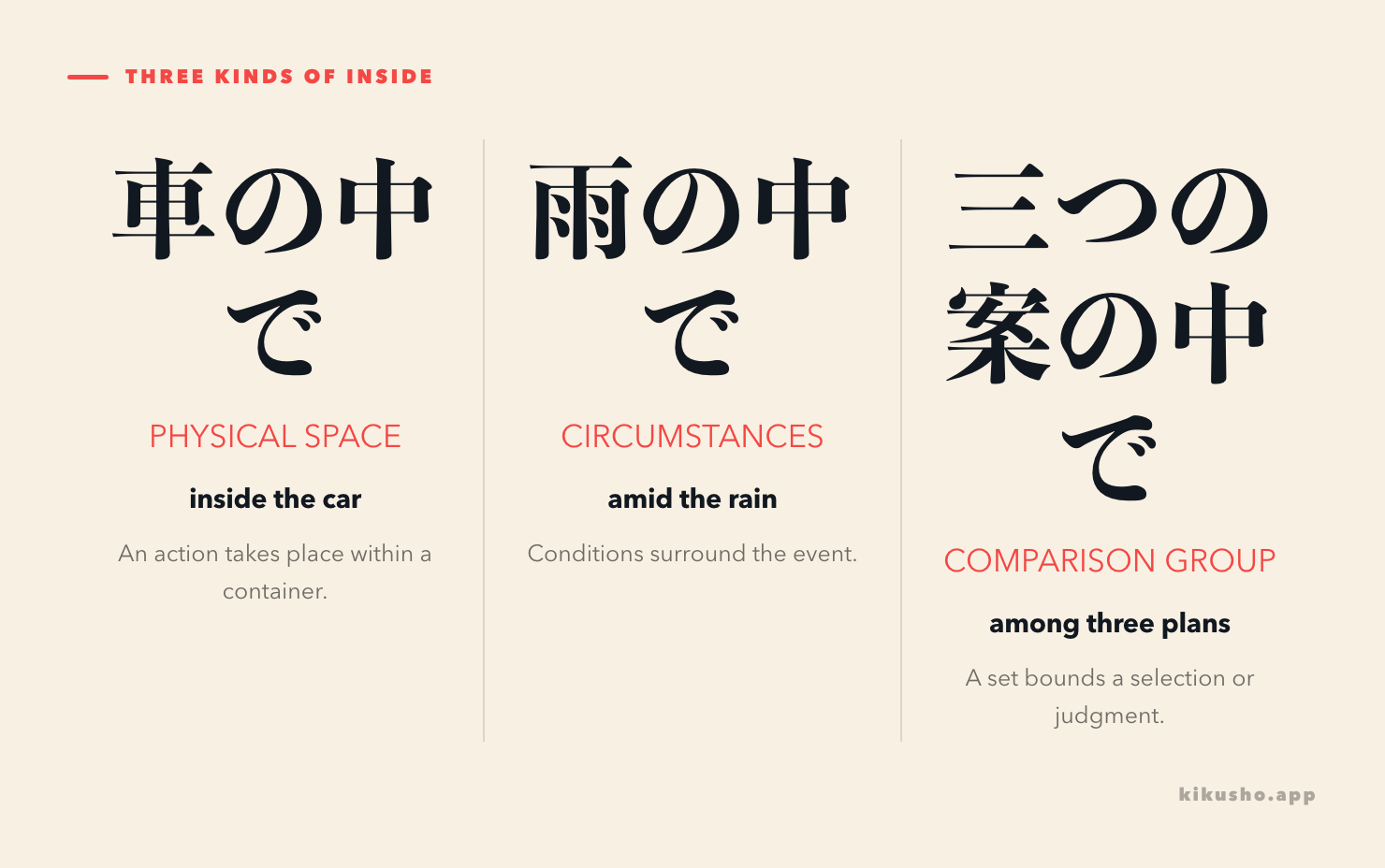
| Kind of boundary | Example | Reading |
|---|---|---|
| physical interior | 車の中で待ちました | waited inside the car |
| surrounding circumstances | 雨の中で試合が続きました | the match continued amid rain |
| comparison group | 三つの案の中で二番目がいちばん現実的です | among three plans, the second is most realistic |
| membership domain | クラスの中で日本語を話せる人は三人です | within the class, three people can speak Japanese |
車の中で、友だちを待ちました。
くるまの なかで、ともだちを まちました。
I waited for my friend inside the car.
雨の中で、試合が続きました。
あめの なかで、しあいが つづきました。
The match continued in the rain.
The first inside is concrete; the second treats the rain as surrounding circumstances. JLPT Sensei's N4 page documents physical, mental, circumstantial, and group readings. Tofugu's 中 guide independently separates a location of action from a bounded comparison set.
The following predicate tells you which inside is meant
With a container such as 車, 部屋, or 箱, の中で normally gives a physical setting for an action. With a group such as 家族, クラス, or 三つの案, it defines the members relevant to a choice, count, or comparison.
家族の中で、妹がいちばん早く起きます。
かぞくの なかで、いもうとが いちばん はやく おきます。
In my family, my younger sister gets up earliest.
Here いちばん creates the superlative; 家族の中で only states the comparison group. The wider Japanese comparison lesson teaches the complete frame. Without いちばん, の中で can still bound a count or selection, as in クラスの中で三人が参加します, “Three people from the class will participate.”
For two named choices, Japanese usually asks どちら and compares with ほうが. の中で is especially useful once a group or set must be treated as the domain. It does not itself mean “best,” “only,” or “all.”
Location also explains 中に versus 中で:
- 箱の中に鍵があります。 The key exists inside the box.
- 車の中で電話しました。 I made a phone call inside the car.
The place-particle lesson gives the larger rule: に locates existence or a destination, while で marks where an event occurs. 中 names the interior but does not erase that particle choice.
Both assigned records are placed at N4 by JLPT Sensei, and Bunpro independently places だけで at N4. Some narrower comparison courses teach Nの中でAがいちばん earlier, at N5. That is a scope difference rather than a contradiction: this lesson includes physical, circumstantial, membership, and comparison domains. The JLPT organisers do not publish an exhaustive grammar list, so these levels are teaching estimates.
If you capture この地図だけで駅まで行ける in Kikusho, keep the result with the limited input. For 三つの案の中で二番目がいい, keep the group and selected member together. The editable example then preserves the relationship that で creates instead of leaving an isolated fragment that could belong to several patterns.
Seven checks on inputs and boundaries
Question 1
Choose the sentence that means “I understood it just by looking at one photo.”
- ア. 写真の中でわかりました。
- イ. 写真を一枚見ただけでわかりました。
- ウ. 写真だけです。
- エ. 写真を一枚見ますだけでわかりました。
Question 2
You are comparing five designs. Which phrase correctly sets those designs as the comparison group?
- ア. 五つのデザインだけで
- イ. 五つのデザインの中で
- ウ. 五つのデザインの中にだけ
- エ. 五つのデザインでなく
Question 3
Which sentence says that listening alone is insufficient?
- ア. 聞くだけでわかります。
- イ. 聞くの中でわかります。
- ウ. 聞くだけではわかりません。
- エ. 聞くだけでなくわかりません。
Question 4
Compose “This key alone opens the door” with この鍵, だけで, ドアが開きます. Put the sufficient means first.
Question 5
Read the account:
三つの案を読みました。三つの案の中で、二番目がいちばん現実的だと思います。
What does 三つの案の中で contribute, and which expression makes the ranking superlative?
Question 6
Complete the contrast with 中に or 中で:
かばんの( )財布があります。車の( )電話しました。
Explain the event or existence test behind both choices.
Question 7
A product note says:
このカードだけで入れます。建物の中でカードを見せてください。
Which interpretation is supported?
- ア. The card alone permits entry; show it inside the building.
- イ. Choose the best card among the building's cards.
- ウ. The card is located inside the building and cannot be used alone.
- エ. Enter only the card, then wait outside the building.
Answers and explanations
Answer 1
イ. 写真を一枚見ただけでわかりました. Plain past 見た reports the completed minimal action, だけ limits it, and で links that one look to the result. ア sets the photo as an interior or domain, ウ stops at “it is only a photo,” and エ incorrectly inserts polite 見ます before だけで.
Answer 2
イ. 五つのデザインの中で. The five designs form the bounded set within which the following comparison holds. ア would present the five designs as the only or sufficient input, ウ changes the particle relationship, and エ belongs to the “not A” seam of an additive connector.
Answer 3
ウ. 聞くだけではわかりません. だけ limits the input to listening, で links it to the judgment, and は makes that input the contrasted topic. The negative predicate states that it is insufficient. ア says listening is enough; イ cannot attach 中 directly to a verb this way; エ is an incomplete use of だけでなく.
Answer 4
この鍵だけで、ドアが開きます。 この鍵 is the sole means presented as sufficient. The result clause says the door opens; no second tool or action is included.
Answer 5
三つの案の中で limits the judgment to the three plans that were read. いちばん makes the judgment superlative: the second is the most realistic within that group. の中で alone does not mean “most.”
Answer 6
かばんの中に財布があります。車の中で電話しました。 The wallet exists at a location, so に follows 中. The phone call is an event performed inside the car, so で marks its setting.
Answer 7
ア. The card alone permits entry; show it inside the building. In the first sentence, カードだけで is the sufficient means for 入れます. In the second, 建物の中で is the physical setting for 見せてください. The matching で endings do not give the two phrases the same role.
Common questions
What does だけで mean in Japanese?
Nだけで or a plain-form verb plus だけで presents that one thing or action as enough to produce the following result. この地図だけで行けます means “I can get there with this map alone.”
What is the difference between だけ and だけで?
だけ limits a phrase: 読むだけです means “I will only read.” Adding で links that limited input to a result: 読むだけでわかります means “I understand just by reading.”
What does の中で mean?
Nの中で sets the place, circumstances, or group within which the following event or judgment holds. It can mean “inside,” “amid,” or “among,” depending on the noun and sentence.
What is the difference between 中に and 中で?
中に commonly pinpoints where something exists or is placed, as in 箱の中に鍵があります. 中で marks where an action occurs or the group within which a judgment is made, as in 車の中で待ちます or 三つの中でこれがいちばん軽いです.