On this page
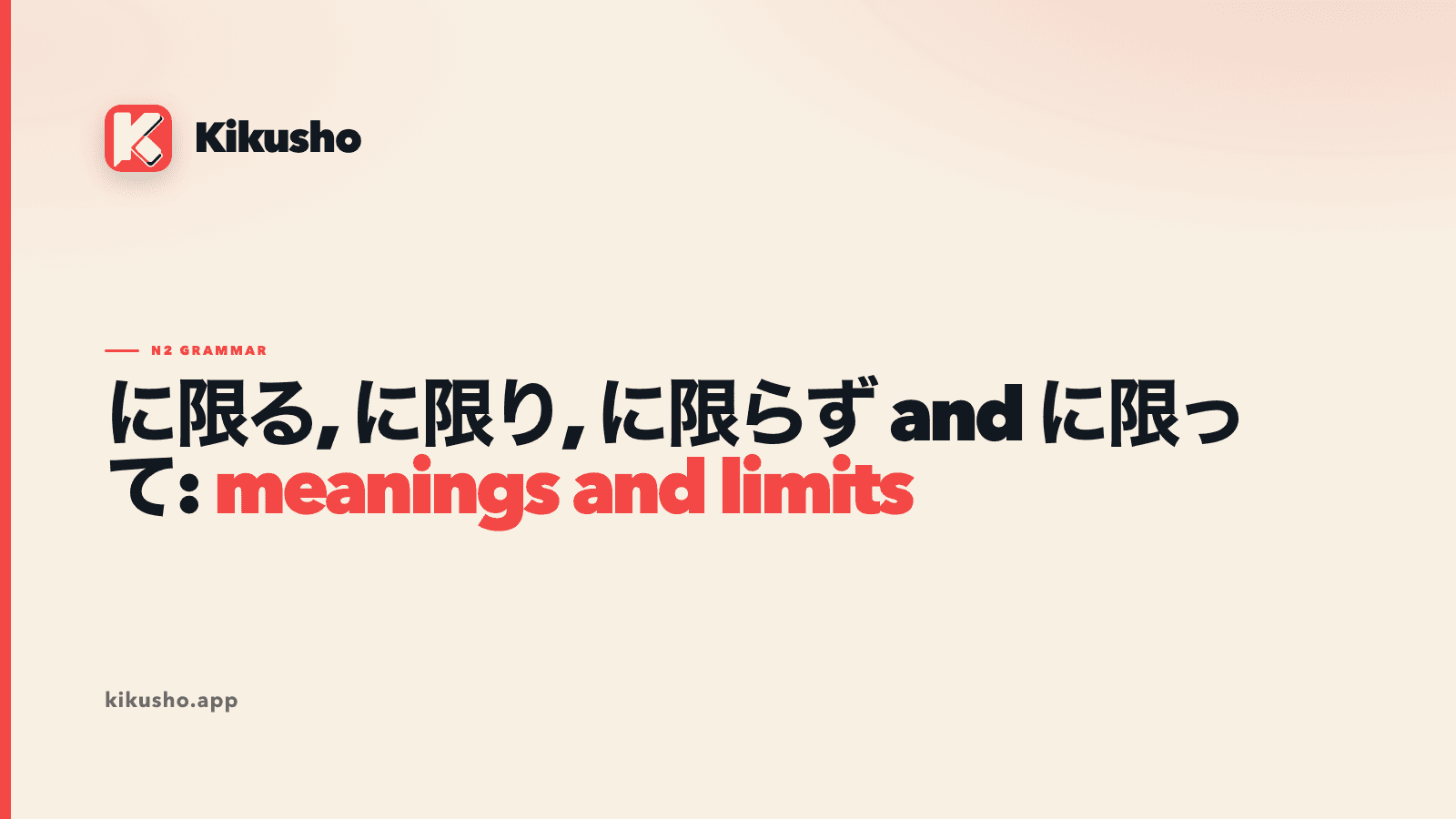
に限る can recommend a preferred choice or state a restriction; に限り restricts a case, while に限らず expands beyond it. に限って singles out a particular case, which may be a restriction, an unexpected occasion, or someone the speaker trusts not to do something.
This N2 grammar comparison teaches all four frames. The kanji 限 is read かぎ in them: にかぎる、にかぎり、にかぎらず、にかぎって. The useful first question is what the sentence does: recommend, restrict, widen, or single out a case against an expectation.
Level estimates differ. Bunpro and Japanese NET place the recommendation に限る at N3, while JLPT Sensei places it at N2. This page compares that earlier recommendation with the neighbouring restriction and exception frames; the labels are study estimates, not an exhaustive official syllabus.
Identify the purpose before translating 限る
| Frame | Main task in the sentence | What to check |
|---|---|---|
| に限る | Prefer one option, or limit the stated scope | Is this someone's choice, or a rule defining who or what qualifies? |
| に限り | Restrict an arrangement to a named case | Which date, group or condition receives the arrangement? |
| に限らず | Extend the scope beyond the named case | What else does the rest of the sentence include? |
| に限って | Single out a case | Is it a limited arrangement, an unexpected occasion, or a claim about a particular person? |
An ending gives you a frame, but the sentence supplies its purpose. A workshop notice about membership and a friend's opinion about the best way to tidy tools can both contain に限る. Translating both as “nothing beats” loses the rule in the notice.
The noun and verb slots differ
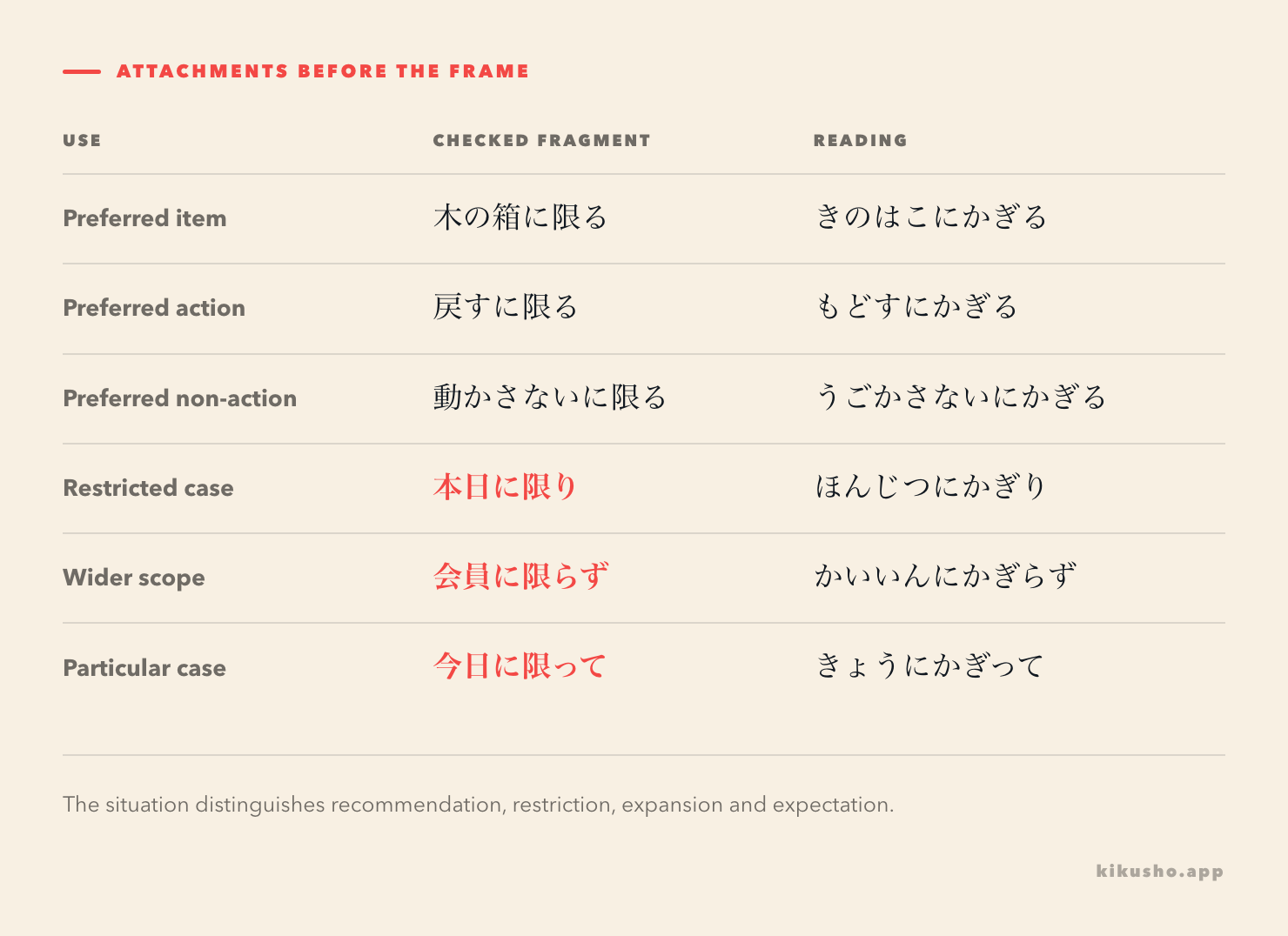
| Use | Attachment | Checked fragment |
|---|---|---|
| Preferred choice | Noun + に限る | 木の箱に限る — nothing beats a wooden box |
| Preferred action | Dictionary verb + に限る | 箱に戻すに限る — putting it back in the box is best |
| Preferred non-action | Plain negative verb + に限る | 動かさないに限る — best not to move it |
| Restricted case | Noun + に限り | 本日に限り — only today |
| Wider scope | Noun + に限らず | 会員に限らず — not limited to members |
| Particular case | Noun + に限って | 今日に限って — today in particular / today of all days |
Bunpro's attachment table and Japanese NET agree on nouns, dictionary verbs and ない forms for the recommendation. 戻しますに限る puts a polite verb in the wrong slot. 箱に戻すに限ります keeps plain 戻す before the frame and makes final 限る polite.
A whole description can modify the noun: 予約した方に限り (よやくしたかたにかぎり), “only for those who booked.” Here 方(かた), “person,” is the noun before に限り; 予約した modifies it. This does not establish a rule allowing any bare past verb before every frame.
The plain-negative reference explains the distinction between ない and ません separately.
に限る recommends what the speaker considers best
細かい道具をしまうなら、ふたのある箱に限る。
こまかい どうぐを しまうなら、ふたのある はこに かぎる。
“For storing small tools, nothing beats a box with a lid.”
A hobbyist prefers a lidded box. They are endorsing it as the best option in that situation, rather than announcing that every other container is forbidden. 細かい(こまかい) means small or fine here; しまう means put away.
A verb gives the preferred action: 迷ったら、道具を元の場所に戻すに限る (まよったら、どうぐを もとの ばしょに もどすに かぎる), “If you're unsure, putting the tools back where they belong is best.”
A negative gives the preferred non-action: 置き場所が決まるまでは、動かさないに限る (おきばしょが きまるまでは、うごかさないに かぎる), “Until we decide where it belongs, it's best not to move it.” The speaker recommends leaving the object in place. They are not claiming that moving it is impossible.
This is a strong preference in its context. It does not certify a universally best solution. Compare ものだ advice, which can invoke expected conduct instead of choosing a favoured option.
に限り restricts an arrangement to the named case
本日に限り、会議室を午後七時まで利用できます。
ほんじつに かぎり、かいぎしつを ごご しちじまで りようできます。
“Only today, the meeting room can be used until 7 p.m.”
A notice limits the stated arrangement to today. 本日(ほんじつ) is a notice-style word for “today”; 利用(りよう) means use. The sentence does not recommend today as the best day. It defines when this arrangement applies.
Japanese NET's に限り explanation presents this noun-based restriction. Maggie Sensei's comparison also covers a time-limited arrangement.
A group can be the condition: 会員の方に限り、道具を貸し出します (かいいんのかたに かぎり、どうぐを かしだします), “Tools are lent only to members.” The relevant limit is membership, not whether the tools are recommended. The shopping and service word set helps with the ordinary nouns surrounding rules like this.
The same restricted scope can appear with final に限る/に限ります: 貸し出しの対象は会員に限ります (かしだしの たいしょうは かいいんに かぎります), “Those eligible to borrow are limited to members.” 対象(たいしょう) identifies the eligible group. This is a rule, not praise for members. に限り commonly connects the restricted case to the following arrangement; final に限ります can state the limit itself.
Do not confuse 本日に限り with 本日のスープ, “today's soup.” The latter labels an item associated with today. It does not, by itself, announce how long an offer is available. The menu-reading guide lists that 本日の〜 label.
に限らず extends beyond the first case
この体験会には、会員に限らず、会員ではない方も参加できます。
この たいけんかいには、かいいんに かぎらず、かいいんではない かたも さんかできます。
“Not just members: people who are not members can also take part in this trial session.”
体験会(たいけんかい) is a trial or taster session; 参加(さんか) means participation. The second group expands the scope beyond the first. Membership is not the exclusive eligibility condition in this fictional notice.
Bunpro and Japanese NET teach the noun attachment and broader scope. も often marks an additional included case, but is not required in every sentence. 今日に限らず、毎日利用できます (きょうに かぎらず、まいにち りようできます), “It can be used every day, not just today,” supplies the wider time range instead.
That wider scope is still the one stated in the sentence. “Not limited to members” does not promise unrestricted use at any hour, free equipment, or admission without booking. Check the rest of the notice for separate conditions.
に限って can single out an inconvenient occasion
普段は八時まで開いているのに、今日に限って五時に閉まった。
ふだんは はちじまで あいているのに、きょうに かぎって ごじに しまった。
“It's usually open until eight, but today of all days it closed at five.”
The ordinary opening time establishes the expectation; today's earlier closure breaks it. 普段(ふだん) means usually, 開いている(あいている) is be open, and 閉まった(しまった) is closed. The speaker singles out the inconvenient case rather than prescribing a new rule for every day.
An event can modify a time noun: 材料を買いに行く日に限って、店が休みになる (ざいりょうを かいにいく ひに かぎって、みせが やすみに なる), “It's always on the days I go to buy materials that the shop is closed.” This is the speaker's complaint about a pattern. It need not establish a complete record of the shop's closing days.
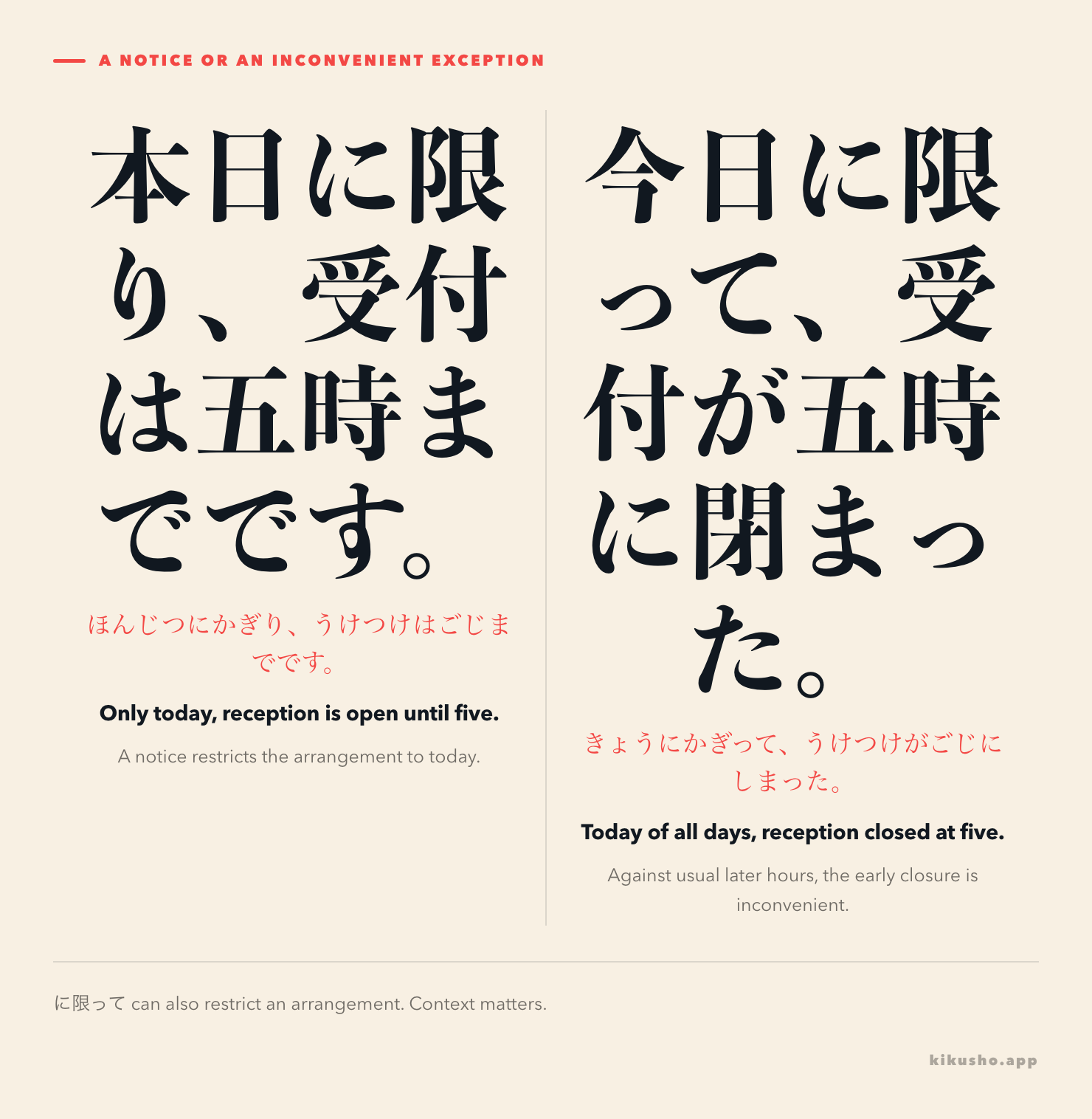
に限って can also restrict an arrangement: 火曜日に限って、受付は午後七時までです (かようびに かぎって、うけつけは ごご しちじまでです), “Only on Tuesdays, reception stays open until 7 p.m.” Given a schedule notice, に限り can express that restriction too. Do not make “に限って always means bad luck” your replacement rule.
に限って can express trust or an asserted tendency
佐藤さんに限って、提出日を忘れるはずがありません。
さとうさんに かぎって、ていしゅつびを わすれる はずが ありません。
“Sato, of all people, wouldn't forget the submission date.”
The speaker sees Sato as particularly unlikely to do it. The negative expectation comes from 忘れるはずがありません, not a negative conjugation of 限る. Japanese NET's に限って lesson covers this trust-based reading and unexpected occasions.
The claim reflects the speaker's confidence. It does not prove that Sato remembered the date. In a story, later evidence may contradict that confidence.
The same particular-case frame can assert a tendency: 「大丈夫」と言う人に限って、持ち物を忘れるんだ (「だいじょうぶ」と いう ひとに かぎって、もちものを わすれるんだ), “It's always the people who say ‘It'll be fine’ who forget their belongings.” Maggie Sensei discusses this use to contrast an apparent characteristic with what the speaker says happens. Here 持ち物(もちもの) means belongings. Treat the line as a character's generalisation, not a verified fact about everyone who says 大丈夫.
For a notice you meet on a door, Kikusho's photo capture can help you keep the limiting phrase with its date or group. When checking the proposed card, keep 本日に限り attached to the actual offer, or 会員に限らず attached to the groups included. A card that remembers only 限る and “limit” loses the decision the notice asks you to make.
Practice: choose the function in context
Complete all six questions before consulting the numbered solutions below them.
Question 1
The speaker recommends a first step when unsure how to tidy tools. Choose the verb form for that recommendation.
片付け方に迷ったら、まず道具を箱に( )に限る。
片付け方(かたづけかた): way of tidying; 迷う(まよう): be unsure; 戻す(もどす): put back.
- A. 戻して
- B. 戻します
- C. 戻す
- D. 戻した
Question 2
The trial session admits both members and people who are not members. Choose the phrase that keeps this broader eligibility.
この体験会には、会員( )、会員ではない方も参加できます。
- A. に限り
- B. に限って
- C. に限る
- D. に限らず
Question 3
Arrange every fragment once. Which letter fills ★?
紙をまっすぐ切るなら、 __ __ ★ __。
まっすぐ: straight; 定規(じょうぎ): ruler.
- A. 定規を
- B. に
- C. 使う
- D. 限る
Question 4
Complete the sentence stating a members-only eligibility rule. Give the letter at ★ after arranging all four fragments.
参加できるのは __ __ ★ __。
- A. に
- B. 限ります
- C. 方
- D. 会員の
Question 5
Read this fictional account and choose the interpretation that preserves its contrast.
普段は午後八時まで開いている店が、今日に限って午後五時に閉まっていました。仕事の後で寄るつもりだったのに、残念です。
寄る(よる): stop by; 残念(ざんねん): disappointing.
- A. The shop permanently changed its closing time to five every day.
- B. The speaker recommends five as the best time for everyone to visit.
- C. Every shop in the area is required to close at five.
- D. The shop's earlier closing today conflicts with its usual hours and the speaker's plan.
Question 6
Read the speaker's comment about a reliable colleague.
佐藤さんはいつも締め切りを守っています。佐藤さんに限って、提出日を忘れるはずがありません。まず、連絡して確認しましょう。
締め切り(しめきり): deadline; 提出日(ていしゅつび): submission date; 確認(かくにん): check.
What does the speaker express?
- A. Sato alone is permitted to submit the work.
- B. Sato forgets submission dates on every occasion.
- C. Sato is particularly unlikely to forget, in the speaker's judgement; the speaker still proposes checking.
- D. Contacting Sato is forbidden by the rule.
Answers and explanations
Answer 1. C. 箱に戻すに限る (はこに もどすに かぎる) recommends putting the tools back in the box. 戻す is the dictionary form. A links an action with て but does not supply the required recommendation attachment; B puts polite ます before the frame; D supplies past 戻した where this recommendation takes a plain nonpast form. The speaker prefers this first step, rather than reporting a completed action.
Answer 2. D. 会員に限らず、会員ではない方も参加できます (かいいんに かぎらず、かいいんではないかたも さんかできます) expands participation beyond members. A restricts the arrangement to members; B would single out members and does not supply this inclusive connection; C neither connects the clauses correctly here nor expresses the required expansion. The explicitly included nonmembers prevent a members-only reading.
Answer 3. B. The order is A → C → B → D: 紙をまっすぐ切るなら、定規を使うに限る (かみを まっすぐ きるなら、じょうぎを つかうに かぎる), “For cutting paper straight, using a ruler is best.” 定規を supplies the object, 使う the preferred action, and に限る the frame. B is the third fragment; the remaining pieces cannot replace that particle there.
Answer 4. A. The order is D → C → A → B: 参加できるのは会員の方に限ります (さんかできるのは かいいんのかたに かぎります), “Participation is limited to members.” 会員の modifies 方, then に限ります states the restricted eligibility. A is third. This final に限ります is a rule about scope, not the recommendation “members are best.”
Answer 5. D. 今日に限って singles out today's exceptional early closure against the ordinary eight o'clock closing time. The next sentence explains why it is inconvenient: the speaker intended to visit after work. A invents a permanent change, B replaces the complaint with a recommendation, and C invents a rule for other shops. None is supplied by the passage.
Answer 6. C. 佐藤さんに限って singles out someone the speaker trusts; 忘れるはずがありません expresses their negative expectation. The preceding sentence supplies their reason, and the last sentence proposes checking. A invents an eligibility rule, B reverses the expectation, and D invents a prohibition. Confidence about Sato is not itself proof that the work was submitted.
Common questions
Does に限る always mean that something is best?
No. In a recommendation, noun or plain nonpast verb plus に限る expresses the speaker's preferred choice. In a rule such as 対象は会員に限る, it means that the scope is restricted to members. The situation distinguishes the readings.
What is the difference between に限り and に限らず?
Noun plus に限り restricts an arrangement to that case, as in 本日に限り, only today. Noun plus に限らず says that the named case is not the full scope; the rest of the sentence supplies the wider range or additional cases.
Does に限って always express bad luck?
No. It can restrict a case, single out an unexpected occasion, or identify someone whom the speaker considers especially unlikely to do something. The following statement and surrounding situation determine its function.
Why is に限る taught at both N3 and N2?
Bunpro and Japanese NET label the recommendation N3; JLPT Sensei labels it N2. These are reference-site estimates. The JLPT does not publish an exhaustive official grammar syllabus.