On this page
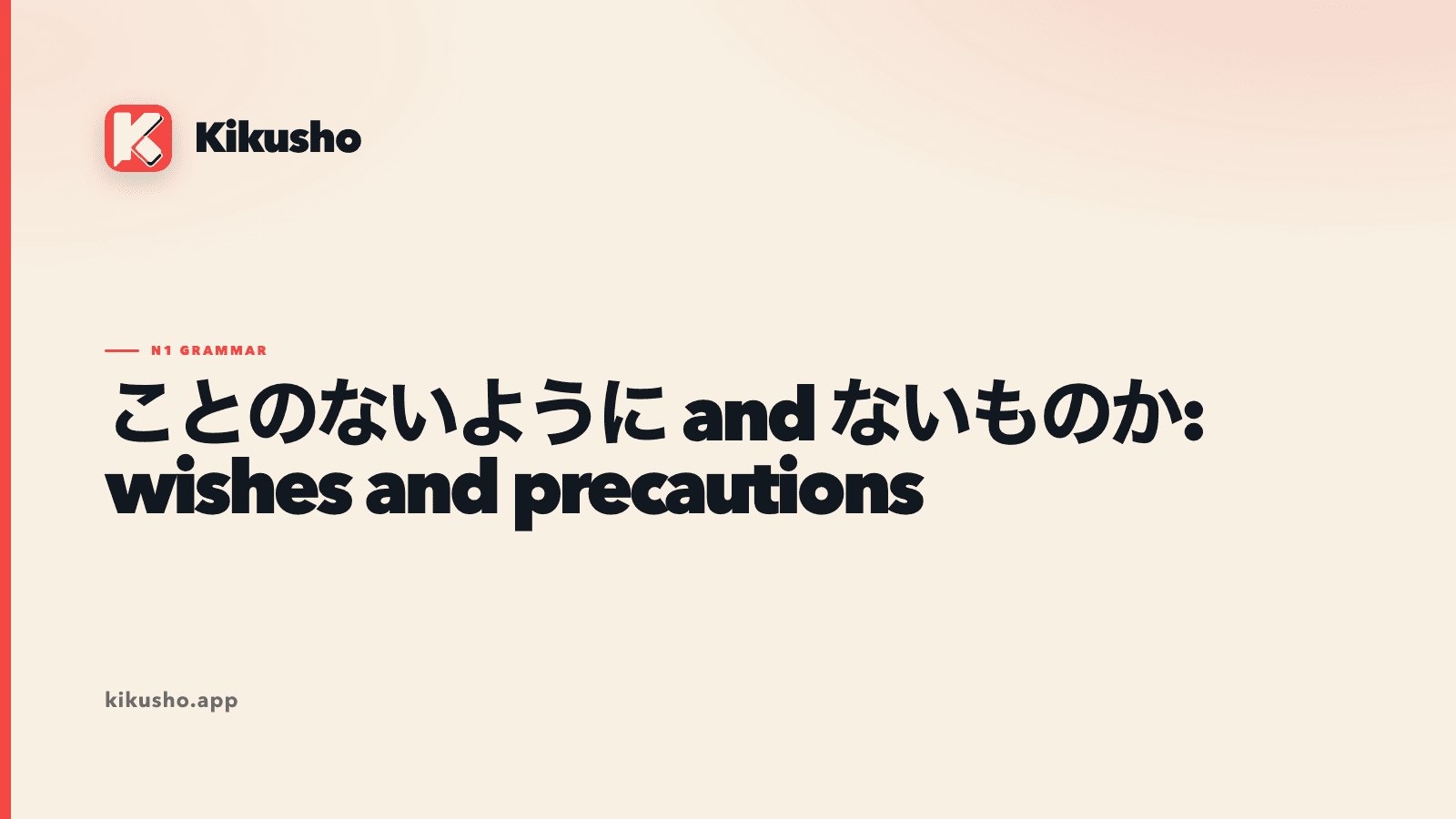
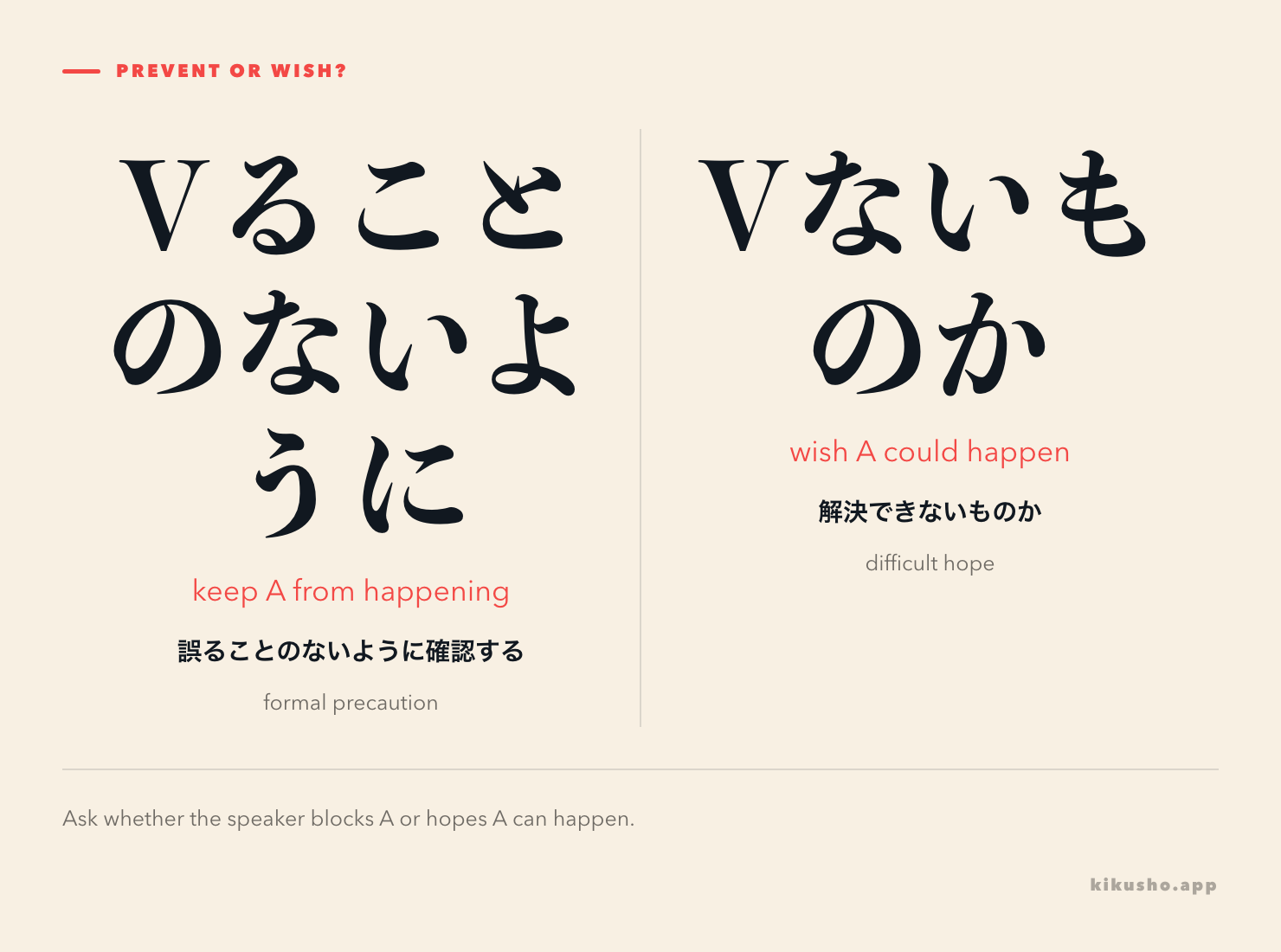
Use Vることのないように when someone takes a formal precaution so that an unwanted event will not occur. Use Vないものか/Vないものだろうか when the speaker hopes that a difficult change might somehow become possible.
今後、同じ誤解が生じることのないように、説明を追加した。
こんご、おなじ ごかいが しょうじる ことの ないように、せつめいを ついかした。
We added an explanation so that the same misunderstanding would not arise again.
この誤解を何とか解けないものだろうか。
この ごかいを なんとか とけない ものだろうか。
Is there some way we might clear up this misunderstanding?
Both expressions contain ない, but their directions are opposite. The first aims to keep an event out of reality. The second wants a presently unrealized event to enter reality.
This lesson reviews g-0a86b453e24e, ことのないように, and g-79f557237d49, ないものか/ないものだろうか. JLPT Sensei and Nihongo-bu place the first at N1. JLPT Sensei, Bunpro and the TRY! N1 syllabus place the wish pattern at N1, while Tanosuke and some other teaching series label it N2. These are editorial estimates because the JLPT publishes no exhaustive grammar list.
One prevents A; the other longs for A
| Speaker's goal | Form | Role of A | Typical continuation |
|---|---|---|---|
| prevent an unwanted event | V dictionary + ことのないよう(に)、B | A must not happen | B is a precaution, instruction or preparation |
| wish for a difficult event | Vない + ものか/ものだろうか | A is desirable but not yet realized | sentence often ends here or continues with と思う |
Read the verb before deciding what the sentence wants. 忘れることのないようにメモする makes a note to prevent forgetting. 問題を解決できないものか asks whether some way of solving a problem might exist. The shared negative element does not give them a shared intention.
ことのないように builds a formal safeguard
Put a dictionary-form verb before ことのないよう(に):
| Event to prevent | Precaution frame | Natural result |
|---|---|---|
| 忘れる | 忘れることのないように | メモしておく |
| 間違える | 間違えることのないように | 二人で確認する |
| 被害が広がる | 被害が広がることのないように | 早めに避難させる |
| 混乱が生じる | 混乱が生じることのないよう | 手順を統一する |
書類を取り違えることのないように、番号を確認してください。
しょるいを とりちがえる ことの ないように、ばんごうを かくにんして ください。
Please check the number so that you do not mix up the documents.
利用者が不利益を受けることのないよう、制度を見直す必要がある。
りようしゃが ふりえきを うける ことの ないよう、せいどを みなおす ひつようが ある。
The system needs to be reviewed so that users do not suffer a disadvantage.
Nihongo-bu gives the attachment as V辞書形+ことのないように and describes it as a somewhat formal way to give a caution. It also shows both ように and よう. Dropping に before the following clause is common in formal directions; it does not turn the expression into a different grammar point.
The verb is affirmative in shape because it names the event being guarded against. The negation belongs to のない. Writing 忘れないことのないように creates a confusing double negative and does not mean the ordinary “so that you do not forget.”
The action after ように supplies the preventive move
The clause after ことのないように often gives a controllable measure: check, prepare, revise, warn, protect or make a habit of something. It answers “what will we do to stop A?”
緊急時にも連絡が途切れることのないように、予備の回線を用意している。
きんきゅうじにも れんらくが とぎれる ことの ないように、よびの かいせんを よういしている。
We keep a backup line so that communication will not be cut off even in an emergency.
The backup line can affect the feared result. By contrast, 地震が起こることのないように祈る is grammatically interpretable as a wish, but there is no practical safeguard in the second clause. If the point is simply personal hope, 地震が起こらないように祈る is the plainer choice. The longer construction is most informative when an institution or person takes a concrete measure against a risk.
The shorter ないように purpose pattern works in everyday speech: 忘れないようにメモした. Adding ことの makes the unwanted occurrence itself more explicit and gives the instruction a careful, often written tone. It is useful in manuals, notices, policy statements and formal promises.
ないものか turns a negative question into hope
Attach ものか or ものだろうか to a verb in the negative form:
| Base idea | Wish form | What the speaker wants |
|---|---|---|
| 解決できる | 解決できないものか | a solution to become possible |
| 費用が下がる | 費用が下がらないものだろうか | the cost to decrease |
| 誰かが助けてくれる | 誰か助けてくれないものか | someone to help |
| 方法がある | もっと良い方法はないものか | a better method to exist |
待ち時間をもう少し短くできないものだろうか。
まちじかんを もうすこし みじかく できない ものだろうか。
Is there no way to make the waiting time a little shorter?
失われた記録を何とか復元できないものかと、専門家に相談した。
うしなわれた きろくを なんとか ふくげんできない ものかと、せんもんかに そうだんした。
Hoping there might be some way to restore the lost records, I consulted a specialist.
The pattern often favors potential verbs and changes that are not under the speaker's immediate control. 何とか, どうにか, もう少し and もっと make the frustrated hope explicit. Tanosuke notes the frequent pairing with potential or non-volitional predicates and the sense that realization is difficult, but still strongly desired.
ものだろうか sounds more reflective than short ものか. Polite ものでしょうか can soften the presentation, while ものかな and ものかしら occur in more conversational self-questioning. The choice changes tone, not the underlying wish for A.
もの frames the wish as a wider problem
The Japan Foundation's account of もの compares 減らしてもらえないだろうか with 減らしてもらえないものだろうか. Adding もの presents the issue more objectively or generally. The speaker is not merely asking a direct favor; they are contemplating whether the desired state can somehow be achieved.
That distance explains why the form is common in proposals, opinion writing and complaints about a stubborn situation:
地域全体で食品ロスを減らせないものだろうか。
ちいき ぜんたいで しょくひんロスを へらせない ものだろうか。
Could we somehow reduce food waste across the whole community?
This may still imply a request, but it is not a direct command to the listener. If you need someone to act, 減らしていただけませんか asks them directly. 減らせないものだろうか raises the desired change as a problem to consider.
Negative ないものか and affirmative ものか point apart
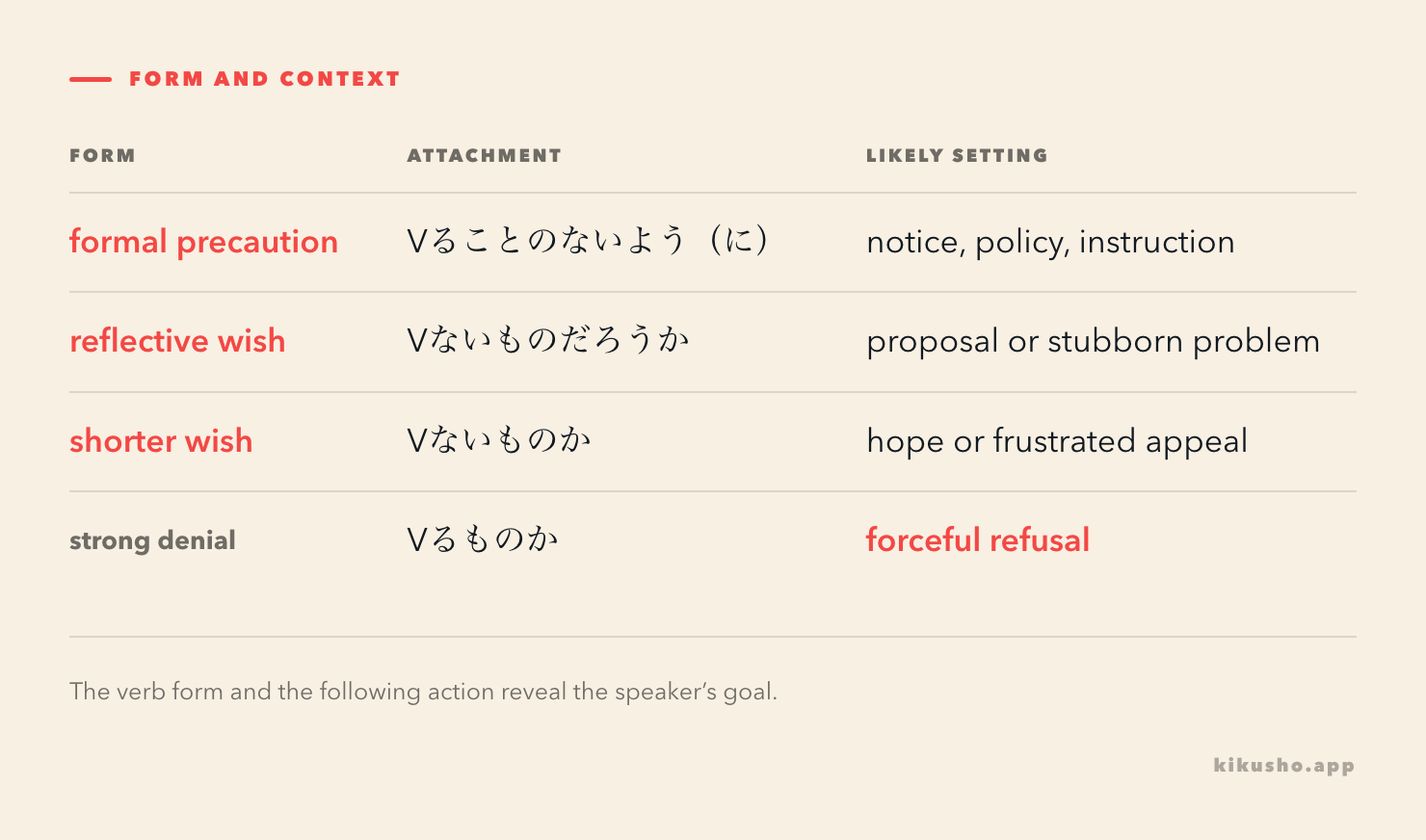
Do not remove ない and keep the same translation:
何とか参加できないものか。
If only there were some way I could participate.
そんな会議に参加するものか。
There is no way I am attending such a meeting.
The first begins with the negative form できない and uses a negative question to lean toward the positive possibility: the speaker wants to participate. The second attaches ものか to affirmative 参加する and forcefully rejects the proposition. Intonation and context matter, but the attachment is the quickest reliable clue.
The Japan Foundation explicitly separates ないものだろうか, which expresses hope for realization, from plain ものか, which can express strong denial. The ものだ and ものではない lesson covers other sentence-final uses of もの; one translation for every もの construction will not survive real text.
For Kikusho, capture the whole decision-bearing span. A card with ものか alone hides whether the verb was 参加する or 参加できない. Keep 何とか参加できないものか together, and compare it with 参加するものか before saving. That contrast makes the intended direction visible during later FSRS reviews.
Practice: identify the event the speaker wants
Question 1 · grammar choice. Complete the formal instruction: 入力内容を誤る__、送信前にもう一度確認してください。
① ないものか
② ことのないように
③ ものか
④ ことなしには
Question 2 · meaning. What does この混雑を何とか解消できないものだろうか express?
① A precaution that prevents congestion
② A firm refusal to reduce congestion
③ A difficult wish to find a way to relieve congestion
④ A report that congestion has already disappeared
Question 3 · attachment. Which form correctly asks whether a cheaper method might be possible?
① もっと安い方法にすることのないように。
② もっと安い方法はないものだろうか。
③ もっと安い方法があるものか。
④ もっと安い方法なしには。
Question 4 · connected text. A hospital adds a second identity check after a near miss. Complete: 今後、患者を取り違える__、確認手順を改めた。
① ものか
② ないものか
③ ことのないように
④ ことがあるように
Question 5 · interpretation. Compare もう少し早く終えられないものか with こんな仕事を続けるものか. Which event does the speaker desire in each sentence?
Question 6 · sentence composition. Arrange 何とか/負担を/減らせない/ものだろうか into a complete reflective wish. Give the piece that appears third.
Question 7 · rewrite. Rewrite conversational 同じ間違いをしないように、手順を確認した with the more formal precaution pattern.
Answers and explanations
Why the first sentence needs a safeguard
② ことのないように. 誤る is the dictionary-form event to prevent, and checking before submission is the practical precaution.
Explanation for Question 2
③. The speaker wants congestion to be relieved but presents the change as difficult. 何とか reinforces the search for a possible way.
Explanation for Question 3
②. Existential ない supplies the negative clause, and ものだろうか turns it into reflective hope. The other choices either express prevention, forceful denial or an unfinished condition.
Explanation for Question 4
③ ことのないように. The hospital changes a controllable procedure to stop another patient mix-up from occurring. That preventive action licenses the formal frame.
Explanation for Question 5
In 早く終えられないものか, the speaker wants the work to finish earlier. In 続けるものか, affirmative 続ける before ものか is rejected: the speaker does not intend to continue the work.
Explanation for Question 6
何とか負担を減らせないものだろうか。 The order is 何とか → 負担を → 減らせない → ものだろうか, so the third piece is 減らせない.
Explanation for Question 7
同じ間違いをすることのないように、手順を確認した。 The unwanted event appears as dictionary-form する plus ことのないように; the following check is the safeguard.
Minion 7 checked both assigned items, every attachment, the preventive and wish directions, the N1/N2 placement disagreement, the strong-denial boundary, all original Japanese and the reasoning for the seven tasks. This was an AI language review, without a human or native-speaker reviewer.
Common questions
What is the difference between ことのないように and ないものか?
ことのないように introduces a formal precaution taken to stop an unwanted event. ないものか or ないものだろうか voices a wish that a difficult but desirable event might become possible.
What form comes before ことのないように?
Use the dictionary form of a verb: 忘れることのないように, not 忘れないことのないように. The whole expression makes the occurrence of that verb the event to prevent.
Why is ないものか different from ものか?
Vないものか is a negative question that can express a difficult wish, such as 解決できないものか. Plain Vるものか commonly expresses forceful denial or refusal, such as 二度と行くものか.
Is ないものか N1 or N2?
Study guides disagree. JLPT Sensei, Bunpro and TRY! place it at N1, while Tanosuke and some other teaching series place it at N2. The JLPT does not publish an exhaustive official grammar list.