On this page
までだ limits what an action amounts to; くらいのものだ limits who or what qualifies. With a dictionary-form verb, までだ/までのことだ often means “then I will just do that.” With a past-form verb, it means “I merely did that.” By contrast, Xくらいのものだ presents X as virtually the only member of a narrow set.
JLPT Sensei places both constructions at N1, as do the other dedicated references consulted for this lesson. These are study-resource estimates rather than an official JLPT grammar list. The useful distinction is semantic: までだ closes down an action's alternatives or implications, while くらいのものだ closes down a category.
Three limits that look similar in English
All three patterns may be translated with “just” or “only,” but they answer different questions.
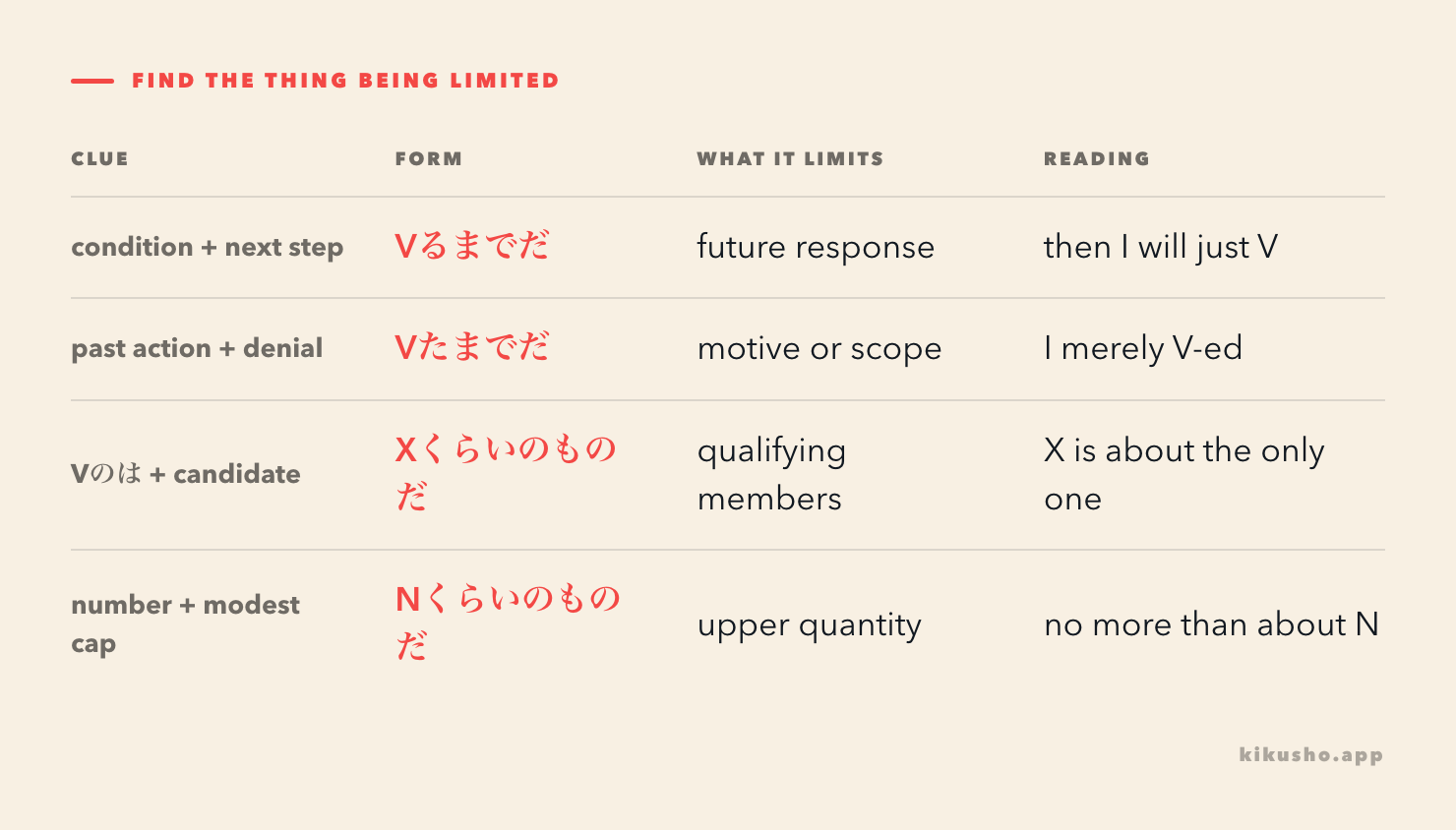
| Form | What is limited? | Core reading |
|---|---|---|
| V dictionary + までだ/までのことだ | the response still available | If necessary, I will just V. |
| V past + までだ/までのことだ | the meaning or motive of a completed action | I merely V-ed; that is all. |
| X + くらい/ぐらいのものだ | the people, things, times or quantity that qualify | X is about the only one; no more than roughly X. |
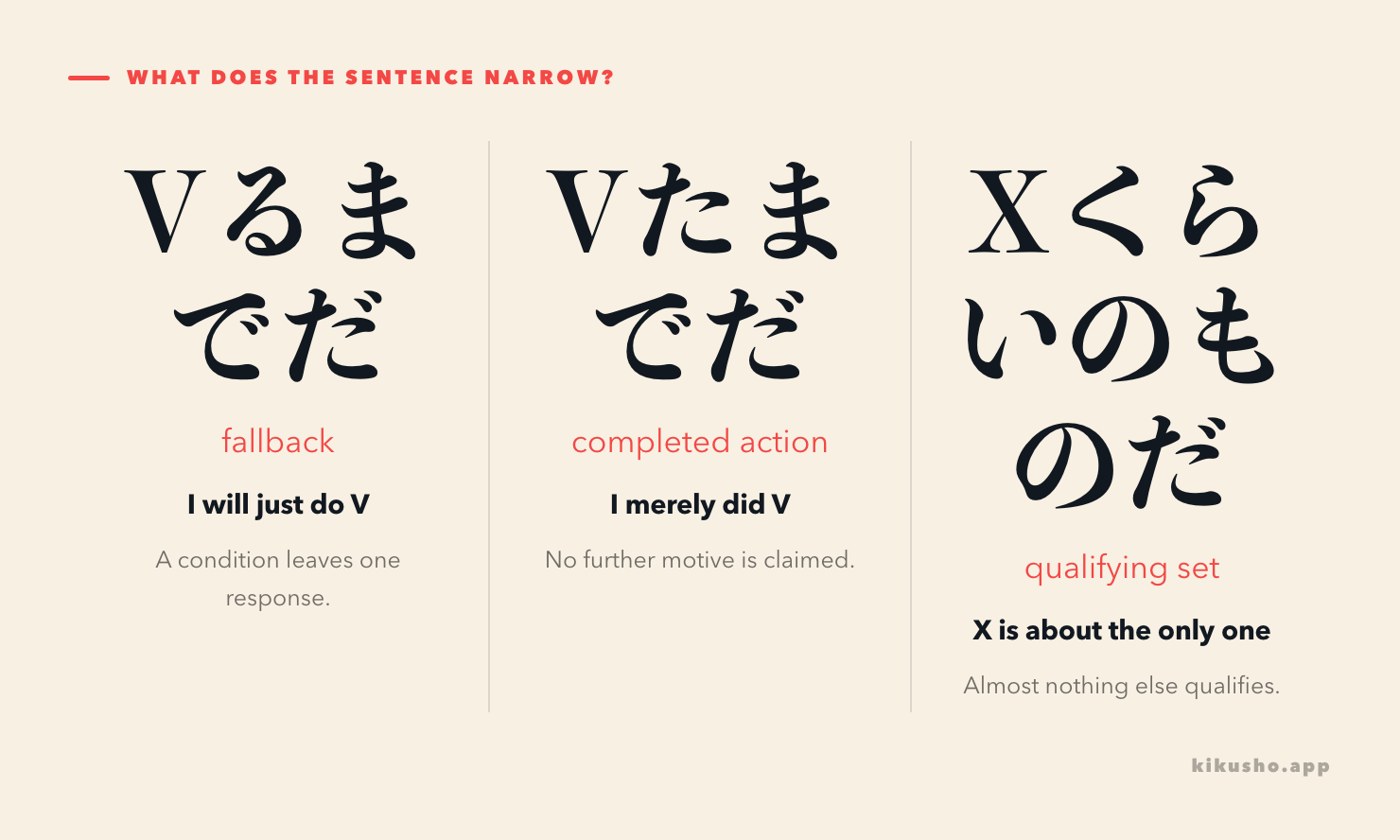
The verb tense before までだ does real interpretive work. Compare these two sentences:
誤解されるなら、事実を説明するまでだ。
ごかいされるなら、じじつをせつめいするまでだ。
If I am misunderstood, I will simply explain the facts.
聞かれたので、知っていることを説明したまでだ。
きかれたので、しっていることをせつめいしたまでだ。
I merely explained what I knew because I was asked.
The first speaker looks ahead to a response. The second looks back and denies a hidden motive or larger significance. An English translation that uses “just explain” for both can hide this contrast.
Vるまでだ presents the remaining fallback
Attach までだ or までのことだ to a dictionary-form verb when a condition leaves one straightforward course of action.
この案が通らなければ、条件を変えて出し直すまでのことだ。
このあんがとおらなければ、じょうけんをかえてだしなおすまでのことだ。
If this proposal is not accepted, we will simply change the conditions and submit it again.
The condition often appears with なら, たら, ば, ても or としても. The speaker reduces the fallback to a simple decision: if A happens, doing B is all that remains. Hedgehog Japanese describes this as a response or final means, and JLPT Sensei gives the same conditional pattern.
電車が止まっても、歩いて帰るまでです。
でんしゃがとまっても、あるいてかえるまでです。
Even if the trains stop, I will simply walk home.
This does not literally mean that walking is easy. It presents the decision as settled and removes the need for further debate. Depending on context, that stance can sound calm, resolute or blunt. までのことだ is a slightly fuller version of the same construction; politeness appears at the end as までです/までのことです.
Do not confuse this with Vるまでもない, which marks V as an excessive step. 歩いて帰るまでだ chooses walking as the fallback. 歩いて帰るまでもない rejects walking as unnecessary. Our lesson on までもない develops that no-need scale.
Vたまでだ reduces a completed action to its stated reason
After a past-form verb, までだ/までのことだ says that the completed action was nothing more than what the speaker states.
私は資料を整理したまでで、内容を分析したわけではありません。
わたしはしりょうをせいりしたまでで、ないようをぶんせきしたわけではありません。
I merely organized the documents; I did not analyze their contents.
The continuation までで connects the limited claim to a contrast. Phrases such as わけではない, 特別な意味はない and ほかの意図はない often make the denied implication explicit.
困っているようだったから、声をかけたまでです。
こまっているようだったから、こえをかけたまでです。
They seemed to be having trouble, so I merely spoke to them.
This reading can defend the speaker against an accusation, explain a narrow role, or modestly downplay a kind action. N1et records both the explanatory and modest uses, while にほんご部 gives Vた + まで(のこと)だ as the “merely did” pattern. It is more deliberate and weighty than ordinary だけです, though it can appear in conversation when someone is clarifying motives.
The pattern does not automatically make the speaker's claim true. 頼まれたから伝えたまでだ presents “I was asked” as the whole explanation; another person may still suspect a motive. Grammar tells us how the speaker frames the action, not whether the defense is convincing.
くらいのものだ leaves one plausible member in the set
Use Xくらいのものだ or Xぐらいのものだ when X is virtually the only person, thing, time or case that meets a condition. くらい and ぐらい are interchangeable here.
この古い時計を直せるのは、祖父くらいのものだ。
このふるいとけいをなおせるのは、そふくらいのものだ。
My grandfather is about the only person who can repair this old clock.
The common frame Vのは Xくらいのものだ first defines a set with Vのは, then narrows the qualifying members to X. “About the only” is often better than an absolute “the only”: the speaker makes an emphatic practical judgment without proving that no exception exists anywhere.
この村で夜遅くまで開いているのは、駅前の店ぐらいのものだ。
このむらでよるおそくまであいているのは、えきまえのみせぐらいのものだ。
The shop by the station is about the only place in this village open late.
J-Nihongo explains the construction as emphasizing that almost no other person, time or thing meets the condition. JLPT Sensei likewise illustrates people, occasions and places as the narrow remaining member.
The construction can also cap an approximate quantity:
この会場に入れるのは、せいぜい五十人くらいのものだ。
このかいじょうにはいれるのは、せいぜいごじゅうにんくらいのものだ。
At most, only about fifty people can fit in this venue.
Here 五十人くらい supplies an approximation, while のものだ reinforces the modest upper bound. Do not assume that every ordinary approximation needs のものだ. 五十人くらい来た simply means “about fifty people came.” The longer form adds the speaker's limiting judgment.
Keep three neighbouring expressions separate
それまでだ is a fixed boundary expression meaning “that is the end of it” or “then it is all for nothing.” It does not use a verb to present a fallback or explain a completed action.
どれほど準備しても、当日寝坊すればそれまでだ。
No matter how much you prepare, if you oversleep on the day, it is all for nothing.
Plain だけだ is broader and usually more neutral. 質問しただけです can simply report “I only asked.” 質問したまでです more strongly closes off an inferred motive: asking was the full extent of the action.
Finally, ものだ has several independent uses, including general truths and recollection. In くらいのものだ, it belongs to the limiting construction; do not read the sentence as a general-truth ものだ merely because the ending looks identical. The four-use guide to ものだ provides the wider map.
Practice
Choose by the form before までだ and by what the sentence limits. All answers appear together after Question 7.
Question 1
The speaker has a fallback if negotiations fail. Choose the best completion.
交渉がまとまらなければ、別の会社を探す____。
ア. くらいのものだ
イ. までのことだ
ウ. たまでだ
エ. までもない
Question 2
The speaker denies having a special motive. Choose the best completion.
私は事実を確認するために電話し____。責めるつもりはなかった。
ア. たまでだ
イ. るまでだ
ウ. くらいのものだ
エ. それまでだ
Question 3
Only Ms. Mori is realistically able to read the damaged document. Choose the completion.
この古い文書を読めるのは、森さん____。
ア. までのことだ
イ. までもない
ウ. くらいのものだ
エ. たまでだ
Question 4
What does 断られても、方法を変えてもう一度頼むまでだ primarily express?
ア. The speaker already asked twice.
イ. Asking again would be unnecessary.
ウ. The speaker treats asking again as the remaining response.
エ. Only one person can make the request.
Question 5
Arrange all fragments to say “I merely passed on what I heard.”
聞いたことを、__ __ __ __。
- 伝え
- です
- た
- まで
Question 6
Complete the sentence with くらいのものだ and translate it naturally.
この時間に開いている薬局は、駅の中の店____。
Question 7
Choose the pair that preserves both intended limits.
雨が強くなれば、試合を延期する( ① )。私は決定を伝えた( ② )で、延期を提案したわけではない。
ア. ① くらいのものだ / ② まで
イ. ① までのことだ / ② まで
ウ. ① までもない / ② くらいのもの
エ. ① それまでだ / ② までもない
Answers and explanations
Answer 1
イ. までのことだ. The dictionary-form 探す presents finding another company as the remaining fallback after failed negotiations. までもない would say that searching is unnecessary, which reverses the intended meaning.
Answer 2
ア. たまでだ. The action is already complete, and the next sentence rejects an inferred intention. 電話したまでだ therefore means “I merely called.” Dictionary-form 電話するまでだ would look ahead to a fallback.
Answer 3
ウ. くらいのものだ. 読めるのは defines the qualifying set, and 森さんくらいのものだ reduces it to Ms. Mori as virtually the only plausible member.
Answer 4
ウ. The speaker treats asking again as the remaining response. 頼む is in dictionary form, and 断られても supplies the condition. The construction expresses resolve about what the speaker will do next.
Answer 5
1 → 3 → 4 → 2: 聞いたことを、伝えたまでです。 The past form 伝えた marks a completed action whose scope the speaker minimizes. The polite ending is です; the verb before the construction does not become polite.
Answer 6
この時間に開いている薬局は、駅の中の店くらいのものだ。 A natural translation is “The pharmacy inside the station is about the only one open at this hour.” The noun identifies the virtually sole member of the set defined before は.
Answer 7
イ. ① までのことだ / ② まで. 延期するまでのことだ presents postponement as the fallback if the rain intensifies. 伝えたまでで limits the speaker's completed role to conveying the decision, and the following わけではない rejects the broader inference that the speaker proposed it.
Common questions
What is the difference between までだ and くらいのものだ?
までだ limits the meaning of an action or presents an action as the remaining fallback. くらいのものだ limits a set, saying that X is virtually the only person, time or thing that qualifies.
Why can までだ follow both a dictionary-form and a past-form verb?
Vるまでだ normally presents a future response as the simple fallback: if the condition occurs, the speaker will just do V. Vたまでだ looks back and says the speaker merely did V, with no further motive or significance.
Are くらいのものだ and ぐらいのものだ different?
The two pronunciations ordinarily express the same limiting judgment. Both can identify the only plausible member of a set; context can also produce a modest upper estimate such as about that many at most.
Is までだ the same as までもない?
No. Vるまでだ says that doing V is the remaining response. Vるまでもない marks doing V as an excessive or unnecessary step.