On this page
一週間で、ずいぶん大きな模型を作ったものですね admires an impressive completed model, rather than recalling an old habit. ものだ can express recollection, a general expectation, norm-based advice, or reflective surprise; ものではない can warn that an action should not be done.
This N2 grammar lesson teaches both constructions, including ものです, conversational もんだ/もんじゃない, and the adjective endings they require. 模型(もけい) means “model,” and 一週間(いっしゅうかん) means “one week.” In the opening, someone is speaking to the model's maker: “That's quite a large model you've built in a week.” The past 作った locates the making in the past; the comment's purpose is admiration.
Level lists differ. Japanese NET's main ものだ lesson is labelled N2, whereas Bunpro's expectation lesson and its separate recollection lesson are N3. Those labels help order study; they are not an exhaustive official JLPT syllabus.
ものだ presents a view of the situation
The four functions share a speaker who is looking back, recognising a pattern, invoking a norm, or reflecting on what happened. You cannot translate every occurrence as “must,” and you cannot select the function from tense alone.
| Function | What to look for | What the ending adds |
|---|---|---|
| Recollection | An earlier period, repeated actions or a former state | Looking back on how things used to be |
| General expectation | A type of situation or a usual characteristic | “That is how it generally is” |
| Advice | An action presented as appropriate conduct | “That is what one ought to do” |
| Admiration or surprise | Something considered remarkable in context | “It really is something that…” |
A general expectation and advice can overlap: someone can state a norm in order to correct you. The sentence does not become an objectively established law because it ends in ものだ. Ask what the speaker is trying to do with it.
Use plain forms before もの and politeness at the end
For a verb, retain the plain form needed by the meaning. For an い-adjective, retain い. For a nonpast な-adjective, put な before もの.
| Attachment | Checked form | Reading |
|---|---|---|
| Dictionary-form verb + ものだ | 返すものだ | かえすものだ |
| Plain past verb + ものだ | 返したものだ | かえしたものだ |
| い-adjective + ものだ | 難しいものだ | むずかしいものだ |
| な-adjective + なものだ | 静かなものだ | しずかなものだ |
| Dictionary-form verb + ものではない | 壊すものではない | こわすものではない |
Bunpro's structure table confirms the nonpast attachments. The Japan Foundation's teaching explanation also includes plain past forms when recalling an earlier state.
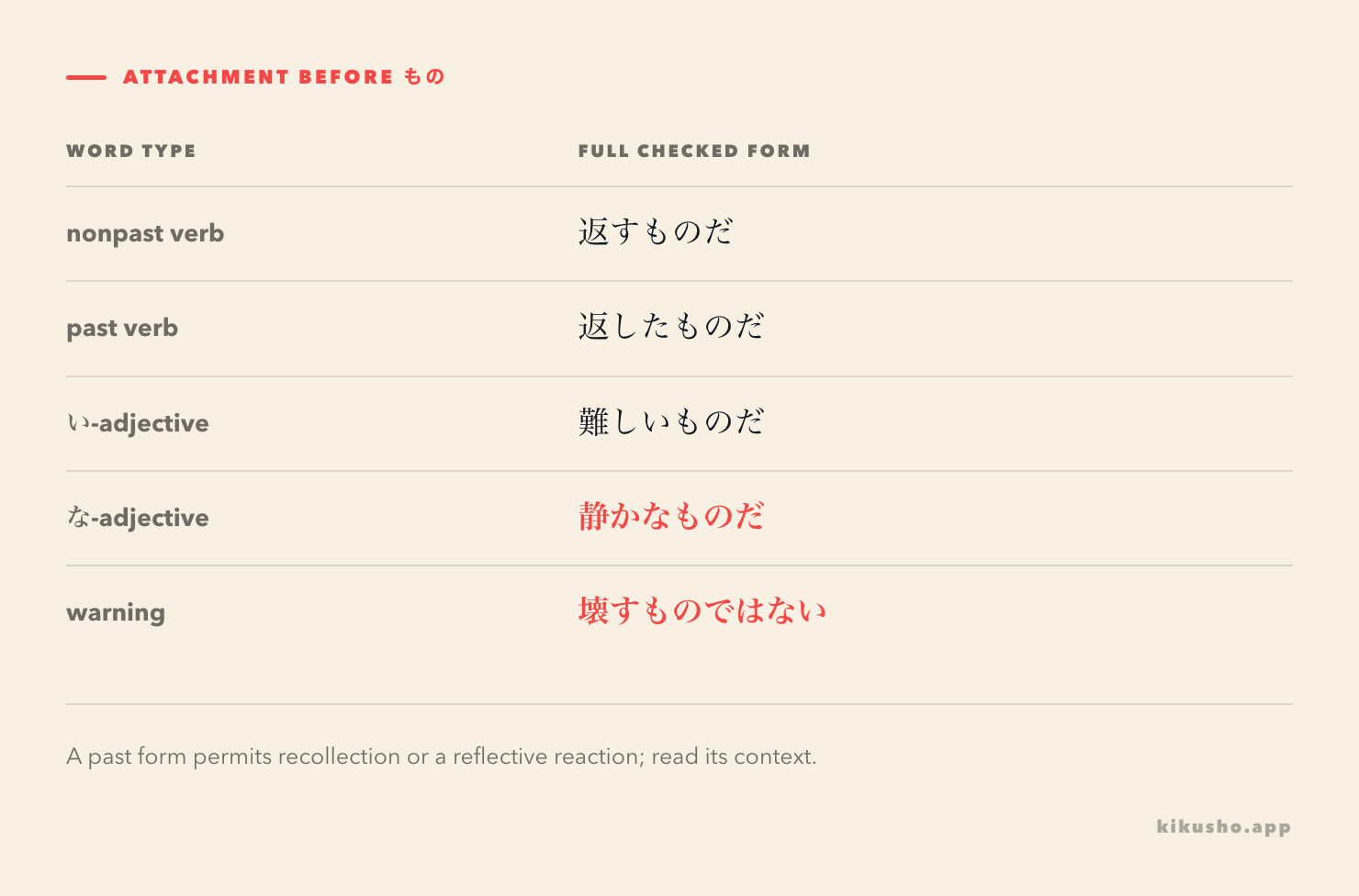
A past な-adjective becomes 静かだったものだ. It does not keep nonpast な after だった. A plain negative can also precede ものだ, as in 壊れないものだ (こわれないものだ), describing something that generally does not break. That differs from a warning against someone breaking it.
For polite speech, 難しいものです keeps the adjective and changes final だ → です. 返しますものだ inserts a polite verb into the wrong slot. The です and だ reference explains that final distinction separately.
Recollection looks back at an earlier habit or state
小学生の頃は、毎週土曜日に祖父と模型を作ったものだ。
しょうがくせいの ころは、まいしゅう どようびに そふと もけいを つくったものだ。
“When I was in primary school, I used to make models with my grandfather every Saturday.”
The speaker remembers a recurring activity from childhood. 毎週土曜日, every Saturday, establishes the repetition. The ending adds a backward-looking feeling that an ordinary past report need not carry.
The remembered situation can be a state: 以前は、この通りも静かだったものだ (いぜんは、このとおりも しずかだったものだ), “This street used to be quiet too.” The speaker is reflecting on a former condition, rather than counting repeated acts of being quiet.
Bunpro's たものだ lesson and Japanese NET's recollection page distinguish this remembered past from a neutral experience claim. 模型を作ったことがある states that the speaker has made a model before. The ~たことがある lesson teaches that experience pattern; it does not by itself express the Saturday habit.
Do not add ものだ to a bare answer about yesterday's activity just to make the past sound more advanced. 昨日、模型を作りました reports making a model yesterday. A remembered habit needs its own context.
A general expectation describes what the speaker regards as usual
慣れない作業は、最初は難しいものです。
なれない さぎょうは、さいしょは むずかしいものです。
“Unfamiliar work is generally difficult at first.”
Someone reassuring a beginner is presenting initial difficulty as an ordinary feature of unfamiliar work. ものです does not add a demand to be difficult. It turns the adjective into a reflective generalisation.
Japanese NET separates this use from advice. A character saying ものだ presents what they regard as natural or usual; the grammar does not verify their claim, exclude exceptions, or make every individual behave alike.
Nor is it a prediction derived from specific evidence about one future event. If that is the reading task, attend to the rest of the sentence before importing “should” from an English word list.
Advice invokes a standard of conduct
借りた道具は、使った後できちんと返すものだ。
かりた どうぐは、つかった あとで きちんと かえすものだ。
“You ought to return borrowed tools properly after using them.”
A club organiser might say this to someone who leaves borrowed equipment lying around. 返す is the dictionary form. The organiser presents returning the tools as expected conduct, rather than simply predicting that the tools will come back.
This can sound instructive or scolding. Changing ものだ to ものです makes the ending polite to the listener, but keeps the norm being asserted. It neither raises the listener's action nor turns the advice into a gentle favour. The politeness discussion separates the polite ending from other features of an utterance.
ものではない can warn against an action
借りた道具を乱暴に扱うものではありません。
かりた どうぐを らんぼうに あつかうものでは ありません。
“You should not handle borrowed tools roughly.”
This warning keeps affirmative dictionary-form 扱う, “handle,” and negates the final ものだ frame. The speaker judges rough treatment inappropriate. They are not saying that nobody has the physical ability to handle the tools that way.
The warning has several listener endings:
| Form | Whole warning frame |
|---|---|
| Plain | 扱うものではない |
| Polite | 扱うものではありません |
| Conversational | 扱うものじゃない |
| Shortened conversational | 扱うもんじゃない |
扱わないものだ instead puts the negative on the action. It can present not handling something as the expected behaviour; that is not the same form as the warning table. Sensei's main ものだ explanation also distinguishes verb attachment from the ものじゃない warning.
Not every sentence ending in ものではない is an instruction. 簡単に壊れるものではない (かんたんに こわれるものではない), “It isn't something that breaks easily,” rejects easy breakage as an expected characteristic. The verb and situation distinguish that description from 壊すものではない, “You should not break it.”
A past verb can also express admiration
Return to the model made in one week. ずいぶん大きな模型を作ったものですね reacts to the scale of what the maker accomplished. The speaker can admire that single completed project without recalling a childhood routine.
Japanese NET's admiration lesson includes verbs and adjectives. Words such as ずいぶん, “quite a lot / remarkably,” and endings such as ね can help frame the reaction; they do not mechanically select it on their own.
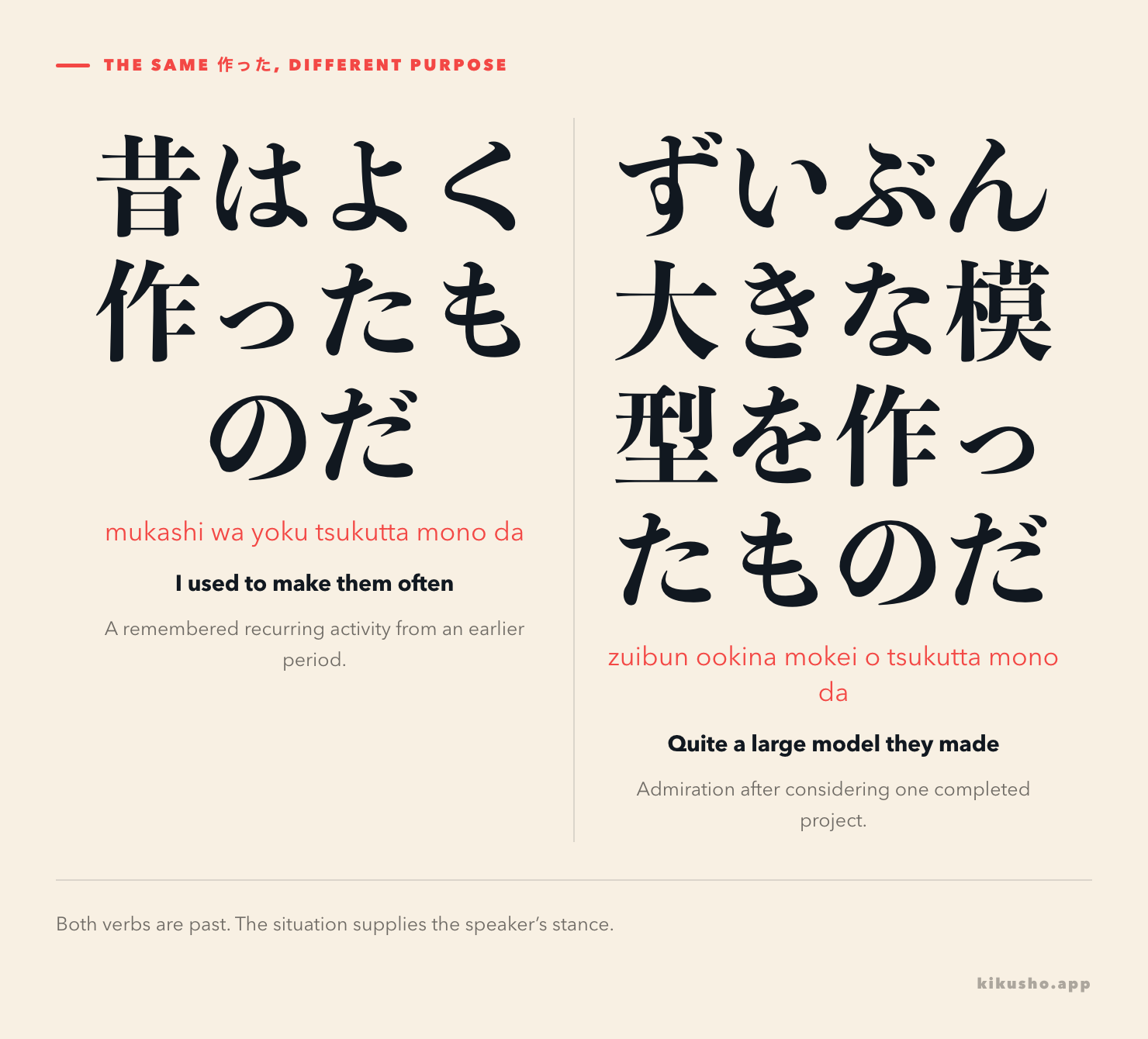
The Japan Foundation’s discussion of もの distinguishes reflective appreciation from a direct spontaneous reaction. Adding ものだ changes the stance; a short “Wow!” does not require it.
If you encounter the line in a maker's interview or a conversation, Kikusho's text capture can propose a card. Before saving it, check the example and its surrounding situation: does the maker remember a weekly childhood activity, or does someone admire a finished piece? Edit the proposed card if it loses that distinction. 作った and “made” alone leave the speaker's purpose undecided.
Practice: read the speaker's purpose
Attempt the six questions in order. A single numbered solution section follows the complete exercise.
Question 1
The speaker is looking back on regularly making paper boats with their grandmother during primary school. Supply the plain verb form needed for that recollection.
小学生の頃は、祖母とよく紙の船を( )ものだ。
祖母(そぼ): grandmother; 紙の船(かみのふね): paper boat.
- A. 作ります
- B. 作った
- C. 作ったです
- D. 作り
Question 2
A librarian gives general advice against writing in borrowed books without permission. Choose the ending that expresses that warning.
借りた本に勝手に書き込む( )。
勝手に(かってに): without permission here; 書き込む(かきこむ): write into.
- A. ものです
- B. ことがあります
- C. ものではありません
- D. つもりです
Question 3
Arrange all four fragments after the printed beginning. Give the letter filling ★ in the resulting sentence.
昔はよく __ __ ★ __。
- A. 作って
- B. 模型を
- C. ものだ
- D. 遊んだ
Question 4
Complete this reassuring statement to a beginner by placing every piece once. Report the fragment at ★.
新しいことを __ __ ★ __。
- A. もの
- B. です
- C. 始めるのは
- D. 不安な
Question 5
Interpret the teacher's comment in this fictional account.
先週初めて模型を作ってみました。今日、先生に見せると、「ずいぶん細かいところまで作ったものですね」と言われました。
先週(せんしゅう): last week; 細かい(こまかい): fine / detailed; 見せる(みせる): show.
What is the teacher doing?
- A. Forbidding the learner to make any more models.
- B. Expressing admiration for the detail of the completed model.
- C. Ordering the learner to finish an unfinished model today.
- D. Recalling the teacher's own regular model-making in childhood.
Question 6
The owner describes a tool, then comments on how a borrower should use it. Which interpretation keeps both functions?
この道具は簡単には壊れないものです。でも、借りた道具を乱暴に扱うものではありません。
壊れる(こわれる): break, as an event affecting the object; 乱暴に(らんぼうに): roughly; 扱う(あつかう): handle.
- A. Both sentences recall repeated childhood activities.
- B. The owner claims that handling the tool roughly is physically impossible.
- C. The owner presents durability as a usual characteristic, then advises against rough treatment.
- D. The owner requires the borrower to break the tool before returning it.
Answers and explanations
Answer 1. B. 紙の船を作ったものだ (かみのふねを つくったものだ) recalls making paper boats. The childhood period and よく establish the repeated activity. A uses a polite verb before a frame requiring a plain form; C adds です to that past verb in the wrong place; D supplies a stem instead of the plain past. In this context 作る would not preserve the requested remembered-past form either, though it is not one of the choices.
Answer 2. C. 借りた本に勝手に書き込むものではありません (かりた ほんに かってに かきこむものでは ありません), “You should not write in borrowed books without permission,” negates the norm-based frame. A presents writing as expected; B reports that it sometimes happens or that there are occasions of doing it; D states an intention. Those endings are grammatical in other situations, but none expresses this librarian's warning.
Answer 3. D. The order is B → A → D → C: 昔はよく模型を作って遊んだものだ (むかしは よく もけいを つくって あそんだものだ), “I used to build models and play with them often.” 模型を supplies the object of 作って; the linked activities end in past 遊んだ, which attaches to ものだ. D fills ★. A is the linking て-form, B the object and C the final recollection frame, so those pieces cannot replace D there.
Answer 4. A. The complete order is C → D → A → B: 新しいことを始めるのは不安なものです (あたらしいことを はじめるのは ふあんなものです), “Starting something new can be unsettling.” 不安な modifies もの, and です provides the polite ending. The speaker reassures a beginner by presenting that unease as ordinary. A is the third fragment; C, D and B supply the other positions.
Answer 5. B. The learner explicitly says this was their first model, made last week and shown today. ずいぶん細かいところまで作ったものですね (ずいぶん こまかいところまで つくったものですね) admires how much detail they included. A invents a warning; C invents an unfinished task and command; D assigns a childhood memory to the teacher that the passage never supplies. The past form does not override the actual situation.
Answer 6. C. 壊れないものです presents being hard to break as a usual characteristic. 扱うものではありません warns against the action of handling borrowed tools roughly. A invents an earlier period; B turns a judgement about conduct into inability; D reverses the warning. The owner is asserting an expectation in the first sentence and giving advice in the second, without either sentence proving an exceptionless physical law.
Common questions
What are the four uses of ものだ?
It can recall an earlier habit or state, present a general expectation, advise through an accepted norm, or express reflective admiration or surprise. The surrounding situation matters; a past verb does not always mean “used to.”
How does ものだ attach to adjectives?
Keep an い-adjective intact, as in 難しいものだ. A nonpast な-adjective takes な before もの, as in 静かなものだ. A past state uses its plain past form, as in 静かだったものだ. Change final だ to です for polite speech.
What does ものではない mean as a warning?
Dictionary-form verb plus ものではない can advise against an action judged inappropriate. 壊すものではない means that one should not break it in this warning frame. It does not say that breaking it is physically impossible.
Does もんだ change the meaning?
もん is a conversational shortening of もの. もんだ and もんじゃない retain the relevant expectation or warning. Their casual form does not remove a potentially scolding tone, and ものです is not an honorific verb.