On this page
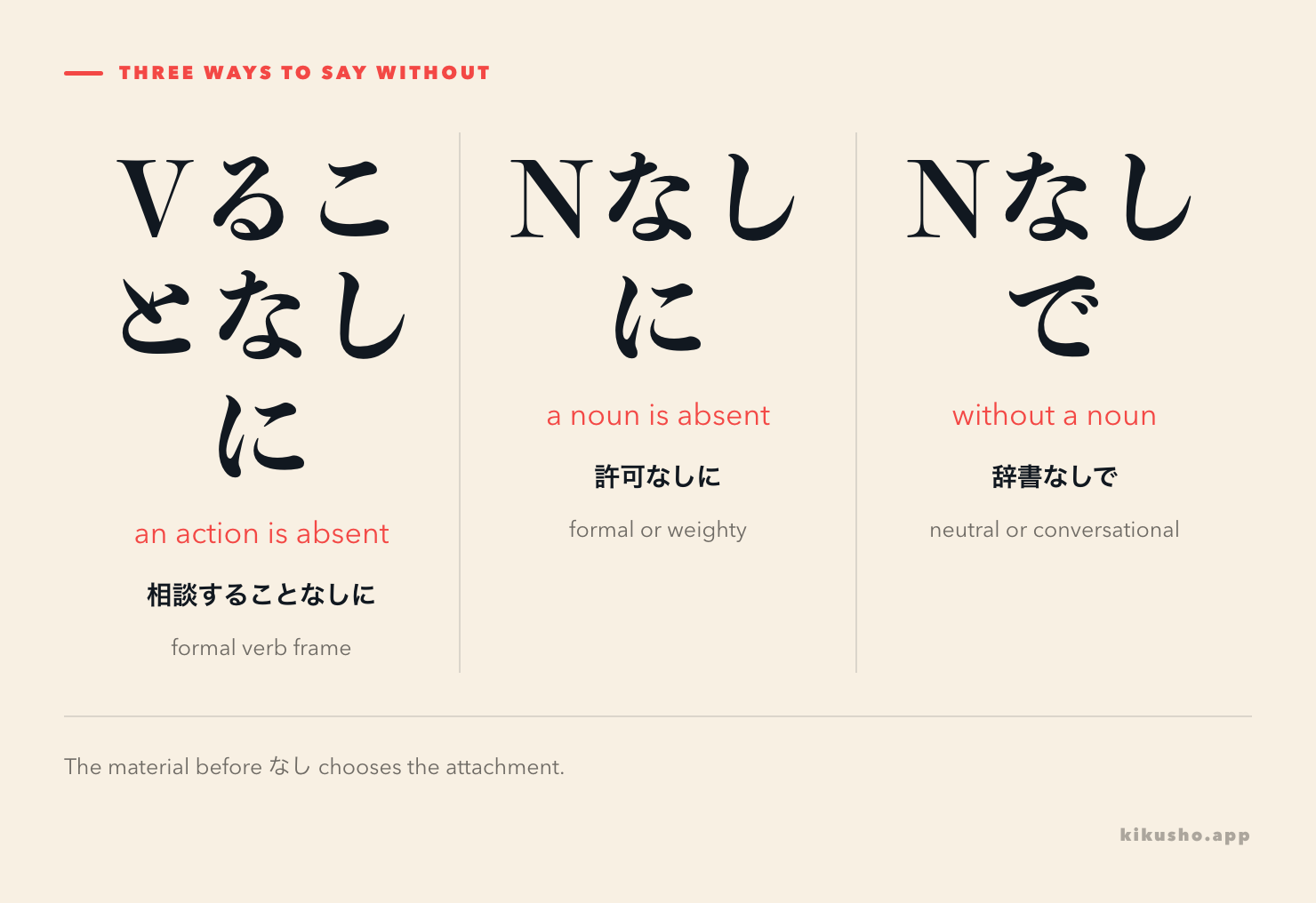
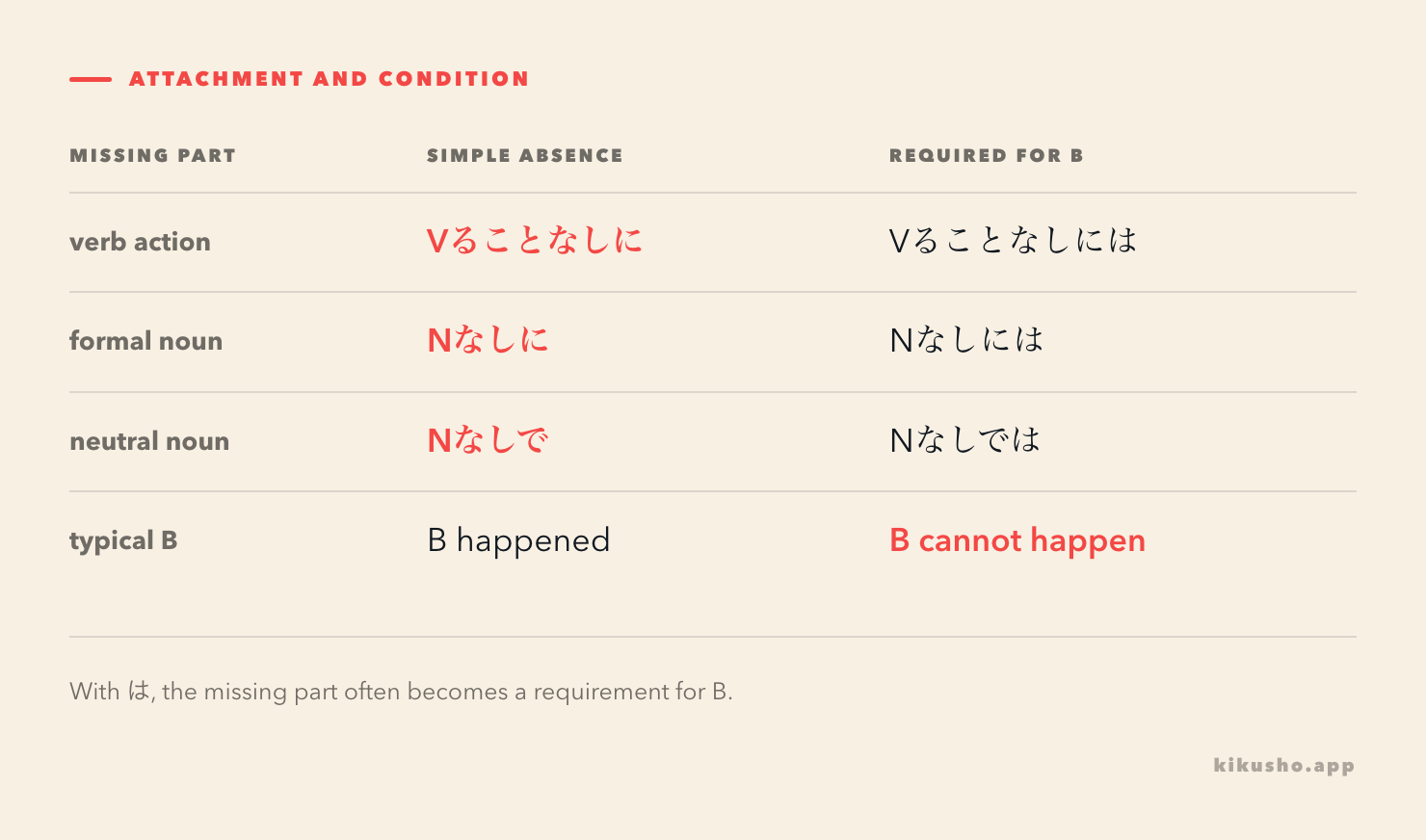
Put ことなしに after a dictionary-form verb when an action is missing. Put なしに or なしで after a noun when a permission, resource, person or other element is missing. Add は when the sentence means that B cannot hold unless A is present.
彼は誰にも相談することなしに、計画を変更した。
かれは だれにも そうだんする ことなしに、けいかくを へんこうした。
He changed the plan without consulting anyone.
十分な資料なしには、正確な判断はできない。
じゅうぶんな しりょう なしには、せいかくな はんだんは できない。
Without sufficient material, an accurate judgment is impossible.
The first sentence reports a missing action while another action occurs. The second treats the material as a prerequisite. English uses “without” for both, but Japanese marks whether the missing part is a verb or a noun, and は often reveals whether the sentence is making a condition.
This lesson reviews g-09459c70060c, ことなしに, and g-8fc50fd5751a, なしに/なしで. Kikusho's September 2026 reference inventory, JLPT Sensei and the recorded Tanos comparison place the assigned forms at N1 with no level disagreement. These are study-guide estimates because the JLPT publishes no exhaustive grammar list.
Choose by what is absent, then inspect the result
| Missing part | Pattern | Main clause | Reading |
|---|---|---|---|
| an action | V dictionary + ことなしに、B | positive or negative | B happens without doing V |
| an action required for B | V dictionary + ことなしには、B-negative | normally negative or impossible | B cannot happen unless V happens |
| a noun-like element | N + なしに/なしで、B | positive or negative | B happens with N absent |
| a noun required for B | N + なしには/なしでは、B-negative | normally negative or impossible | B cannot happen without N |
Start with attachment. A verb such as 確認する needs 確認することなしに. A noun such as 確認 can take 確認なしに. Then read B. 決定した reports what happened despite the missing check; 決定できない makes the check necessary.
ことなしに makes an absent action explicit
Attach the expression to the dictionary form, even though the action does not happen:
| Verb | Correct form | Meaning |
|---|---|---|
| 調べる | 調べることなしに | without investigating |
| 相談する | 相談することなしに | without consulting |
| 振り返る | 振り返ることなしに | without looking back |
| 来る(くる) | 来ることなしに | without coming |
彼女は一度も振り返ることなしに、会場を後にした。
かのじょは いちども ふりかえる ことなしに、かいじょうを あとにした。
She left the venue without looking back even once.
現状を詳しく調べることなしには、有効な対策を立てられない。
げんじょうを くわしく しらべる ことなしには、ゆうこうな たいさくを たてられない。
Without examining the current situation closely, we cannot devise an effective response.
The first B is affirmative: she did leave. ことなしに simply tells you which accompanying action never occurred. The second adds は and ends in 立てられない. It asserts that investigation is an indispensable condition.
The Japan Foundation's grammar guidance explicitly gives both readings: written “without doing,” and ことなしには followed by a judgment that the next event cannot occur. Tanosuke also records positive main clauses alongside Bできない prerequisite sentences. A rule that demands a negative ending after every ことなしに example is therefore too broad.
This is a written, formal construction. Ordinary conversation usually chooses ないで or ずに. The ずに lesson teaches 調べずに決めた; the meaning can overlap, but 調べることなしに決めた gives the absent action more weight and sounds at home in careful prose.
なしに presents a noun as absent
With a noun, remove こと:
事前の許可なしに、この区域へ入ってはいけない。
じぜんの きょか なしに、この くいきへ はいっては いけない。
You must not enter this area without prior permission.
彼は何の説明もなしに、突然席を立った。
かれは なんの せつめいも なしに、とつぜん せきを たった。
He suddenly left his seat without any explanation.
許可 and 説明 name actions or prerequisites that the situation would normally include. Their absence is conspicuous. 日本語教師のN1et notes this strong fit with action-like nouns and the expectation that A would ordinarily be present. Benri Japan's なしに(は) account likewise treats the form as formal and common in rules or statements of principle.
The range is not limited to verbal nouns. Established sentences can present an emotion, resource or person as absent: 涙なしにこの映画は見られない, “I cannot watch this film without tears,” or 皆さんの協力なしには完成できない, “We cannot finish without everyone's cooperation.” The deciding question is whether the noun is being treated as a missing circumstance or requirement.
なしで is broader and less formal
N + なしで is natural when someone proceeds without a tool, ingredient, service or participant:
今日は辞書なしでこの記事を読んでみる。
きょうは じしょ なしで この きじを よんでみる。
Today I will try reading this article without a dictionary.
予約なしで入れますか。
よやく なしで はいれますか。
Can we enter without a reservation?
部長なしでは、この件を決められない。
ぶちょう なしでは、この けんを きめられない。
We cannot decide this matter without the department head.
N1et describes なしで as the less formal partner of なしに. Do not turn that tendency into a rigid meaning split. 許可なしで入った and 許可なしに入った can describe the same unauthorized entry; the second is more likely in a rule, report or formal criticism. The particle pair also appears with は: なしでは is common in ordinary conditional statements, while なしには sounds more formal.
は turns absence into a sharper condition
Compare the punctuation-sized difference:
専門家の助言なしに、計画を進めた。
We proceeded with the plan without expert advice.
専門家の助言なしには、計画を進められない。
We cannot proceed with the plan without expert advice.
The first reports an event. The second makes the advice necessary. This is why なしには/なしでは strongly favors results such as できない, 難しい, 不可能だ, 考えられない and 成り立たない.
The same contrast works with a verb:
本人に確認することなしに、記事を公開した。
The article was published without checking with the person concerned.
本人に確認することなしには、記事を公開できない。
The article cannot be published without checking with the person concerned.
In the second pair, ことなしには can be paraphrased as 確認しなければ. The construction does not merely say that checking was omitted. It says checking is the gate through which publication must pass.
Keep ことなく and 抜きで at their own boundaries
Vることなく is another written way to say “without doing V.” It overlaps heavily with Vることなしに. The ことなく and 抜きにして comparison shows that ことなく often highlights uninterrupted continuation or complete nonoccurrence. ことなしに is especially useful when the absent action is treated as an expected step or, with は, a prerequisite. This is a tendency, not a promise that every pair changes meaning.
N抜きで more readily suggests deliberate exclusion. 休憩なしで働いた reports work done with no break; 休憩抜きで働いた can present the break as intentionally cut from the schedule. With people and ingredients, 抜き often sounds like a chosen arrangement: 部長抜きで話す, 砂糖抜きのコーヒー.
Basic ないで stays the most direct conversational verb form. The ないで lesson separates “without doing” from the request ないでください. Neither ことなしに nor noun なしに forms that request pattern.
For Kikusho, save the clause that proves the reading. 協力なしに alone does not tell you whether cooperation was absent in a completed event or necessary for an impossible one. The pair 協力なしに進めた/協力なしには進められない makes the role of は retrievable during later FSRS reviews.
Practice: find the missing action, noun and condition
Question 1 · verb attachment. Complete: 十分に調査する__、結論を出すべきではない。
① なしで
② ことなしに
③ なしの
④ ことなしで
Question 2 · noun attachment. Which sentence correctly means “He entered without permission”?
① 彼は許可することなしで入った。
② 彼は許可なしに入った。
③ 彼は許可ことなしに入った。
④ 彼は許可なしい入った。
Question 3 · condition. Complete: 皆さんの協力__、この計画は完成できない。
① なしには
② なしの
③ ことなしに
④ なく
Question 4 · text grammar. In 彼女は一度も振り返ることなしに会場を出た, is the positive main clause an error, or does it report an exit during which looking back never occurred?
Question 5 · repair. Correct 本人に確認なしには、記事を公開できない so that the missing element remains the verb 確認する rather than the noun 確認.
Question 6 · sentence composition. Use 十分な資料, なしには, 判断, and できない to state that adequate material is necessary for a judgment.
Question 7 · register choice. In an ordinary conversation about reading an article without a dictionary, why is 辞書なしで読む generally a better default than 辞書なしに読む?
Answers and explanations
Why Question 1 takes ことなしに
② ことなしに. 調査する is a dictionary-form verb, so it needs こと before なしに. The negative recommendation in B treats sufficient investigation as an expected prior step.
Reasoning 2
②. 許可 is a noun, and なしに attaches directly to it. The sentence formally reports that entry occurred while the expected permission was absent.
Reasoning 3
① なしには. 協力 is the missing noun, and は strengthens the indispensable-condition reading before 完成できない.
Reasoning 4
It is grammatical. 会場を出た states the event that happened, while 振り返ることなしに describes the action that did not accompany it. A negative main clause becomes especially likely when the sentence instead argues that A is required for B.
Reasoning 5
本人に確認することなしには、記事を公開できない。 The dictionary-form verb 確認する must be nominalized by こと before なしには. If you choose the noun instead, 本人への確認なしには is possible but changes the attachment requested.
Reasoning 6
十分な資料なしには、判断できない。 The noun phrase comes directly before なしには, and the negative potential predicate states that the material is necessary.
Reasoning 7
なしで is the neutral, less formal way to present the dictionary as an absent tool. なしに can express the same core absence, but it gives the sentence a more written or weighty tone that an ordinary plan does not require.
The editorial check covered both inventory items, every attachment, positive and negative result clauses, the conditional effect of は, register differences, boundaries with ことなく, 抜きで, ずに and ないで, and the keyed reasoning for all seven tasks. Minion 7 performed this AI review; it does not represent a human or native-speaker review.
Common questions
What is the difference between ことなしに and なしに?
ことなしに follows a dictionary-form verb and makes an absent action explicit. なしに normally follows a noun and presents that action, permission, help or other element as absent.
What is the difference between なしに and なしで?
Both can mean “without.” なしに is more formal and often marks an expected action or prerequisite as absent. なしで is the more neutral or conversational choice for doing something without a person, tool, ingredient or other noun.
What does は add in ことなしには or なしには?
は strengthens a conditional reading: unless A happens or exists, B cannot happen. The main clause therefore commonly contains a negative or an expression of impossibility.
Must the clause after ことなしに be negative?
No. A positive main clause can report that B happened while A did not. A negative result is especially common when A is presented as an indispensable prerequisite.