On this page
ほどのことではない lowers your assessment of the matter; までもない lowers your assessment of the proposed action. If the problem is too minor to warrant a reaction, use Vるほどのことではない. If doing V would go farther than necessary, use Vるまでもない.
JLPT Sensei classifies ほどのことではない as N1, and Bunpro classifies までもない as N1. These N1 placements come from preparation references rather than an official list of test grammar. The practical distinction is stable across the references: one judges how substantial the situation is, while the other asks whether an action is worth taking that far.
First decide whether you are judging the matter or the action
Imagine a small technical problem. You could say either sentence, but each gives a different reason for doing less.
この不具合は、会議を中止するほどのことではない。
このふぐあいは、かいぎをちゅうしするほどのことではない。
This fault is not serious enough to cancel the meeting over.
この不具合なら、専門家を呼ぶまでもない。
このふぐあいなら、せんもんかをよぶまでもない。
With this fault, there is no need to go as far as calling a specialist.
The first sentence grades the fault against the threshold for cancellation. The second grades calling a specialist as an excessive step. A minor matter often makes a large response unnecessary, so the two ideas naturally overlap; the grammatical viewpoint still differs.
| Pattern | Question it answers | Typical reason | Core translation |
|---|---|---|---|
| V dictionary + ほどのことではない | Is the matter substantial enough to warrant V? | It is not that serious or important. | It is not such a matter as to V. |
| V dictionary + までもない | Is V a step worth going as far as taking? | A simpler step is enough, or the answer is obvious. | There is no need to go as far as V. |
| V dictionary + までもなく、… | What follows once V is treated as unnecessary? | The following conclusion holds without V. | Without even needing to V, … |
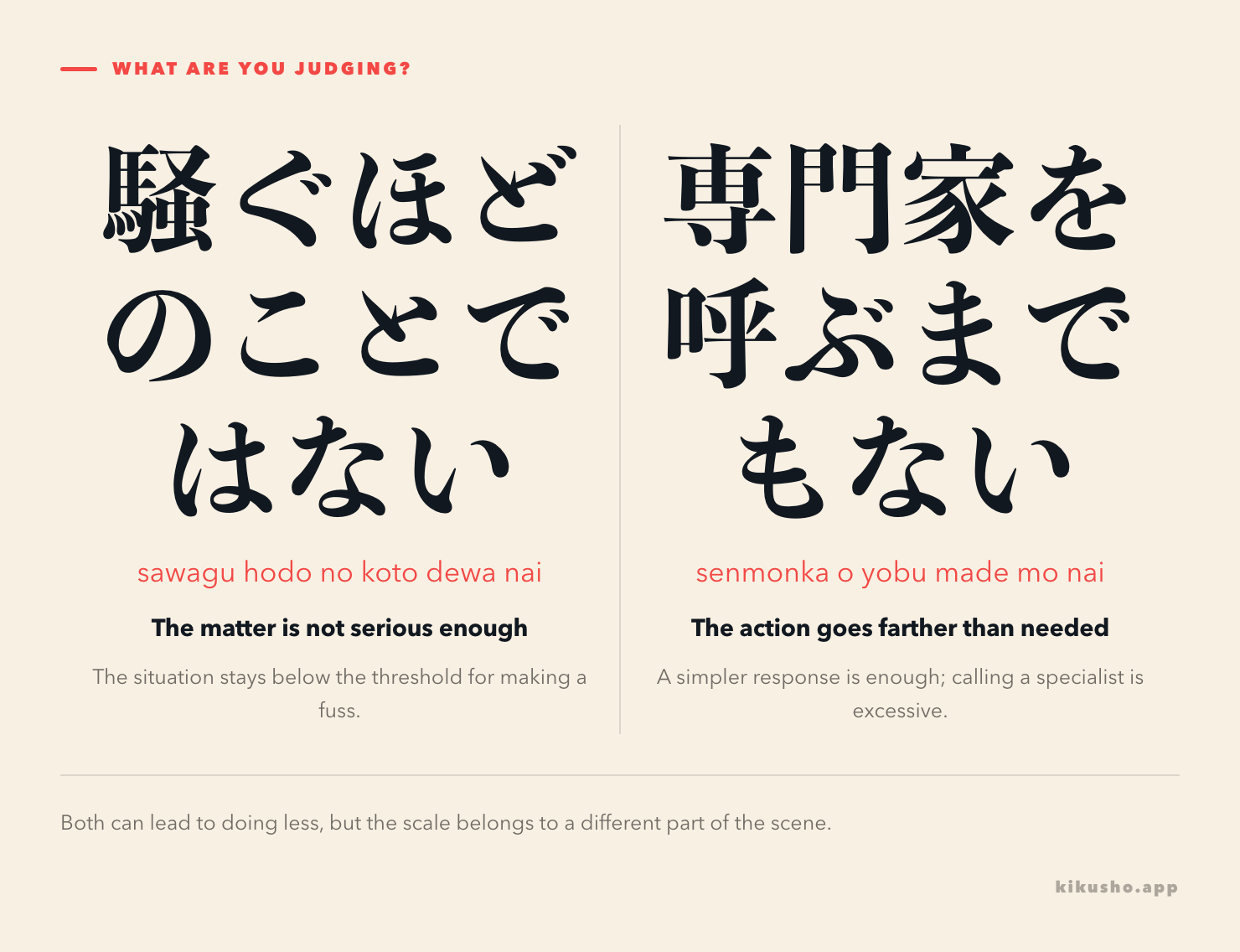
ほどのことではない places the situation below a threshold
Attach ほどのことではない to a dictionary-form verb. The verb names the reaction, concern or measure whose threshold the situation fails to reach.
少し予定が変わっただけで、騒ぐほどのことではない。
すこしよていがかわっただけで、さわぐほどのことではない。
The schedule changed only a little; it is not serious enough to make a fuss about.
The sentence does more than say 騒ぐ必要はない, “there is no need to make a fuss.” It evaluates what happened as too slight to justify that reaction. Expressions such as だけ, 程度, 小さな and たいした often make the scale visible, but none is grammatically required.
日本語NET describes the construction as 大したことではないので、〜する必要はない: because the matter is not significant, the action is unnecessary. Its examples and JLPT Sensei's examples repeatedly pair the pattern with reactions such as worrying or making an issue of something.
一度断られたからといって、落ち込むほどのことではない。
いちどことわられたからといって、おちこむほどのことではない。
Being turned down once is not something to get depressed about.
This can reassure, but it can also minimize another person's feelings. 心配するほどのことではありません may be kind when supported by evidence; said too quickly, it can sound dismissive. Grammar identifies the threshold judgment, while relationship and context determine whether that judgment is tactful.
The polite ending changes the copula, not the verb before the construction:
ご報告いただくほどのことではありません。
It is not important enough for you to report.
Do not attach the construction to a polite verb as 報告しますほどのことではありません. Keep 報告する in dictionary form and make the final ではない polite.
までもない says the proposed step goes too far
Attach までもない to a dictionary-form verb when the action would exceed what is needed.
この計算なら、電卓を使うまでもない。
このけいさんなら、でんたくをつかうまでもない。
For this calculation, there is no need to go as far as using a calculator.
The phrase does not criticize calculators. It places this calculation low on a scale of required effort. The speaker expects mental calculation or another easy method to suffice.
日本語NET gives Vる + までもない as the central connection and notes that a simpler means often makes the larger action unnecessary. Meguro Language Center likewise glosses it as “no need to go so far”, with examples such as 私が行くまでもない. This sense of an unnecessary upper step separates it from a bare statement of non-requirement.
Another common reason is obviousness:
結果はデータを見れば明らかで、改めて説明するまでもない。
けっかはデータをみればあきらかで、あらためてせつめいするまでもない。
The result is clear from the data; there is no need to explain it again.
The answer is already accessible, so a new explanation adds unnecessary effort. 言うまでもない, literally “there is no need to say it,” is a conventional expression meaning “it goes without saying.”
安全が最優先なのは、言うまでもない。
It goes without saying that safety comes first.
Be careful when directing this pattern at a person. 君に言われるまでもない means “I do not need you to tell me” and can reject the other person's intervention sharply. The pattern's judgment of excess remains active even when the English translation sounds routine.
までもなく connects that judgment to what follows
Use までもなく when the sentence continues after the no-need judgment.
詳しく調べるまでもなく、この数字が間違っているとわかる。
くわしくしらべるまでもなく、このすうじがまちがっているとわかる。
Without even needing to investigate closely, you can tell that this figure is wrong.
Here までもなく behaves adverbially: it sets the condition under which わかる holds. By contrast, 詳しく調べるまでもない can end the sentence. Bunpro records both Vる + までもない and Vる + までもなく + phrase, while noting までもなくて as a less common connector. For a reliable N1 default, finish with ない or connect with なく.
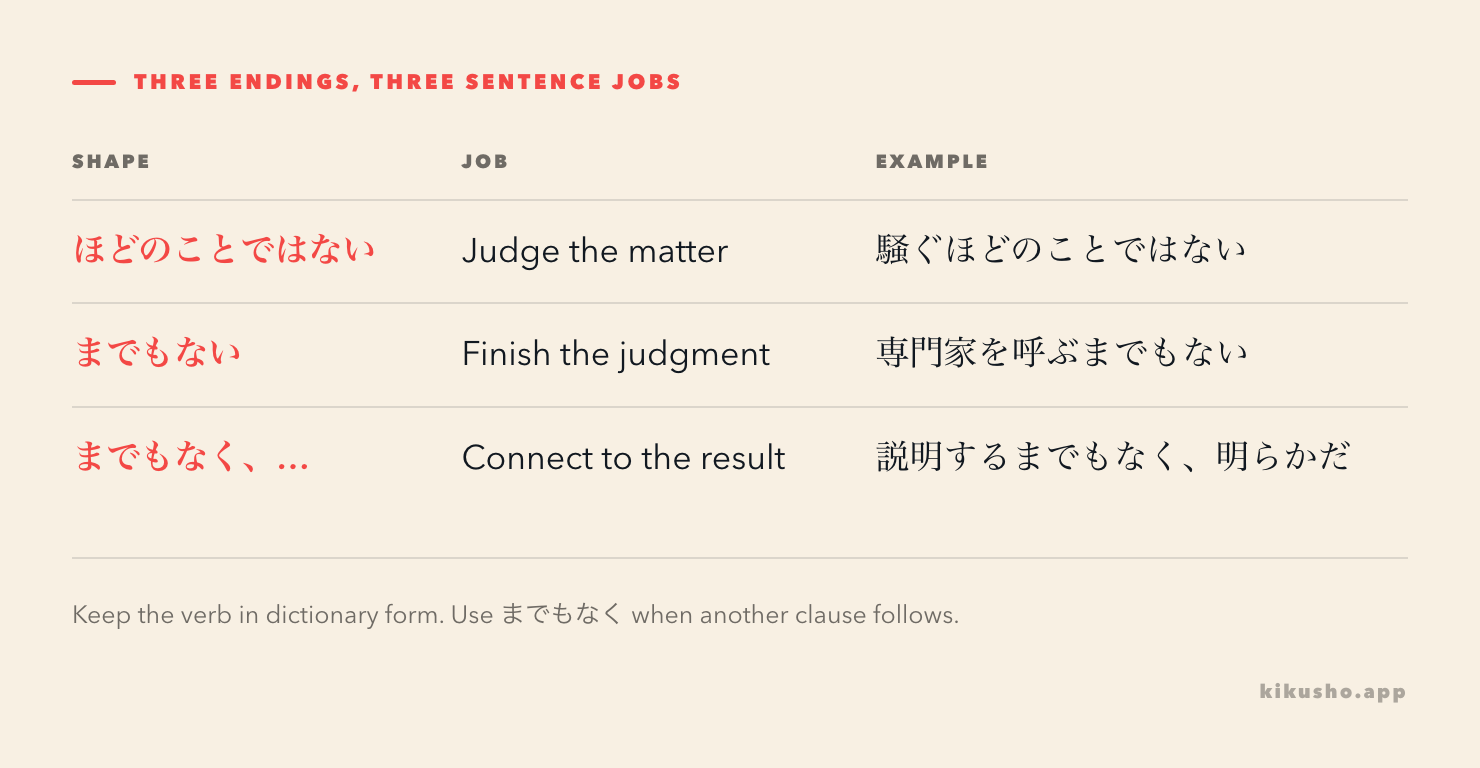
| Shape | Job | Example |
|---|---|---|
| 騒ぐほどのことではない | downrate the matter | It is not serious enough to make a fuss. |
| 専門家を呼ぶまでもない | reject an excessive step | There is no need to call a specialist. |
| 説明するまでもなく、明らかだ | connect to a result | It is obvious without explanation. |
Do not leave a standard までもなく sentence hanging: 説明するまでもなく。 announces a connection but supplies no following result. In casual speech a listener may recover an omitted ending, but that is not the structure to learn for an exam item.
The same scene can support both viewpoints
Suppose a glass falls but receives only a tiny scratch.
この程度の傷なら、交換するほどのことではない。
With a scratch this minor, it is not serious enough to replace the glass over.
この程度の傷なら、新品を注文するまでもない。
With a scratch this minor, there is no need to go as far as ordering a new one.
The first sentence treats the scratch as below the replacement threshold. The second treats ordering a new item as a step beyond what the scratch requires. Tanosuke's comparison illustrates the same split with a mild condition: ほどのことではない says the matter is not serious, whereas までもない says a stronger measure is unnecessary because something less is enough.
This also shows why translation alone is unreliable. Both sentences may emerge as “there's no need to replace it.” On a test, find the noun or condition being graded, the action under consideration, and any easier alternative. These clues reveal which scale the writer wants.
Keep broader no-need expressions separate
Vることはない and Vる必要はない can state that an action is unnecessary without the same threshold structure. Compare:
今すぐ返事をする必要はない。
There is no requirement to answer immediately.
今すぐ返事をするまでもない。
There is no need to go as far as answering immediately.
The first is a direct statement about necessity. The second invites a scale: perhaps acknowledging the message is enough, or the matter is too obvious to deserve an answer. It can therefore sound more evaluative. Our comparison of ことはない and 必要はない covers the broader no-need choices and their polite forms.
わざわざ can make effort explicit, as in わざわざ電話するまでもない, but it is not part of the grammar. The わざと and わざわざ lesson explains when deliberate effort is helpful or excessive. Meanwhile, the ordinary particle ほど has wider uses for degree; ほど and あまりにも provides that scale background.
When saving a Kikusho card, keep the reason with the target phrase. メールで済むから、会いに行くまでもない preserves the easier alternative; 小さな誤差だから、計画を変えるほどのことではない preserves the low-severity judgment. A card containing only “no need” cannot recreate the choice.
Practice
Choose by viewpoint as well as attachment. All seven answers appear together after the final question.
Question 1 — judge the matter
The delay is only two minutes. Choose the completion that explicitly says it is not serious enough to make a fuss.
二分遅れただけで、騒ぐ____。
ア. までもなく
イ. ほどのことではない
ウ. ことになっている
エ. 始末だ
Question 2 — reject an excessive step
The station is close enough to walk to. Choose the most precise completion.
駅は歩いて五分だから、タクシーを使う____。
ア. ほどのことではない
イ. ものがある
ウ. までもない
エ. にほかならない
Question 3 — connect to the result
Which form correctly links “without needing to ask” to the following conclusion?
本人に聞く____、表情を見れば答えはわかった。
ア. ほどのことではない
イ. までもなく
ウ. までもないで
エ. ほどではなくては
Question 4 — interpret the viewpoint
What does 失敗は一度だけで、責任者を交代させるほどのことではない primarily say?
ア. Replacing the manager is impossible.
イ. The single failure is below the threshold that would justify replacing the manager.
ウ. A replacement has already been ordered.
エ. The manager has no responsibility.
Question 5 — arrange the sentence
Arrange all fragments to say “The cause is obvious, so there is no need to investigate again.”
原因は明らかだから、__ __ __ __。
- までも
- 調べ
- ない
- 直す
Question 6 — repair the ending
The writer wants to continue with 誰でも気づく. Replace the underlined ending with the form that connects naturally.
専門家が説明するまでもない、誰でも気づく間違いだ。
Question 7 — choose both viewpoints
Read the situation and choose the pair.
箱に小さなへこみがあるだけで、商品を捨てる( ① )。中身に問題がないなら、新しい物を注文する( ② )。
ア. ① までもなく / ② ほどのことではない
イ. ① ほどのことではない / ② までもない
ウ. ① ことになった / ② 始末だ
エ. ① までもない / ② までもなく
Answers and explanations
Answer 1
イ. ほどのことではない. The two-minute delay is the matter being rated as too minor to justify 騒ぐ. までもなく would need a following clause and would judge the action as an unnecessary step rather than explicitly downrating the delay.
Answer 2
ウ. までもない. Walking is an easier sufficient option, so taking a taxi would go farther than necessary. The issue is not that the distance itself fails to warrant some named reaction; the sentence directly rejects the proposed means.
Answer 3
イ. までもなく. The no-need phrase modifies the following conclusion 答えはわかった. Sentence-final までもない would require a full stop or a different connection.
Answer 4
イ. The single failure is below the threshold that would justify replacing the manager. 一度だけ supplies the low-severity evidence, and 交代させるほどのことではない compares it with the threshold for replacement. It does not deny ability, erase responsibility or report a completed action.
Answer 5
2 → 4 → 1 → 3: 原因は明らかだから、調べ直すまでもない。 調べ直す stays in dictionary form before までもない. The obvious cause makes another investigation unnecessary.
Answer 6
Use までもなく: 専門家が説明するまでもなく、誰でも気づく間違いだ。 The connective form leads into the result “it is a mistake anyone would notice.”
Answer 7
イ. ① ほどのことではない / ② までもない. The small dent is below the threshold for discarding the product. Once the contents are known to be fine, ordering a replacement is the excessive step. The shared situation supports both patterns because each sentence selects a different scale.
Common questions
What is the difference between ほどのことではない and までもない?
Vるほどのことではない says the matter is not serious or important enough to warrant V. Vるまでもない says there is no need to go as far as V, often because the answer is obvious or a simpler measure is enough.
What form comes before ほどのことではない and までもない?
Both core patterns follow a dictionary-form verb: 騒ぐほどのことではない and 専門家を呼ぶまでもない. Politeness normally appears at the end.
What is the difference between までもない and までもなく?
までもない can finish a sentence. までもなく connects to a following clause, as in 説明するまでもなく、理由は明らかだ. The underlying judgment is the same: the action would go farther than necessary.
Is までもない the same as ことはない?
They can overlap, but までもない highlights a scale: the proposed action is farther than the situation requires or the answer is already obvious. ことはない is a broader way to say that an action is unnecessary, often as advice.