On this page
めく turns a limited set of bases into verbs meaning “take on that air”; がましい turns established bases into い-adjectives that often criticize an obtrusive resemblance. Compare 皮肉めいた口調, “a tone tinged with irony,” with 言い訳がましい口調, “a tone that sounds unpleasantly like an excuse.” The first describes an impression; the second usually adds the speaker's disapproval.
Study references commonly list both suffixes at N1. That placement is preparation guidance because the exam authority does not provide a form-by-form syllabus. The practical challenge is not translating both as “-ish.” You need to recognize the word class each suffix creates, its inflection, and the small group of natural combinations in which it appears.
One suffix makes a verb; the other makes an adjective
| Suffix | Basic attachment | Resulting word class | Central job |
|---|---|---|---|
| N + めく | 春めく, 謎めく, 皮肉めく | godan verb | show signs of N; take on an N-like air |
| noun or verb stem + がましい | 言い訳がましい, 押し付けがましい | い-adjective | seem like N in an excessive or objectionable way |
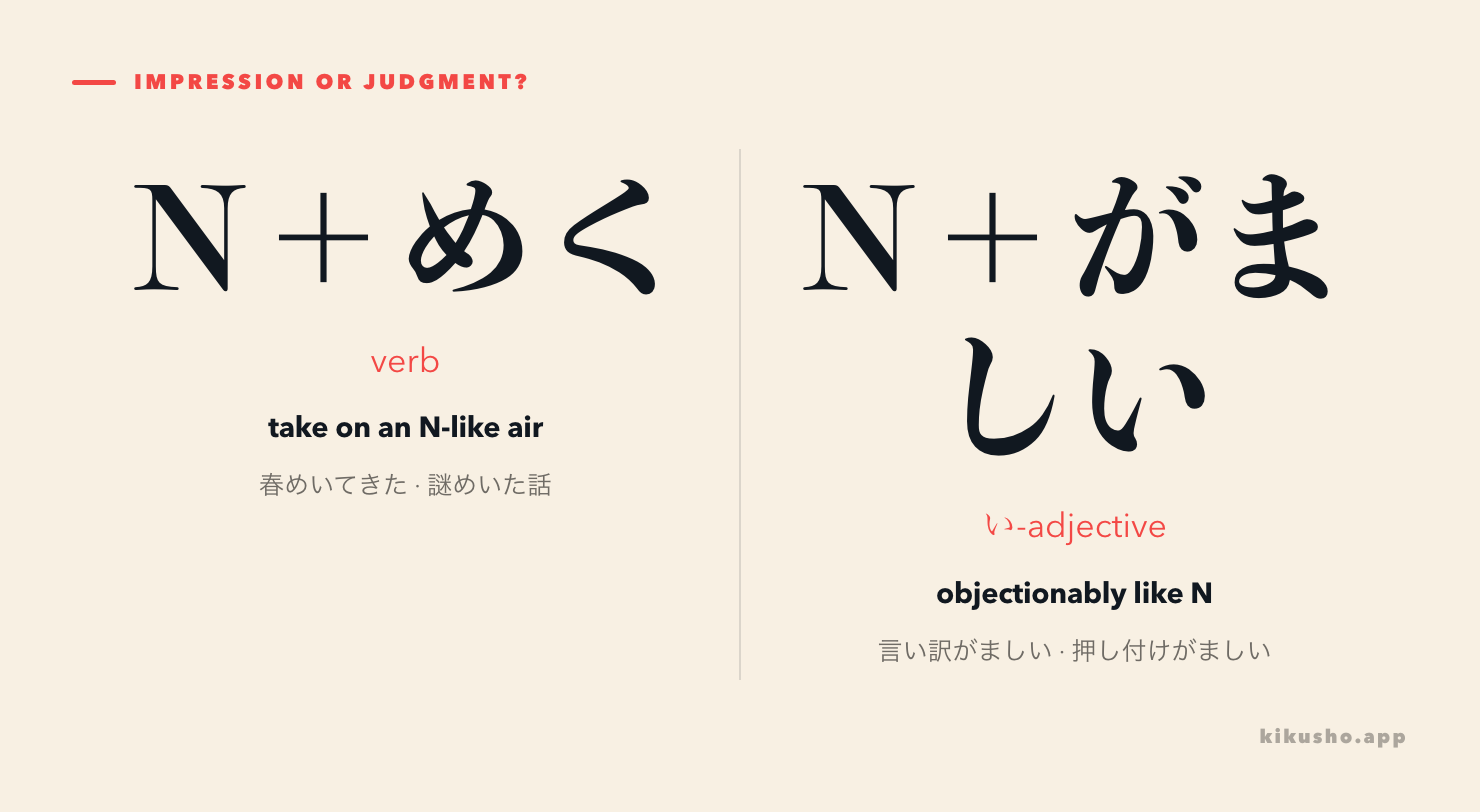
The endings after the suffix expose the difference:
日差しが春めいてきた。
ひざしがはるめいてきた。
The sunlight has begun to feel springlike.
その助言は少し押し付けがましかった。
そのじょげんはすこしおしつけがましかった。
That advice was a little pushy.
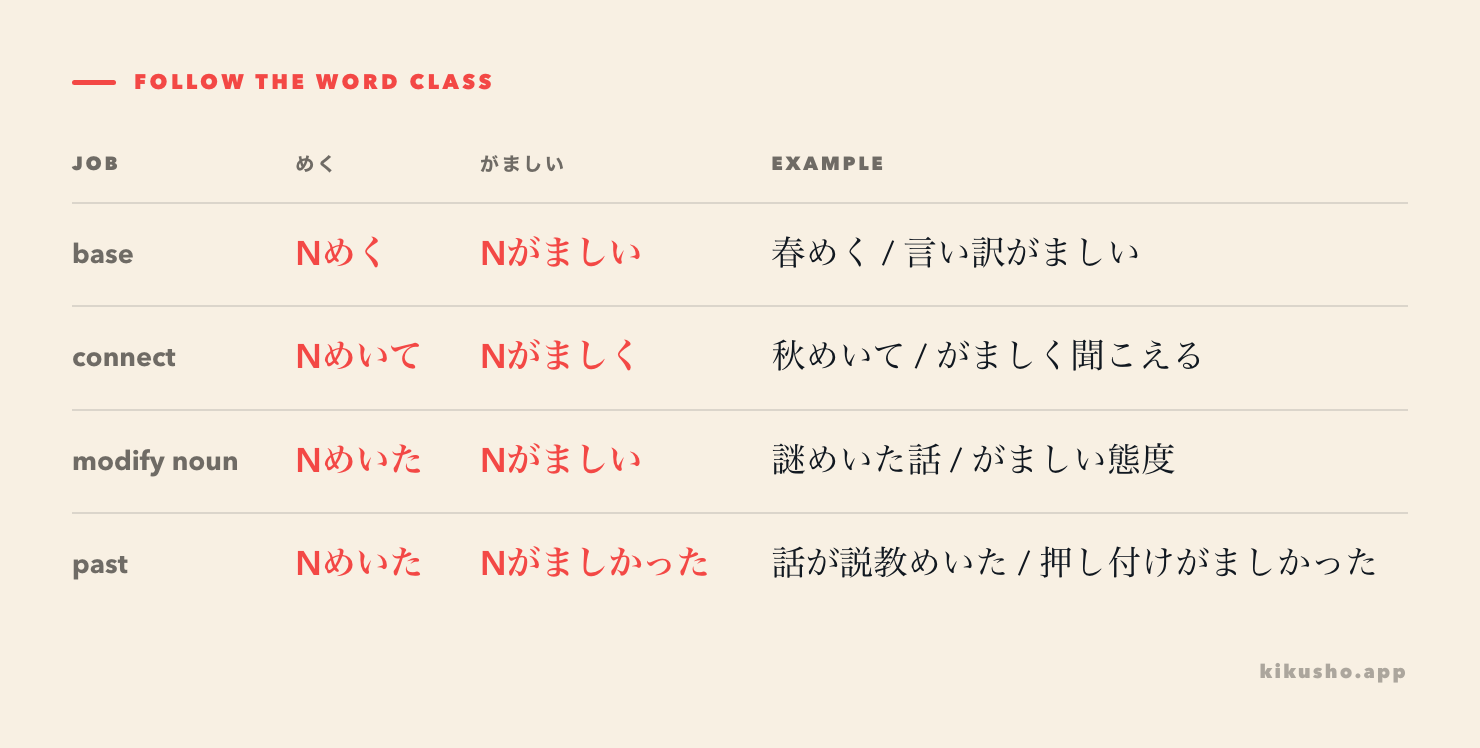
春めいて is the て-form of the verb 春めく. 押し付けがましかった is the past form of the い-adjective 押し付けがましい. Treating both as unchanging particles will produce attachment errors.
めく presents signs, atmosphere or change
The suffix めく means that something comes to have a certain character or appears to show it. Kotobank's dictionary entry identifies it as a suffix that forms a godan verb and expresses entering a state or showing a similar appearance. Seasonal examples make the change especially clear.
朝の空気が少し秋めいてきた。
あさのくうきがすこしあきめいてきた。
The morning air has started to feel a little autumnal.
The season itself is not literally changing into another object. Temperature, light and atmosphere provide signs from which the speaker senses autumn. めいてくる combines naturally with this emerging impression.
With abstract bases, the suffix can present a quality visible in words, behavior or a scene.
彼は謎めいた笑みを浮かべた。
かれはなぞめいたえみをうかべた。
He gave a mysterious smile.
最後の一言は、冗談めいて聞こえた。
さいごのひとことは、じょうだんめいてきこえた。
The final remark sounded somewhat like a joke.
When めく modifies a noun, use the verb's past attributive form めいた + noun: 謎めいた笑み, 皮肉めいた発言, 脅迫めいた手紙. To describe the manner of a following predicate, めいて is common: 説教めいて聞こえる. 日本語教師のまる得 confirms these attachments and stresses that only a limited set of nouns combines naturally.
| Function | Form | Example |
|---|---|---|
| nonpast verb | N + めく | 空気が春めく |
| connective | N + めいて | 話が説教めいてくる |
| noun modifier | N + めいた + noun | 皮肉めいた返事 |
| negative | N + めかない | 少しも冗談めかない口調 |
Do not assume めく freely attaches to every noun. 春めく, 秋めく, 謎めく, 皮肉めく, 冗談めく and 説教めく are established combinations. If you need an improvised everyday comparison, っぽい, ような or みたいな may be safer. The suffix has a descriptive, sometimes literary feel, but common compounds such as 謎めいた remain ordinary in journalism and conversation.
がましい judges an excessive resemblance
The suffix がましい forms an い-adjective. The base may be a noun, as in 言い訳がましい, or part of an established expression built from a verb stem, as in 押し付けがましい and 差し出がましい.
事情を説明しただけなのに、言い訳がましく聞こえてしまった。
じじょうをせつめいしただけなのに、いいわけがましくきこえてしまった。
I only explained the circumstances, but it ended up sounding like an excuse.
相手のためでも、押し付けがましい助言は避けたい。
あいてのためでも、おしつけがましいじょげんはさけたい。
Even when it is meant to help, I want to avoid pushy advice.
The speaker does more than notice a resemblance. 言い訳がましい suggests that the words have the unwelcome air of excuse-making. 押し付けがましい judges the behavior as forcing a view or favor on another person. JLPT Sensei's がましい entry notes both the limited combinations and their usual negative coloring.
Kotobank's dictionary account gives the broader lexical rule: the suffix attaches to nouns or verb continuative forms and creates an adjective meaning that something resembles the base or has that tendency. Modern teaching examples lean negative, but the suffix is not historically negative in every word. 晴れがましい, for example, means proud, splendid or ceremonially conspicuous. Learn the evaluation with the complete compound.
Useful modern combinations include:
| Compound | Practical meaning | Typical target |
|---|---|---|
| 言い訳がましい | sounding like an excuse | explanation, wording |
| 押し付けがましい | pushy; imposing | advice, attitude, kindness |
| 恩着せがましい | making a favor feel like a debt | manner, remark |
| 差し出がましい | presumptuously forward | comment, behavior |
| 未練がましい | lingering and undignified | conduct, words |
Because the result is an い-adjective, it inflects accordingly: がましくない, がましかった, がましく聞こえる, and がましさ. Do not insert な before a noun: say 言い訳がましい説明, not 言い訳がましいな説明.
Similar scenes, different speaker commitments
Suppose a manager gives a long comment after a meeting.
部長の話は、だんだん説教めいてきた。
The manager's remarks gradually took on the air of a lecture.
部長の話し方は、少し押し付けがましかった。
The manager's way of speaking was a little pushy.
The first sentence tracks a developing atmosphere. It leaves room for the talk to resemble a lecture without directly accusing the manager of forcing a belief. The second applies a critical adjective to the manner and says the pressure itself was objectionable.
This distinction also separates めく from appearance markers such as げ, そう and っぽい. 不安げ interprets a visible emotional air; 子供っぽい describes a broad characteristic; 春めく presents signs of a state arriving. Our lesson on げ and related appearance endings maps those choices. The new suffix pair adds two restrictions: established lexical bases and a word-class change that controls every following ending.
When saving a Kikusho card, include the whole combination and one inflected form. A card for isolated めく = seem invites inventions such as attaching it to any noun. Save 秋めいてきた or 皮肉めいた返事. For がましい, keep the judgment: 恩着せがましい態度 is more useful than a vague gloss such as “similar to.”
Practice
Work through all seven prompts, then uncover the explanations together.
Question 1
Fill the blank so that the sunlight shows the first signs of spring.
風はまだ冷たいが、日差しは少し春__きた。
ア. がましく
イ. めいて
ウ. めいたな
エ. がましいで
Question 2
Choose the form that criticizes an explanation for sounding like an excuse.
その説明は、かえって言い訳__聞こえた。
ア. めくに
イ. がましく
ウ. がましいな
エ. めいたを
Question 3
Which phrase correctly modifies 手紙?
ア. 脅迫めくな手紙
イ. 脅迫めいて手紙
ウ. 脅迫めいた手紙
エ. 脅迫がましいな手紙
Question 4
What does 会議がだんだん説教めいてきた primarily say?
ア. The meeting was formally cancelled.
イ. The meeting gradually took on the air of a lecture.
ウ. Someone apologized for the meeting.
エ. The meeting was pushy from the beginning.
Question 5
Arrange the fragments to say “I want to avoid pushy advice.”
__ __ __ __。
- 避けたい
- 助言は
- 押し付け
- がましい
Question 6
Change その態度は恩着せがましい to the past negative: “That attitude was not patronizing.”
Question 7
Choose the pair that preserves both the emerging impression and the critical judgment.
空気が秋( ① )きた一方で、店員の勧め方は押し付け( ② )。
ア. ① がましくなって / ② めいていた
イ. ① めいて / ② がましかった
ウ. ① めいたな / ② がましいな
エ. ① がましいで / ② めいたかった
Answers and explanations
Answer 1
Choose イ. めいて. 春めく is a godan verb, so its て-form is 春めいて. 春めいてきた presents springlike signs as beginning to appear.
Answer 2
イ. がましく. 言い訳がましい is an い-adjective. Its adverbial form 言い訳がましく modifies 聞こえた and adds the critical sense that the explanation sounded objectionably like an excuse.
Answer 3
ウ. 脅迫めいた手紙. めく is a verb, so its past attributive form めいた modifies the following noun. めくな and めいて cannot fill that noun-modifying slot.
Answer 4
イ. The meeting gradually took on the air of a lecture. だんだん and めいてきた describe an impression developing over time. The sentence does not itself report cancellation, apology or a fixed judgment from the outset.
Answer 5
3 → 4 → 2 → 1: 押し付けがましい助言は避けたい。 押し付けがましい is the complete い-adjective and directly modifies 助言 without な.
Answer 6
その態度は恩着せがましくなかった。 Remove final い and add くなかった, the ordinary past-negative ending of an い-adjective.
Answer 7
イ. ① めいて / ② がましかった. 秋めいてきた describes seasonal signs emerging. 押し付けがましかった is the past form of an い-adjective and criticizes the clerk's recommendation style.
Common questions
What is the difference between めく and がましい?
めく forms a verb meaning to take on the air or signs of something. がましい forms an i-adjective that says something resembles a quality, often with a critical judgment that it is excessive or unpleasant.
How does めく conjugate?
It behaves as a godan verb: 春めく, 春めいて, 春めいた and 春めかない. The past form めいた commonly modifies a noun, as in 謎めいた話.
How does がましい conjugate?
It behaves as an i-adjective: 押し付けがましい, 押し付けがましく, 押し付けがましくない and 押し付けがましかった.
Can めく and がましい attach to any noun?
No. Both are restricted suffixes with established combinations. Learn them through attested compounds such as 春めく, 謎めく, 言い訳がましい and 押し付けがましい rather than creating combinations freely.