On this page
ものとする establishes a formal rule, decision or premise; ものとして uses an assumed premise to perform the next action. A regulation may say 申請書は月末までに提出するものとする, “Applications shall be submitted by the end of the month.” A planner may say 全員が参加するものとして会場を準備する, “Prepare the venue on the assumption that everyone will attend.”
The extra て is structural. する can close the provision. して is the connective form of the same verb, so ものとして leaves the sentence open for a calculation, judgment, treatment or procedure.
First establish, then ask whether another action follows
| Form | Sentence job | Practical test | Typical translation |
|---|---|---|---|
| A ものとする | formally set A as a rule, decision or premise | Can the provision end here? | shall; is to; suppose A |
| A ものとして, B | adopt A as operative and proceed with B | What is done on that assumption? | assuming A; treating A as given |
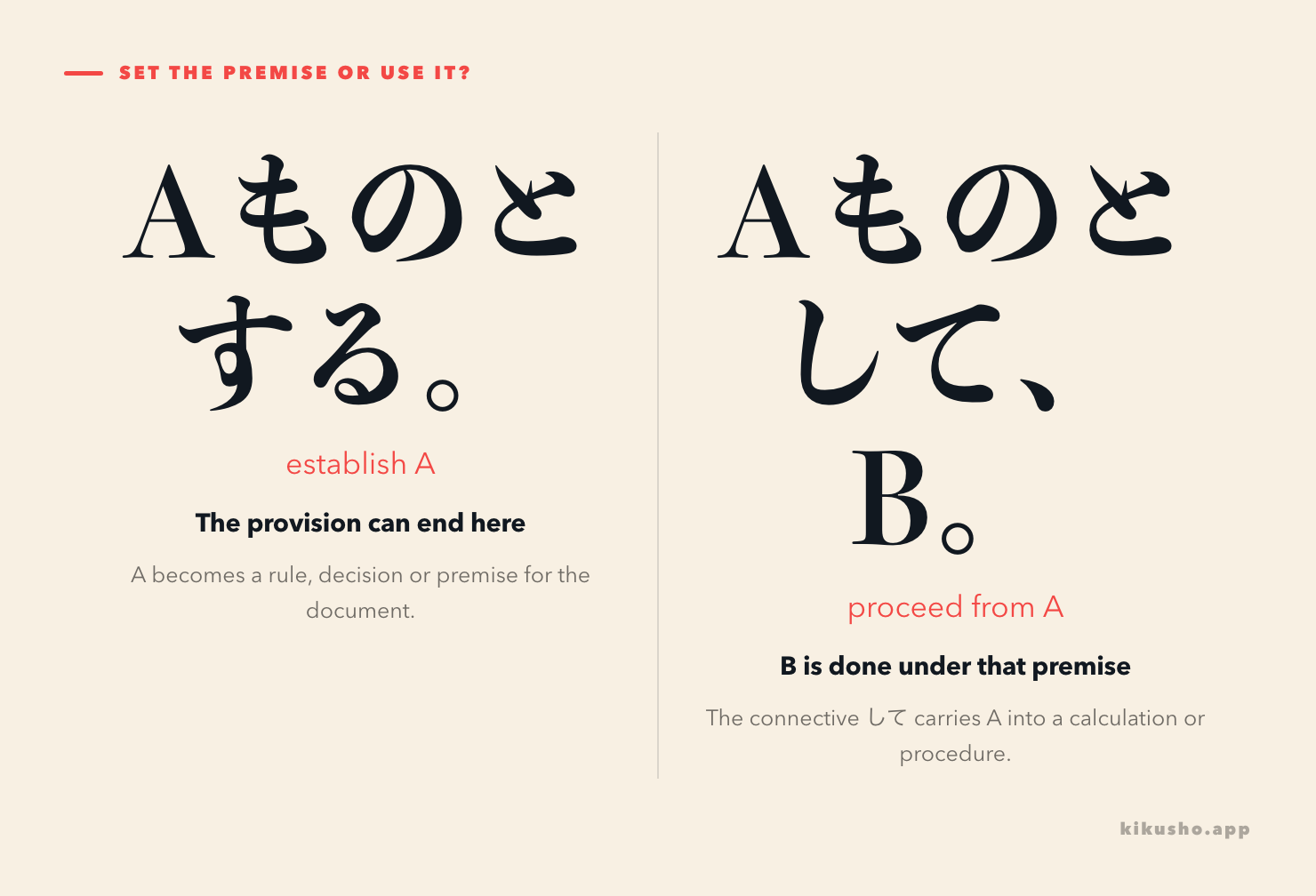
J-nihongo describes ものとする as setting a decision or assumption in rules, contracts and arguments. Its separate ものとして lesson describes taking something as fact or as a settled condition, then proceeding with judgment, calculation or procedure. The two constructions meet at “treat A as fixed,” but their position in the sentence differs.
ものとする gives a provision its force
In rules, contracts and official instructions, V dictionary/negative + ものとする makes the content a formal provision.
参加者は受付で身分証明書を提示するものとする。
さんかしゃはうけつけでみぶんしょうめいしょをていじするものとする。
Participants shall present identification at reception.
The English “shall” fits because the Japanese establishes a requirement. The same ending can set a prohibition:
記録は許可なく削除しないものとする。
きろくはきょかなくさくじょしないものとする。
Records must not be deleted without permission.
This is much harder and more impersonal than telling one listener 提示してください or 削除しないでください. The document defines how participants or records are to be handled. ヤトモンキー先生の日本語 likewise places the form in contracts, regulations and other highly formal writing, with the core operation “decide officially that A.”
Do not translate every instance mechanically as “must.” A contract can establish a result rather than command a person:
契約は双方の署名がそろった日に成立するものとする。
けいやくはそうほうのしょめいがそろったひにせいりつするものとする。
The contract shall take effect on the day both signatures are obtained.
No participant is ordered to “take effect.” The clause defines the legal or procedural consequence.
ものとする can also pose an assumption
Outside regulations, ものとする can establish a premise for an argument or exercise.
A社の利益は毎年五パーセント増えるものとする。
エーしゃのりえきはまいとしごパーセントふえるものとする。
Suppose that Company A's profit increases by five percent each year.
The sentence instructs the reader to accept that premise for the calculation. In mathematical or analytical prose, English “suppose” can therefore fit the same form that contracts translate as “shall.” The shared operation is deliberate setting, not obligation by itself.
A past form can set a hypothetical completed event:
全員が提案に同意したものとする。
ぜんいんがていあんにどういしたものとする。
Let us assume that everyone agreed to the proposal.
The writer has not necessarily asserted that agreement happened. The proposition is adopted for the current reasoning.
ものとして makes the adopted premise modify the next step
With ものとして, the sentence continues and tells you what is calculated, decided or done under the premise.
全員が提案に同意したものとして、契約書の作成を進めます。
ぜんいんがていあんにどういしたものとして、けいやくしょのさくせいをすすめます。
We will proceed with drafting the contract on the assumption that everyone agreed to the proposal.
The agreement remains the assumed A. Drafting is B, the action organized around it. Bunpro calls this a determination that A will count as true for the discussion and contrasts it with ordinary として, which presents a real role or category.
Common following verbs reveal the relationship:
| Following expression | What happens under the assumption |
|---|---|
| 計算する | calculate |
| 扱う | treat or process |
| 判断する | judge |
| 準備する | prepare |
| 話を進める | continue a discussion |
追加費用は発生しないものとして、予算を組みました。
ついかひようははっせいしないものとして、よさんをくみました。
We drew up the budget on the assumption that no additional costs would arise.
If additional costs later appear, the original budget may fail. ものとして tells the reader which premise the plan depends on; it does not guarantee that premise.
Build a full proposition before ものとして
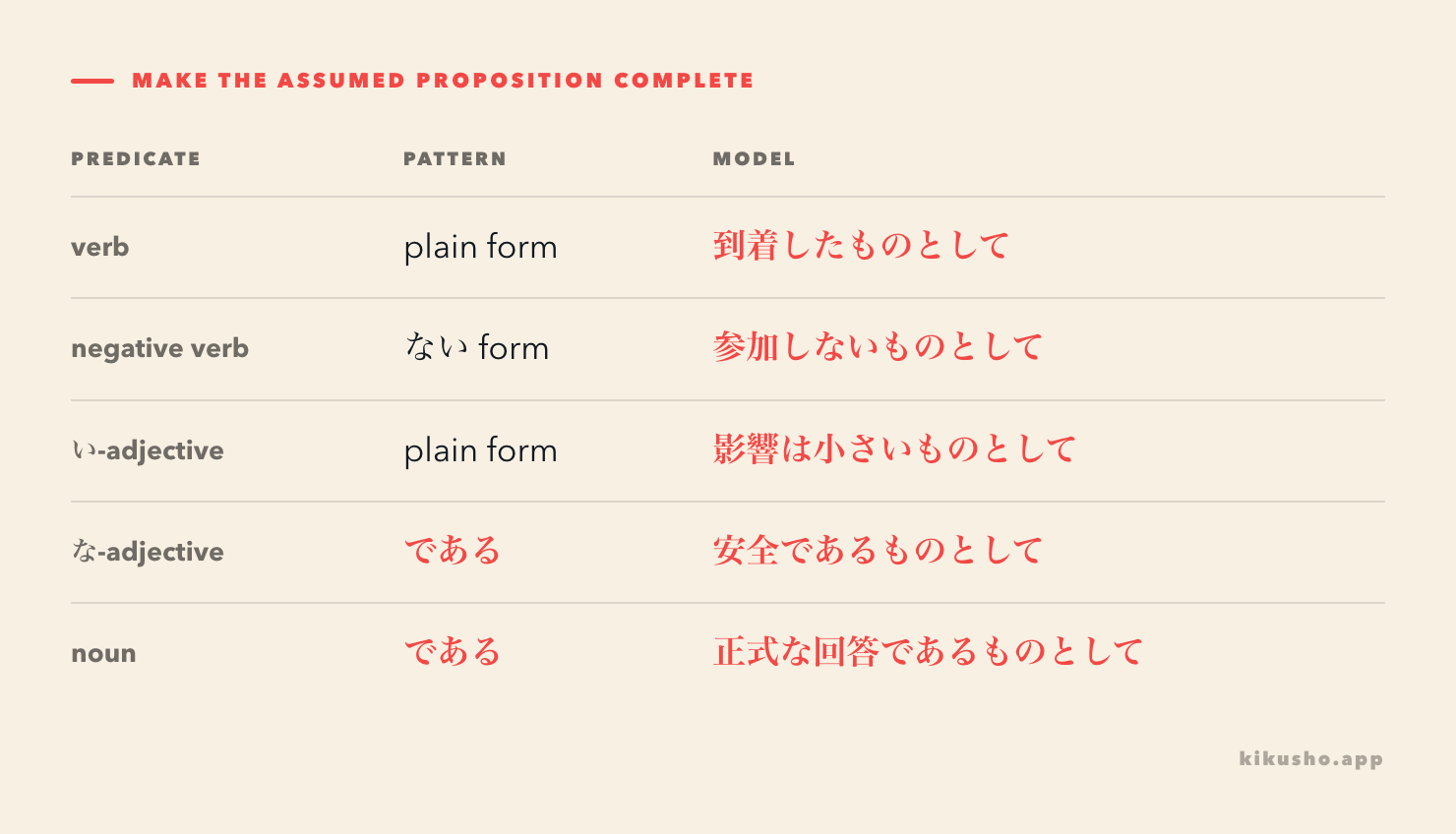
The assumed material behaves as a plain clause. Noun and な-adjective propositions are clearest with である.
| Predicate | Pattern | Example |
|---|---|---|
| verb | plain form + ものとして | 到着したものとして |
| negative verb | ない form + ものとして | 参加しないものとして |
| い-adjective | plain form + ものとして | 影響は小さいものとして |
| な-adjective | である + ものとして | 安全であるものとして |
| noun | である + ものとして | 正式な回答であるものとして |
この数値は正確であるものとして、分析を続けた。
このすうちはせいかくであるものとして、ぶんせきをつづけた。
We continued the analysis on the assumption that these figures were accurate.
The である completes the な-adjective predicate 正確である. Dropping it to make 正確ものとして breaks the attachment.
Ordinary として states a role, not a provisional premise
Compare a factual capacity with an assumed state:
彼は通訳として会議に参加した。
He attended the meeting as an interpreter.
彼が通訳できるものとして、英語版の資料を用意しなかった。
Assuming that he could interpret, we did not prepare English materials.
The first sentence identifies his actual role. The second says the decision about materials depended on an assumption about his ability. ものとして is therefore not a longer, more formal substitute for every noun + として.
It is also different from a simple condition such as もし参加しなければ. A conditional describes what follows if A occurs. 参加しないものとして席を減らす says the planner actively adopts non-participation as the working premise now.
The cause, result and condition vocabulary lesson distinguishes 前提, an assumption already in place when reasoning begins, from evidence that supports a later claim. ものとして shows that premise operating inside a sentence.
Compare the pair with one administrative decision
Read these as two stages of one rule:
期限までに返答がない場合は、提案に同意したものとする。
If no reply arrives by the deadline, the person will be deemed to have agreed to the proposal.
同意したものとして、次の手続きを開始する。
Treating agreement as established, the next procedure will begin.
The first clause creates the deemed effect. The second uses that effect as the basis for action. This set-then-use sequence is common in policies because the institution must state both what counts as true and what it will do as a result.
For an externally held belief rather than a provision, use the distinction in ものと思われる and とされる. 原因だとされている reports an established view; 同意したものとする actively creates a procedural assumption.
Capture both the premise and its consequence
A card containing only “assuming” cannot show whether the sentence sets or uses the premise. Save the complete clause. For ものとする, retain the document context or analytical instruction. For ものとして, retain the following verb that reveals what the assumption controls.
In Kikusho, label the sentence “provision,” “premise set,” or “premise used.” During review, reconstruct whether the document established the premise or merely acted on it instead of choosing between two nearly identical English glosses.
Practice
Answer Questions 1–7 before revealing the explanations.
Question 1
A company rule establishes a duty. Choose the best ending.
利用者は年に一度、登録情報を更新する____。
ア. ものとして
イ. ものとする
ウ. ものと思われる
エ. として
Question 2
The planner takes full attendance as a premise for preparing the venue.
全員が参加する____、会場を準備します。
ア. ものとする
イ. ものとして
ウ. ものを
エ. とされる
Question 3
Which sentence defines a procedural consequence rather than issuing a direct personal command?
ア. 返事がなければ、電話してください。
イ. 期限までに返答がない場合は、同意したものとする。
ウ. 同意したと思います。
エ. 同意したものとして、相談しました。
Question 4
Arrange the fragments to mean “We calculated the cost on the assumption that it would be 10,000 yen per person.”
- 計算した
- 一人一万円かかる
- 費用を
- ものとして
Question 5
Why is 彼は通訳として会議に参加した different from 彼が通訳できるものとして資料を準備した?
ア. The first states an actual role; the second adopts an ability as a premise.
イ. The first is a prohibition; the second is reported speech.
ウ. The first is past and the second is future.
エ. There is no difference.
Question 6
Complete the formal negative provision: “Staff must not delete records without permission.”
担当者は記録を許可なく____ものとする。
Question 7
Complete both stages of the policy.
返答がない場合は、申請を取り下げた( ① )。取り下げた( ② )、受付を終了する。
ア. ① ものとして / ② ものとする
イ. ① ものとする / ② ものとして
ウ. ① とされる / ② ものと思われる
エ. ① ものを / ② として
Answers and explanations
The first three answers identify whether the text sets a rule or carries a premise forward.
Answer 1
Choose イ. ものとする. The company rule establishes the annual update as a formal duty and can end at that provision. ものとして would require a following action performed under an assumption.
Answer 2
Choose イ. ものとして. The assumption that everyone will attend guides the following preparation of the venue. The connective して links the premise to that action.
Answer 3
Choose イ. The deadline clause creates the procedural effect “count as having agreed.” It is not addressed as a request to one listener. Choice エ uses an assumption to describe a later consultation instead.
Answer 4
2 → 4 → 3 → 1: 一人一万円かかるものとして、費用を計算した。 The amount is the working premise and 計算した is the action performed under it.
Answer 5
Choose ア. Bare 通訳として identifies the person's real capacity at the meeting. The clause 彼が通訳できるものとして says the material preparation relied on an assumption that he could interpret.
Answer 6
Use 削除しない: 担当者は記録を許可なく削除しないものとする。 The negative plain form appears before ものとする, and the document makes non-deletion the formal rule.
Answer 7
Choose イ. ① ものとする / ② ものとして. The first sentence establishes withdrawal as the deemed result of no reply. The second treats that result as the premise for closing reception.
Common questions
What is the difference between ものとする and ものとして?
ものとする establishes a rule, decision or premise. ものとして treats a proposition as an operative assumption and connects it to the calculation, judgment or procedure that follows.
What does ものとする mean in a contract?
It gives a clause the force of a formal provision, often translated as “shall,” “must,” or “is to.” The exact English depends on whether the clause imposes a duty, prohibition, condition or agreed effect.
Is ものとして the same as ordinary として?
No. Noun plus として states an actual role or capacity, such as 教師として. A clause plus ものとして adopts the clause as an assumption for the next action, even when its truth has not been confirmed.
Are ものとする and ものとして N1 grammar?
The independent references checked for this lesson place both constructions at N1. The JLPT does not publish an exhaustive official grammar list, so that level remains study guidance rather than an official boundary.