On this page
に基づいて grounds a judgment or action in evidence, rules or another foundation that constrains the result. をもとに treats a source, model or experience as material from which something can be developed, adapted or created.
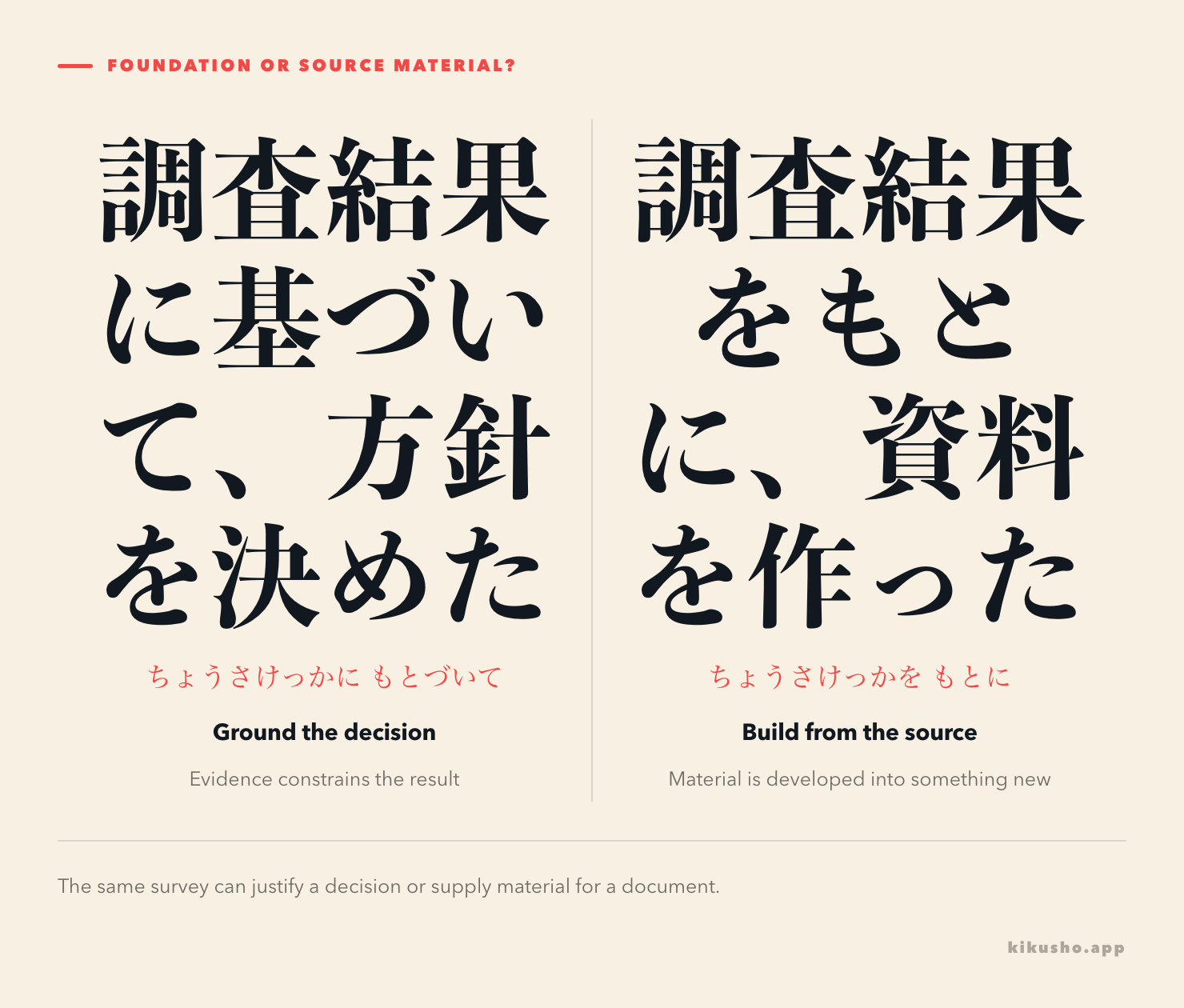
The same survey can support two different moves:
調査結果に基づいて、方針を決めた。
ちょうさけっかに もとづいて、ほうしんを きめた。
We decided the policy based on the survey results.
調査結果をもとに、説明資料を作った。
ちょうさけっかを もとに、せつめいしりょうを つくった。
We made explanatory materials using the survey results as a basis.
The first sentence presents the results as grounds for the decision. The second presents them as input used to produce something new.
Ask whether the source constrains or supplies material
English often translates both forms as “based on.” The Japanese choice shows what relationship the result has to its basis.
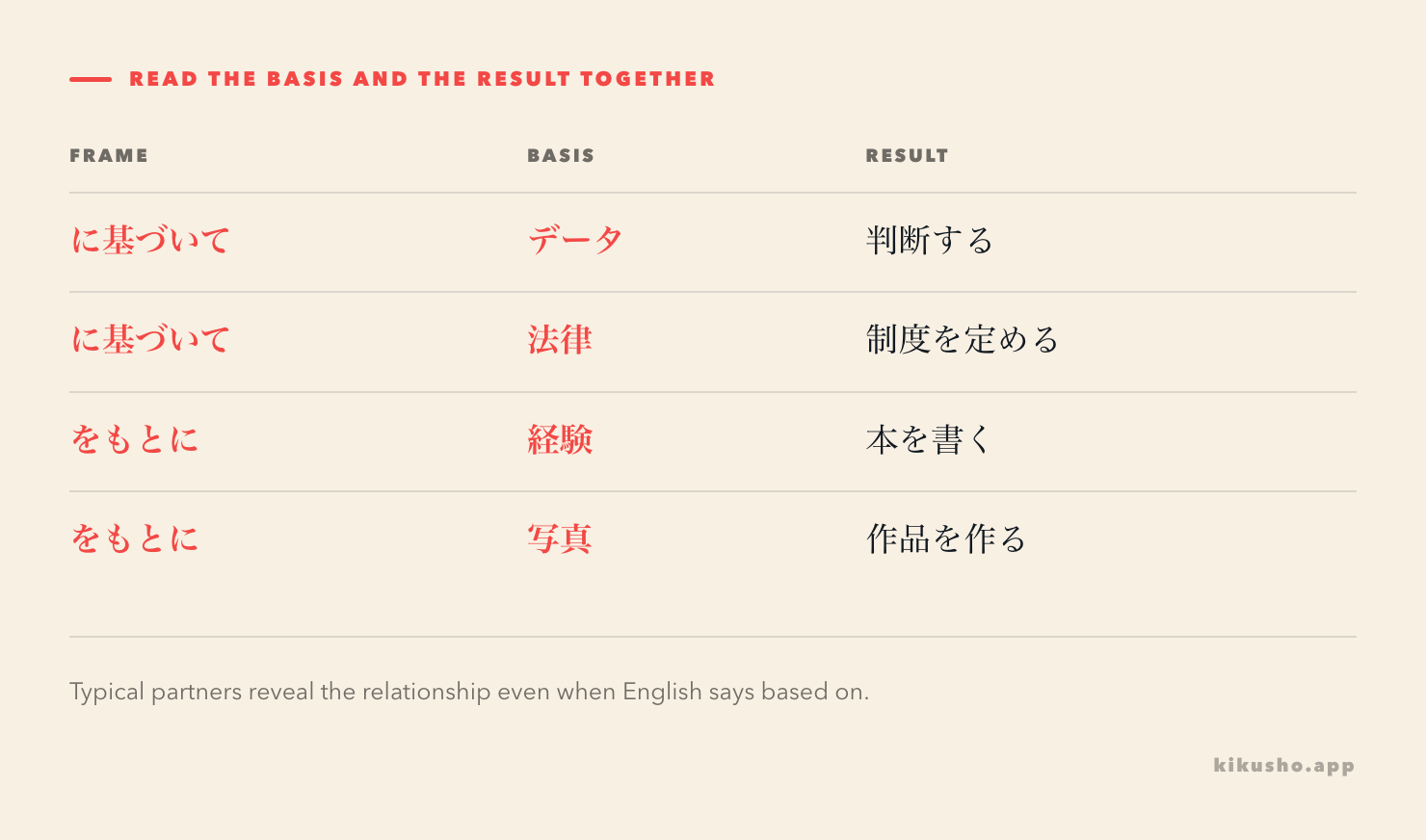
| Question to ask | Choose | Typical basis |
|---|---|---|
| What evidence, rule or principle justifies this? | Nに基づいて | 事実, データ, 法律, 規則, 調査結果 |
| What source or model did someone work from? | Nをもとに(して) | 実話, 経験, 写真, アイデア, アンケート |
The distinction is strongest in clear cases, not an absolute ban on every overlapping noun. Data can justify a decision or supply material for a chart. A true story can ground a factual reconstruction or inspire a novel. The following verb and the writer's stance reveal which relation matters.
に基づいて presents a foundation for judgment or action
に基づいて(にもとづいて, ni motozuite) follows a noun. The noun names the foundation on which the following judgment, system, report or action rests.
事実に基づいて報道してください。
じじつに もとづいて ほうどうして ください。
Please report on the basis of facts.
この手続きは法律に基づいて行われる。
この てつづきは ほうりつに もとづいて おこなわれる。
This procedure is carried out in accordance with the law.
The form comes from 基づく, “to be based or grounded on.” That verb explains the particle: the foundation takes に, not を.
JLPT Sensei's に基づいて reference records N + に基づいて and places it at N2. Elon.io's comparison independently describes facts, data and laws as foundations for judgment or action, and distinguishes this grounding from following a route with に沿って. Bunpro currently files に基づいて under N3, so the N2 label here is a curriculum placement rather than an official boundary.
Before a noun, replace the connective て-form with a modifier:
- 科学的な証拠に基づく説明: an explanation based on scientific evidence
- 調査に基づいた提案: a proposal based on research
に基づく states the general relation. に基づいた presents the proposal or explanation as the result of grounding work already carried out. In many descriptions either can be possible, so tense and viewpoint decide more than an English adjective does.
をもとに turns a source into a starting point
をもとに(して) also follows a noun, but marks that noun as source material, a model or a starting point.
祖父の体験をもとに、小説を書いた。
そふの たいけんを もとに、しょうせつを かいた。
I wrote a novel based on my grandfather's experiences.
この写真をもとにして、ポスターをデザインした。
この しゃしんを もとにして、ポスターを デザインした。
I designed a poster using this photograph as a basis.
The result can select, combine or reshape what the source provides. A novel need not reproduce every event in the experience, and a poster need not copy the photograph unchanged.
Bunpro's をもとに entry places the pattern at N2 and treats をもとに and をもとにして as noun-based forms. 日本語NET independently defines the basis as material, a standard or a reference and shows it with creative and analytical results.
Before a noun, use Nをもとにした + noun:
実話をもとにした映画
じつわを もとにした えいが
a film based on a true story
A full event must first become noun-like: 取材で聞いたことをもとに記事を書いた, “I wrote the article based on what I heard during interviews.” The connector still follows a noun phrase, here 聞いたこと.
One source can produce two different claims
Compare 実話, a true story:
証言と記録に基づいて、事件を再現した。
Based on testimony and records, they reconstructed the incident.
実話をもとに、登場人物を加えて脚本を書いた。
Using a true story as a basis, they added characters and wrote a screenplay.
The reconstruction claims fidelity to evidence. The screenplay openly develops its source. This is why “evidence versus raw material” is a useful test, even though both English translations can contain “based on.”
| Pattern | Basis | Natural result |
|---|---|---|
| データに基づいて | verified data | judge, calculate, conclude |
| 法律に基づいて | law | establish, authorize, carry out |
| 経験をもとに | experience | write, design, develop |
| 写真をもとに | photograph | draw, model, create |
The neighboring によって does a different job. It can mark cause, means, an agent or variation. The lesson on the four roles of によって explains why 事実によって判断する does not simply replace 事実に基づいて判断する.
The particle and modifier form expose common mistakes
Keep each expression as a whole frame:
- Nに基づいて + action
- Nに基づく/Nに基づいた + noun
- Nをもとに(して)+ action
- Nをもとにした + noun
Do not combine the particle from one frame with the verb from the other: データを基づいて is incorrect because 基づく selects に. Likewise, 写真にもとに loses the を required by the source-material frame.
In Kikusho, keep the source noun and the result together when you save one of these expressions. A card containing only に基づいて hides whether the original sentence cited a law, evidence or a loose inspiration. Capturing 調査結果に基づいて方針を決めた preserves the exact relationship you need to recall.
Practice: identify the source-result relationship
Question 1 · evidence
Complete: 専門家は最新のデータ( )、安全基準を見直した。
- A. をもとにした
- B. に基づいて
- C. によると
- D. を基づいて
Question 2 · creative material
Complete: 監督は作家の短編小説( )、映画を制作した。
- A. をもとに
- B. に基づくを
- C. によると
- D. にもとに
Question 3 · noun modifier
Which phrase means “a proposal based on the investigation”?
- A. 調査に基づく提案
- B. 調査を基づいて提案
- C. 調査に基づいての提案する
- D. 調査をもとに提案した
Question 4 · completed source material
Complete: これは住民への聞き取り( )報告書です。 The report was produced from the interviews.
- A. に基づいて
- B. をもとにした
- C. をもとにしての作る
- D. によってした
Question 5 · same noun, different stance
Which sentence most clearly claims that a conclusion is justified by survey evidence?
- A. アンケートをもとに、イラストを描いた。
- B. アンケートに基づいて、結論を出した。
- C. アンケートによると、絵を作った。
- D. アンケートを基づく結論だ。
Question 6 · interpretation
A novel is described as 実話をもとにした小説. What does the phrase allow?
- A. Every detail must reproduce the real events exactly.
- B. The real story is the source, but the novel may reshape it.
- C. The novel is legally authorized by the story.
- D. The story merely reports who wrote the novel.
Answers and explanations
Answer 1
B. に基づいて. The data supplies evidence for revising a safety standard. 基づく takes に, so D has the wrong particle. によると introduces reported information rather than the basis of the experts' action.
Answer 2
A. をもとに. The short story is material from which the director creates a film. B and D mix incompatible particles and forms; C would need a following report or statement.
Answer 3
A. 調査に基づく提案. に基づく directly modifies 提案. B gives 基づく the wrong particle, C does not form a clean noun modifier, and D is a complete predicate fragment rather than the requested phrase.
Answer 4
B. をもとにした. The interviews are source material for a completed report, and をもとにした modifies 報告書. A needs a following action, while C and D are malformed.
Answer 5
B. アンケートに基づいて、結論を出した. The survey is evidence supporting the conclusion. A is grammatical but describes creative production; C misuses によると before an action, and D gives 基づく the wrong particle.
Answer 6
B. The real story is the source, but the novel may reshape it. をもとにした identifies source material, not a promise of exact reproduction or legal authority. The result can adapt the source.
Read the result verb before translating “based on”
When both choices seem possible, look to the right. 判断する, 決定する and 行う often need a foundation that justifies them. 作る, 書く and 開発する often transform an input into something new. The verb does not decide mechanically, but it reveals whether the writer is defending a result or describing how it was made.
Common questions
What is the difference between に基づいて and をもとに?
に基づいて grounds a decision, judgment or action in evidence, rules or another authoritative foundation. をもとに uses information, experience or a model as source material from which something may be developed or reshaped.
What comes before に基づいて and をもとに?
Both follow nouns. Use Nに基づいて for the evidential foundation and Nをもとに, optionally Nをもとにして, for source material or a starting model.
How do these expressions modify a noun?
Use Nに基づく or Nに基づいた before a noun, and Nをもとにした before a noun. For example, 事実に基づく判断 is a judgment grounded in facts.