On this page
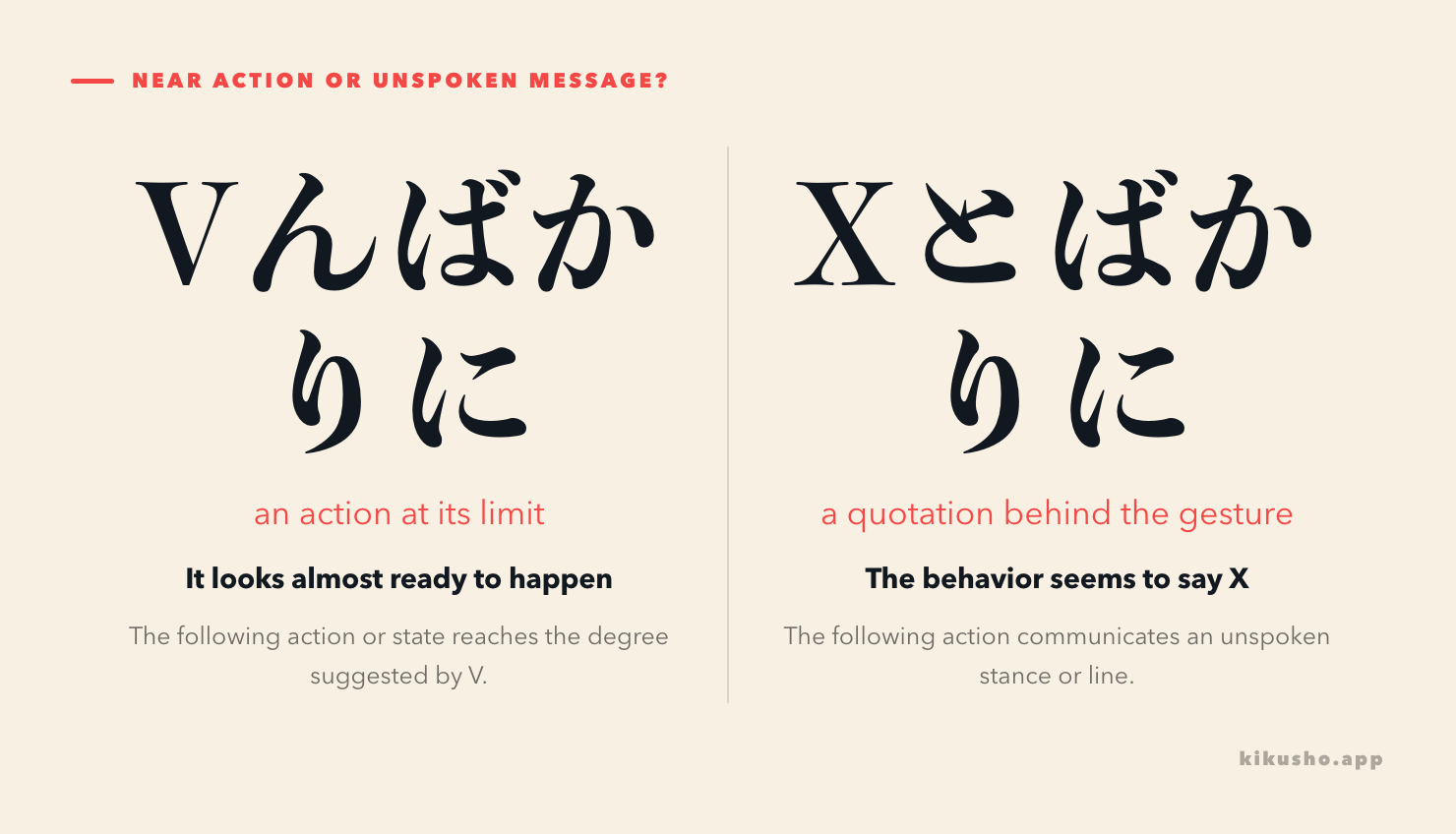
Use んばかりに when a visible action or state seems close to another action; use とばかりに when a gesture seems to communicate a quoted thought. A suitcase can be 破裂せんばかりに膨らんでいる, “swollen as if about to burst.” Someone can point at the exit 帰れとばかりに, “as if to say, ‘Leave.’”
Both constructions turn observation into vivid narration. The deciding question is whether you are imagining an action at its limit or hearing an unspoken line behind someone’s behavior.
Ask whether the hidden material is an action or a quotation
| Form | Hidden comparison | What the following action shows | Practical translation |
|---|---|---|---|
| Vない-stem + んばかりに, B | V looks almost ready to occur | B reaches the degree suggested by V | as if about to V; almost V-ing |
| quotation + とばかりに, B | “X,” although nobody says it aloud | B communicates the stance X | as if to say X; as though thinking X |
日本語教師のN1et teaches the pair together: んばかりに presents a manner suggesting that an action is almost happening, while とばかりに lets an attitude or gesture imply quoted content. The surface similarity comes from ばかりに, but the material before it does different work.
観客は舞台が揺れんばかりに拍手した。
かんきゃくはぶたいがゆれんばかりにはくしゅした。
The audience applauded so hard that the stage seemed about to shake.
The stage does not need to shake. 揺れんばかりに supplies an imagined limit for the force of the applause.
観客は待っていましたとばかりに拍手した。
かんきゃくはまっていましたとばかりにはくしゅした。
The audience applauded as if to say, “We’ve been waiting.”
Here 待っていました is the line their applause appears to express.
んばかりに builds from the ない-form without ない
Start with the plain negative, remove ない, and add んばかりに. The resulting ん does not make the sentence a modern negative. It belongs to a literary formation meaning that the action seems on the verge of occurring.
| Dictionary form | Plain negative | Remove ない | Result |
|---|---|---|---|
| 泣く | 泣かない | 泣か | 泣かんばかりに |
| 飛び出す | 飛び出さない | 飛び出さ | 飛び出さんばかりに |
| あふれる | あふれない | あふれ | あふれんばかりに |
| する | しない | special base せ | せんばかりに |
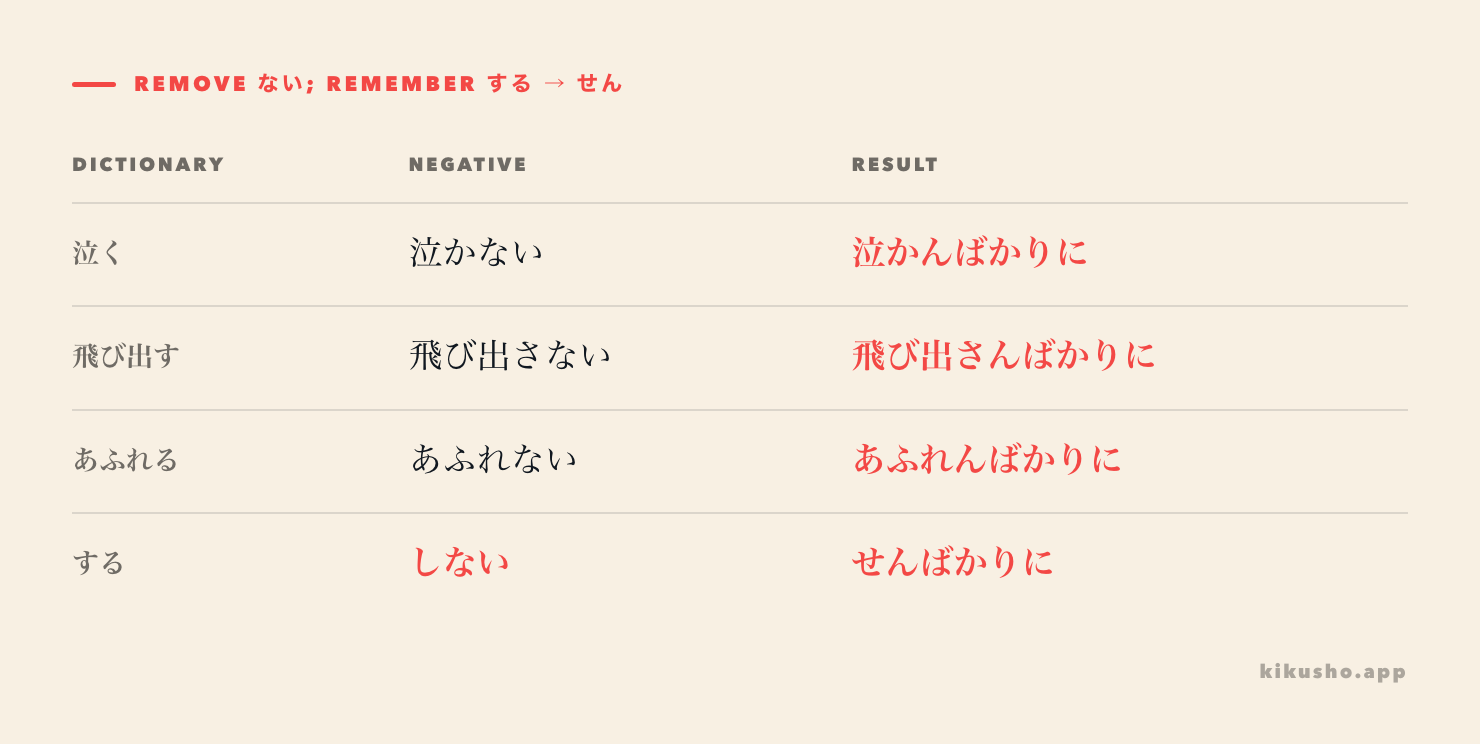
毎日のんびり日本語教師 gives the same attachment and singles out せんばかりに for する. It also distinguishes three endings:
| Ending | Sentence job | Example |
|---|---|---|
| んばかりに + action | modifies a following action | 飛び上がらんばかりに喜んだ |
| んばかりの + noun | modifies a noun | あふれんばかりの笑顔 |
| んばかりだ | closes the description | 袋は破れんばかりだ |
合格の知らせを聞いて、彼女は飛び上がらんばかりに喜んだ。
ごうかくのしらせをきいて、かのじょはとびあがらんばかりによろこんだ。
When she heard that she had passed, she was so delighted that she looked ready to jump.
The main event is 喜んだ. The imagined jump measures how intense that delight appeared.
The action before んばかりに remains unrealized
The construction is effective because it approaches a boundary without asserting that the boundary was crossed.
紙袋は中身がこぼれんばかりに膨らんでいた。
かみぶくろはなかみがこぼれんばかりにふくらんでいた。
The paper bag was bulging as if its contents were about to spill out.
The sentence describes the bag’s appearance. If the contents really spilled, say so separately: とうとう中身がこぼれた, “the contents finally spilled.”
This also explains fixed-looking descriptions such as 割れんばかりの拍手, literally applause intense enough to seem capable of splitting something, and あふれんばかりの笑顔, a smile full to overflowing. The imagined action can be physical or figurative, but it must still provide a natural limit for the degree described.
Do not build this expression from adjectives or nouns. If the hidden material is “This is the chance” or “You are at fault,” you need a proposition followed by とばかりに.
とばかりに turns behavior into an unspoken line
Put the words or thought that the gesture seems to convey before と. The following action becomes evidence for that reading.
彼は「早く来い」とばかりに大きく手を振った。
かれは「はやくこい」とばかりにおおきくてをふった。
He waved broadly as if to say, “Come quickly.”
No spoken command is required. The quotation marks make the implied line easy to see, but ordinary prose can omit them:
今が好機だとばかりに、各社は新製品を発表した。
いまがこうきだとばかりに、かくしゃはしんせいひんをはっぴょうした。
The companies announced new products as though thinking, “Now is the opportunity.”
The quoted material may be plain or polite and can contain a verb, adjective or noun predicate. What matters is that it can stand as something thought or said. N1et notes that the following clause often contains a forceful action, which is why the construction frequently appears in reports and narrative description.
The idiom ここぞとばかりに means that someone seizes precisely this moment as the opportunity:
相手が迷った瞬間、ここぞとばかりに攻め込んだ。
あいてがまよったしゅんかん、ここぞとばかりにせめこんだ。
The moment the opponent hesitated, she attacked as if thinking, “Now is my chance.”
言わんばかりに reveals why the forms can overlap
Compare two descriptions of the same gesture:
彼は帰れとばかりにドアを指した。
He pointed at the door as if to say, “Leave.”
彼は帰れと言わんばかりにドアを指した。
He pointed at the door as though on the verge of saying, “Leave.”
The first attaches とばかりに directly to the quoted command 帰れ. The second places the same command before と, then attaches んばかりに to 言う: 言わない → 言わ + んばかりに. Both can describe an unspoken message, which is why dictionaries and teaching pages often gloss them alike.
Their internal structure still differs. In 帰れとばかりに, the quote is the stance inferred from the gesture. In 帰れと言わんばかりに, the nearly realized action is 言う, so the sentence pictures the person as almost voicing that quote. Recognizing 言わん prevents you from treating the entire string as one indivisible form.
These are written, observational choices
Both patterns sound expressive and are common in written narrative, journalism and formal description. Ordinary conversation more often uses 今にも泣きそう, “looks about to cry,” or 帰れと言っているように, “as if saying leave.” The N1 forms compress that observation into a denser phrase.
JLPT Sensei lists んばかりに and とばかりに at N1, as do the two independent Japanese teaching references used above. Treat that placement as study guidance: the official JLPT FAQ says the exam body no longer releases a complete specification of tested words, kanji and grammar.
They also normally describe another person, a group, an object or a scene from the outside. A narrator can describe their own past behavior at a distance, but the construction is a poor choice for a direct statement of present intention. 私は帰れとばかりに指します does not simply mean “I point because I want them to leave.” It frames the gesture as something an observer interprets.
This differs from かのように, which can compare a situation with an unreal appearance more broadly. んばかりに specifically uses a verb as the imagined limit; とばかりに specifically reconstructs quoted content from conduct. The N3 ばかり comparison covers restriction, recent completion and repeated activity instead of these expressive N1 uses.
Save the gesture with the line it implies
An isolated card reading “ばかり = only” erases the structure that decides the meaning. When you meet んばかりに, keep the preceding verb and the action whose degree it modifies. For とばかりに, save both the implied quotation and the gesture that lets the narrator hear it.
In Kikusho, a subtitle or photographed sentence can become a card with the full context intact. Add a short note such as “near action” or “unspoken message,” then test yourself by rebuilding the missing half: which action nearly happened, or which line did the gesture appear to communicate?
Practice
Keep the disclosure closed while you work through all seven questions.
Question 1
Which completion describes a bag that looks ready to burst?
かばんは破裂____膨らんでいた。
ア. とばかりに
イ. せんばかりに
ウ. したばかりで
エ. するものとして
Question 2
Choose the form that makes the gesture communicate an unspoken command.
彼は「座れ」____椅子を指した。
ア. んばかりに
イ. とばかりに
ウ. たばかりに
エ. ないばかりに
Question 3
Which attachment is correct for 泣く?
ア. 泣きんばかりに
イ. 泣くんばかりに
ウ. 泣かんばかりに
エ. 泣けんばかりに
Question 4
Arrange the fragments to mean “She was delighted as if about to jump.”
- 喜んだ
- 彼女は
- 飛び上がらんばかりに
- 合格して
Question 5
Complete the noun-modifying form: “a smile full to overflowing.”
あふれんばかり__笑顔
Question 6
Read the short passage and choose the interpretation of the marked phrase.
会議では誰も発言しなかった。終了後、部長は「時間の無駄だった」とばかりに資料を机へ置き、すぐに部屋を出た。
ア. The manager explicitly said that the meeting was a waste of time.
イ. The manager’s actions conveyed that the meeting had been a waste of time.
ウ. The documents were nearly thrown away.
エ. The manager had only just prepared the documents.
Question 7
Choose the pair that completes both sentences.
観客は会場が揺れ( ① )拍手した。選手は「もっと」( ② )両手を上げた。
ア. ① とばかりに / ② んばかりに
イ. ① んばかりに / ② とばかりに
ウ. ① たばかりに / ② ものとして
エ. ① そうに / ② せんばかりに
Answers and explanations
Answer 1
Choose イ. せんばかりに. 破裂する becomes 破裂しない in the plain negative, but する takes the special attachment せんばかりに. The sentence describes the bag’s extreme swelling without asserting that it burst.
Answer 2
Choose イ. とばかりに. 「座れ」 is quoted content, and pointing at the chair is behavior that appears to convey it. んばかりに would need a verb stem such as 言わんばかりに.
Answer 3
Choose ウ. 泣かんばかりに. Begin with 泣かない, remove ない, then add んばかりに. The other choices use the verb stem, dictionary form or potential-looking base and do not form this construction.
Answer 4
2 → 4 → 3 → 1: 彼女は合格して、飛び上がらんばかりに喜んだ。 Passing provides the occasion, 飛び上がらんばかりに measures the intensity, and 喜んだ is the action that actually occurred.
Answer 5
Use の: あふれんばかりの笑顔. The の form lets the expressive description modify the noun 笑顔. With a following action, use に; to close the statement, use だ.
Answer 6
Choose イ. The passage reports silence during the meeting, then invites the reader to interpret the manager’s placement of the documents and quick exit as conveying 「時間の無駄だった」. It does not say that he voiced those words.
Answer 7
Choose イ. ① んばかりに / ② とばかりに. 会場が揺れる is the imagined action used to measure the applause, so 揺れない → 揺れんばかりに. 「もっと」 is the unspoken message communicated by raising both hands, so it takes とばかりに.
Common questions
What is the difference between んばかりに and とばかりに?
んばかりに follows a verb stem based on the ない-form and describes an action that looks almost ready to happen or an extreme degree. とばかりに follows quoted content and presents a gesture as conveying that unspoken message.
Why does する become せんばかりに?
This fixed literary construction uses the irrealis verb base, so する takes せ before ん and becomes せんばかりに. It is not the modern negative しない shortened to しん.
Is the action before んばかりに completed?
Normally no. It supplies the imagined limit used to describe the visible action or degree, as in a bag that looks ready to burst. The context does not assert that the bag actually bursts.
Are んばかりに and とばかりに N1 grammar?
The independent references checked for this lesson place both at N1. The JLPT does not publish an exhaustive official grammar list, so this is a study-list estimate rather than an official boundary.