On this page
ものと思われる presents a measured inference; とされる presents a view, rule or classification as already established outside the writer. Compare 記録から、火事は漏電が原因であるものと思われる (“the records suggest that an electrical fault caused the fire”) with この地域では、古い木を切ることは禁忌とされている (“in this region, cutting old trees is regarded as taboo”). The first sentence performs an inference. The second reports a social judgment.
English often renders both as “is thought,” “is considered” or “is believed.” The deciding question is therefore not the translation. Ask whether the sentence is drawing a conclusion now or reporting a position that already exists.
Decide where the judgment comes from
| Form | Main job | Implied source | Typical setting |
|---|---|---|---|
| plain clause + ものと思われる | measured inference or forecast | the writer or reporter, backgrounded | reports, announcements, careful analysis |
| plain clause + ものと見られる | assessment from observable evidence | analysts, investigators or observers | news, figures, developing events |
| plain clause / noun + とされる | accepted view, rule, definition or classification | society, experts, an institution or a text | academic, official and explanatory prose |
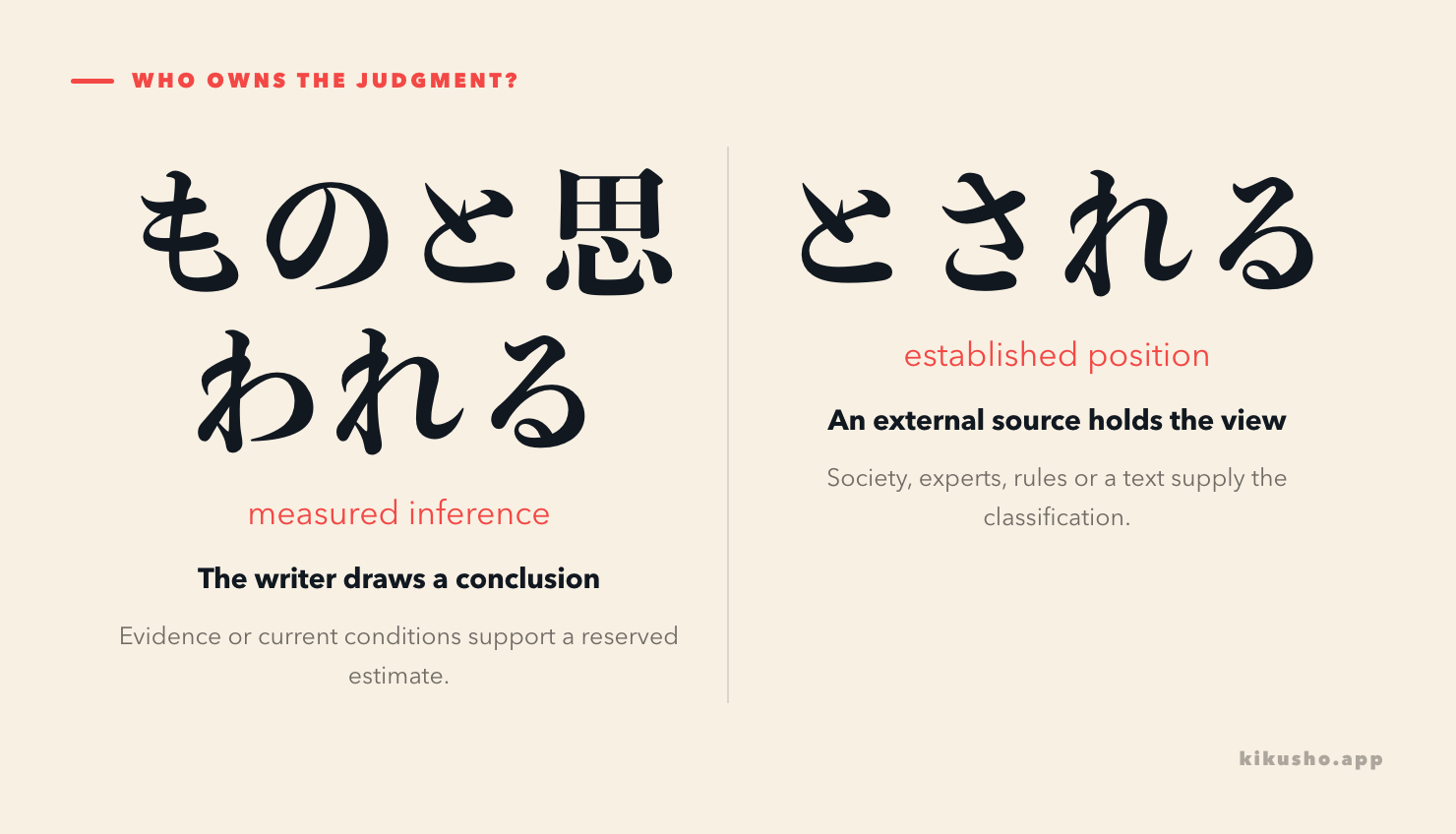
J-nihongo's ものと思われる reference describes an evidence-based inference stated formally, with the judging person kept out of the foreground. Its とされる reference instead points to judgments, classifications and rules held by society, specialists or institutions. Those descriptions make the contrast clearer than a shared English passive.
ものと思われる turns a conclusion into a measured report
Build a complete plain-form proposition, then add ものと思われる.
記録の時刻から、停電は午前二時ごろ始まったものと思われる。
きろくのじこくから、ていでんはごぜんにじごろはじまったものとおもわれる。
From the recorded times, the power outage is thought to have begun at around 2 a.m.
The records are evidence. The sentence presents 停電は午前二時ごろ始まった as the reporter's conclusion without saying 私はそう思う. The passive shape makes the judgment more reserved; it does not prove that the conclusion is objective or correct.
The construction also works for forecasts:
台風の影響で、午後の便は欠航するものと思われます。
たいふうのえいきょうで、ごごのびんはけっこうするものとおもわれます。
Because of the typhoon, the afternoon flights are expected to be cancelled.
Here the writer assesses the likely result from current conditions. ものと思われる is formal and often appears in announcements or reports. In ordinary conversation, 欠航すると思います or 欠航しそうです would usually sound lighter.
For noun and な-adjective predicates, formal prose commonly makes the proposition explicit with である:
| Predicate inside the claim | Reliable pattern | Example |
|---|---|---|
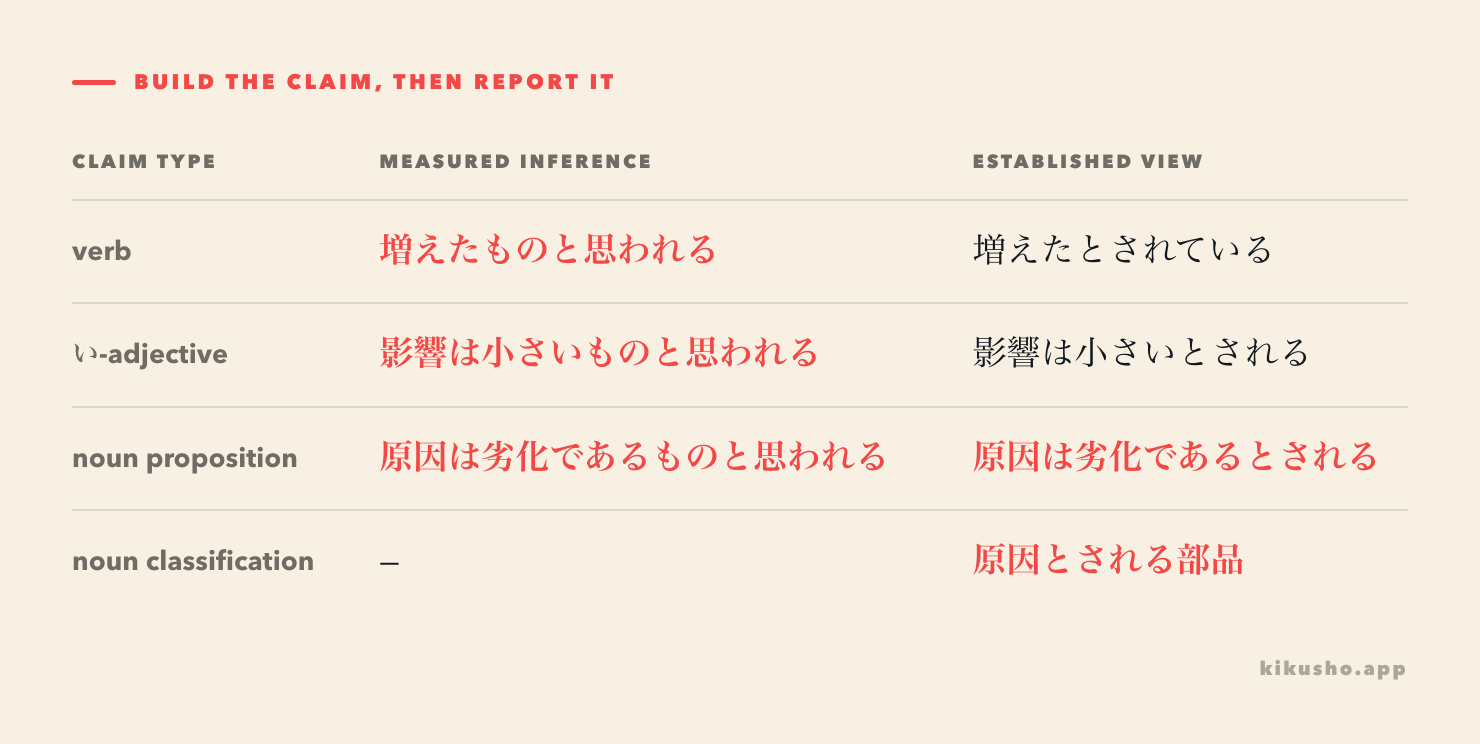
| verb | plain form + ものと思われる | 増加したものと思われる |
| い-adjective | plain form + ものと思われる | 影響は小さいものと思われる |
| な-adjective | である + ものと思われる | 状況は一時的であるものと思われる |
| noun | である + ものと思われる | 原因は劣化であるものと思われる |
The もの here packages the preceding proposition as the content of the formal judgment. It is not the concrete noun “thing,” and this pattern does not express the speaker's explanatory ものだ.
ものと見られる favors observable evidence
ものと見られる occupies much of the same territory, especially in news reports and analysis. The verb 見る encourages a reading like “is viewed/estimated on the available evidence.”
予約数の伸びから、来場者は昨年を上回るものと見られている。
よやくすうののびから、らいじょうしゃはさくねんをうわまわるものとみられている。
From the growth in reservations, attendance is expected to exceed last year's figure.
Figures and observable movement support the forecast. ものと思われる would also be possible, so do not invent a rigid boundary. 見られる tends to suit an assessment presented as the reading of evidence; 思われる is the broader formal inference.
絵でわかる日本語 glosses ものと思われる as an inference comparable to “probably” or “presumably.” The independent comparison at Hakkiri Nihongo likewise separates と思われる, which neutralizes a current inference, from とされる, which presents an externally recognized position.
とされる reports an established position
とされる is the passive of とする, “to treat, define or regard as.” It does not merely soften the current writer's opinion. It frames the quoted content as a view, norm or classification that exists beyond that writer.
この資料は、十九世紀末に作成されたとされている。
このしりょうは、じゅうきゅうせいきまつにさくせいされたとされている。
This document is believed to have been produced at the end of the nineteenth century.
The sentence reports an accepted dating. It does not show the writer calculating the date from evidence in this sentence.
規則では、申請後の内容変更は無効とされる。
きそくでは、しんせいごのないようへんこうはむこうとされる。
Under the rules, changes made after submission are deemed invalid.
This is institutional classification, so ものと思われる would be wrong: the rule does not “infer” invalidity. It defines the status.
とされている often presents the established view as a continuing state. The shorter とされる is common in definitions, rules and relative clauses:
事故の原因とされる部品を交換した。
じこのげんいんとされるぶひんをこうかんした。
They replaced the component considered to be the cause of the accident.
Here 原因とされる directly modifies 部品. A noun can attach without だ because the structure classifies the component as the cause. By contrast, a full quoted proposition keeps its ordinary predicate: この部品が原因だとされている.
The same fact can move from inference to consensus
The forms can describe different stages of one investigation:
現場の状況から、出火原因は配線の劣化であるものと思われる。
From conditions at the scene, deteriorated wiring is thought to be the cause of the fire.
最終報告書では、出火原因は配線の劣化であるとされている。
In the final report, deteriorated wiring is identified as the cause of the fire.
The first writer is still presenting an inference from observed conditions. The second sentence attributes the conclusion to a named external document. This is a discourse difference, not a difference in the event itself.
That distinction also separates the target from と考えられる. The と考えられる lesson focuses on a conclusion reached through reasoning and compares it with an ongoing generally held view. ものと思われる overlaps with that current conclusion but can sound more like a forecast or measured estimate. とされる steps farther away and reports a classification or accepted position.
For reported language at a lower register, と言ってもいい and と言われている distinguishes the speaker's own acceptable description from something people generally say. とされる is especially at home in institutional, academic and official framing.
Treat JLPT levels as estimates, not borders
The reference inventory for this lesson records both constructions as N1 from JLPT Sensei. J-nihongo also labels both N1. However, 毎日のんびり日本語教師 places とされている at N3 and describes its use for social conventions, theories and customs in news and academic prose.
That disagreement is plausible because とされている is common formal Japanese even when the contrast with nearby reporting expressions is advanced. The official JLPT FAQ explains the test's broad competency model but does not provide an exhaustive official grammar list. Use N1 here as the curriculum placement for mastering the distinction, not as a claim that the form cannot appear earlier.
Save the source of the claim with the sentence
A card containing only ~とされる = is considered loses the main contrast. Keep the evidence or authority in the example: 記録から signals an inference, while 報告書では, 規則では and 専門家の間では point to an external position.
When you capture formal Japanese in Kikusho, preserve the full proposition and note “current inference,” “evidence-based estimate,” or “established classification.” That extra line makes the next review test who owns the judgment instead of asking you to match two forms to the same English gloss.
Practice
Answer Questions 1–7 before opening the shared explanation block.
Question 1
A reporter draws a forecast from current reservation figures. Choose the best ending.
予約数の伸びから、来場者は昨年を上回る____。
ア. とされる
イ. ものと見られる
ウ. こととする
エ. ものとされない
Question 2
An official rule defines late applications as invalid.
規則では、期限後の申請は無効____。
ア. ものと思われる
イ. ものと見られる
ウ. とされる
エ. と思っている
Question 3
Which sentence presents the writer's measured inference from evidence?
ア. この地域では、その鳥は神の使いとされている。
イ. 規則では、この行為は違反とされる。
ウ. 足跡の大きさから、大型の動物が通ったものと思われる。
エ. この作品は作者の代表作とされている。
Question 4
Arrange the fragments to report an established historical view: “This temple is believed to have been built 800 years ago.”
- 建てられた
- この寺は
- とされている
- 八百年前に
Question 5
What changes between these two sentences?
現場の状況から、故障の原因は部品の劣化であるものと思われる。
最終報告書では、故障の原因は部品の劣化であるとされている。
ア. The first defines a rule; the second expresses a personal preference.
イ. The first draws an inference; the second attributes an established conclusion to the report.
ウ. The first is casual speech; the second is a request.
エ. They differ only in politeness.
Question 6
Rewrite the idea as a direct noun classification with とされる: “They examined the device considered to be the cause of the accident.”
Question 7
Complete both gaps without changing the source of either judgment.
雲の動きから、雨は夕方まで続く( ① )。この地域では、春の雨は豊作の兆し( ② )。
ア. ① とされている / ② ものと思われる
イ. ① ものと見られる / ② とされている
ウ. ① とされる / ② ものと見られる
エ. ① ものと思われない / ② と見られる
Answers and explanations
For each item, identify the holder of the judgment before checking the attachment.
Answer 1
Choose イ. ものと見られる. The reservation figures are observable evidence from which the reporter estimates future attendance. とされる would instead present the forecast as an externally established position.
Answer 2
Choose ウ. とされる. The rule classifies late applications as invalid. No inference is being drawn, so ものと思われる and ものと見られる do not fit the institutional definition.
Answer 3
Choose ウ. 足跡の大きさから supplies evidence, and 通ったものと思われる gives the writer's reserved conclusion. The other sentences report social, institutional or critical classifications with とされる.
Answer 4
2 → 4 → 1 → 3: この寺は八百年前に建てられたとされている。 The past passive 建てられた belongs inside the quoted historical claim; outer とされている presents that claim as an established view.
Answer 5
Choose イ. The first sentence reaches a tentative conclusion from conditions at the scene. The second points to a final report as the external holder of the conclusion.
Answer 6
One natural answer is 事故の原因とされる装置を調べた。 The noun 原因 attaches directly to とされる and the whole phrase modifies 装置. A full proposition would instead be その装置が事故の原因だとされている.
Answer 7
Choose イ. ① ものと見られる / ② とされている. The cloud movement supports a current weather estimate. The second clause reports a regional interpretation already held as a convention.
Common questions
What is the difference between ものと思われる and とされる?
ものと思われる presents a conclusion that the writer or reporter draws while keeping the thinker in the background. とされる attributes a classification, rule or accepted view to an external group, institution or body of knowledge.
How is ものと見られる different from ものと思われる?
Both express a formal estimate. ものと見られる often sounds especially natural for an assessment based on observable developments, figures or evidence, while ものと思われる is the broader measured-inference form.
What comes before とされる?
A complete plain-form clause can come before とされる, with だ retained after a noun or na-adjective. A noun may also attach directly when it is being classified as something, as in 原因とされる装置.
Are these forms officially N1 grammar?
The reference inventory used here places both at N1, but another independent teaching source places とされている at N3. The JLPT does not publish an exhaustive official grammar list, so level labels should be treated as study guidance.