On this page
A Japanese report can move from 背景 (background) and 前提 (premise), through 原因, 理由 and 要因, to 影響, 効果 and a 結論. 根拠 is what supports the claim along the way. These nine nouns are more useful as positions in that chain than as nine loose translations of “cause,” “reason,” “basis” and “effect.”
The nine words trace a report from setup to conclusion
Consider a report about a city where bicycle use has increased. It may first describe the circumstances behind the change, state an assumption used in the analysis, and separate one direct cause from several contributing factors. It then points to evidence, describes the wider influence of the change, measures whether a policy worked, and reaches a conclusion.
That sequence is not a compulsory template for Japanese writing. It is a reading map: each noun tells you what kind of relationship the writer is naming. The formal connectors used around these nouns tell you how one sentence follows another.
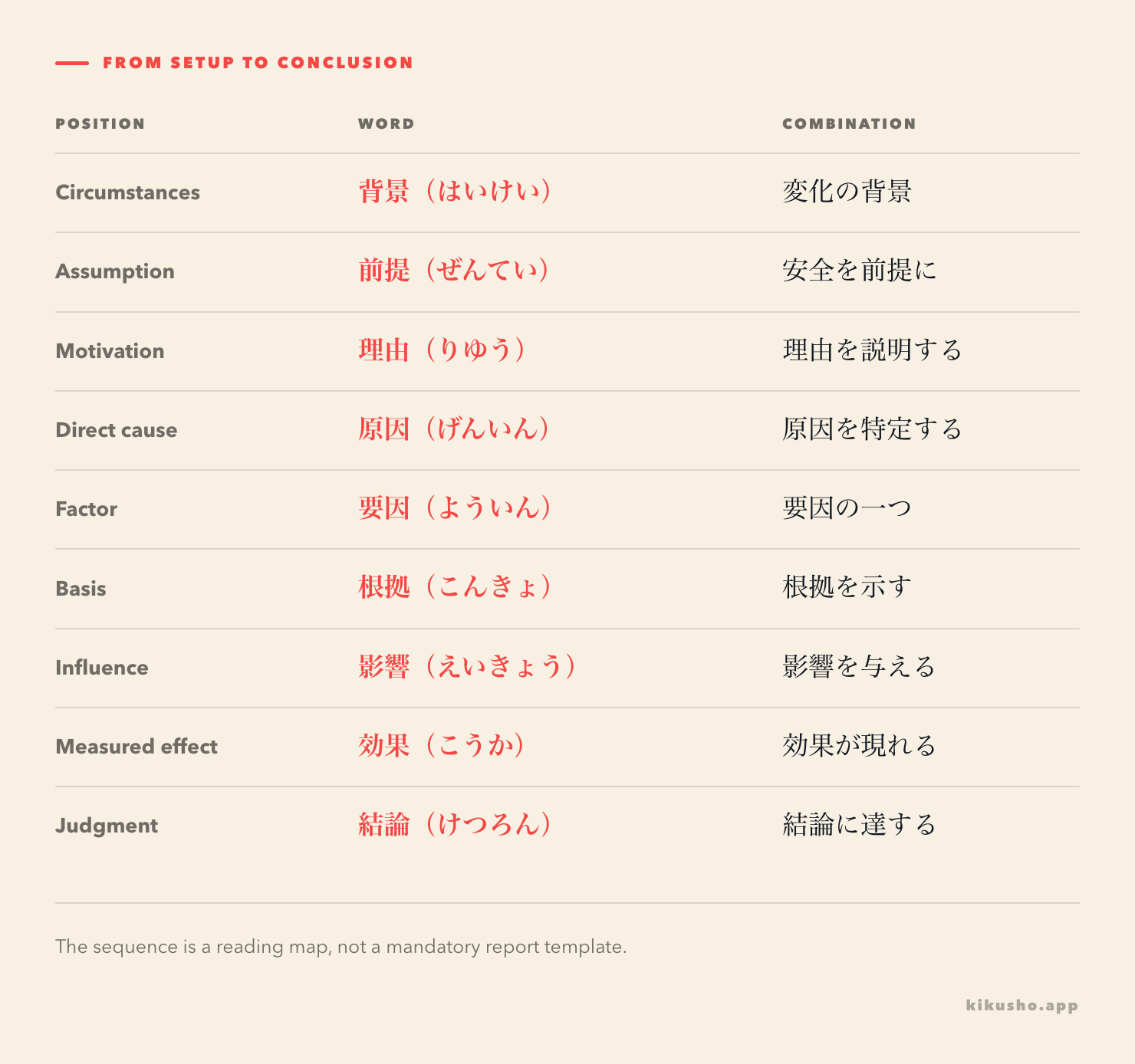
| Word and reading | Class | Role in a report | Combination to keep |
|---|---|---|---|
| 背景(はいけい) | Noun | Circumstances behind an event | 変化の背景を説明する |
| 前提(ぜんてい) | Noun / する | Premise or condition assumed first | 安全を前提とする |
| 理由(りゆう) | Noun | Why someone acts or judges | 理由を説明する |
| 原因(げんいん) | Noun / する | What brings about a state or change | 原因を特定する |
| 要因(よういん) | Noun | A factor contributing to an outcome | 主な要因の一つ |
| 根拠(こんきょ) | Noun | Basis or evidence supporting a claim | 根拠を示す |
| 影響(えいきょう) | Noun / する | Influence reaching another thing | 交通に影響を与える |
| 効果(こうか) | Noun | Intended or measured effect | 効果が現れる |
| 結論(けつろん) | Noun | Conclusion reached after reasoning | 結論に達する |
The table is the complete assigned set. Several nouns have broader dictionary senses: 背景 can be the background of a photograph, for example. This lesson keeps the reading-and-argument sense that makes the words belong together.
背景 sets the scene; 前提 sets what the argument assumes
この変化の背景には、燃料価格の上昇がある。
このへんかの はいけいには、ねんりょうかかくの じょうしょうが ある。
Behind this change is a rise in fuel prices.
背景(はいけい) names circumstances behind the visible event. It does not by itself assert a direct causal link. The dictionary entry for 背景 includes the circumstances lying behind an event, alongside the literal background of a picture or stage.
安全に利用できることを前提に、計画を立てた。
あんぜんに りようできることを ぜんていに、けいかくを たてた。
We made the plan on the premise that it could be used safely.
前提(ぜんてい) is already in place when the reasoning begins: Xを前提に, Xを前提とする, or Xが前提だ. It can be a practical condition or a logical premise. Daijisen’s entry records both. If the assumption turns out to be false, 前提が崩れる: the premise collapses.
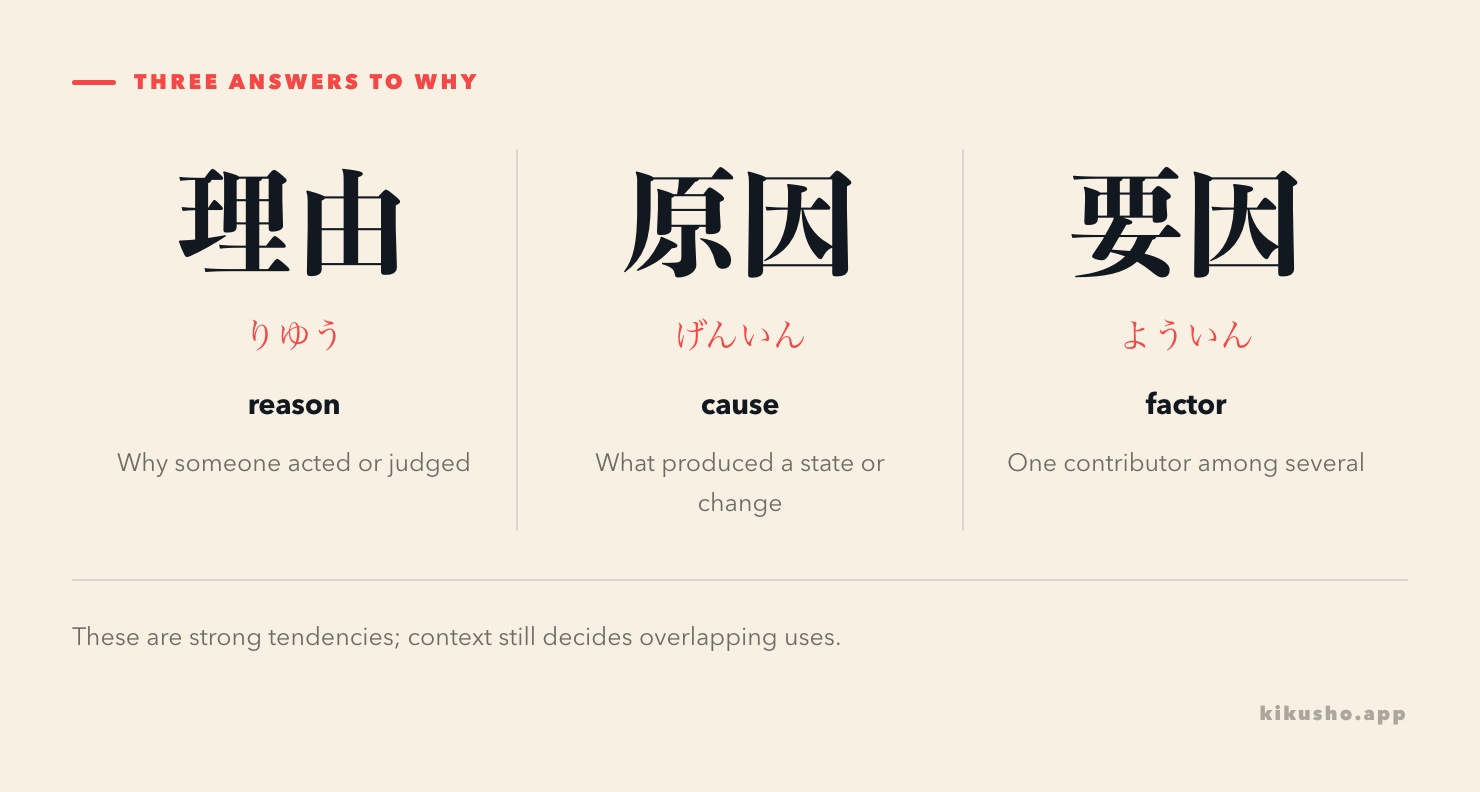
理由, 原因 and 要因 answer three versions of “why”
自転車を選んだ理由は、費用の安さだった。
じてんしゃを えらんだ りゆうは、ひようの やすさだった。
The reason people chose bicycles was their low cost.
理由(りゆう) comfortably explains an action, decision or judgment. It can be positive or negative. 原因(げんいん) names what brought about an event, state or change, and often appears when the outcome is a problem:
駐輪場の不足が、歩道の混雑の原因となった。
ちゅうりんじょうの ふそくが、ほどうの こんざつの げんいんと なった。
The shortage of bicycle parking caused congestion on the pavement.
The distinction is a tendency, not a mechanical substitution rule. An ARC Japanese teacher’s comparison recommends 理由 as the safer choice across positive and negative situations and associates 原因 with unwanted states. A Meiji University vocabulary study gives a more precise axis: 原因 tends toward events and states, while 理由 tends toward actions and judgments.
要因(よういん) is a factor within the explanation, often one among several:
利用者が増えた要因の一つは、新しい専用レーンだ。
りようしゃが ふえた よういんの ひとつは、あたらしい せんようレーンだ。
One factor in the increase in users was the new dedicated lane.
The same research distinguishes a specific cause from one factor among multiple contributors; the dictionary entry for 要因 defines it as a principal cause or an element necessary for an event to arise. 要因の一つ, 主な要因, and 複数の要因 keep that factor-like reading visible.
根拠 supports a claim after the premise is in place
市の調査結果を根拠に、利用者は今後も増えると判断した。
しの ちょうさけっかを こんきょに、りようしゃは こんごも ふえると はんだんした。
On the basis of the city survey, we judged that user numbers would continue to rise.
根拠(こんきょ) is what a claim or judgment rests on. Common frames include 根拠を示す, 根拠がある/ない, 根拠に基づく, and Xを根拠に判断する. It is not interchangeable with 前提: a premise is assumed at the start; a basis is offered in support.
The National Institute for Japanese Language and Linguistics shows the relationship clearly. A claim has a 根拠, while an often unstated 前提 connects that basis to the claim. If two readers do not share the premise, the same fact may fail to persuade one of them.
The nearby N1 academic argument lesson covers the words for defining and testing a claim. This set stays with the causal path through a report.
影響 spreads outward; 効果 measures what worked
自転車利用の増加は、市内の交通に影響を与えた。
じてんしゃりようの ぞうかは、しないの こうつうに えいきょうを あたえた。
The increase in bicycle use affected traffic in the city.
影響(えいきょう) is an influence that reaches something else and causes a response or change. It can be beneficial, harmful or neutral. Useful frames are Xに影響を与える, Xに影響する, and Xの影響を受ける. The dictionary definition centres on an action extending to another thing and changing it.
専用レーンには、事故を減らす効果があった。
せんようレーンには、じこを へらす こうかが あった。
The dedicated lane had the effect of reducing accidents.
効果(こうか) asks whether a particular measure produced a result, usually a desired or anticipated one. 効果がある, 効果が現れる, and 効果を上げる belong with interventions, treatment, advertising, training and policy. The two dictionary definitions collected here describe a desired result or a notable result expected from an intervention.
The dedicated lane may have a measurable 効果 on accidents and a broader 影響 on traffic, shops and travel habits. One intervention can therefore carry both words without making them synonyms.
結論 is reached or drawn; it is not simply any result
以上から、専用レーンを増やすべきだという結論に達した。
いじょうから、せんようレーンを ふやすべきだという けつろんに たっした。
From the above, we reached the conclusion that more dedicated lanes should be added.
結論(けつろん) is what a discussion or inference settles on. You reach one with 結論に達する, draw one with 結論を導く, or make one with 結論を出す. A 結果 is an outcome that occurred; a 結論 is a judgment reached after considering information.
The logical chain can now be read without translating every noun into “reason”: 背景 supplies circumstances, 前提 states the starting condition, 原因 and 要因 account for an event, 根拠 supports a claim, 影響 and 効果 describe what follows, and 結論 closes the reasoning.
The N2 setting is a reading task, not nine official labels
This is an N2 vocabulary lesson because it trains a cluster used in reports and argumentative reading. The assigned reference inventory itself places 原因 and 理由 at N4; 影響, 結論 and 効果 at N3; and 根拠, 前提, 背景 and 要因 at N1. Earlier items are revisited as contrasts, and the four later items are a deliberate reach ahead.
Those levels are study-list estimates. The JLPT FAQ does not provide an exhaustive official word list that can resolve every boundary. What the N2 reader needs here is the relationship between the nouns, including the ones a list introduced earlier and the ones native reports do not postpone until a future chapter.
When one of these compounds stops you in a report, save the phrase that tells you its job: 原因となる, 要因の一つ, 根拠に基づく, 影響を与える. Kikusho can draft a card from selected text or a photographed passage, including the reading and an editable example. Keeping the combination prevents nine abstract nouns from collapsing into the same English gloss.
Practice: six questions
Attempt every question before checking the answer section.
Question 1
Select the reading of 根拠 in 判断の根拠を示す.
- A. ねきょ
- B. こんきょ
- C. こんしょ
- D. ねんきょ
Mark one choice, then move to the spelling task without checking the table above.
Question 2
Choose the kanji spelling of えいきょう in 交通にえいきょうを与える.
- A. 影響
- B. 映響
- C. 影郷
- D. 営響
Question 3
A survey asks commuters why they chose bicycles instead of buses. Complete the sentence.
自転車を選んだ__を教えてください。
- A. 効果
- B. 結論
- C. 理由
- D. 影響
Question 4
Which paraphrase best matches 十分な資料があることを前提に議論する?
- A. Discuss while assuming that enough material is available.
- B. Prove that the available material caused the discussion.
- C. Measure the effect of the material after the discussion.
- D. Reject the conclusion because the material is unavailable.
Question 5
Which sentence uses the natural combination and meaning?
- A. 調査結果を根拠に、必要だと判断した。
- B. 調査結果を効果に、必要だと判断した。
- C. 調査結果を背景する、必要だと判断した。
- D. 調査結果に結論を受けて、必要だと判断した。
Question 6
Read the short passage and choose the missing word.
駐輪場の不足だけでなく、道路の狭さや利用者の急増も混雑に関係している。つまり、混雑には複数の__がある。
- A. 要因
- B. 効果
- C. 結論
- D. 前提
Record all six selections before continuing; the explanations compare each distractor with the target word.
Answers and explanations
Answer 1
B: こんきょ. 根拠 is the basis supporting a judgment. こんしょ is not its reading; ねきょ and ねんきょ incorrectly use possible readings of 根 or add a sound that is absent.
Answer 2
A: 影響. 交通に影響を与える means to affect traffic. The other choices replace one character with a similar-looking or same-sounding character and are not spellings of えいきょう.
Answer 3
C: 理由. The survey asks why people made a choice, an action or decision, so 理由 fits. 効果 and 影響 would describe what followed from the choice; 結論 would be a judgment drawn after analysis.
Answer 4
A. Xを前提に means proceeding while treating X as an assumed starting condition. The sentence does not claim cause, measure an effect or say the premise is false.
Answer 5
A. Xを根拠に判断する uses the survey result as the basis for a judgment. The other choices assign particles or verbal behaviour that these nouns do not take in the intended meaning: 効果に does not mean “on the basis of,” 背景する is not the report frame taught here, and 結論を受ける would need a different sentence structure.
Answer 6
A: 要因. The passage explicitly names several contributors, so 複数の要因 is natural. 効果 would be a result of a measure, 結論 would be the final judgment, and 前提 would be an assumption made before the reasoning.
Common questions
What is the difference between 原因 and 理由?
原因 names what brought about an event, state or change, and often appears with problems. 理由 gives why someone acted or reached a judgment and can cover positive or negative situations. The distinction is a strong tendency rather than a ban on every overlapping use.
What is the difference between 影響 and 効果?
影響 is an influence or change that reaches something else and can be positive, negative or neutral. 効果 is the result or efficacy of a particular intervention, usually the result someone wanted or measured.
Are all nine words officially N2 vocabulary?
No. This is an N2 reading set assembled from adjacent study levels. The reference inventory places two items at N4, three at N3 and four at N1; the JLPT publishes no exhaustive official vocabulary list.
Can 前提 mean a condition?
Yes. 前提 can be a condition assumed before a plan proceeds, or a premise from which an argument draws a conclusion. It is the starting assumption, not the evidence later offered to support the claim.