On this page
にかこつけて uses one thing as a respectable-looking reason for a different aim. をいいことに uses a real circumstance because it makes a questionable action easier. Both can invite criticism, but the first hides a purpose and the second exploits an opportunity.
出張にかこつけて、前から行きたかった店に寄った。
しゅっちょうにかこつけて、まえからいきたかったみせによった。
I used the business trip as a pretext to visit a shop I had long wanted to see.
上司が出張中なのをいいことに、彼は勤務中に長い私用電話をしていた。
じょうしがしゅっちょうちゅうなのをいいことに、かれはきんむちゅうにながいしようでんわをしていた。
Taking advantage of the boss being away on business, he made a long personal call during work.
The trip in the first sentence is presented as cover. The boss's absence in the second is simply the condition that removes an obstacle.
Ask whether A is cover or an opening
Use this test before choosing the grammar:
| Question about A | Choose | Relationship to B |
|---|---|---|
| Is A the reason someone puts forward while pursuing another aim? | A にかこつけて B | A is the pretext |
| Does A create a favorable opening that someone exploits? | A をいいことに B | A is the enabling situation |
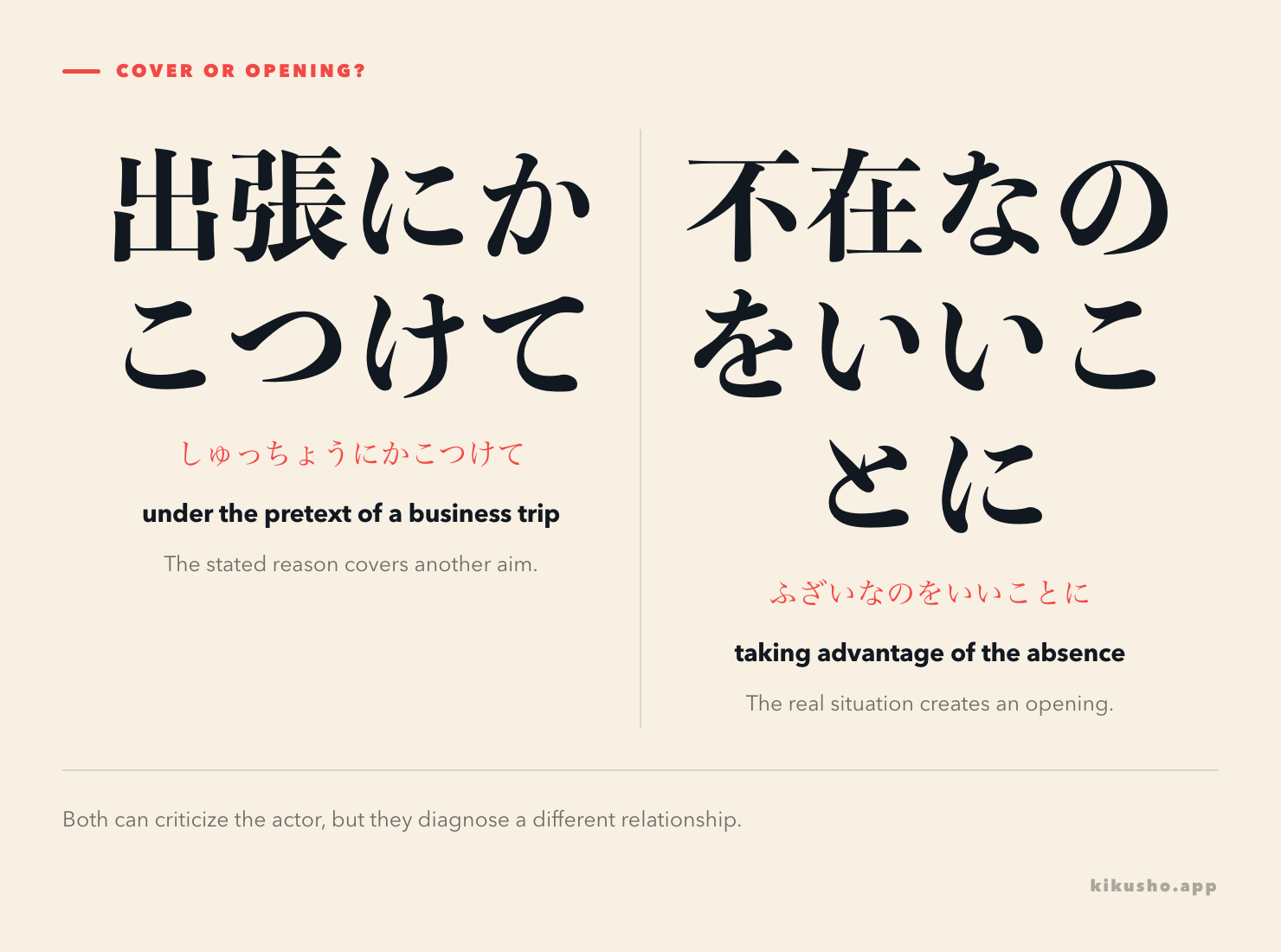
The criticism lands in a different place. With にかこつけて, the speaker exposes the mismatch between the stated reason and the actor's real purpose. With をいいことに, the situation may be exactly as described; the problem is what the actor does with it.
毎日のんびり日本語教師 explains that the noun before にかこつけて is only the outward pretext for another action and notes its frequent use in criticism. J-nihongo independently defines をいいことに as using a circumstance to one's advantage for an undesirable or blameworthy action.
にかこつけて puts a pretext in front
The core attachment is simple:
N + にかこつけて + ulterior action
The noun is an occasion, duty, condition or event that can plausibly explain the action in public. It need not be invented. A genuine conference can still become cover for private sightseeing.
研修にかこつけて、会社の費用で旧友に会いに行った。
けんしゅうにかこつけて、かいしゃのひようできゅうゆうにあいにいった。
Using the training session as a pretext, I went to see an old friend at the company's expense.
子どもの迎えにかこつけて、面倒な会議を早めに抜けた。
こどものむかえにかこつけて、めんどうなかいぎをはやめにぬけた。
I used picking up my child as an excuse to leave the tedious meeting early.
A clause can be turned into a noun with こと:
忙しいことにかこつけて、何か月も返事をしなかった。
いそがしいことにかこつけて、なんかげつもへんじをしなかった。
I used being busy as an excuse not to reply for months.
The clause still behaves as a nominalized reason. Do not attach a plain predicate directly: × 忙しいにかこつけて. Also keep にかこつけて separate from にかまけて: the former supplies a pretext, while the latter marks what consumes attention and causes another duty to be neglected. The にかまけて and そっちのけ lesson follows that attention shift from both directions.
The form often sounds measured, written or pointedly ironic. It can describe another person's conduct critically, but it also works as a self-aware confession:
記念日にかこつけて、少し高いケーキを買ってしまった。
きねんびにかこつけて、すこしたかいケーキをかってしまった。
I used the anniversary as an excuse and ended up buying a rather expensive cake.
Here the wrongdoing is slight. The speaker smiles at their own ulterior motive. 日本語NET also gives noun attachment, an N1 placement and the tendency for the following action to attract criticism if discovered.
をいいことに exploits a circumstance
The enabling circumstance can be a noun or a complete proposition:
| Before をいいことに | Formation | Example fragment |
|---|---|---|
| noun | N + をいいことに | 相手の沈黙をいいことに |
| verb clause | plain V + のをいいことに | 誰も見ていないのをいいことに |
| い-adjective clause | いA + のをいいことに | 道が空いているのをいいことに |
| な-adjective clause | なA + なのをいいことに | 規則が曖昧なのをいいことに |
| noun predicate | N + なのをいいことに | 担当者が不在なのをいいことに |
相手が反論しないのをいいことに、要求を次々と増やした。
あいてがはんろんしないのをいいことに、ようきゅうをつぎつぎとふやした。
Taking advantage of the other side not objecting, they added demand after demand.
規則が曖昧なのをいいことに、一部の業者は料金を自由に決めていた。
きそくがあいまいなのをいいことに、いちぶのぎょうしゃはりょうきんをじゆうにきめていた。
Some operators took advantage of the vague rules and set prices as they pleased.
して can follow the expression without changing the core meaning: 相手の無知をいいことにして、契約を急がせた. In many sentences it is simply omitted.
JLPT Sensei and Bunpro both place the construction at N1 and document noun, verb and adjective material before it. Direct Nをいいことに is well established; for a full noun predicate, Nなのをいいことに makes the proposition explicit.
The same scene can change with the speaker's diagnosis
Consider a worker who visits a café during a client trip:
外回りにかこつけて、評判のカフェに寄った。
そとまわりにかこつけて、ひょうばんのカフェによった。
They used the client visit as a pretext to stop at a popular café.
The sentence diagnoses 外回り as cover for the café visit. Now change the setup:
午後は予定がないのをいいことに、評判のカフェで二時間も過ごした。
ごごはよていがないのをいいことに、ひょうばんのカフェでにじかんもすごした。
Taking advantage of having nothing scheduled that afternoon, they spent two hours at a popular café.
The empty schedule is not an excuse announced to anyone. It is an opening that the worker exploits. This is why the two forms cannot be swapped mechanically even when English uses “taking advantage of” for both.
Some contexts could support either form after the writer changes the diagnosis. 病気にかこつけて休んだ accuses someone of using illness as an excuse for absence. 誰も体調を確認しないのをいいことに休んだ points instead to the lack of scrutiny that enabled the absence.
Keep neutral reasons outside both patterns
Neither expression is the default way to state an ordinary cause.
- 雨を理由に試合を中止した neutrally gives rain as the reason for cancellation.
- 雨なので試合を中止した states a cause without suggesting manipulation.
- 雨にかこつけて店を早く閉めた suggests that rain served as cover for wanting to close early.
- 客が少ないのをいいことに、店員は奥で長く休んでいた criticizes staff for exploiting the quiet period.
を口実にして is the close plain-language paraphrase of にかこつけて. を理由に is broader and can be neutral. に乗じて also means exploiting a situation, often an upheaval, confusion or weakness, but it does not require the fixed evaluative frame AをいいことにB.
Do not confuse をいいことに with sentence-final ことに expressions such as 残念なことに, “regrettably.” Here いいこと is part of a fixed phrase followed by another action. The particle を marks the situation being made into an advantage.
The sound-alike にかかっている lesson belongs to another family entirely: it says that an outcome depends on a determining factor.
Save the motive and the opportunity together
A one-line gloss hides the choice. On a Kikusho card, keep the whole relation: 研修にかこつけて旧友に会った or 規則が曖昧なのをいいことに料金を上げた. The review prompt can ask whether the first part supplies cover or removes an obstacle. Cards captured from text remain editable before they enter the FSRS review schedule, and the saved deck can be reviewed offline.
Practice: diagnose the speaker's criticism
Complete every question before opening the explanations.
Question 1 — pretext or opportunity
Choose the form that presents the conference as an outward reason for private sightseeing.
会議への出席__、翌日は一人で観光した。
- ア. をいいことに
- イ. にかこつけて
- ウ. にかかっている
- エ. によらず
Question 2 — exploitable circumstance
Choose the form that says the students exploited the teacher's absence.
先生が席を外している__、学生たちは答えを見せ合った。
- ア. ことにかこつけて
- イ. のをいいことに
- ウ. にかこつけて
- エ. ほどのことではなく
Question 3 — attachment
Which sentence is correctly formed?
- ア. 規則が曖昧にかこつけて、勝手に解釈した。
- イ. 規則が曖昧なのをいいことに、勝手に解釈した。
- ウ. 規則が曖昧のをいいことに、勝手に解釈した。
- エ. 規則が曖昧だをいいことに、勝手に解釈した。
Question 4 — neutral cause
Which sentence neutrally says that the event was cancelled because of heavy rain?
- ア. 大雨にかこつけて、イベントが中止になった。
- イ. 大雨をいいことに、イベントが中止になった。
- ウ. 大雨のため、イベントが中止になった。
- エ. 大雨なのをいいことに、イベントが中止になった。
Question 5 — sentence composition
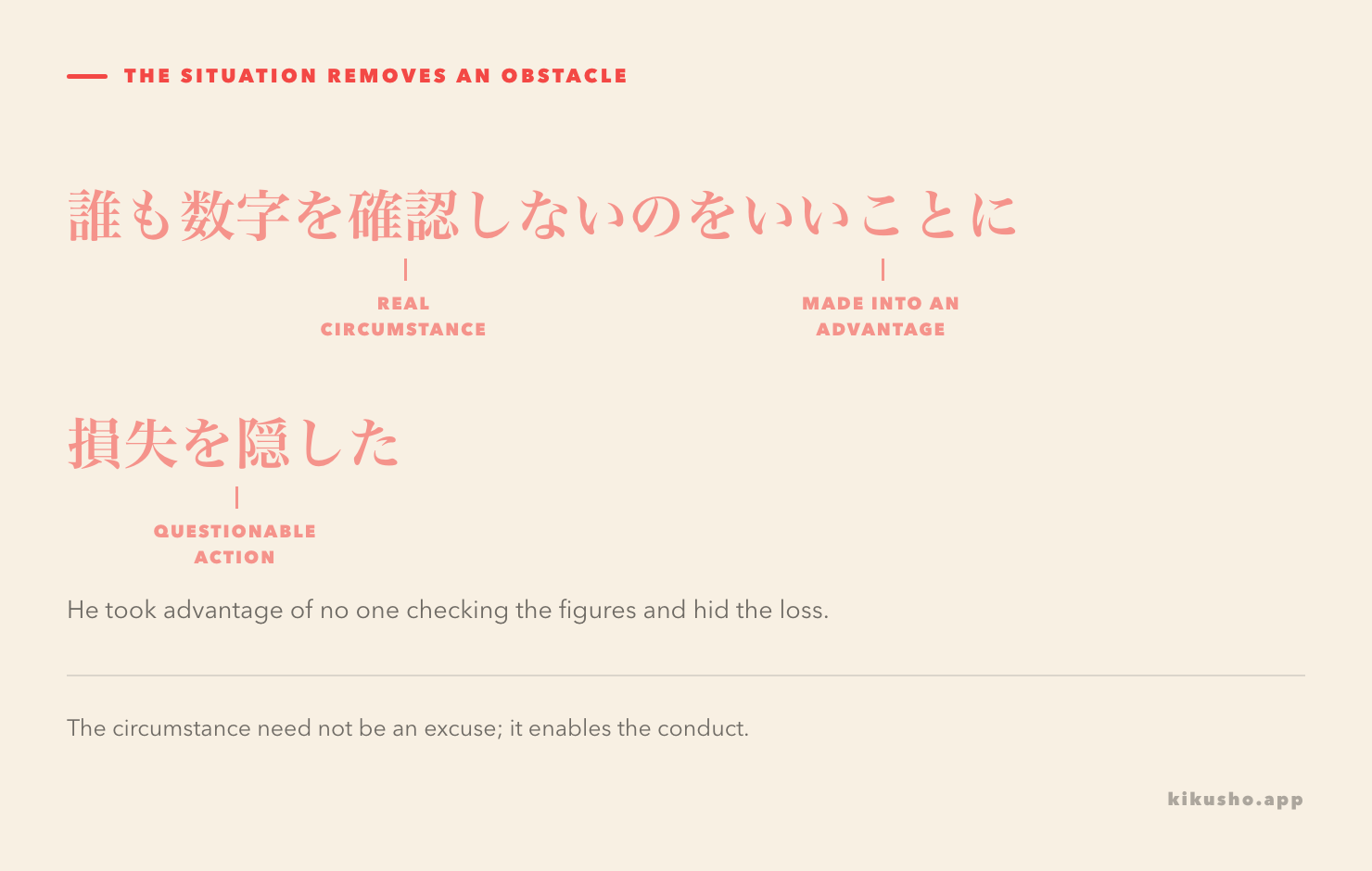
Arrange the pieces to say “Taking advantage of no one checking the figures, he kept hiding the loss.”
- 誰も数字を確認しないのをいいことに
- 彼は損失を隠し続けた
Question 6 — explain the hidden purpose
In 取材にかこつけて、好きな俳優に会いに行った, what is the stated reason, and what is presented as the real aim?
Question 7 — connected contrast
Choose the pair that first marks a pretext and then an exploited opening.
彼は健康管理( 甲 )、高価な器具を次々と買った。家族が何も言わない( 乙 )、居間まで器具で埋めてしまった。
- ア. をいいことに/にかこつけて
- イ. にかこつけて/のをいいことに
- ウ. によらず/にかかっている
- エ. にかこつけて/ことにかこつけて
Answers and explanations
1. イ, にかこつけて. The conference is the outward justification; private sightseeing is the separate aim. をいいことに would require a circumstance that makes the sightseeing easier rather than a reason presented as cover.
2. イ, のをいいことに. The teacher's absence is a real situation that removes supervision. The students exploit that opening to exchange answers.
3. イ. A な-adjective predicate takes なの before をいいことに: 曖昧なのをいいことに. The other choices do not nominalize the predicate correctly.
4. ウ, 大雨のため. This reports an ordinary cause. The other two target expressions would add a deliberate actor, an ulterior purpose or opportunistic exploitation that the sentence does not contain.
5. 誰も数字を確認しないのをいいことに、彼は損失を隠し続けた。 The whole negative clause is nominalized with の. The absence of checking creates the opportunity that he abuses.
6. 取材 is the stated reason. Meeting a favorite actor is presented as the private aim hidden behind that professional reason, so にかこつけて fits.
7. イ, にかこつけて/のをいいことに. Health management is used as the respectable cover for buying equipment. The family's silence then becomes the enabling circumstance that lets the behavior escalate.
Level and review note
The frozen inventory, JLPT Sensei, Bunpro and the independent Japanese-teacher references checked for this lesson place both constructions at N1, with no recorded disagreement. Neutral を理由に, plain ので, close paraphrase を口実に, opportunistic に乗じて and evaluative sentence-final ことに are contrasts and receive no inventory credit here. The official JLPT FAQ explains that no exhaustive grammar-item list has been published since the 2010 revision, so N1 is a reference-backed study placement rather than an official item assignment.
Common questions
What does にかこつけて mean?
It means using something as an ostensible reason or pretext for a different aim. It commonly follows a noun and carries a critical, ironic or self-deprecating tone.
What does をいいことに mean?
It means taking advantage of a real circumstance because it makes a questionable action easier. It can follow a noun or a clause nominalized with の.
What is the difference between にかこつけて and をいいことに?
にかこつけて focuses on a reason presented as cover for another purpose. をいいことに focuses on an enabling situation that someone exploits.
Can these expressions describe a neutral cause?
Usually not. にかこつけて implies an ulterior purpose, while をいいことに normally judges the exploitation as selfish, irresponsible or unfair. Use を理由に or ので for a neutral reason.