On this page
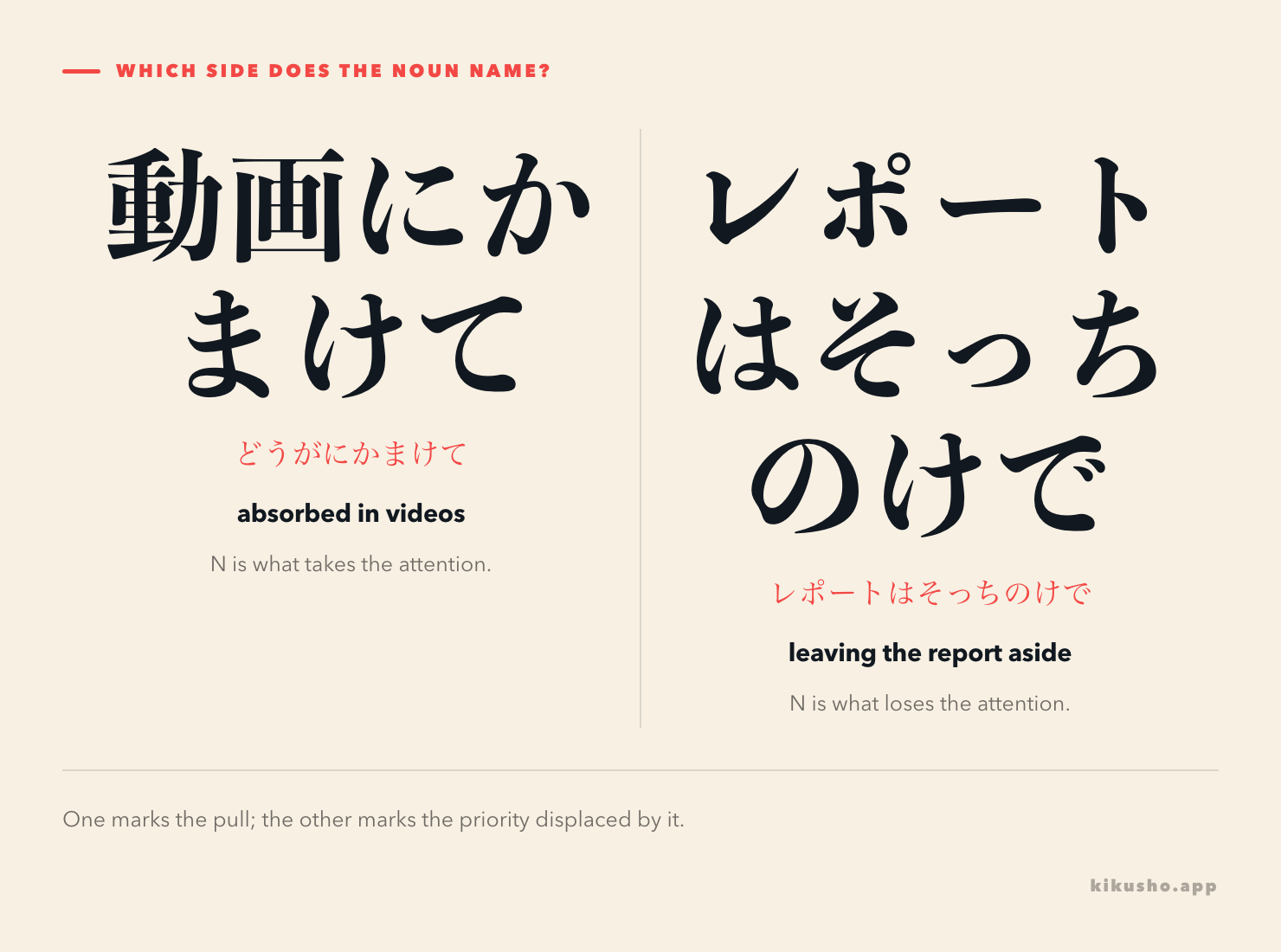
にかまけて names what absorbs someone's attention. は/をそっちのけで names what that person leaves aside. The same neglected duty can be described from opposite ends of the scene.
動画にかまけて、レポートを仕上げなかった。
どうがにかまけて、レポートをしあげなかった。
I was so absorbed in videos that I did not finish the report.
レポートはそっちのけで、動画を見続けた。
レポートはそっちのけで、どうがをみつづけた。
I left the report aside and kept watching videos.
動画 takes にかまけて because it captures the attention. レポート takes はそっちのけで because it loses the attention.
Find the noun on each side of the attention shift
Do not start with the English translation “neglecting.” First decide which role the noun plays.
| Role of the marked noun | Pattern | What follows |
|---|---|---|
| source of absorption | N + にかまけて | the neglected duty, omission or consequence |
| neglected priority | N + は/を + そっちのけで | the competing activity that receives attention |
This gives a practical conversion:
Aにかまけて、Bをしない。
Bはそっちのけで、Aをする。
The two sentences can portray one event, but they do not make A and B interchangeable. Move the particles with the roles: A is the absorbing activity; B is the abandoned priority.
日本語NET defines Nにかまけて as becoming too busy or absorbed in one thing while another is neglected. おにぎり君の日本語発音教室 independently explains Nは/をそっちのけで as leaving an important task aside to concentrate on something else.
にかまけて marks what occupies the mind
The attachment is noun + にかまけて. Common nouns include 仕事, work; 遊び, play; 趣味, hobbies; 恋愛, romance; and 忙しさ, busyness.
目の前の仕事にかまけて、来月の準備を後回しにしていた。
めのまえのしごとにかまけて、らいげつのじゅんびをあとまわしにしていた。
I was so occupied with the work in front of me that I kept postponing next month's preparations.
忙しさにかまけて、祖母への連絡を忘れていた。
いそがしさにかまけて、そぼへのれんらくをわすれていた。
I let busyness consume me and forgot to contact my grandmother.
新しい趣味にかまけて、睡眠時間まで削ってしまった。
あたらしいしゅみにかまけて、すいみんじかんまでけずってしまった。
I became so absorbed in my new hobby that I even cut into my sleep.
The noun before に can be an obligation such as work or an attraction such as a hobby. The grammar does not condemn that noun by itself. It criticizes the imbalance shown by the rest of the sentence.
That neglected side may appear as a negative predicate, 勉強していない, or as a regrettable result, 約束を忘れた. If nothing else suffers, plain に夢中で or に集中して is usually more accurate:
- 研究に集中して、新しい方法を見つけた praises focused work.
- 研究にかまけて、健康診断を受けなかった faults what the focus displaced.
The verb can be written 感ける, but modern explanatory prose normally uses hiragana. The Kotobank dictionary entry defines the relevant sense as having one's attention taken by one matter while treating others as secondary. 日本語教師のまる得 confirms noun attachment, the frequent negative continuation and the common phrase 忙しさにかまけて.
は and を point at what is left aside
そっちのけ literally treats something as put over there and left alone. 漢字ペディア defines it as leaving something unattended or refusing to treat it as a concern.
Three surface patterns occur:
| Pattern | Example | Effect |
|---|---|---|
| Nはそっちのけで | 食事はそっちのけで | makes the neglected item the contrastive topic |
| Nをそっちのけで | 食事をそっちのけで | marks it as what the subject leaves aside |
| Nそっちのけで | 食事そっちのけで | compact idiomatic form |
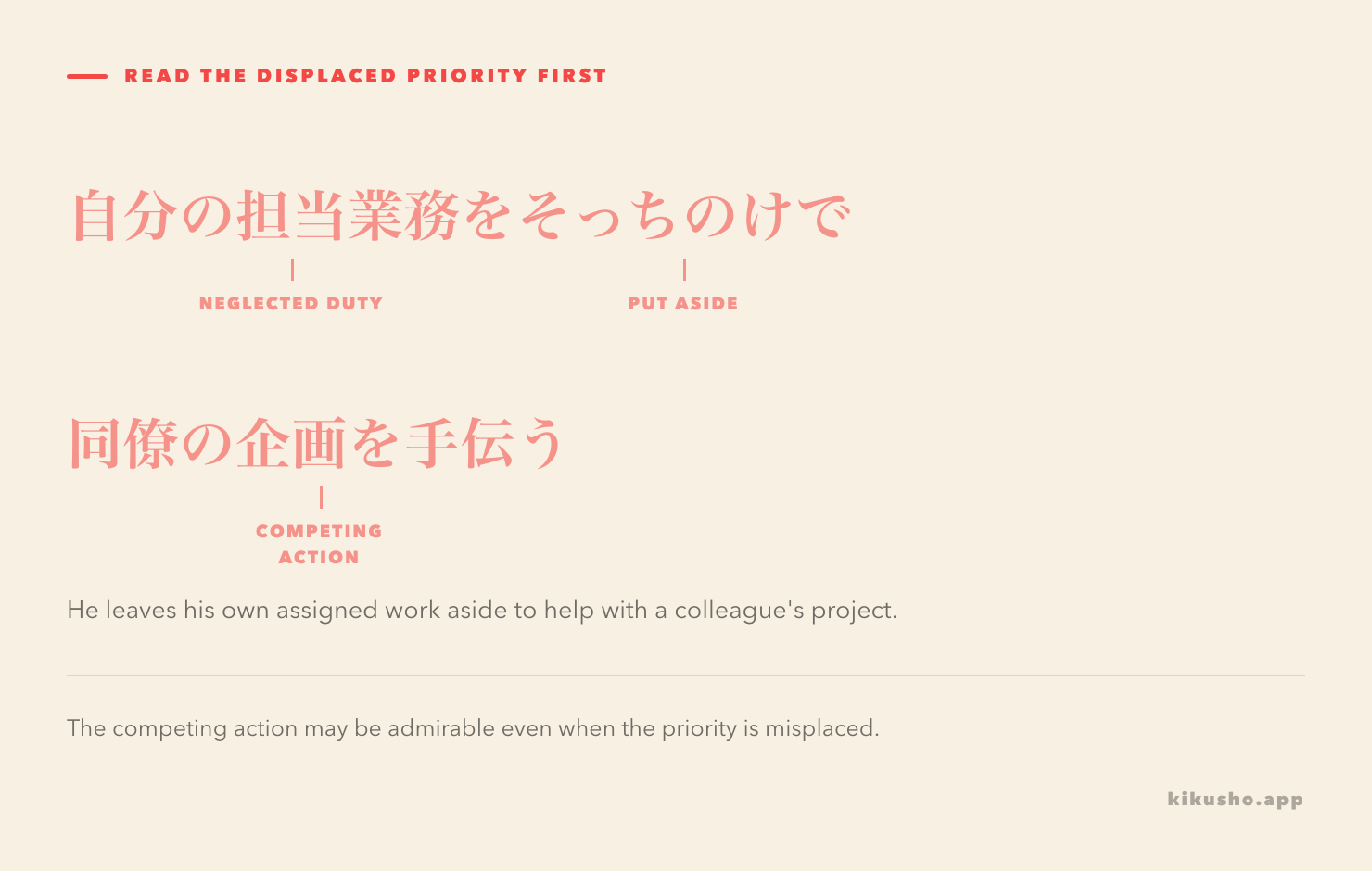
彼は自分の担当業務をそっちのけで、同僚の企画を手伝っている。
かれはじぶんのたんとうぎょうむをそっちのけで、どうりょうのきかくをてつだっている。
He has left his own assigned work aside to help with a colleague's project.
食事もそっちのけで、復旧作業を続けた。
しょくじもそっちのけで、ふっきゅうさぎょうをつづけた。
They continued the recovery work, even setting meals aside.
The first may criticize poor priorities even though helping is kind. The second can praise dedication. JLPT Sensei notes that そっちのけで can describe both good and bad conduct. What remains constant is the vivid image of one concern being displaced.
You can also say Nをそっちのけにして:
自分の悩みをそっちのけにして、彼女は私の話を聞いてくれた。
じぶんのなやみをそっちのけにして、かのじょはわたしのはなしをきいてくれた。
Putting her own worries aside, she listened to me.
The form with で links directly to the competing action. The form with にして explicitly presents the act of putting something aside. The core relationship is the same.
The particle swap reverses the diagnosis
Compare these two pairs:
ゲームにかまけて、試験勉強をしなかった。
I was absorbed in games and did not study for the exam.
試験勉強はそっちのけで、ゲームばかりしていた。
I left exam study aside and did nothing but play games.
Now change which noun receives the grammar:
- × 試験勉強にかまけて、ゲームばかりしていた would say exam study absorbed the person, which conflicts with the second clause.
- × ゲームはそっちのけで、ゲームばかりしていた says games were abandoned while games received all the attention.
The grammar is not chosen by whether A is “important” or “fun.” It is chosen by the direction of attention in this particular sentence.
Do not confuse にかまけて with にかこつけて. The latter introduces a pretext that covers another aim, while にかまけて describes attention being consumed. The pretexts and exploitation lesson develops that distinction.
Separate absorption from deliberate disregard
Nearby expressions describe different mental relationships.
- 仕事に夢中で時間を忘れた reports absorption; it does not automatically criticize a neglected responsibility.
- 仕事が忙しくて連絡できなかった presents busyness as a cause and may sound like a straightforward explanation.
- 家族の反対をよそに計画を進めた says the subject acts without regard for an external reaction.
- 宿題をほったらかしにして遊んだ plainly says the homework was abandoned and sounds more conversational.
にかまけて makes the consuming focus part of the diagnosis. そっちのけで makes the displaced concern visible. Neither necessarily means that the person consciously decided, “I will neglect this.” A person can become absorbed and only later notice what was lost.
That matters in reading. A narrator may use either expression to criticize a character, while the character would describe the same situation with neutral 忙しくて or 夢中で.
Store the two roles on the card
Saving only “neglect” encourages you to attach the expression to the wrong noun. A Kikusho card works better with a reversible pair: 動画にかまけてレポートをしなかった on one side, then レポートはそっちのけで動画を見ていた as a contrast note. You can edit the captured sentence before saving it, and the resulting card remains available for offline review through the FSRS schedule.
Practice: trace where the attention went
Complete the full set before opening the explanations.
Question 1 — source of absorption
Choose the form that marks games as what consumed the student's attention.
ゲーム__、学生は締め切りを忘れていた。
- ア. はそっちのけで
- イ. にかまけて
- ウ. をよそに
- エ. をそっちのけで
Question 2 — neglected priority
Choose the form that marks the report as what was left aside.
レポート__、彼は旅行の動画を編集していた。
- ア. にかまけて
- イ. にかこつけて
- ウ. はそっちのけで
- エ. に集中して
Question 3 — same scene, opposite role
Which sentence describes someone neglecting housework because a new hobby holds their attention?
- ア. 家事にかまけて、新しい趣味を楽しんでいる。
- イ. 新しい趣味をそっちのけで、家事をしていない。
- ウ. 新しい趣味にかまけて、家事をしていない。
- エ. 家事はそっちのけで、家事をしていない。
Question 4 — particle variants
Which two patterns can naturally mark 自分の仕事 as the task left aside?
- ア. 自分の仕事はそっちのけで/自分の仕事をそっちのけで
- イ. 自分の仕事にそっちのけで/自分の仕事がそっちのけで
- ウ. 自分の仕事でかまけて/自分の仕事をかまけて
- エ. 自分の仕事のそっちのけで/自分の仕事とかまけて
Question 5 — sentence composition
Arrange the pieces to say “I was so occupied with immediate problems that I postponed preparations for next month.”
- 目の前の問題にかまけて
- 来月の準備を後回しにした
Question 6 — positive evaluation
In 自分の食事もそっちのけで、看護師たちは患者の対応を続けた, is the nurses' conduct necessarily criticized? Explain what the grammar still contributes.
Question 7 — two directions in one report
Complete the report so the first blank identifies the manager's attention trap and the second identifies the abandoned responsibility.
部長は新規事業( 甲 )、既存の顧客への対応( 乙 )。
- ア. はそっちのけで/にかまけていた
- イ. にかまけて/はそっちのけだった
- ウ. をそっちのけで/に集中していた
- エ. にかこつけて/をいいことにした
Answers and explanations
1. イ, にかまけて. Games are the source of absorption. The forgotten deadline supplies the neglected consequence.
2. ウ, はそっちのけで. The report is the priority displaced while video editing receives the attention. にかまけて would make the report the absorbing activity.
3. ウ. The new hobby occupies the person, and housework is the neglected duty. The other choices reverse the roles or contradict themselves.
4. ア. Both Nはそっちのけで and Nをそっちのけで mark N as left aside. は makes it a contrastive topic; を presents it as what the subject leaves aside.
5. 目の前の問題にかまけて、来月の準備を後回しにした。 The immediate problems consume the attention. Next month's preparation is the responsibility delayed as a result.
6. No. The context can praise their dedication to patients. そっちのけで still emphasizes that even their own meals were displaced, making the sacrifice vivid.
7. イ, にかまけて/はそっちのけだった. The new business absorbs the manager, while existing customers are the concern left without adequate attention.
Level and review note
Both target records enter Kikusho's dated inventory at N1. JLPT Sensei assigns that level to each, and the two Japanese-teacher explanations corroborate their formation and use; no source in the dossier assigns either to another level. This review credits only にかまけて and は/をそっちのけで. Neutral に集中して, causal 忙しくて, conversational ほったらかし and disregard expressions such as をよそに remain comparisons. The official JLPT FAQ says the organizers stopped releasing itemized content specifications after the 2010 revision, so reference agreement cannot guarantee that these exact forms appear on a particular test.
Common questions
What does にかまけて mean?
Nにかまけて says that someone is so occupied, distracted or absorbed by N that another responsibility or relationship receives too little attention.
What does はそっちのけで mean?
Nはそっちのけで presents N as the duty, person or concern left aside while the subject focuses on something else. Nをそっちのけで and bare Nそっちのけで are also used.
What is the difference between にかまけて and そっちのけで?
にかまけて points to what captures the attention. そっちのけで points to what loses the attention. The same scene can therefore use both forms with different nouns.
Are にかまけて and そっちのけで always negative?
Both highlight neglect. にかまけて is normally critical or regretful. そっちのけで can occur in praise when someone sets aside their own needs to help others, although the left-aside relation remains.