On this page
Use Nでしかない to judge something as “nothing more than N.” Use のみ to mark the only admitted person, thing, place or action, especially in formal writing, notices and rules.
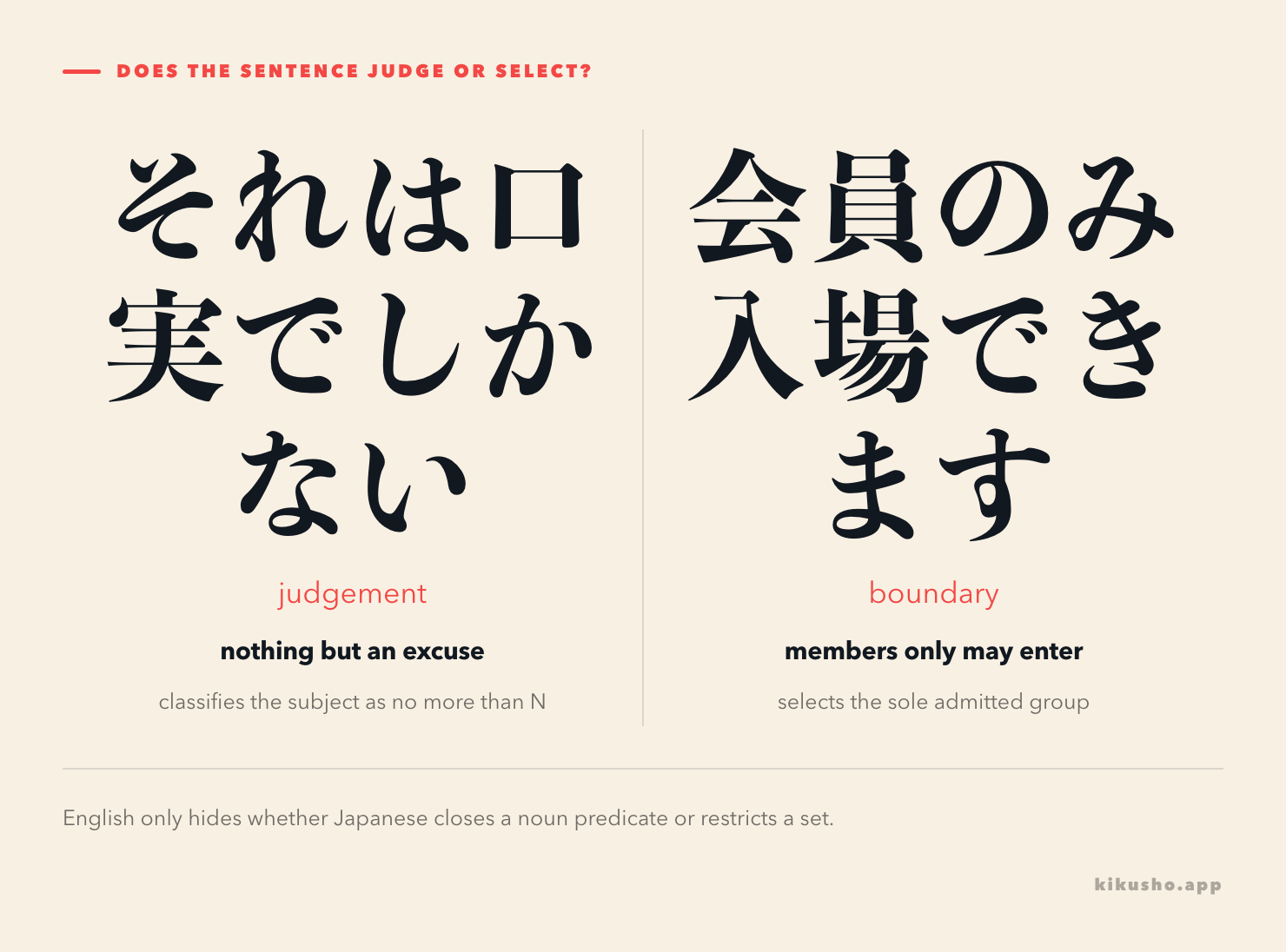
That difference is structural as well as tonal. それは推測でしかない classifies it as no more than a guess. 回答は会員のみです restricts who may respond to members. Both can contain English “only,” but the first narrows a judgement and the second draws a boundary around a set.
This lesson covers inventory items g-f556571a3551, でしかない, and g-86ec3cf88794, のみ. JLPT Sensei and Bunpro place the first at N2; both also place のみ at N2. These are teaching placements because the JLPT does not publish an exhaustive grammar syllabus.
First ask whether the sentence judges or selects
The quickest decision is to identify the work done by “only.”
| Form | Question answered | Original example | Result |
|---|---|---|---|
| Nでしかない | What is this really, and no more? | それは口実でしかない | It is nothing but an excuse |
| Xのみ | Which X is admitted or remains? | 会員のみ入場できます | Members only may enter |
口実(こうじつ) is an excuse or pretext. Calling something 口実でしかない rejects a grander description. By contrast, 会員のみ does not judge members as insignificant. It restricts the eligible group.
This is more reliable than asking which expression sounds “stronger.” のみ can appear in a strict rule, and でしかない can state a calm analytical limit. Sentence structure tells you what is restricted before tone tells you how the writer feels about it.
Nでしかない closes a noun predicate
The core attachment is noun + でしかない.
この説明は推測でしかない。
この せつめいは すいそくでしかない。
This explanation is nothing more than speculation.
その数字は一例でしかない。
その すうじは いちれいでしかない。
That figure is only one example.
The pieces are で, the connective form of the copula, しか, and the negative ない. The whole predicate says that the subject does not exceed the named classification. Bunpro therefore describes it as a noun-only direct attachment and relates it to the ordinary しか~ない pattern.
The ending changes for time and politeness:
| Claim | Form |
|---|---|
| nothing more than a guess | 推測でしかない |
| was nothing more than a guess | 推測でしかなかった |
| is nothing more than a guess, polite | 推測でしかありません |
The negative shape belongs to the construction. 推測でしかない does not deny that it is speculation; it denies a larger status such as fact or proof. This is why a word-for-word reading of ない can mislead.
The pattern often carries a dismissive or limiting evaluation. Bunpro notes that this nuance is frequent rather than compulsory. それは言い訳でしかない dismisses something as an excuse. Yet この数字は一例でしかない can be a careful warning about evidence rather than an insult to the example.
Some teaching materials describe な-adjective stems in this slot because many な-adjectives behave as adjectival nouns. For dependable production, learn the pattern through a noun classification: 必要でしかない can be analysed with 必要 as a nominal quality, but a sentence such as 安いでしかない is not formed from an い-adjective this way.
のみ places a formal boundary after the restricted phrase
のみ is a restriction particle close to だけ, with a formal or literary tendency. It is common in instructions, application conditions, signs, announcements and formal prose.
本日は予約客のみ入場できます。
ほんじつは よやくきゃくのみ にゅうじょうできます。
Today, only guests with reservations may enter.
支払いは現金のみです。
しはらいは げんきんのみです。
Payment is by cash only.
あとは結果を待つのみだ。
あとは けっかを まつのみだ。
All that remains is to wait for the result.
The first two examples restrict nouns. The third places のみ after the plain verb 待つ and presents waiting as the sole remaining action.
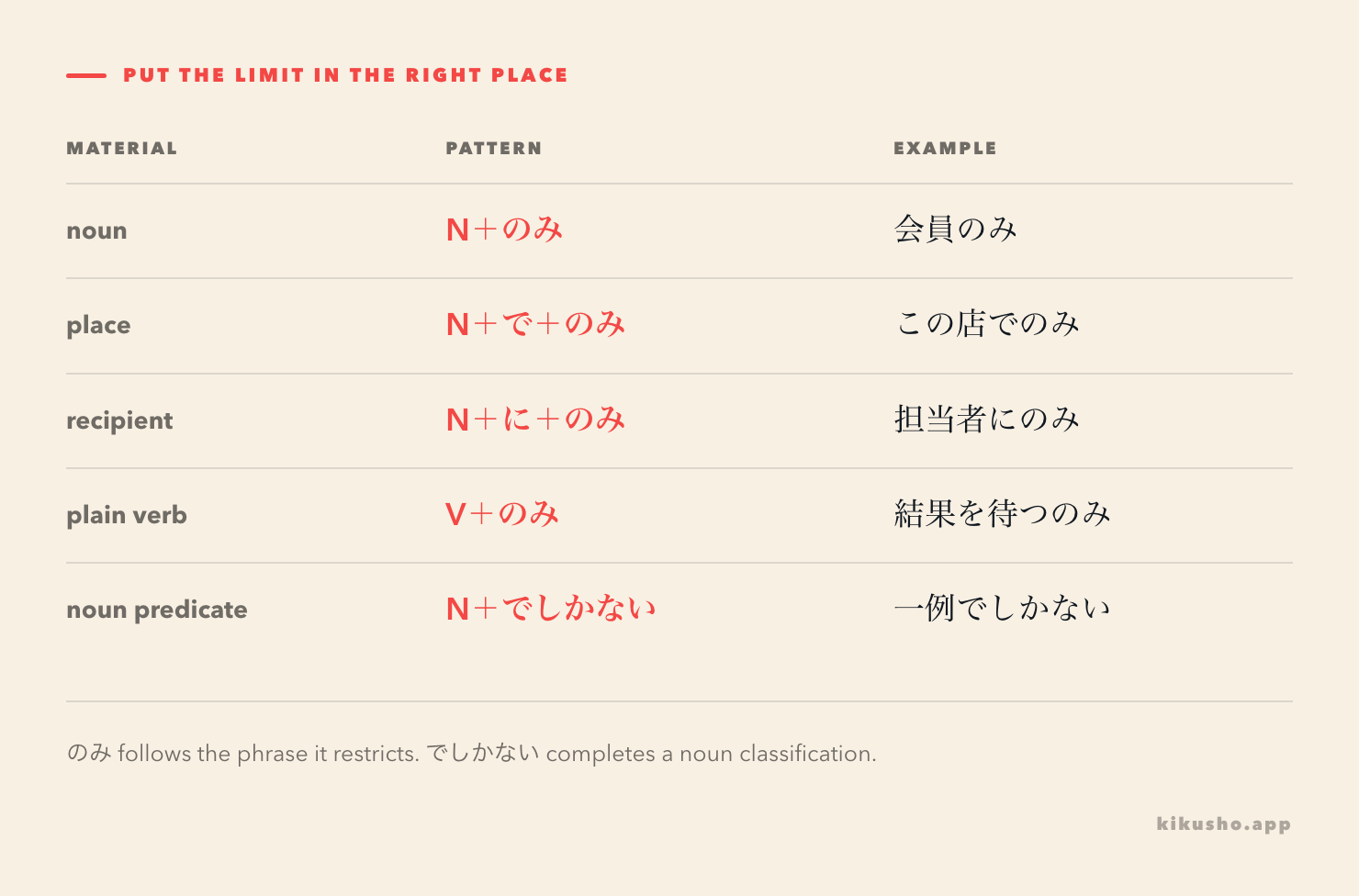
| Material | Pattern | Example |
|---|---|---|
| noun | N + のみ | 会員のみ |
| noun plus case particle | N + particle + のみ | この場所でのみ販売する |
| plain verb | V + のみ | 結果を待つのみだ |
| noun predicate | N + でしかない | 一例でしかない |
With case particles, のみ can follow the particle required by the underlying phrase. この店で販売する becomes この店でのみ販売する, “sell only at this shop.” 担当者に伝える becomes 担当者にのみ伝える, “tell only the person in charge.” Removing で or に can change the role of the noun, so do not treat the particle as decoration.
Kotobank's dictionary record for のみ classifies it as a limiting particle and records attachment to nouns, noun-like material, verbs, adverbs and case particles. Modern use is primarily literary or formal. Bunpro adds a useful caution: adjective attachment exists at the edges of usage, but can sound rare or archaic. Nouns and verbs are the safe productive centre.
The two forms cannot simply trade places
Compare two sentences about a report:
この資料は参考情報でしかない。
This document is nothing more than reference information.
閲覧できる資料はこの一冊のみです。
This is the only document available for viewing.
The first reclassifies the document and limits its authority. The second restricts the available set to one item. Replacing でしかない with のみ in the first sentence would require rebuilding the predicate and deciding what set is being restricted. Replacing のみ with でしかない in the second would turn この一冊 into a judgement about the subject rather than a selection from available documents.
A surface pair can make the contrast clearer:
これは提案でしかない。
This is merely a proposal.
提案は一件のみです。
There is only one proposal.
The first limits the proposal's status. The second limits the number of proposals. English places “only” in both translations, but Japanese attaches the limit to different material.
Keep だけ, しか~ない and に過ぎない separate
のみ often corresponds to restrictive だけ, with a more formal register:
会員だけ入場できます。
会員のみ入場できます。
Only members may enter.
The basic だけ lesson covers its neutral restriction in ordinary speech. Do not replace every だけ mechanically. 好きなだけ食べてください means “Please eat as much as you like,” where だけ marks extent. Bunpro cautions that のみ does not naturally substitute for this degree use.
Ordinary しか~ない places しか after the restricted material and requires a negative predicate: 千円しかありません, “I have only one thousand yen.” でしかない is the copular version that says something is nothing more than a noun. It is unrelated to the action-choice pattern Vるしかない, “there is no choice but to do”; the しかない and ようがない lesson handles that limit on possible action.
Nに過ぎない also means “no more than N” and can overlap with Nでしかない. A useful tendency is that に過ぎない presents a factual ceiling on quantity, status or significance, while でしかない readily sounds like a negative or dismissive classification. The distinction is not absolute. The ~に過ぎない lesson compares limiting and emphatic claims in detail.
Preserve the restricted set when you capture the sentence
If a notice says 予約客のみ入場できます, save the whole condition in Kikusho. A card containing only のみ hides both the eligible group and the permitted action. If an editorial calls a result 偶然でしかない, keep the subject and the classification so review can reconstruct the writer's judgement.
These two patterns are especially sensitive to missing context. Add a compact note such as “formal eligibility rule” or “speaker rejects stronger status.” That note records why English “only” became one form rather than the other without turning the card into a general translation rule.
Practice: locate the boundary before choosing
Complete all six tasks before revealing the corrections.
Task 1 — classification. The writer dismisses the explanation as nothing more than an excuse. Choose the completion.
その説明は言い訳__。
- ア. のみです
- イ. でしかない
- ウ. にのみある
- エ. しか説明しない
Task 2 — formal eligibility. Complete a museum notice meaning “Only visitors with reservations may enter.”
本日は予約客__入場できます。
- ア. でしかない
- イ. しかなく
- ウ. のみ
- エ. のみでしかない
Task 3 — case particle. Choose the formal sentence meaning “This product is sold only at this shop.”
- ア. この商品はこの店でのみ販売しています。
- イ. この商品はこの店でしかない販売しています。
- ウ. この商品はこの店のみでしかありません。
- エ. この商品はこの店をのみ販売しています。
Task 4 — assemble a remaining action. Arrange every chunk once: のみだ / あとは / 結果を / 待つ.
Task 5 — status versus count. Which sentence means “This is merely a proposal,” limiting its status rather than its number?
- ア. 提案は一件のみです。
- イ. 提案のみ提出しました。
- ウ. これは提案でしかない。
- エ. 提案にのみ書きました。
Task 6 — connected text. Choose the line that completes the policy without adding a negative evaluation.
申請方法を変更しました。今月から、申請はオンラインに限ります。窓口では受け付けません。つまり、__。
- ア. オンライン申請は形式でしかありません
- イ. オンラインでのみ申請できます
- ウ. オンライン申請は口実でしかありません
- エ. オンラインしか申請でしかありません
Answers and explanations
Task 1: イ, でしかない. 言い訳でしかない forms a noun predicate and downplays the explanation as nothing more than an excuse. ア would restrict something to excuses but does not express the requested dismissive classification in this sentence.
Task 2: ウ, のみ. 予約客のみ restricts the admitted group, while 入場できます states the permission. でしかない would classify someone or something as no more than a reservation guest instead of writing an eligibility rule.
Task 3: ア. The underlying place phrase is この店で販売しています. Adding のみ after the place marker gives この店でのみ販売しています. エ wrongly replaces the location marker with the object marker.
Task 4: あとは結果を待つのみだ. The complete plain verb 待つ comes before のみ. The phrase presents waiting for the result as the sole remaining action.
Task 5: ウ, これは提案でしかない. The noun predicate classifies これ as no more than a proposal. ア limits the proposal count to one, and イ says that proposals were the only material submitted.
Task 6: イ, オンラインでのみ申請できます. The method phrase requires で, then のみ restricts applications to that method. The policy is formal and exclusive, but it does not dismiss online applications as worthless. ア and ウ create unsupported classifications; エ is malformed.
The N2 label is a study placement
JLPT Sensei and Bunpro independently assign both でしかない and のみ to N2, and the curriculum inventory records no disagreement for either item. Their attachment and register descriptions also agree on the productive core: noun + でしかない, and formal restrictive のみ after nouns or verbs.
The official JLPT does not certify these forms in a public exhaustive list. Treat N2 as a sequencing estimate. A learner should already control basic noun predicates, case particles, だけ and しか~ない before working on the finer difference between evaluative classification and formal restriction.
OpenAI Codex carried out the final language review. It checked attachments, readings, glosses, register claims, particle order, the six tasks and every distractor against the cited independent sources. No human review is claimed.
Common questions
What does でしかない mean in Japanese?
Nでしかない means “is nothing more than N” or “is merely N.” It forms a noun predicate and often downplays a label: それは推測でしかない means “That is nothing more than a guess.”
What does のみ mean in Japanese?
のみ is a formal restriction particle similar to だけ. It commonly follows a noun or plain verb in notices, rules and formal writing: 会員のみ means “members only,” and あとは待つのみだ means “all that remains is to wait.”
What is the difference between でしかない and のみ?
でしかない classifies something as no more than the noun before it, often with a limiting evaluation. のみ selects the only permitted person, thing, place or action and is often neutral. They occupy different grammatical positions.
Can のみ replace だけ everywhere?
No. のみ often replaces restrictive だけ in formal contexts, but it does not naturally replace every extent use of だけ. 好きなだけ食べる means “eat as much as you like”; this is not an ordinary place to substitute のみ.