On this page
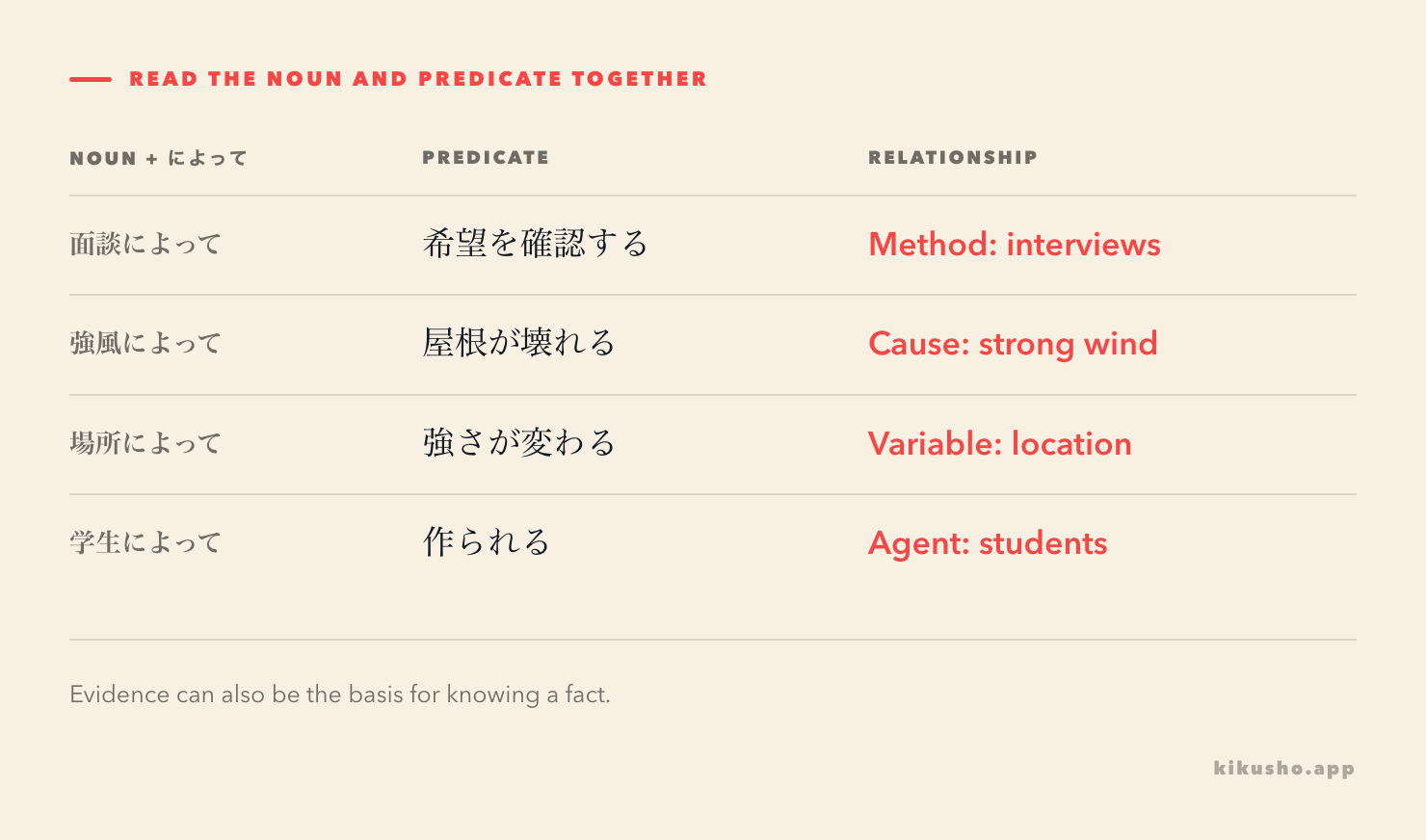
によって links a noun to a method, a cause or a factor on which the outcome varies; in a passive sentence, it can name the agent. Read the noun before it and the predicate after it together: one English translation cannot decide all these jobs.
This N3 grammar lesson teaches によって / による, including the written connector により. JLPT Sensei, Bunpro and Coto Academy place the construction at N3. That is a study estimate, not an exhaustive official JLPT syllabus. You will need noun-modifying clauses and, for the agent use, the Japanese passive.
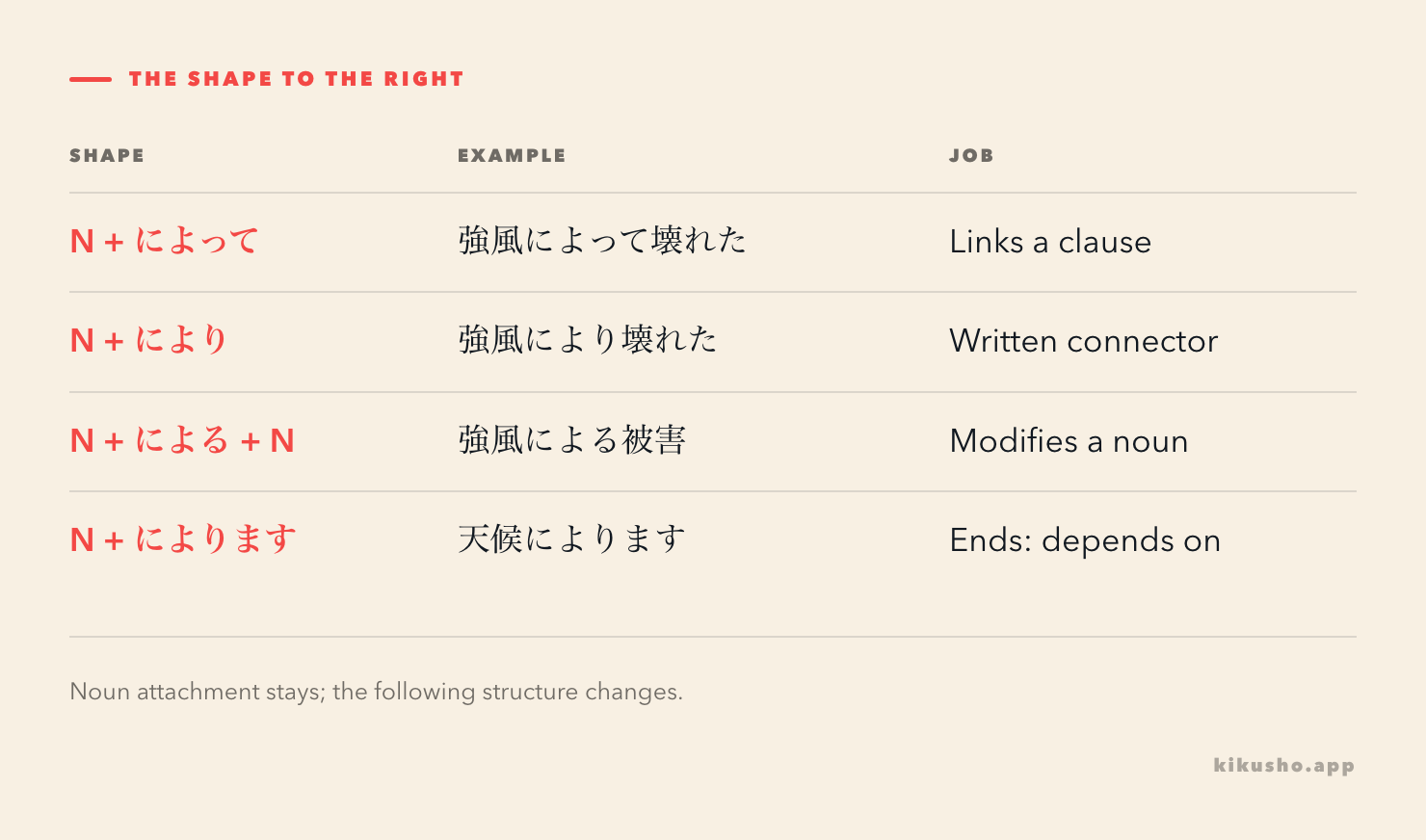
Attach it to a noun, then choose the shape that follows
The preceding noun takes によって directly: 面談によって, “through interviews.” Do not insert の between that noun and によって.
| Shape | What follows | Example fragment | Reading and meaning |
|---|---|---|---|
| Noun + によって | A clause | 強風によって壊れた | きょうふうによって こわれた: broke because of strong winds |
| Noun + により | A clause, often in writing | 強風により壊れた | きょうふうにより こわれた: broke because of strong winds |
| Noun + による + noun | A noun being modified | 強風による被害 | きょうふうによる ひがい: damage caused by strong winds |
| Noun + による / によります | A sentence ending expressing dependence | 天候によります | てんこうによります: depends on the weather |
For an action used as the method, make it a noun phrase with こと:
写真を比べることによって、傷の変化がわかります。
しゃしんを くらべることによって、きずの へんかが わかります。
By comparing photographs, you can see how the wound has changed.
比べるによって does not have that attachment. Here the entire action 写真を比べること supplies the method. Japanese with Yoshie illustrates both noun attachment and an action nominalized with こと.
The predicate tells you which relationship is intended
A method explains how someone obtains a result
面談によって、参加者の希望を確認しました。
めんだんによって、さんかしゃの きぼうを かくにんしました。
We confirmed the participants' preferences through interviews.
The interviews are the procedure used to obtain information. This is the means reading. 面談で確認しました can convey the same basic method more briefly. によって gives an explanation of how the result was reached; it is useful in reports and descriptions of procedures.
A cause explains why a result occurred
強風によって、屋根の一部が壊れました。
きょうふうによって、やねの いちぶが こわれました。
Part of the roof was damaged by strong winds.
The wind caused the damage. It was not a tool someone chose to use. Causal によって often describes an event and its consequence in an explanatory tone. The result need not be negative, and the expression itself does not assign gratitude or blame. For that evaluation, compare おかげで and せいで.
Do not use this causal pattern as your default way to make a personal request. 暑いから、窓を開けてください(あついから、まどを あけてください), “It's hot, so please open the window,” links a reason to a request with から. 暑いによって also fails the noun attachment. から and ので handle clauses giving reasons more broadly.
A varying factor explains which outcome you get
場所によって、電波の強さが変わります。
ばしょによって、でんぱの つよさが かわります。
Signal strength changes depending on the location.
Compare one location with another. Location is the variable; signal strength is the result that changes. Predicates such as 違う(ちがう), “differ,” 変わる(かわる), “change,” and 異なる(ことなる), “differ,” make this relationship easy to recognize. It does not mean that every location has a unique result.
The clause can be shortened to a statement of dependence:
屋外で開催できるかどうかは、天候によります。
おくがいで かいさいできるかどうかは、てんこうによります。
Whether we can hold it outdoors depends on the weather.
によっては singles out a possible case:
地域によっては、このサービスを利用できません。
ちいきによっては、このサービスを りようできません。
In some regions, this service is unavailable.
The は draws attention to some cases within the range. It does not turn the sentence into a claim that the service is unavailable everywhere.
A passive agent identifies who carried out the action
この案内図は、地元の学生によって作られました。
この あんないずは、じもとの がくせいによって つくられました。
This guide map was made by local students.
作る → 作られる → 作られました puts the map in the subject position. The students remain the makers. Creator and producer descriptions are familiar settings for agent によって in writing.
It is not a replacement for に in every passive. In 私は友だちにノートを破られました(わたしは ともだちに ノートを やぶられました), “My friend tore my notebook, to my dismay,” に marks the person responsible in an affected-person passive. Keep に here rather than mechanically upgrading it to によって. The Japan Foundation's lesson on によって distinguishes ordinary passive agents from the common written uses of によって, including descriptions of creation and discovery. It does not reduce every passive to one agent marker.
Evidence can explain how a fact became known
防犯カメラの映像によって、車の色がわかりました。
ぼうはんカメラの えいぞうによって、くるまの いろが わかりました。
The security-camera footage revealed the car's colour.
The footage is evidence used to establish the colour. This is close to the method reading, but the focus is on the basis for knowing. The Japan Foundation treats this basis use separately. Meanings can overlap: comparing photographs can be both a procedure and a source of evidence. You do not need to force an arbitrary boundary where the context supports both.
による modifies a noun without adding の
停電による遅れを、受付に伝えました。
ていでんによる おくれを、うけつけに つたえました。
We told reception about the delay caused by the power outage.
停電による modifies 遅れ. The whole phrase is the object of 伝えました, marked with を. Neither 停電によって遅れ nor 停電によるの遅れ builds this noun phrase.
| Relationship inside a noun phrase | Japanese | Reading | Meaning |
|---|---|---|---|
| Cause → result | 停電による遅れ | ていでんによる おくれ | Delay due to a power outage |
| Method → activity | 面談による確認 | めんだんによる かくにん | Confirmation through interviews |
| Factor → difference | 場所による違い | ばしょによる ちがい | Differences depending on location |
| Maker → creation | 学生による案内図 | がくせいによる あんないず | A guide map by students |
The noun-modifying shape preserves the relationship; it does not guarantee that “due to” is the right translation. 学生による案内図 identifies the makers, while 停電による遅れ identifies the cause.
により is common in notices; によると introduces a report
設備点検により、午前中は休館します。
せつびてんけんにより、ごぜんちゅうは きゅうかんします。
We will be closed in the morning for an equipment inspection.
により is a compact written connector. It does not itself make the ending polite: 休館する is plain and 休館します is polite. Conversely, variation phrases such as 場所によって違う can be used in ordinary conversation; によって is not confined to official notices.
For a reported source, use a different shape:
受付の人によると、明日は休館だそうです。
うけつけの ひとによると、あしたは きゅうかんだそうです。
According to the person at reception, the facility will be closed tomorrow.
Here you pass along what reception said. Replacing によると with によって does not introduce the source of this hearsay sentence. Contrast 映像によってわかった: the evidence enabled a discovery, rather than simply supplying a statement to repeat. For だそうです, see hearsay そう and the other evidence forms.
Nor can によって replace every English “by,” “with” or “at.” A simple place of action remains 駅で待ちます(えきで まちます), “I'll wait at the station.” 駅によって待ちます does not mean waiting at that station. Translation starts with the relationship, not with the English preposition.
Practice: six questions
Try the entire set before opening the answers below. There are two choice questions, two ordering tasks and two short passages.
Question 1
Select the form that directly modifies the noun 故障 in this sentence:
水__故障は、保証の対象外です。
A. によって
B. による
C. により
D. によると
Question 2
You are reporting a receptionist's statement, not describing a discovery through evidence. Complete:
受付の人__、予約は不要だそうです。
A. によって
B. による
C. により
D. によると
Question 3
Build one sentence from all four pieces. Put 配送料は first and 違います last. The intended meaning is “Delivery charges differ depending on the region.”
- 違います。\
- によって\
- 配送料は\
- 地域
Question 4
Use every piece once, starting with これは. The meaning is “This is a mural painted by local children.”
- 描かれた壁画です。\
- これは\
- 地元の子どもたち\
- によって
Question 5
Read this service notice:
このサービスは全国で利用できます。ただし、地域によっては、翌日配達ができないことがあります。詳しくは住所を入力して確認してください。
Which interpretation matches the notice?
A. The service is unavailable throughout the country.
B. Every region must have a different delivery schedule.
C. Next-day delivery may be unavailable in some regions; check the address.
D. Local residents are the agents who created the service.
Question 6
Choose the meaning of によって that fits the full paragraph:
説明会のあとで、参加者と個別に面談をしました。面談によって、どの時間帯なら参加できるかがわかりました。その結果をもとに、次回の開始時刻を決めました。
A. Interviews supplied the method for finding participants' available times.
B. Participants created the interviews in a passive sentence.
C. The schedule varied from interview to interview, and no information was obtained.
D. The writer is merely reporting what an outside source said with によると.
Answers and explanations
Answer 1
B, による. 水による故障(みずによる こしょう)is “a malfunction caused by water.” による directly modifies 故障. A and C are clause connectors; D would introduce the source of a report, not build this noun phrase. 保証の対象外(ほしょうの たいしょうがい)means “not covered by the warranty.”
Answer 2
D, によると. 受付の人によると、予約は不要だそうです(うけつけの ひとによると、よやくは ふようだそうです)means “According to reception, no reservation is required.” だそうです signals hearsay. A and C do not mark a reported source in this construction; B cannot link the person's statement to that clause in this way.
Answer 3
3 → 4 → 2 → 1: 配送料は地域によって違います。
はいそうりょうは ちいきによって ちがいます。
The charge is the thing being compared, 地域 is the changing factor, and 違います states the difference. によって attaches to 地域. Putting 配送料 first is required by the task; swapping the roles would lose the intended relationship.
Answer 4
2 → 3 → 4 → 1: これは地元の子どもたちによって描かれた壁画です。
これは じもとの こどもたちによって えがかれた へきがです。
描く → 描かれる → 描かれた gives the passive past. The children are the painters, and 地元の子どもたちによって描かれた modifies 壁画. This is authorship in a creation description, not a claim that the mural differs depending on the child.
Answer 5
C. The first sentence says the service is available nationwide. The qualification concerns 翌日配達(よくじつはいたつ), next-day delivery. 地域によっては singles out regions where that option may be unavailable. A erases the distinction between the service and its delivery option; B invents a unique result for every region; D invents a passive creator.
Answer 6
A. The writer conducted individual interviews and learned which time slots people could attend. 面談によって supplies the method leading to わかりました, “found out.” The interview answers also provide evidence, so these two readings meet here. B has no passive predicate; C contradicts わかりました; D confuses investigation with the reported-source construction. 時間帯 is じかんたい, “time slot,” and 開始時刻 is かいしじこく, “start time.”
Keep the predicate on the card
A card labelled only “によって = by” leaves you to reconstruct the relationship at every review. If you save 地域によっては翌日配達ができない, keep the restriction and its predicate; removing は or できない discards the qualification you wanted to remember. Kikusho's example and register fields are editable, so you can preserve that notice's meaning when checking a captured word before saving it. Later, ask yourself what 地域 controls in the sentence before playing the audio.
Common questions
What does によって mean?
によって can introduce a method, cause, factor that changes the outcome, or agent in a passive sentence. It can also identify evidence through which something becomes known. The surrounding noun and predicate determine the relationship.
What is the difference between によって and による?
によって connects the preceding noun to a following clause. による can modify a noun directly, as in 停電による遅れ, a delay due to a power outage. At the end of a sentence, it can mean depends on; the polite form is によります.
Can I replace によると with によって?
Not when introducing the source of a reported statement. Use によると for according to a source. Discovering something through evidence differs from reporting what a source says.
Is によって always formal?
Cause, method and passive-agent uses are common in explanatory writing. Variation expressions such as 場所によって違う also occur naturally in conversation. により is a common written alternative; politeness still depends on the sentence ending.