On this page
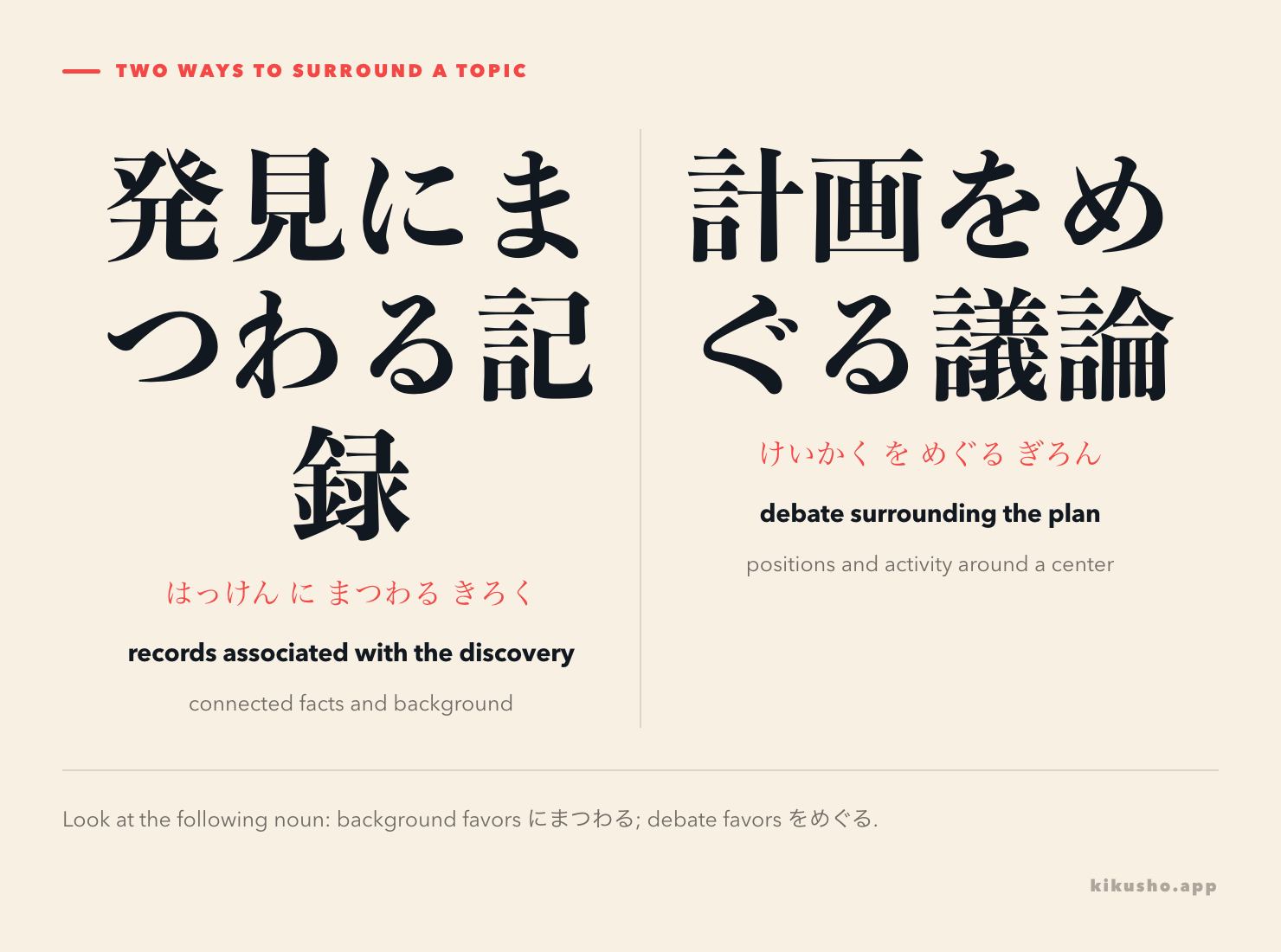
Use NにまつわるN for a story, fact, custom, rumor or other piece of background closely associated with a topic. Use NをめぐるN when the topic sits at the center of discussion, disagreement, competition or unfolding events.
Both can become “about” or “surrounding” in English. The choice depends on the relationship inside the Japanese sentence: association for にまつわる, activity around a center for をめぐる.
にまつわる gathers connected background
The basic pattern is fixed:
| Form | Function | Example |
|---|---|---|
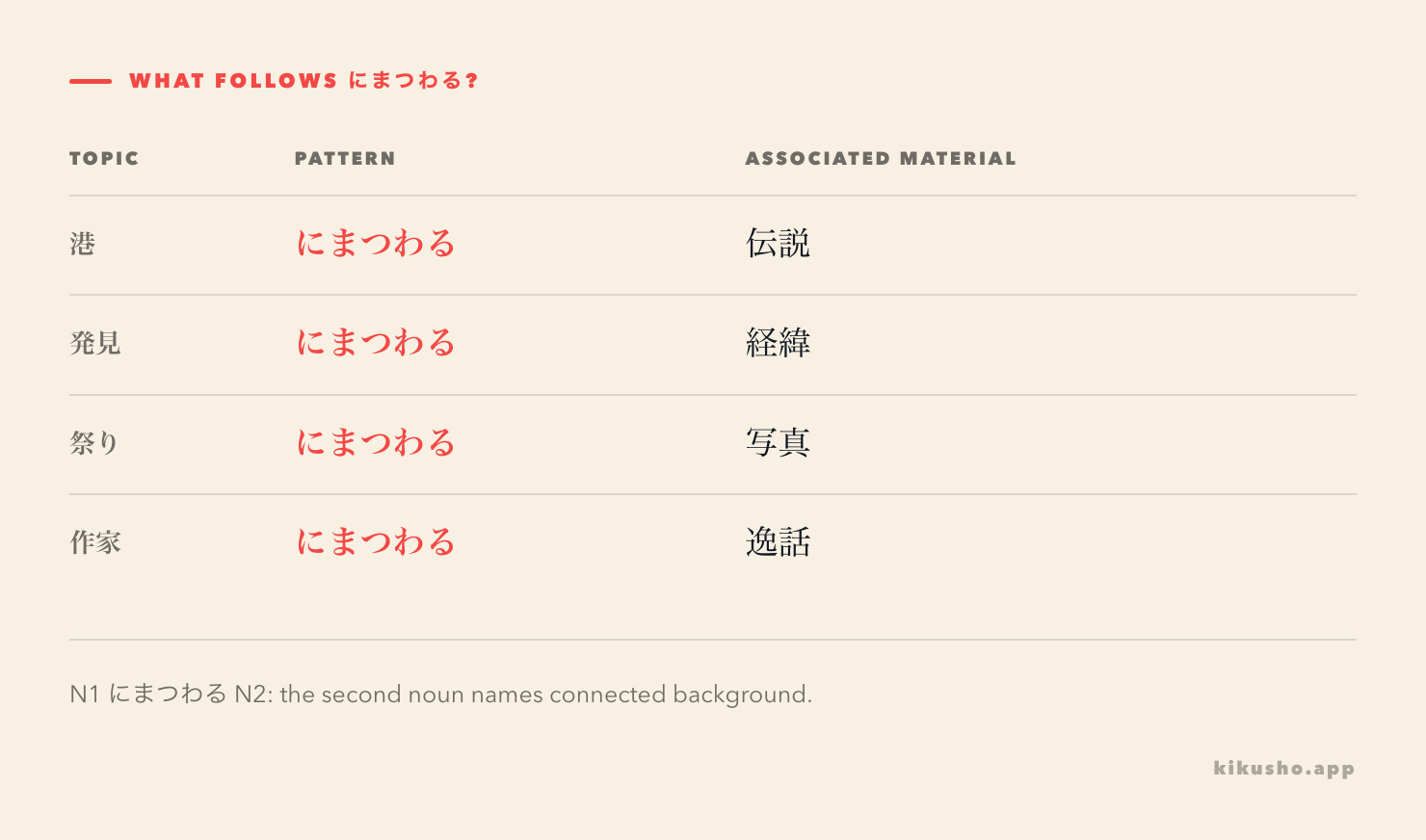
| N1 + にまつわる + N2 | N2 is closely associated with N1 | 港にまつわる伝説 |
この港にまつわる伝説は、今も漁師たちの間で語られている。
この みなとに まつわる でんせつは、いまも りょうしたちの あいだで かたられている。
The legend associated with this port is still told among the fishermen.
The port is not an issue being contested. It is the subject to which the legend belongs. まつわる originally evokes something winding around or becoming entwined with something else, and the grammar keeps that sense of a close connection.
The noun after にまつわる often names information, history or cultural material:
| Common following noun | What the phrase presents |
|---|---|
| 話・物語・伝説 | a story, tale or legend |
| 逸話・うわさ | an episode or rumor |
| 記録・資料・写真 | a record, source or photograph |
| 歴史・経緯・事情 | history, background or circumstances |
| 風習・信仰 | a custom or belief |
発見にまつわる詳しい経緯は、研究者の日記に残されていた。
はっけんに まつわる くわしい けいいは、けんきゅうしゃの にっきに のこされていた。
The detailed circumstances surrounding the discovery were recorded in the researcher's diary.
この地域には、山にまつわる独特の信仰がある。
この ちいきには、やまに まつわる どくとくの しんこうが ある。
This region has distinctive beliefs associated with the mountain.
JLPT Sensei lists the construction as N1 and gives the attachment noun + にまつわる. Bunpro's N1 reference further notes its formal register and its tendency to introduce information or explanation. J-nihongo's description independently identifies the full attributive pattern N1にまつわるN2 and the close relationship it expresses. JLPT levels outside the official test specifications remain study estimates, but these references agree on N1 for this use.
The second noun reveals whether the phrase is natural
にまつわる behaves like a relative clause: it normally modifies the noun that follows it. That noun tells the reader what kind of associated material is being introduced.
祖母から、家の建築にまつわる意外な話を聞いた。
そぼから、いえの けんちくに まつわる いがいな はなしを きいた。
I heard an unexpected story from my grandmother about the construction of the house.
The sequence ends with 話, so the association has a clear destination. A learner may try to use にまつわって as a general clause connector, but the JLPT pattern tested here is the attributive にまつわる + noun.
It also differs from a neutral topic label:
江戸時代の交通について調べている。
I am researching transportation in the Edo period.
江戸時代の交通にまつわる資料を集めている。
I am collecting materials associated with transportation in the Edo period.
The first sentence merely names the research topic. The second identifies materials connected with that topic. The について and に関する lesson covers the neutral and formal topic markers in detail.
をめぐる introduces positions and developments around a center
をめぐる also modifies a following noun, but its scene is more active. People argue, compete, negotiate or form different opinions around the noun marked by を.
新しい駅の建設をめぐる議論が続いている。
あたらしい えきの けんせつを めぐる ぎろんが つづいている。
Debate over construction of the new station is continuing.
王位をめぐる争いが長年続いた。
おういを めぐる あらそいが ながねん つづいた。
The struggle over the throne continued for many years.
The station project and the throne are centers around which different sides act. 日本語NET's をめぐって reference classifies this family at N2 and emphasizes discussion, disputes and opposing opinions. The full family includes Nをめぐって + clause, the written connector Nをめぐり + clause, and the attributive Nをめぐる + noun. The dedicated をめぐって lesson teaches those forms alongside に関わる.
Compare the two constructions with the same topic:
祭りにまつわる古い写真が展示されている。
Old photographs associated with the festival are on display.
祭りの開催をめぐる話し合いが行われた。
Discussions took place over whether to hold the festival.
The photographs belong to the festival's background, so にまつわる fits. The talks contain positions around a decision, so をめぐる fits.
Three nearby forms draw three different relationships
The English word “about” hides distinctions that remain visible in Japanese.
| Form | Core relationship | Natural example |
|---|---|---|
| NにまつわるN | associated stories, facts or background | 作家にまつわる逸話 |
| NをめぐるN | discussion, conflict or developments around N | 法案をめぐる議論 |
| Nに関するN | neutral or formal topic/content label | 法案に関する資料 |
にまつわる often feels narrative or documentary. をめぐる often appears in news and analytical prose because it frames an issue and the activity around it. に関する can simply label content without implying either association or dispute.
その事件に関する報告書を読んだ。
I read a report concerning the incident.
その事件にまつわるうわさを調べた。
I investigated rumors associated with the incident.
その事件をめぐる報道が過熱した。
Reporting surrounding the incident intensified.
All three sentences concern the same event. The first classifies the report by subject, the second gathers connected rumors, and the third presents reporting as activity developing around the event.
In Kikusho, save enough of the sentence to recover this relationship. A card containing only 事件にまつわる leaves the destination hidden. 事件にまつわるうわさ preserves both nouns and makes the association retrievable. For the contrast, 計画をめぐる議論 keeps the dispute noun that licenses をめぐる. The useful memory is the relationship, not an English gloss shared by several forms.
Practice: identify the relationship before choosing
Question 1 — form and attachment
Complete the sentence: この神社__不思議な伝説が、今も語り継がれている。
- にまつわる
- をめぐって
- にまつわって
- をめぐりの
Question 2 — association or dispute
Choose the natural form: 新しい空港の建設__住民同士の意見が分かれている。
- にまつわる
- をめぐって
- に関するの
- にまつわって
Question 3 — neutral topic or connected story
Fill the blank: 番組では、名曲の誕生__知られざる逸話が紹介された。
- について
- にまつわる
- をめぐって
- によって
Question 4 — explain the contrast
Why does 城にまつわる伝説 favor にまつわる, while 城の所有権をめぐる争い favors をめぐる?
Question 5 — sentence correction
Correct the form in this sentence: 資料館で、港にまつわって写真を見た。 Keep 港 and 写真.
Question 6 — sentence composition
Write one sentence meaning “The museum displayed records associated with the expedition.” Use 博物館, 探検, 記録, 展示する and にまつわる.
Question 7 — two relationships in context
Fill both blanks with にまつわる and をめぐる: 王の死__さまざまな逸話が残っている。一方、後継者__争いは十年続いた。
Decide which blank describes inherited background and which one creates an arena of conflict.
Answers and explanations
Answer 1: 1, にまつわる. The following noun 伝説 is a story associated with the shrine. The tested pattern is N1にまつわるN2.
Answer 2: 2, をめぐって. The airport project is the issue around which residents hold different positions. 意見が分かれている supplies the active disagreement that favors をめぐって.
Answer 3: 2, にまつわる. 逸話 names background closely associated with the song's creation. について would need a different structure to introduce a neutral topic, while をめぐって would suggest positions or developments not present here.
Answer 4. A legend belongs to the castle's body of stories and background, so 城にまつわる伝説 expresses association. A dispute contains competing parties and treats ownership as its center, so 城の所有権をめぐる争い expresses conflict around a topic.
Answer 5. 資料館で、港にまつわる写真を見た。 The pattern modifies 写真, so the attributive form にまつわる belongs directly before that noun.
Answer 6. A model answer is 博物館は、探検にまつわる記録を展示した。 The expedition is the topic, and the records are associated material.
Answer 7. 王の死にまつわるさまざまな逸話が残っている。一方、後継者をめぐる争いは十年続いた。 The first blank links stories to the king's death. The second puts the successor at the center of a struggle.
Common questions
What does にまつわる mean in Japanese?
NにまつわるN describes a story, fact, custom, rumor, memory or other piece of information closely associated with a topic. It often translates as related to, connected with or surrounding.
How do you form a sentence with にまつわる?
Put a noun before にまつわる and another noun after it: N1にまつわるN2. For example, 町にまつわる伝説 means a legend associated with the town.
What is the difference between にまつわる and をめぐる?
にまつわる links background, stories or facts to a topic. をめぐる presents that topic as the center of discussion, disagreement, competition or a series of developments.
Is にまつわる formal?
Yes. It is most at home in written, explanatory and narrative language, such as articles, documentaries, museum descriptions and book titles. Everyday conversation often uses について or 関係する instead.