On this page
~きらいがある says that a person, group, text or system has a recurring tendency the speaker sees as undesirable. It is a restrained, often written criticism, not the ordinary “dislike” meaning of 嫌いだ.
The criticism is part of the grammar
Consider a report that says:
この委員会は、少数意見を軽く扱うきらいがある。
この いいんかいは、しょうすういけんを かるく あつかう きらいが ある。
This committee has a tendency to treat minority opinions lightly.
The sentence does more than count how often the committee behaves this way. The writer identifies a recurring pattern and presents it as a problem. English “tends to” can sound neutral, so that judgment is easy to lose in translation.
Here きらい is a noun meaning an unwelcome leaning or tendency. It is not a statement that the committee “hates” minority opinions. MLC Japanese Language School defines the pattern through a bad or undesirable tendency and notes that the grammatical expression is usually written in kana. 例文で学ぶ日本語文法 independently describes the speaker's negative evaluation and gives the three attachment frames used below.
This curriculum treats the pattern as N1 grammar, matching JLPT Sensei's placement and MLC's N1 lesson. The JLPT itself explains that it no longer publishes a list of grammar items in its official FAQ, so N1 is a study-list placement rather than a guaranteed exam item.
Build it from a verb or noun
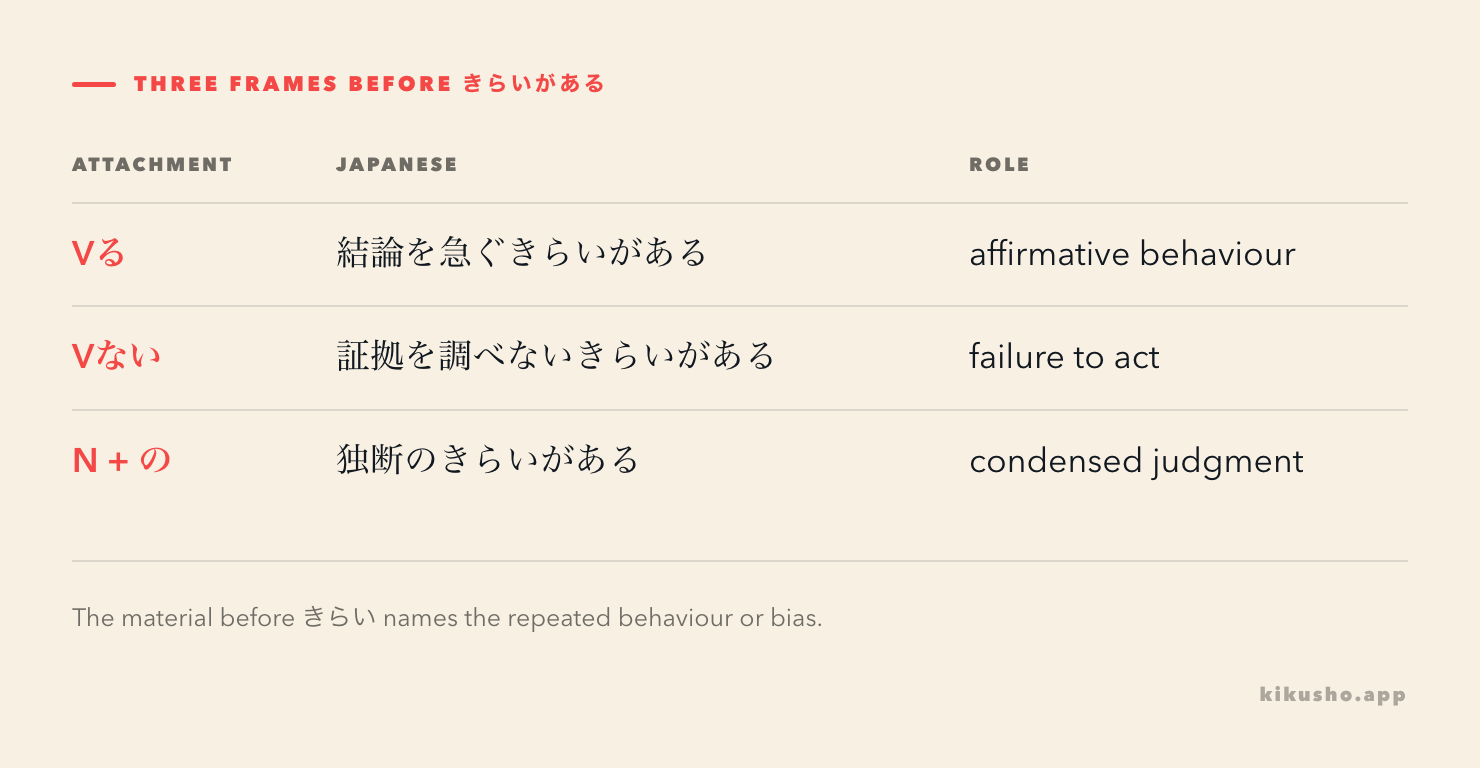
The dependable forms are dictionary-form verb + きらいがある, ない-form verb + きらいがある, and noun + の + きらいがある.
| Material before the pattern | Form | Example |
|---|---|---|
| Affirmative non-past verb | Vる + きらいがある | 結論を急ぐきらいがある |
| Negative non-past verb | Vない + きらいがある | 証拠を十分に調べないきらいがある |
| Noun | N + の + きらいがある | 独断のきらいがある |
The verb before きらい describes the repeated behaviour. A negative verb says that the recurring fault is a failure to act:
彼は結論を急ぐあまり、反対の証拠を十分に検討しないきらいがある。
かれは けつろんを いそぐ あまり、はんたいの しょうこを じゅうぶんに けんとうしない きらいが ある。
In his haste to reach a conclusion, he tends not to examine contrary evidence sufficiently.
The noun frame condenses the judgment:
彼の判断には、独断のきらいがある。
かれの はんだんには、どくだんの きらいが ある。
His judgment shows a tendency toward unilateral decision-making.
Do not add な after the noun. It is 独断のきらい, not 独断なきらい. If an adjective supplies the idea, recast it into a natural verb phrase such as 悲観的に考えるきらいがある, “tends to think pessimistically.” The final ある carries tense and connection: a past assessment can end in きらいがあった, while きらいがあり can lead into another clause.
It names a pattern the speaker wants corrected
One event is not yet a tendency. 昨日、会議に遅れた reports yesterday's lateness; 会議の準備を後回しにするきらいがある criticises a repeated way of working. The evidence for that pattern may come from several events, a person's general conduct or a bias visible across a text.
この報告書は、一つの事例から一般化しすぎるきらいがある。
この ほうこくしょは、ひとつの じれいから いっぱんかしすぎる きらいが ある。
This report tends to overgeneralise from a single case.
The subject need not be a person. A report, policy, organisation or period of public debate can all reveal an unwelcome pattern. What matters is that the writer treats the pattern as characteristic enough to assess.
The criticised behaviour can grow out of a good quality. In the next sentence, responsibility is not the fault; taking on too much alone is:
彼は責任感が強い反面、仕事を一人で抱え込むきらいがある。
かれは せきにんかんが つよい はんめん、しごとを ひとりで かかえこむ きらいが ある。
Although he has a strong sense of responsibility, he tends to take all the work on himself.
Because the form evaluates character and conduct, broad subjects such as 若者, 高齢者 or 外国人 can turn a grammatical example into a careless stereotype. The construction does not make a generalisation fair. A precise subject and observable pattern make the criticism easier to justify.
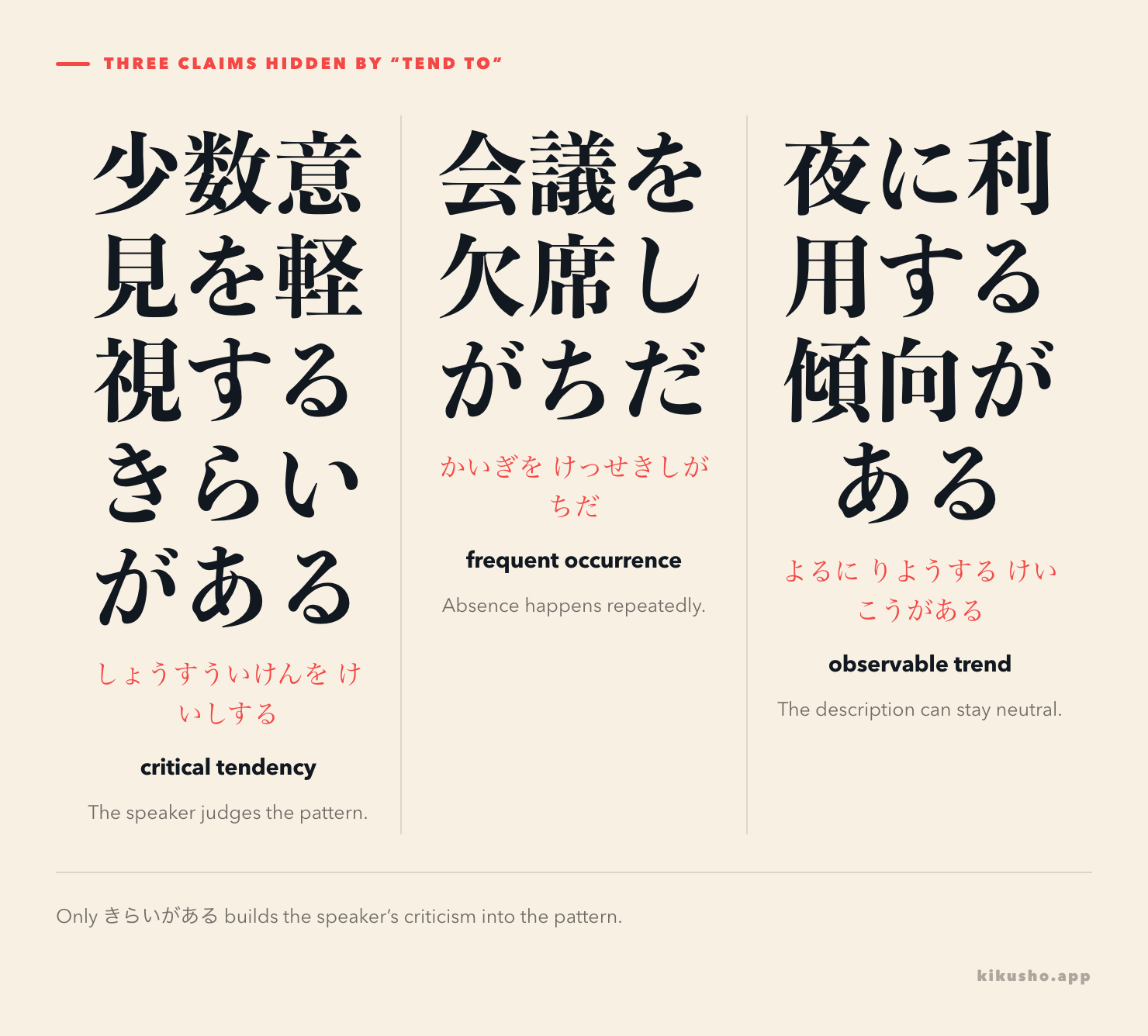
~がち reports recurrence; 傾向がある can stay neutral
These expressions overlap in English, but they answer different questions.
| Form | Main job | Typical force |
|---|---|---|
| ~きらいがある | Evaluate a recurring trait, bias or way of acting | Deliberate criticism |
| ~がちだ | Say that a state or event occurs often | Often unfavourable, but focused on recurrence |
| 傾向がある | Describe an observed pattern or direction | Can remain neutral |
| ~やすい | Say that something happens easily | Property or susceptibility, without criticism by itself |
最近、彼は会議を欠席しがちだ。
さいきん、かれは かいぎを けっせきしがちだ。
Recently, he has often been absent from meetings.
This sentence foregrounds repeated absence. If a manager instead says 彼は都合の悪い議論を避けるきらいがある, the manager interprets a broader disposition: he tends to avoid uncomfortable discussion.
調査では、若い利用者ほど短い動画を選ぶ傾向が見られた。
ちょうさでは、わかい りようしゃほど みじかい どうがを えらぶ けいこうが みられた。
The survey showed a tendency for younger users to choose shorter videos.
The survey sentence can stay descriptive. It does not say that choosing short videos is a defect. Replacing 傾向 with きらい would insert the writer's disapproval.
毎日のんびり日本語教師 distinguishes the character or inner-tendency reading of きらいがある from the frequency focus available with ~がち. Iku老師 also separates critical, written きらいがある from neutral 傾向がある and the more everyday ~がち. These are useful centres of gravity, not a rule that every ~がち sentence is neutral or every 傾向 sentence is favourable.
Praise, isolated events and casual chat need another form
Positive evaluation is the clearest limit. To say “She tends to prepare carefully” as praise, use 丁寧に準備する傾向がある or a direct sentence such as いつも丁寧に準備する. 丁寧に準備するきらいがある makes the care sound excessive or objectionable unless the context supplies that criticism.
A single occurrence also needs a plain report. If someone missed one deadline, say 締切に遅れた. Using きらいがある claims a recurring trait and therefore needs more context than one event.
Everyday conversation usually chooses a lighter form. 最近、遅刻しがちなんだ is natural self-reporting. 私は遅刻するきらいがある sounds like a formal character assessment, even when the speaker is assessing themself. The construction can be spoken, but a considered workplace discussion, interview or debate suits its weight better than loose chat.
Finally, do not confuse the pattern with Xが嫌いだ:
| Sentence | Meaning |
|---|---|
| 彼は待つのが嫌いだ。 | He dislikes waiting. |
| 彼は返事を先延ばしにするきらいがある。 | He tends, regrettably, to put off replying. |
The first names an object of dislike. The second evaluates a pattern of behaviour.
Formal weight is not the same as politeness
Changing ある to あります makes the sentence polite, but it does not remove its criticism. 部長には部下の提案を軽視するきらいがあります still tells the manager that the department head has a fault. Politeness changes how the judgment is delivered, not whether the judgment is present.
In less formal language, paraphrase the criticism rather than merely changing the ending. 人の話を聞かないことが多い, “often does not listen to people,” reports the recurrence. 人の話をもっと聞いたほうがいい, “should listen more,” turns it into advice. Neither has exactly the measured, diagnostic tone of きらいがある.
That tone places the form beside other N1 expressions whose register carries part of their meaning. ~まじき and ~ずして distinguish condemnation from an absent action, while ~であれ and ~たりとも handle formal concession and minimum-unit bans. Their old-looking shapes do different jobs; “formal” is never enough to choose among them.
When you meet きらいがある in an editorial, keep the clause before it on the card. The criticism sits in what the writer calls a tendency. Kikusho lets you select or paste the full sentence, check the generated reading and example, and save the edited card for later offline review. A card containing only きらいがある would preserve the label and lose the judgment that made it useful.
Decide what kind of claim the sentence makes
Before choosing a form, ask what the evidence permits. Repeated events can justify ~がち. A measured pattern can justify 傾向がある. ~きらいがある goes one step further by diagnosing a flaw, bias or worrying disposition.
The difference is especially important in reading questions. The sentence may never use an overtly negative adjective. The evaluation is already inside きらいがある, so a paraphrase that calls the tendency neutral has dropped part of the writer's position.
Test the judgment before reading the solutions
Mark all five responses before scrolling any farther.
Question 1: attach the form
Choose the form that correctly attaches to the verb and conveys the writer's criticism.
この論文は、限られたデータから結論を急ぐ( )。
- ア. きらいがある
- イ. のきらいがある
- ウ. きらいになる
- エ. が嫌いだ
Question 2: keep a survey neutral
The sentence reports a neutral survey pattern. Choose the best noun.
調査では、若い利用者ほど短い動画を選ぶ( )が見られた。
- ア. きらい
- イ. 傾向
- ウ. 嫌い
- エ. 独断
Question 3: construct the negative frame
Write one sentence meaning “This committee has a regrettable tendency not to read the documents to the end.” Use 資料を最後まで読まない and ~きらいがある.
Question 4: follow the evaluation through a passage
Choose the pair that fits the writer's two different claims.
この研究チームは成果を急ぐあまり、不都合なデータを十分に検討しない( 甲 )。前回の報告にも同じ偏りがあり、改善が必要だ。一方、利用者全体には、朝より夜にサービスを使う( 乙 )が見られる。
- ア. 甲=きらいがある、乙=傾向
- イ. 甲=傾向がある、乙=きらい
- ウ. 甲=がちだ、乙=独断
- エ. 甲=やすい、乙=嫌い
Question 5: preserve the writer's judgment
Which paraphrase best preserves the evaluation in the sentence?
彼は何でも一人で決めるきらいがある。
- ア. He dislikes making any decision alone.
- イ. He once made a decision without help.
- ウ. He has a regrettable tendency to decide everything by himself.
- エ. Data show that people generally decide alone.
Answers and explanations
Answer 1
ア. きらいがある. The dictionary-form verb 急ぐ attaches directly to きらいがある. の belongs after a noun, not after this verb. ウ says that something becomes a tendency but does not complete the intended pattern. エ would require a nominalised object such as 急ぐのが嫌いだ and would mean “dislikes rushing.”
Answer 2
イ. 傾向. 選ぶ傾向が見られた reports an observed pattern without condemning the choice. きらい or 嫌い would add negative evaluation, while 独断 means unilateral judgment and does not name the survey trend.
Answer 3
One model answer is この委員会は、資料を最後まで読まないきらいがある。 The negative non-past verb 読まない attaches directly to きらいがある. The sentence treats the failure to finish reading as a recurring fault. 資料を最後まで読まなかった would report a completed past event instead of using the reliable tendency frame practised here.
Answer 4
ア. 甲=きらいがある、乙=傾向. The first two sentences identify a repeated bias and call for improvement, so きらいがある fits the criticism. The final sentence only reports when users tend to use the service, so neutral 傾向が見られる fits. The other pairs either erase the first judgment or insert unrelated nouns.
Answer 5
ウ. The sentence criticises a recurring disposition toward unilateral decisions. ア confuses the grammar pattern with 嫌いだ, イ reduces a pattern to one event, and エ changes a judgment about one person into a neutral population-level observation.
Common questions
Does ~きらいがある mean that someone hates doing something?
No. In this pattern, きらい names an unwelcome tendency or leaning. To say that someone dislikes something, use the ordinary predicate 嫌いだ, as in 彼は待つのが嫌いだ.
Can ~きらいがある describe a good tendency?
Normally no. The speaker presents the tendency as a fault, concern or bias. For a neutral or favourable pattern, 傾向がある is safer.
Is ~きらいがある used in conversation?
It can be spoken, especially in a considered assessment, but it sounds more deliberate and critical than everyday ~がち. It is common in commentary, reports and descriptions of character.
Is きらい written in kanji in this grammar pattern?
嫌いがある is possible, but learner references note that the grammatical expression is usually written きらいがある in kana.