On this page
Use 羽目になる when circumstances leave someone in an unwanted situation; use 始末だ when you look back over a bad sequence and condemn its final development. Both can translate as “end up,” but they organize the story differently.
JLPT Sensei lists 羽目になる as N1, while Bunpro places 始末だ at N1. The JLPT does not publish an exhaustive grammar syllabus, so those levels are preparation estimates rather than an official list. The useful choice is not the English translation but the speaker's viewpoint on the outcome.
The test is predicament or verdict
Ask one question before choosing:
Am I naming the bad situation someone was pushed into, or delivering a verdict on how badly a sequence ended?
| Form | What it foregrounds | Typical context | Core example |
|---|---|---|---|
| V plain nonpast + 羽目になる | an unwanted action or situation imposed by events | a mistake, failure or change of circumstances | 書類を全部やり直す羽目になった |
| V dictionary + 始末だ | the final deplorable development in a preceding sequence | complaint, criticism, exasperated narration | 最後には責任を他人に押しつける始末だ |
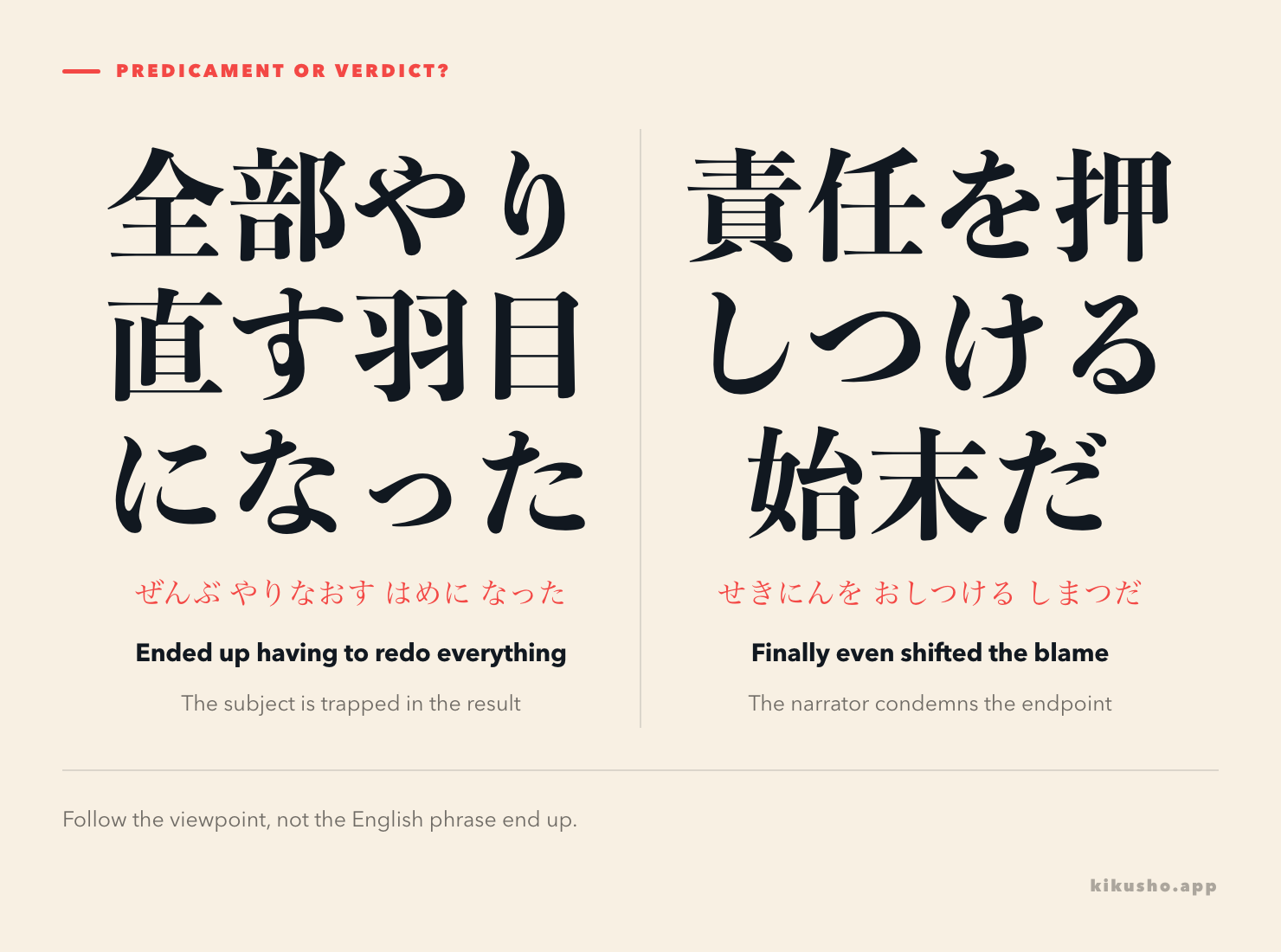
The same event may permit both forms if you rebuild the surrounding story. 結局、私が全部やり直す羽目になった puts me inside the imposed work. 担当者は確認を怠り、データを消し、最後には私に全部やり直させる始末だ judges the person whose conduct culminated in making me redo it. The final event is related, but the grammatical camera has moved.
羽目になる puts the subject inside an unwanted result
The basic attachment is a verb in plain nonpast form plus 羽目になる(はめになる). Both affirmative and negative verb forms can occupy the slot.
| Attachment | Example | Meaning |
|---|---|---|
| V dictionary + 羽目になる | 始発まで待つ羽目になった | ended up having to wait until the first train |
| V negative + 羽目になる | 会議に参加できない羽目になった | ended up unable to attend the meeting |
| この + 羽目になる | どうしてこの羽目になったのか | how did things come to this? |
終電を逃して、始発まで駅で待つ羽目になった。
しゅうでんを のがして、しはつまで えきで まつ はめに なった。
I missed the last train and ended up having to wait at the station until the first train.
The subject did not choose waiting as a welcome plan. Missing the train created the predicament. The cause often appears before the pattern with ので, ため, a て-form or another connection, but no single cause marker is required.
システムの不具合で、予定していた会議に参加できない羽目になった。
システムの ふぐあいで、よていしていた かいぎに さんかできない はめに なった。
Because of a system failure, I ended up unable to attend the meeting I had planned to join.
The negative belongs to 参加できない. It states the unwanted situation itself; it does not negate なる.
The final verb places the predicament in time. 羽目になった reports what happened, 羽目になる can describe a consequence that regularly follows or is expected to follow, and 羽目になりそうだ predicts that the situation is approaching.
このまま準備を先延ばしにすると、前日に徹夜する羽目になる。
If you keep postponing the preparation, you will end up staying up all night the day before.
JLPT Sensei's examples show past results, predictions and 羽目になりそうだ. A separate Japanese grammar reference likewise describes difficult situations produced by mistakes or unexpected events. The repeated feature is an unwelcome result, not one fixed tense.
始末だ judges the last stage of a bad sequence
Attach 始末だ(しまつだ) to a dictionary-form verb. The clause before it names the last objectionable development. Earlier clauses usually establish the path that made this endpoint worth judging.
彼は締め切りを守らず、連絡にも答えず、最後には責任を同僚に押しつける始末だ。
かれは しめきりを まもらず、れんらくにも こたえず、さいごには せきにんを どうりょうに おしつける しまつだ。
He missed the deadline, ignored messages, and finally even shifted the blame onto a colleague.
The endpoint 責任を同僚に押しつける is bad on its own. 始末だ also asks the reader to see it as the culmination of the preceding failures. Words such as 最後には, とうとう, 結局 and あげく often help expose that arc.
Bunpro explains 始末だ as a bad result reached after a series of unwelcome events and gives Vる + 始末だ as the central connection. Tanosuke's Japanese-teacher reference independently records the same attachment, the negative evaluation and its frequent combination with とうとう or 最後は.
This does not mean 始末だ is confined to formal documents. It can appear in speech, especially when the speaker is recounting someone else's conduct with exasperation. Still, it sounds like a narrated judgment. A plain ことになった reports an outcome without automatically carrying that criticism.
この始末だ is an established shortcut when the result is already visible or has just been described:
何度も注意したのに、机の上はこの始末だ。
I warned them repeatedly, yet this is the state of the desk.
Here この points to the deplorable state. No verb appears immediately before 始末 because the phrase functions as この + noun + copula.
The overlap is real, but the surrounding clauses decide
Suppose a careless employee deletes important data. Two sentences can follow.
バックアップがなく、全員でデータを入力し直す羽目になった。
With no backup, we ended up having to enter all the data again.
担当者は確認を怠り、データを消したうえ、謝りもせずに帰る始末だ。
The person responsible failed to check, deleted the data, and to top it off went home without even apologizing.
The first sentence tracks what circumstances forced us to do. The second assembles evidence about the person responsible and delivers a critical final assessment. Replacing one ending with the other is not a neutral synonym swap; the subject, narrative buildup and target of evaluation have to support the new viewpoint.
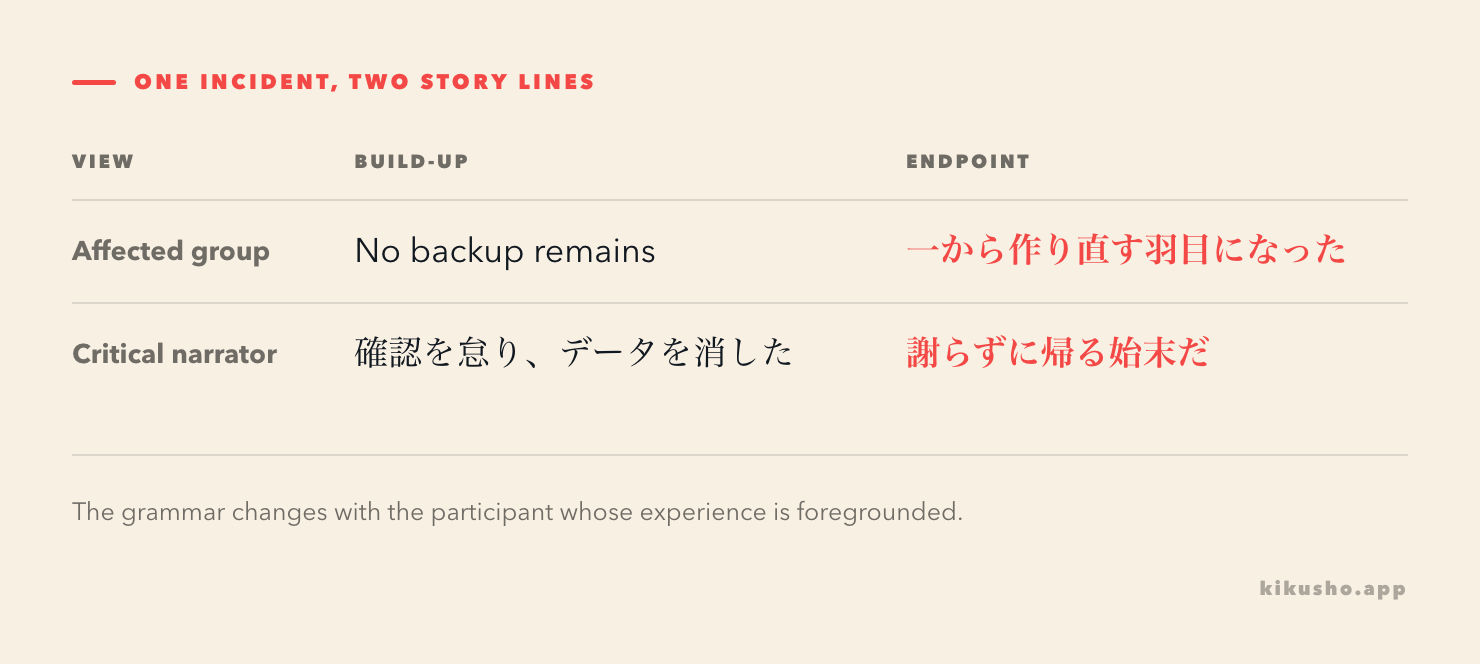
This is also why 始末だ usually needs more context. A bare 電車を待つ始末だ leaves the reader asking why waiting is the deplorable culmination. 終電を逃して、朝まで電車を待つ羽目になった can stand more easily because the missed train directly explains the predicament.
Choosing the wrong form changes who the sentence evaluates
A single imposed task does not need a moral summary
△ コピー機が壊れて、別の階まで印刷しに行く始末だ。
○ コピー機が壊れて、別の階まで印刷しに行く羽目になった。
The breakdown forces an inconvenient action. Without a worsening sequence or a critical story around someone's conduct, 羽目になる is the clearer choice.
A catalogue of misconduct asks for the narrator's verdict
△ 彼は遅刻を重ね、注意すると逆に怒る羽目になった。
○ 彼は遅刻を重ね、注意すると逆に怒る始末だ。
The speaker is not saying that circumstances forced him to get angry. The sentence condemns anger as the latest stage in a pattern of bad behavior.
A welcome result clashes with both patterns
× 努力して、第一志望に合格する羽目になった。
× 努力して、第一志望に合格する始末だ。
If admission is welcome, say 第一志望に合格した or choose a positive evaluative frame. These two N1 patterns make the result sound unfortunate, absurd or blameworthy. An ironic context could reverse the apparent value, but the surrounding text would have to establish that reading.
A useful Kikusho card keeps the cause or sequence with the target construction. Saving only 羽目になる = end up erases who was trapped and why; saving only 始末だ = in the end erases the speaker's judgment. A complete sentence lets later review restore the viewpoint that selects the grammar.
Practice
Work through the whole set. The solutions stay hidden until the last prompt.
Question 1 — direct cause
The last train has left, forcing you to take an expensive taxi. Choose the best completion.
終電を逃して、高いタクシー代を払う____。
ア. 始末だった
イ. 羽目になった
ウ. ことにしていた
エ. ずくめだった
Question 2 — grammar choice
A manager repeatedly ignored warnings and finally blamed a junior employee. Choose the best completion.
部長は何度注意されても態度を改めず、最後には部下に責任を押しつける____。
ア. 羽目になった
イ. 恐れがある
ウ. 始末だ
エ. に違いない
Question 3 — negative attachment
Which sentence correctly says “Because my passport had expired, I ended up unable to travel”?
ア. パスポートの期限が切れて、旅行できない羽目になった。
イ. パスポートの期限が切れて、旅行しない始末になった。
ウ. パスポートの期限が切れて、旅行できなく羽目になった。
エ. パスポートの期限が切れて、旅行できない始末になった。
Question 4 — interpret the viewpoint
What does このまま修理を延ばせば、店を休む羽目になる present?
ア. A closure already completed after a series of misconduct
イ. A welcome choice made by the shop
ウ. An unwanted consequence that continued delay may impose
エ. A neutral standing rule about business hours
Question 5 — sentence composition
Arrange the fragments to say “He ignored every reminder and finally even asked us to extend the deadline again.”
__ __ __ __。
- 締め切りをまた延ばしてほしいと
- 彼は催促をすべて無視し
- 言い出す始末だ
- 最後には
Question 6 — repair the sentence
The following sentence is meant to describe an inconvenient task caused by a printer failure, without criticizing a person's behavior. Replace the underlined expression.
プリンターが壊れて、資料を手書きで用意する始末だ。
Question 7 — grammar in context
Read the passage and choose the pair that fits the two blanks.
担当者は確認を怠り、顧客への連絡も忘れ、最後には記録を削除する( ① )。そのため、私たちが一から報告書を作り直す( ② )。
ア. ① 羽目になった / ② 始末だ
イ. ① 始末だ / ② 羽目になった
ウ. ① ことになった / ② 始末だった
エ. ① 恐れがある / ② ずくめだった
Choose one pair for the two numbered positions.
Answers and explanations
Answer 1
イ. 羽目になった. Missing the last train imposed an unwanted action: paying for the taxi. The sentence gives a direct cause and predicament rather than a series ending in a critical verdict.
Answer 2
ウ. 始末だ. Repeatedly ignoring warnings creates the sequence, 最後には signals its culmination, and blaming a subordinate is the behavior the speaker condemns. Nothing suggests that circumstances forced the manager to shift the blame.
Answer 3
ア. パスポートの期限が切れて、旅行できない羽目になった. The plain negative form 旅行できない modifies 羽目. Choice ウ incorrectly changes it to an adverbial form; choices イ and エ distort the target patterns by building 始末になった as though it were the grammar taught here.
Answer 4
ウ. An unwanted consequence that continued delay may impose. このまま and the conditional 延ばせば establish a future path toward the predicament. Nonpast 羽目になる presents the consequence; it does not say the closure has already happened.
Answer 5
2 → 4 → 1 → 3: 彼は催促をすべて無視し、最後には締め切りをまた延ばしてほしいと言い出す始末だ。 The ignored reminders supply the bad progression. 最後には introduces the culminating request, and 言い出す remains in dictionary form before 始末だ.
Answer 6
プリンターが壊れて、資料を手書きで用意する羽目になった。 The broken printer forces an inconvenient task. With no sequence of misconduct to judge, 羽目になった gives the intended viewpoint.
Answer 7
イ. A 始末だ / B 羽目になった. The first sentence lists the person's failures and judges deletion as the final deplorable step. The second shows the predicament those failures imposed on the group: rebuilding the report from scratch.
One bad event can produce two different sentences
When both forms seem possible, identify two participants. One may be the person whose conduct the narrator judges with 始末だ; another may be the person who must live with the consequence expressed by 羽目になる. That split often resolves the choice faster than translating “end up.”
The formal を余儀なくされる lesson develops a more report-like way to present an imposed result. For neutral decisions and arrangements, ことになる and ことになっている remove the built-in complaint. If the process itself matters, あげく and 末に compare two ways to trace the path before the conclusion.
Common questions
What is the difference between 羽目になる and 始末だ?
羽目になる presents the unpleasant situation or action that circumstances have forced someone into. 始末だ sums up the final bad development in a sequence and expresses the speaker's criticism, frustration or disbelief.
What form comes before 羽目になる?
A verb in its plain nonpast affirmative or negative form normally comes before 羽目になる, as in やり直す羽目になった and 参加できない羽目になった.
What form comes before 始末だ?
The N1 pattern normally follows a dictionary-form verb: 言い訳をする始末だ. この始末だ and そんな始末だ are also established ways to point to a bad state of affairs already visible from context.
Are 羽目になる and 始末だ always used for bad results?
Both normally frame the result as unwelcome. 羽目になる emphasizes an unwanted predicament, while 始末だ adds a judgment that a sequence has culminated in a deplorable or absurd result.