On this page
In a comparison, use には及ばない when A does not reach B's level; use とは比べものにならない when the difference is so large that an ordinary comparison feels inadequate. The first can sound measured or modest. The second is emphatic and often dramatic.
私の技術は、まだ師匠には及ばない。
わたしの ぎじゅつは、まだ ししょうには およばない。
My skill still does not reach my master's level.
私の技術は、師匠とは比べものにならない。
わたしの ぎじゅつは、ししょうとは くらべものに ならない。
My skill is in a completely different league from my master's.
Both sentences put the speaker below the master in this context. まだ in the first leaves room for progress. The second makes the distance feel overwhelming. Before choosing, decide whether the writer is locating A below a benchmark or dismissing the comparison as grossly unequal.
A reachable level or an incomparable gap
| Form | Comparison frame | What it asserts | Typical tone |
|---|---|---|---|
| AはBには及ばない | B is the level A fails to reach | A is below B | measured, factual, modest |
| AはBとは比べものにならない | B is the contrasting comparison partner | the gap between A and B is enormous | emphatic, evaluative, dramatic |
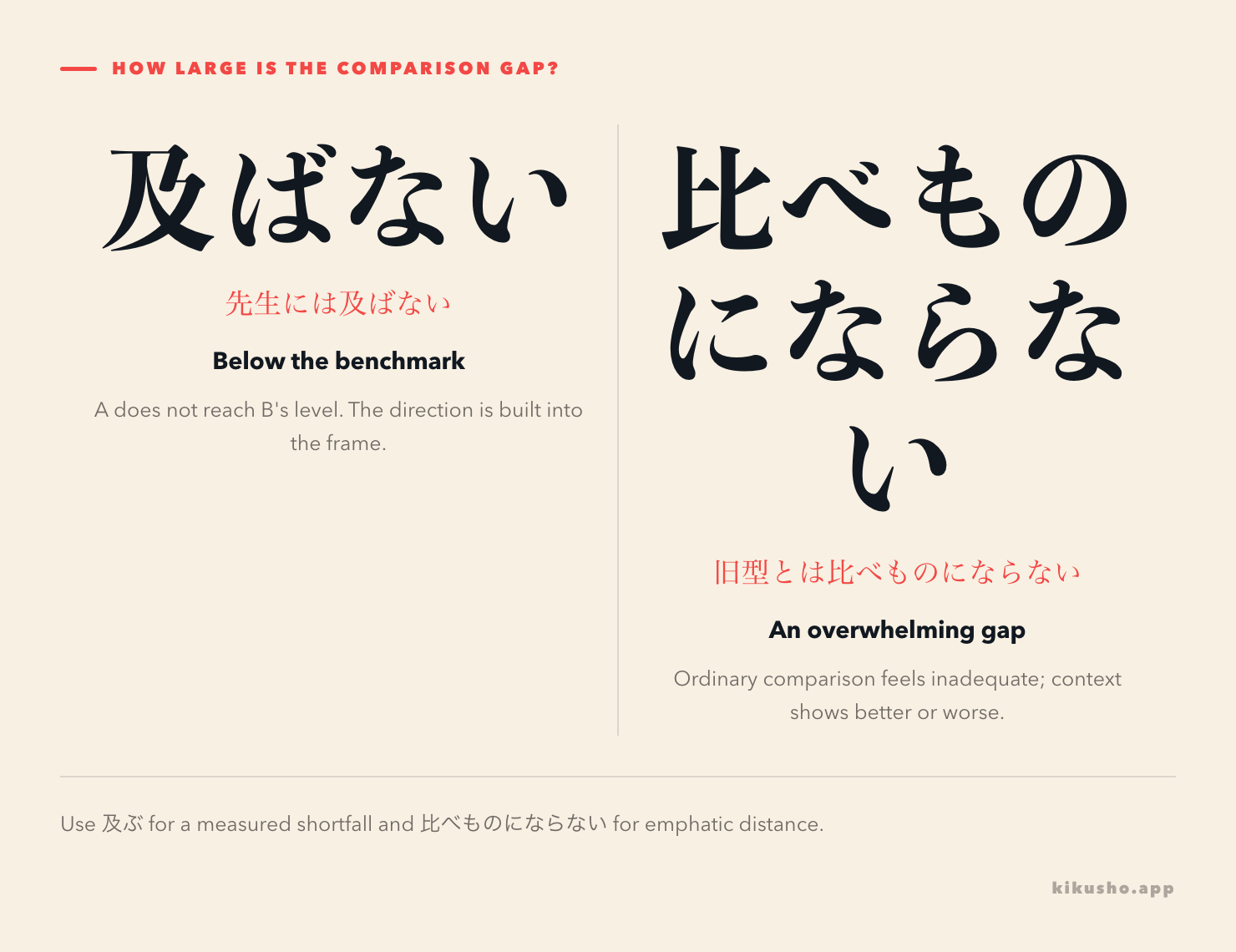
The particles reveal the logic. In Bには及ばない, に marks the endpoint that A does not reach, while は highlights that standard. In Bとは比べものにならない, と marks the comparison partner, and は gives the comparison contrastive force.
には及ばない has a comparison use
及ぶ(およぶ) means “to reach” or “to extend to.” Its negative naturally creates a level comparison: A does not reach as far as B.
今回の売上は、昨年の記録には及ばなかった。
こんかいの うりあげは、さくねんの きろくには およばなかった。
This time's sales did not reach last year's record.
経験では、私は田中さんには遠く及ばない。
けいけんでは、わたしは たなかさんには とおく およばない。
In experience, I am nowhere near Tanaka's level.
The construction fixes the direction. In AはBには及ばない, B is the higher reference point. 遠く及ばない strengthens the shortfall, while まだ及ばない often presents it as a current stage rather than a permanent defeat.
Nihongo Kyoshi Net identifies both “not necessary” and “not at a level to beat” as uses of the N1 pattern. J-nihongo's independent reference likewise separates an unnecessary action from a comparison whose subject fails to reach the target's level.
Level labels are not completely uniform. Those references, JLPT Sensei and Bunpro place the forms at N1, while Iku's grammar dictionary places には及ばない at N2. Kikusho follows the assigned N1 inventory position and records the disagreement. According to the official JLPT FAQ, the organizers replaced fixed vocabulary and grammar specifications with broader competence descriptions after the 2010 revision, so these labels remain study guidance.
The same form can mean there is no need
Do not force every には及ばない into a contest. After a dictionary-form verb or a する-noun, it can formally tell someone that an action is unnecessary.
資料はこちらで用意しますので、お持ちいただくには及びません。
しりょうは こちらで よういしますので、おもちいただくには およびません。
We will prepare the materials, so there is no need for you to bring any.
ご心配には及びません。予定どおり進んでいます。
ごしんぱいには およびません。よていどおり すすんでいます。
There is no need for concern. Everything is proceeding as scheduled.
This use is formal and frequently polite. お礼には及びません, “no thanks are necessary,” and 説明には及びません, “there is no need for an explanation,” are compact noun forms. Bunpro describes the formal register, verb and する-noun attachments, and the comparison use that appears when a noun marks a level.
Look at the whole frame:
| Frame | Reading |
|---|---|
| 私の技術は先生には及ばない | my skill does not reach the teacher's level |
| 説明するには及ばない | there is no need to explain |
| ご説明には及びません | a polite statement that an explanation is unnecessary |
The neighbouring には当たらない can also reject a response, but its image is different: the facts do not warrant that evaluation. The lesson on には無理がある and には当たらない keeps that evidential judgment separate from 及ぶ's level or extent.
とは比べものにならない rejects an ordinary comparison
比べもの means “something comparable.” The negative phrase therefore presents B as no adequate comparison for A. A noun comes before とは比べものにならない.
新型の処理速度は、旧型とは比べものにならないほど速い。
しんがたの しょりそくどは、きゅうがたとは くらべものに ならないほど はやい。
The new model's processing speed is incomparably faster than the old model's.
今回の被害は、前回とは比べものにならないほど深刻だ。
こんかいの ひがいは、ぜんかいとは くらべものに ならないほど しんこくだ。
This time's damage is incomparably more serious than last time's.
The pattern gives you magnitude, but an adjective or context establishes direction. In the first sentence 速い makes the new model superior in speed. In the second, 深刻だ makes the present damage worse. A bare sentence such as 今は昔とは比べものにならない announces a huge difference but may require context to say how things changed.
JLPT Sensei gives the noun attachment and N1 placement. Bunpro's separate account explains that the form marks a large difference in quality, quantity or another measurable feature without specifying an exact amount.
Strong emphasis changes the social effect
Compare three ways to discuss the same work:
私の作品は先生の作品より劣っている。
My work is inferior to my teacher's.
私の作品は先生の作品には及ばない。
My work does not reach my teacher's level.
私の作品は先生の作品とは比べものにならない。
My work cannot even be compared with my teacher's.
The first makes an ordinary comparison. The second frames the teacher as a level not yet reached. The third magnifies the distance until comparison itself seems pointless. Used about your own work, it can sound humble. Used to compare two other people's work, it may sound dismissive or insulting.
Do not replace the idiom with と比べられない and assume the same force. That phrase can literally mean that comparison is impossible, perhaps because the data are missing. とは比べものにならない normally asserts that the gap is striking.
The beginner comparison system with より, のほうが and いちばん remains useful when you only need to name a winner or degree. The ordinary Japanese comparisons lesson provides those neutral frames. For excessive action rather than unequal levels, the ほどのことではない and までもない comparison separates a minor matter from an action that need not be taken.
When saving these expressions in Kikusho, keep both sides of the scale. には及ばない without A and B hides who falls short. とは比べものにならない without the measured feature may hide whether the gap concerns quality, speed, size or severity. A complete sentence turns the grammar into a usable comparison during offline review.
Practice: measure the gap before choosing
Complete all seven items before opening the answer block.
Question 1 · benchmark
Complete: 私の知識は、専門家( )。
- A. には及ばない
- B. とは限らない
- C. には無理がある
- D. にほかならない
Question 2 · large change
Complete: 現在の通信速度は、十年前( )ほど速い。
- A. には及ばない
- B. とは比べものにならない
- C. には当たらない
- D. とは言い切れない
Question 3 · polite refusal
Complete: こちらで手配しますので、ご連絡( )。
- A. とは比べものになりません
- B. には及びません
- C. には及ばれません
- D. とは及びません
Question 4 · direction
Read: 今年の記録は昨年には及ばなかった。 Which record is higher?
- A. This year's record
- B. Last year's record
- C. They are equal
- D. The sentence gives no direction
Question 5 · context
Read: 新型は旧型とは比べものにならないほど軽い。 What supplies the direction of the comparison?
- A. 新型 alone
- B. とは alone
- C. the adjective 軽い
- D. the negative ならない alone
Question 6 · select the reading
Which sentence uses には及ばない to say an action is unnecessary?
- A. 私の経験は部長には及ばない。
- B. この作品は原作には及ばない。
- C. 簡単な確認ですから、来ていただくには及びません。
- D. 新型は旧型とは比べものにならない。
Question 7 · control the tone
Choose the pair for a measured self-assessment followed by a dramatic product claim:
私の演奏は先生(甲)。しかし、この新しい録音の音質は旧版(乙)。
- Measured then emphatic: 甲 には及ばない / 乙 とは比べものにならない
- Emphatic then measured: 甲 とは比べものにならない / 乙 には及ばない
- Two no-need readings: 甲 には及びません / 乙 には及びません
- Two ordinary standards: 甲 より / 乙 より
Answers and explanations
1 — A, には及ばない. The specialist is the benchmark that the speaker's knowledge does not reach. The frame directly orders the two levels.
2 — B, とは比べものにならない. The sentence stresses an enormous speed difference from ten years ago. ほど速い makes the present direction explicit.
3 — B, には及びません. The speaker says that contacting them is unnecessary because arrangements will be handled locally. The polite ending suits the service context.
4 — B. This year's record failed to reach last year's, so last year's result is higher. Bには及ばない makes B the unreached standard.
5 — C. The idiom supplies a very large gap, while 軽い tells us that the new model is lighter. Without a property or enough context, the direction may remain unstated.
6 — C. 来ていただくには及びません says there is no need to come. A and B compare a lower subject with a higher reference; D uses a different construction.
7 — Measured then emphatic. The speaker modestly places their performance below the teacher's with には及ばない. The product claim uses とは比べものにならない to magnify the sound-quality gap.
Decide between level, necessity and emphasis
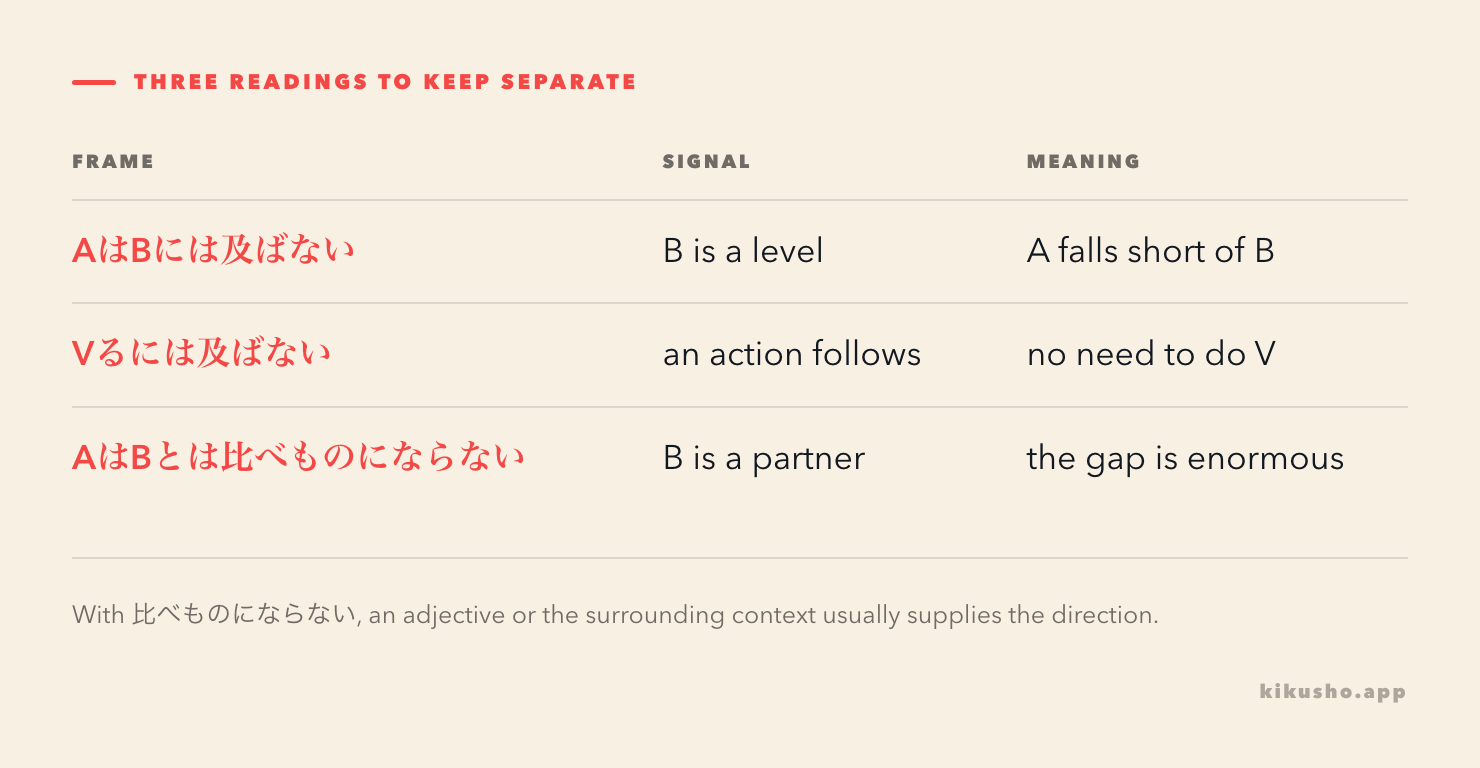
First inspect the attachment. AはBには及ばない places A below B on a scale. Vる/する-noun + には及ばない can instead say formally that the action is unnecessary. AはBとは比べものにならない announces a gap so large that normal comparison feels inadequate.
Then check tone. Choose the 及ぶ pattern for a measured shortfall or formal no-need message. Choose 比べものにならない only when the sentence really needs its stronger, sometimes dramatic dismissal of comparison.
Common questions
What is the difference between には及ばない and とは比べものにならない?
In a comparison, には及ばない says A does not reach B's level. It can sound measured or modest. とは比べものにならない says the gap is so large that ordinary comparison feels pointless, which is much more emphatic.
Does には及ばない always make a comparison?
No. After a dictionary-form verb or a する-noun, it can formally mean there is no need to perform the action, as in ご心配には及びません. Sentence structure and context identify the use.
Which item is the higher standard with には及ばない?
In AはBには及ばない, B is the level A does not reach, so B is higher on the relevant scale. The pattern itself gives the comparison a direction.
Does とは比べものにならない say which side is better?
It emphasizes an enormous difference, but surrounding words often establish whether A is better, worse, faster or more serious. Add a clear property when the direction might otherwise be ambiguous.