On this page
Use を踏まえて when an existing result, experience, opinion or situation informs what happens next. Use を前提として when the next plan or argument depends on treating a condition or proposition as true. One looks back at material already available; the other establishes what must be assumed going forward.
利用者の意見を踏まえて、申込画面を改善した。
りようしゃの いけんを ふまえて、もうしこみ がめんを かいぜんした。
We improved the application screen in light of user feedback.
全員が参加することを前提として、研修の日程を組んだ。
ぜんいんが さんかすることを ぜんていとして、けんしゅうの にっていを くんだ。
We arranged the training schedule on the assumption that everyone would participate.
The feedback already exists and influences the revision. Full attendance is a condition on which the schedule is built. If that assumption fails, the plan may need to be rebuilt.
Ask whether A is input or a required premise
| Form | Status of A | Relationship to B | Frequent A nouns |
|---|---|---|---|
| Nを踏まえて、B | known fact, result, experience or opinion | B considers A and responds to it | 結果, 現状, 意見, 経験, 反省 |
| N/clause + ことを前提として、B | condition, policy or proposition treated as holding | B depends on A as its starting assumption | 参加, 協力, 合意, 安全, 結婚 |
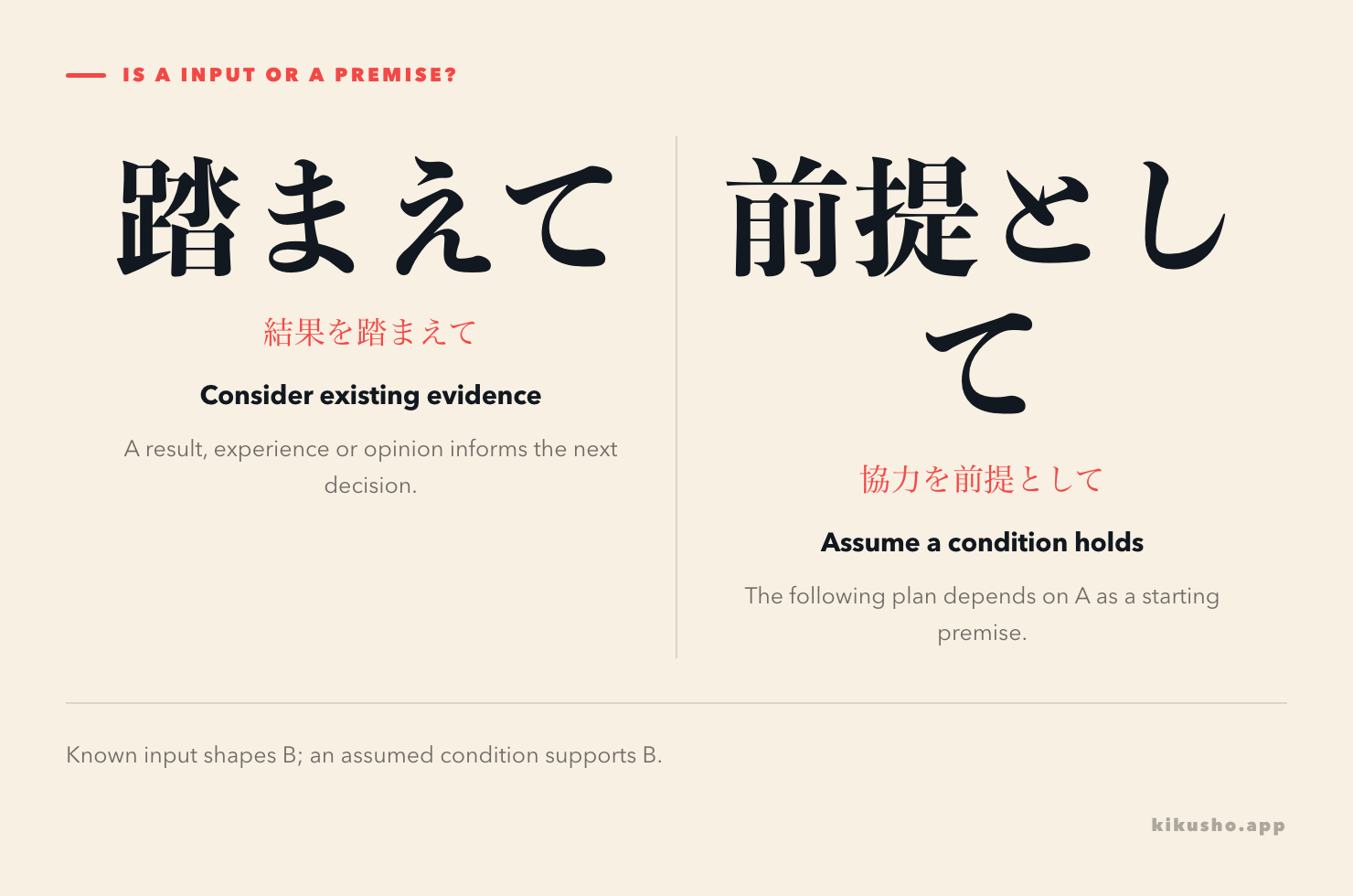
English based on can translate either form and hide the distinction. Ask a more concrete question. Did A supply information that was considered? Choose を踏まえて. Would B fail or change if A did not hold? Choose を前提として.
を踏まえて carries earlier input into a decision
踏まえる(ふまえる) literally relates to placing the feet firmly. In this formal metaphor, the speaker stands on A as a basis while deciding or acting. A noun comes before を踏まえて.
前回の失敗を踏まえて、確認手順を増やした。
ぜんかいの しっぱいを ふまえて、かくにん てじゅんを ふやした。
Taking the previous failure into account, we added verification steps.
現地の状況を踏まえて、出発時刻を変更します。
げんちの じょうきょうを ふまえて、しゅっぱつ じこくを へんこうします。
We will change the departure time in light of local conditions.
The action in B need not follow A mechanically. A committee can consider survey results and still weigh cost, safety and timing. を踏まえて says A entered the reasoning; it does not say A was the only authority.
Nihongo Kyoshi Net confirms the noun attachment, formal register and common use with results, reflection and reports. Bunpro's independent explanation presents the same consideration metaphor and contrasts it with stricter reliance on a fixed rule or source.
The form changes when it connects to a noun:
| Job | Form | Example |
|---|---|---|
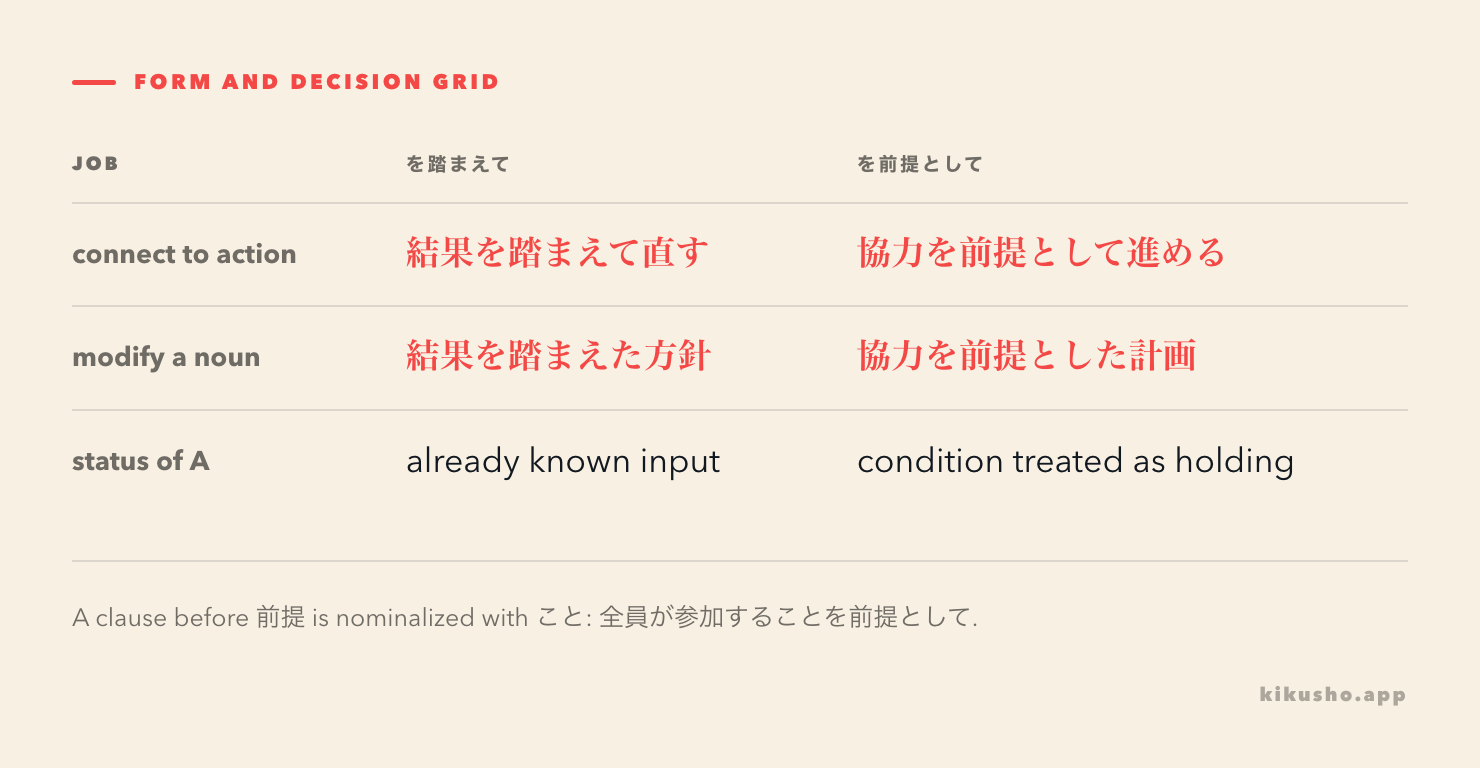
| connect to an action | Nを踏まえて + clause | 結果を踏まえて見直す |
| concise formal connection | Nを踏まえ + clause | 結果を踏まえ、見直す |
| modify a noun | Nを踏まえた + noun | 結果を踏まえた見直し |
Ede Wakaru Nihongo documents the shorter を踏まえ form and を踏まえた + noun. The connective て form does not directly modify a following noun.
を前提として installs a condition beneath the plan
前提(ぜんてい) is a premise: something treated as established before reasoning, preparation or action proceeds. A noun or a nominalized clause with こと comes before を前提として.
住民の同意を前提として、工事の準備を進める。
じゅうみんの どういを ぜんていとして、こうじの じゅんびを すすめる。
We will prepare for construction on the premise of residents' consent.
来年帰国することを前提として、この部屋を借りた。
らいねん きこくすることを ぜんていとして、この へやを かりた。
I rented this room on the assumption that I would return home next year.
The consent and return do not need to be completed when the sentence is spoken. They are treated as conditions that organize the later action. This is why 結婚を前提として付き合う describes dating with marriage as an intended premise, not dating after marriage has already happened.
Benri Japan emphasizes the indispensable-condition reading and gives the attributive を前提とする + noun. J-nihongo independently explains that judgment, preparation or discussion proceeds while treating A as holding.
Several surface forms divide the same work:
| Position | Natural form | Example |
|---|---|---|
| before a clause | Nを前提として/Nを前提に | 協力を前提として進める |
| continuing state | Nを前提としている | 利用を前提としている |
| before a noun | Nを前提とした/Nを前提とする | 安全を前提とした設計 |
The shorter を前提に commonly connects to a following action. Before a noun, use を前提とした or を前提とする, rather than treating に as an attributive ending.
One topic can create two different sentences
A budget may be an existing constraint or a hoped-for condition.
現在の予算を踏まえて、機能を三つに絞った。
げんざいの よさんを ふまえて、きのうを みっつに しぼった。
Considering the current budget, we narrowed the features to three.
追加予算の確保を前提として、開発計画を立てた。
ついか よさんの かくほを ぜんていとして、かいはつ けいかくを たてた。
We made the development plan on the assumption that additional funding would be secured.
The first sentence responds to money currently available. The second makes future funding a load-bearing assumption. If the extra budget is not secured, the second plan loses its premise.
A nearby pair is に基づいて and をもとに. The former often signals adherence to a rule, evidence or standard; the latter can treat A as source material for creating B. The basis and source-material lesson develops that distinction. を踏まえて foregrounds consideration before response, while を前提として foregrounds dependency on an assumed condition.
Kikusho already introduces 踏まえる in an N1 contextual-verbs lesson and 前提 among cause, result and condition words. This page adds the grammatical decision between the two full frames and their noun-modifying forms.
Level placement is not unanimous. JLPT Sensei, Bunpro, Nihongo Kyoshi Net, Benri Japan and J-nihongo place these forms at N1, while Nihongo to Japan labels を前提に/を前提として N2. Kikusho retains the assigned N1 position and records the disagreement. The official JLPT describes proficiency and question formats rather than issuing a fixed public list of every grammar form.
When making a Kikusho card, preserve both A and B. 結果を踏まえて alone does not show what changed after the result was considered. 協力を前提として alone does not show which plan depends on cooperation. A complete sentence lets you test the relationship, not only the translation.
Practice: inspect the status of A
Answer all seven questions before opening the explanations.
Question 1 · survey results
Complete: アンケートの結果( )、案内表示を変更した。
- A. を踏まえて
- B. を前提として
- C. にもかかわらず
- D. を限りに
Question 2 · required cooperation
Complete: 地域の協力( )、祭りの計画を進めている。
- A. を踏まえて
- B. を前提として
- C. に先立って
- D. を通じて
Question 3 · noun modification
Which phrase correctly means “a policy informed by the investigation results”?
- A. 調査結果を踏まえて方針
- B. 調査結果を踏まえた方針
- C. 調査結果を前提に方針
- D. 調査結果が踏まえた方針
Question 4 · clause as premise
Complete: 全員がオンラインで参加できる( )、会議室を予約しなかった。
- A. 結果を踏まえて
- B. ことを前提として
- C. 意見を踏まえた
- D. ことが前提をして
Question 5 · known constraint
Read: 現在の人員を踏まえて、受付時間を短縮した。 What does A do?
- A. It states a future promise that must come true.
- B. It supplies an existing staffing fact considered in the decision.
- C. It provides raw material for manufacturing the schedule.
- D. It reports that staffing was ignored.
Question 6 · failed condition
Read: 資金提供を前提としていたが、支援が得られず計画を見直した。 Why was the plan revised?
- A. The assumed funding condition failed.
- B. Funding data had already proved the plan successful.
- C. The plan followed a legal rule too strictly.
- D. The writer merely remembered an earlier experience.
Question 7 · two stages
Choose the pair for a report that first uses observed data, then states a condition for the new plan:
昨年度の利用状況(甲)、計画を修正した。新しい計画は予算の確保(乙)いる。
- Evidence then premise: 甲 を踏まえて / 乙 を前提として
- Premise then evidence: 甲 を前提として / 乙 を踏まえて
- Two materials: 甲 をもとにして / 乙 をもとにして
- Two concessions: 甲 にもかかわらず / 乙 にもかかわらず
Answers and explanations
1 — A, を踏まえて. The survey results already exist and inform a later revision. They are input to the decision rather than a condition assumed to hold.
2 — B, を前提として. The festival plan depends on local cooperation. If that condition is unavailable, the plan may not stand as designed.
3 — B. を踏まえた is the attributive form before 方針. A leaves a connective て-form directly before the noun, while C and D use the wrong relationship or case structure.
4 — B, ことを前提として. The full clause is nominalized with こと and installed as the assumption behind not booking a room.
5 — B. The current staffing level is an existing circumstance weighed before shortening reception hours. Nothing in the sentence promises future staffing.
6 — A. The plan had funding as a premise, but support was not obtained. Once the condition failed, revision became necessary.
7 — Evidence then premise. Last year's usage is observed input, so 甲 takes を踏まえて. The revised plan depends on securing a budget, so 乙 takes を前提として.
Let time and dependency decide
Choose を踏まえて when A is already available as a result, experience, opinion or current condition and B takes it into account. Choose を前提として when B is organized around A as a condition or assumption that must be treated as holding.
Then check the following word. Use を踏まえた or を前提とした/する before a noun. Meaning identifies the logical relationship; form identifies how that relationship fits into the sentence.
Common questions
What is the difference between を踏まえて and を前提として?
を踏まえて takes an existing result, experience, opinion or situation into account before a decision. を前提として treats a condition, plan or proposition as holding and builds the following action or argument on it.
Can the same noun appear before both forms?
Yes, but the relationship changes. 予算を踏まえて means considering the budget that is known, while 予算の確保を前提として means proceeding on the assumption that funding will be secured.
How do these forms modify a noun?
Use Nを踏まえたN for a noun informed by prior facts, and Nを前提としたN or Nを前提とするN for a noun built on a premise. Do not place the connective て-form directly before the modified noun.
Are を踏まえて and を前提として both N1 grammar?
Several references place both at N1, while one current learner reference labels を前提として N2. Kikusho records that disagreement because the JLPT does not publish a fixed official grammar-item list.