On this page
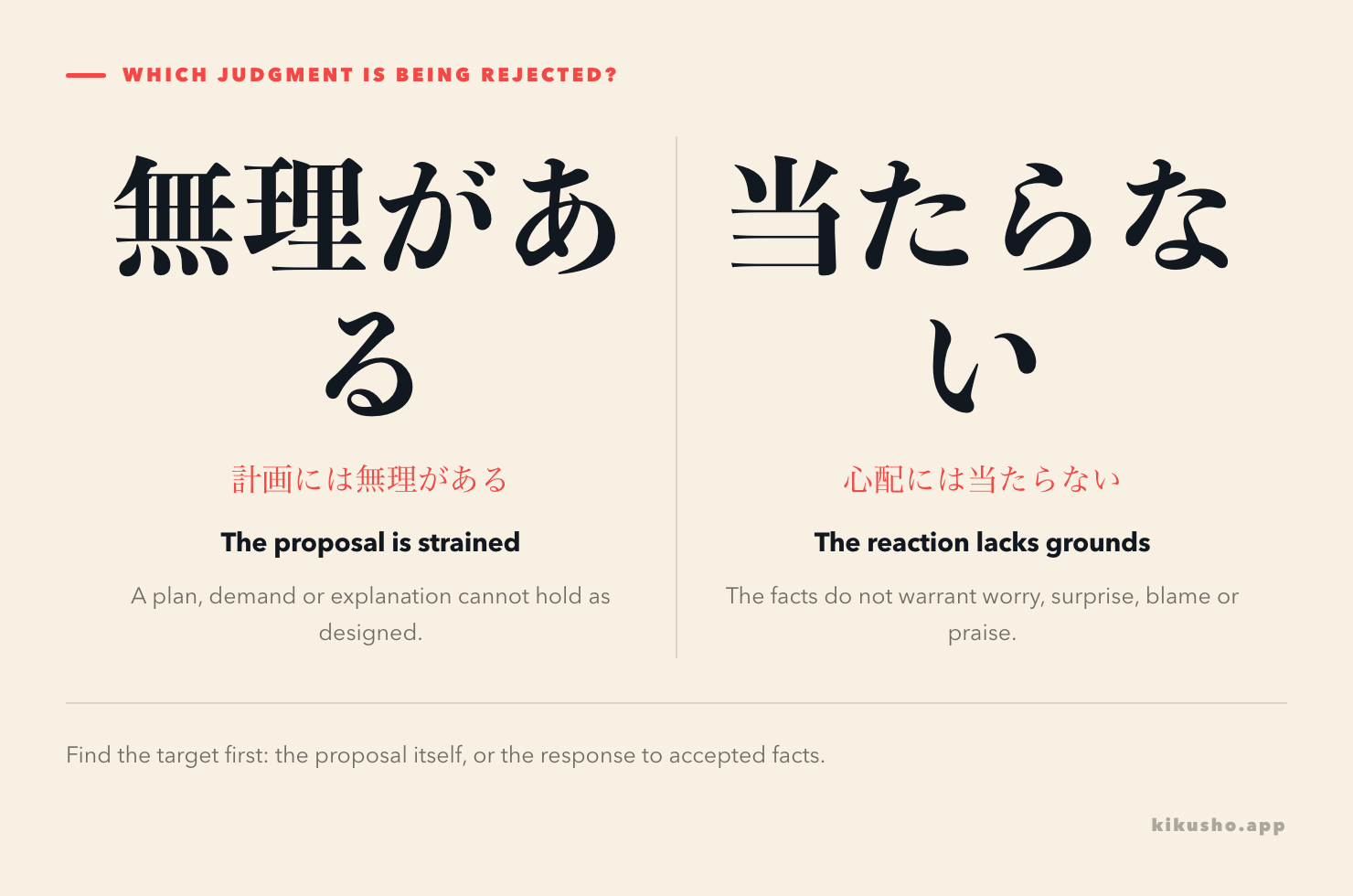
Use には無理がある when the plan, demand, explanation or assumption itself is unrealistic or strained. Use には当たらない when the facts do not justify a reaction or evaluation such as worry, surprise, blame or praise. Both can reject a judgment, but they reject different parts of it.
この計画には無理がある。三日では終わらない。
この けいかくには むりが ある。みっかでは おわらない。
This plan is unrealistic. It will not be finished in three days.
少し遅れただけだから、悲観するには当たらない。
すこし おくれただけだから、ひかんするには あたらない。
It was only a slight delay, so there is no reason to be pessimistic.
The first speaker finds a defect in the schedule. The second accepts that a delay occurred but rejects the level of pessimism. Ask whether the sentence challenges the proposal or the response to the facts.
Put the criticism on the correct target
| Form | What receives the judgment? | Core message | Frequent partners |
|---|---|---|---|
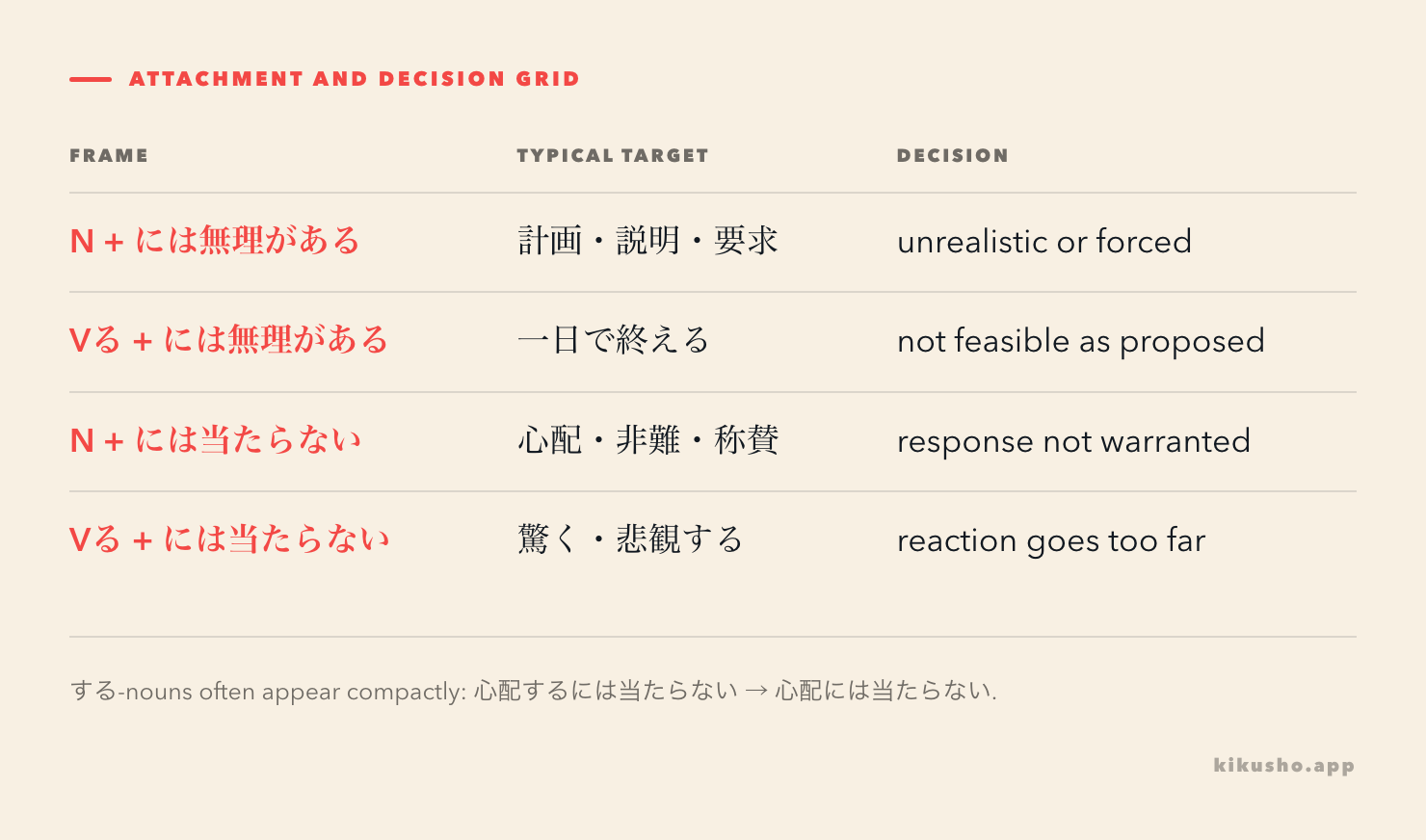
| N/Vる + に(は)無理がある | a plan, demand, theory, explanation or action | it is unrealistic, forced or internally strained | 計画, 説明, 設定, 要求, 一日で終える |
| N/Vる + に(は)当たらない | a reaction, evaluation or classification | the facts do not warrant that response or label | 心配, 驚く, 悲観する, 非難する, 称賛する |
The particle は adds contrast or emphasis to に. References therefore often list both patterns as に(は)無理がある and に(は)当たらない. In the fixed teaching labels, には is especially common.
には無理がある finds strain in a proposal
無理がある literally says that there is something unreasonable or forced in the preceding idea. A noun or a dictionary-form verb can come before には無理がある.
現在の人数で全店舗を同時に調査するには無理がある。
げんざいの にんずうで ぜんてんぽを どうじに ちょうさするには むりが ある。
Trying to inspect every branch simultaneously with the current staff is unrealistic.
証拠が一つもないのに、その説明には無理がある。
しょうこが ひとつも ないのに、その せつめいには むりが ある。
With no evidence at all, that explanation is strained.
The pattern is broader than a flat 無理だ. 今夜中に全部読むのは無理だ directly says that finishing tonight is impossible. 今夜中に全部読めるという計画には無理がある examines the plan and says that some part of its logic or assumptions cannot hold.
This makes the form useful in meetings, reports and criticism. It can question an aggressive deadline, a theory that ignores evidence or a story with a contradiction. Benri Japan's N1 explanation highlights plans, theories and demands that exceed practical ability or common sense. Nihongo Kyoshi Net independently gives the noun and dictionary-form verb attachments and treats the form as a judgment of practical difficulty.
Because it openly criticises an idea, speakers often soften it:
この前提には少し無理があるのではないでしょうか。
この ぜんていには すこし むりが あるのでは ないでしょうか。
Might this premise be somewhat difficult to sustain?
少し, と思います and のではないでしょうか reduce the interpersonal force. They do not change which object is being judged.
には当たらない rejects the proposed response
In this pattern, 当たる carries the sense “correspond to” or “qualify as.” Its negative says that the situation does not rise to the level that would justify the named response. A dictionary-form verb or a noun can precede に(は)当たらない.
初めての作業で一度間違えたからといって、非難するには当たらない。
はじめての さぎょうで いちど まちがえたからといって、ひなんするには あたらない。
One mistake on a first attempt is no grounds for blame.
予定どおり進んでいるので、ご心配には当たりません。
よていどおり すすんでいるので、ごしんぱいには あたりません。
Everything is proceeding as scheduled, so there is no cause for concern.
The first sentence does not deny the mistake. It denies that the mistake warrants blame. The second does not claim that worry is impossible; it reassures the listener that the evidence does not call for it.
Mainichi Nonbiri's teacher reference describes the form as advice against an excessive response and notes its frequent attachment to emotion words. Marutoku's explanation expands the set to evaluative verbs such as 称賛する, 非難する and 軽蔑する, and explains the underlying “does not correspond to that value” sense.
Nouns formed from する-verbs commonly appear without する:
| Full reaction | Common compact form |
|---|---|
| 心配するには当たらない | 心配には当たらない |
| 非難するには当たらない | 非難には当たらない |
| 称賛するには当たらない | 称賛には当たらない |
The expression is formal and can sound authoritative. Telling an anxious person 心配するには当たらない assesses whether their worry is justified; it does not automatically show warmth. In a personal conversation, そんなに心配しなくても大丈夫だよ may sound gentler.
The same facts can support both forms
A report can criticise a proposal while defending the people involved:
二人だけで一週間分のデータを今日中に確認するという計画には無理がある。しかし、作業が遅れたからといって、担当者を非難するには当たらない。
ふたりだけで いっしゅうかんぶんの データを きょうじゅうに かくにんするという けいかくには むりが ある。しかし、さぎょうが おくれたからといって、たんとうしゃを ひなんするには あたらない。
The plan to have two people check a week's data today is unrealistic. But the delay is no grounds for blaming those responsible.
The first clause points upward to the design of the work. The second points away from an excessive judgment of the workers. Swapping the forms would change those targets.
A useful comparison is には当たらない versus に足らない. 判断するに足らない証拠 says the evidence is insufficient for a decision; 驚くには当たらない結果 says the result does not warrant surprise. The に値する, に足る and に足らない lesson treats the merit and sufficiency scale directly.
For a simpler statement of unnecessary action, 必要はない names absence of need without this evaluative threshold. The ことはない and 必要はない comparison shows the everyday advice forms. Formal には及ばない can also mean that an action is unnecessary, while its comparison use marks a lower level; the には及ばない and とは比べものにならない lesson separates both readings. The ほどのことではない and までもない lesson compares two other ways to say that a response or effort is excessive.
When you save either form in Kikusho, keep the judged target. A card with only 無理がある = unreasonable loses whether the problem was a deadline, explanation or demand. A card with 非難するには当たらない preserves the response being rejected, and the surrounding reason gives you evidence to test during offline review.
Practice: identify what the speaker rejects
Answer all seven items before opening the shared key.
Question 1 · deadline
Complete: この人数で百件を一日で処理する( )。
- A. には無理がある
- B. には当たらない
- C. に値する
- D. に違いない
Question 2 · reaction
Complete: 少し順位が下がっただけで、そこまで悲観する( )。
- A. には無理がある
- B. にほかならない
- C. には当たらない
- D. に越したことはない
Question 3 · explanation
Which sentence says that an explanation contains a strained assumption?
- A. その説明には当たらない。
- B. その説明には無理がある。
- C. その説明を心配するには当たらない。
- D. その説明は称賛には当たらない。
Question 4 · compact noun form
Complete: 誰でもする程度の手伝いだから、称賛( )。
- A. するには無理がある
- B. には当たらない
- C. に無理をする
- D. には違いがある
Question 5 · target of the criticism
Read: 証拠を無視したこの推論には無理がある。 What is rejected?
- A. The speaker's emotional reaction
- B. The grammatical form of 推論
- C. The reasoning as a defensible account
- D. The need to collect any evidence
Question 6 · target of the reassurance
Read: 予定どおり進んでいるので、心配するには当たらない。 What remains true?
- A. Worry is grammatically impossible.
- B. The work is progressing according to plan.
- C. The schedule itself is unrealistic.
- D. The listener has already been blamed.
Question 7 · two judgments
Choose the pair that keeps each target clear:
一か月の調査を二日で終えるという日程(甲)。ただし、遅れた担当者を非難する(乙)。
- Plan strained, blame unwarranted: 甲 には無理がある / 乙 には当たらない
- Reaction first, plan second: 甲 には当たらない / 乙 には無理がある
- Two merit judgments: 甲 に値する / 乙 に値する
- Two predictions: 甲 に違いない / 乙 に違いない
Answers and explanations
1 — A, には無理がある. The staff size and one-day deadline make the proposed task unrealistic. The sentence criticises feasibility rather than rejecting an emotional response.
2 — C, には当たらない. A small change in rank does not justify such pessimism. The decline remains real; the response is judged excessive.
3 — B. 説明には無理がある places the flaw inside the account or its assumptions. A lacks a natural response to evaluate, while C and D judge worry or praise instead of coherence.
4 — B, には当たらない. 称賛 is a する-noun and can appear directly before the pattern. Ordinary help does not rise to the level that warrants praise.
5 — C. The sentence rejects the reasoning as defensible because it ignores evidence. It does not describe a feeling or claim that evidence is unnecessary.
6 — B. Progress according to schedule is the reason worry is unwarranted. The pattern evaluates the grounds for concern; it does not make the emotion impossible.
7 — Plan strained, blame unwarranted. The compressed schedule is structurally unrealistic, so 甲 takes には無理がある. The same bad schedule weakens the grounds for blaming the worker, so 乙 takes には当たらない.
Separate the proposal from the response
Choose には無理がある when the sentence opens a plan, theory, demand or explanation and finds a practical or logical strain inside it. Choose には当たらない when the facts are accepted but the proposed worry, surprise, praise, blame or classification goes too far.
English translations such as “unreasonable,” “unnecessary” and “not justified” overlap. The Japanese becomes clearer when you underline the target: what is flawed? points to 無理がある; which reaction lacks grounds? points to 当たらない.
Common questions
What is the difference between には無理がある and には当たらない?
には無理がある judges a plan, demand, explanation or assumption unrealistic or strained. には当たらない says that a reaction or evaluation such as worry, surprise, blame or praise is not warranted by the facts.
Does には無理がある simply mean impossible?
Not always. It can say that execution is unrealistic, but it often points to a flaw, contradiction or forced assumption in the proposal rather than absolute impossibility.
Which verbs commonly appear before には当たらない?
Common choices describe reactions and evaluations, including 心配する, 驚く, 悲観する, 非難する and 称賛する. The form says the situation does not justify that response.
Are these expressions officially N1 grammar?
Multiple study references place both at N1, but the JLPT does not publish an exhaustive official grammar list. N1 is therefore a useful preparation estimate rather than an exclusive official assignment.