On this page
For “A is cheaper than B,” use AはBより安いです or BよりAのほうが安いです; より follows the reference item, B. For “A is the cheapest,” use Aがいちばん安いです, naming the group with Gの中で when you need to say what A is cheapest among.
Read 安い as やすい, inexpensive; ほう as hō, with a long vowel; and 一番 as いちばん, ichiban. These are four connected N5 grammar constructions: a topic-based comparison, a comparison with のほうが, the superlative いちばん, and a superlative with an explicit group. They let you move from “this is cheap” to “this is cheaper” to “this is the cheapest here” without inventing a new adjective ending.
Four frames belong together because the adjective stays put
Start with a description you can already make. この傘は安いです means “This umbrella is inexpensive.” Read 傘 as かさ, umbrella. To compare it, identify another umbrella as the reference; to rank it, identify a set of umbrellas.
This lesson assumes you can form a basic polite adjective statement. The earlier guide to い-adjectives and な-adjectives supplies that foundation. We will compare noun phrases here, rather than cover every possible verb phrase before より or ほう.
The JLPT Sensei comparison lesson labels the AはBより frame N5. Bunpro places both より~のほうが and の中で~がいちばん in its N5 course. Those are editorial learning estimates: the exam has no exhaustive official grammar syllabus. Bunpro's separate, broader entries for より and の中で carry N4 labels; this page teaches the named comparison and superlative frames, not every use of those strings.
The set: two ways to compare, two ways to rank
In this table, A is the item being described, B is the reference, and G is the group. Keep those labels fixed when the word order changes.
| Construction | Noun-based frame | What the sentence claims |
|---|---|---|
| は~より~です | AはBより安いです | A is cheaper than B. |
| より~ほうが | BよりAのほうが安いです | Of the two, A is cheaper. |
| 一番(いちばん) | Aがいちばん安いです | A is the cheapest of the understood options. |
| の中でAが一番 | Gの中でAがいちばん安いです | Among G, A is the cheapest. |
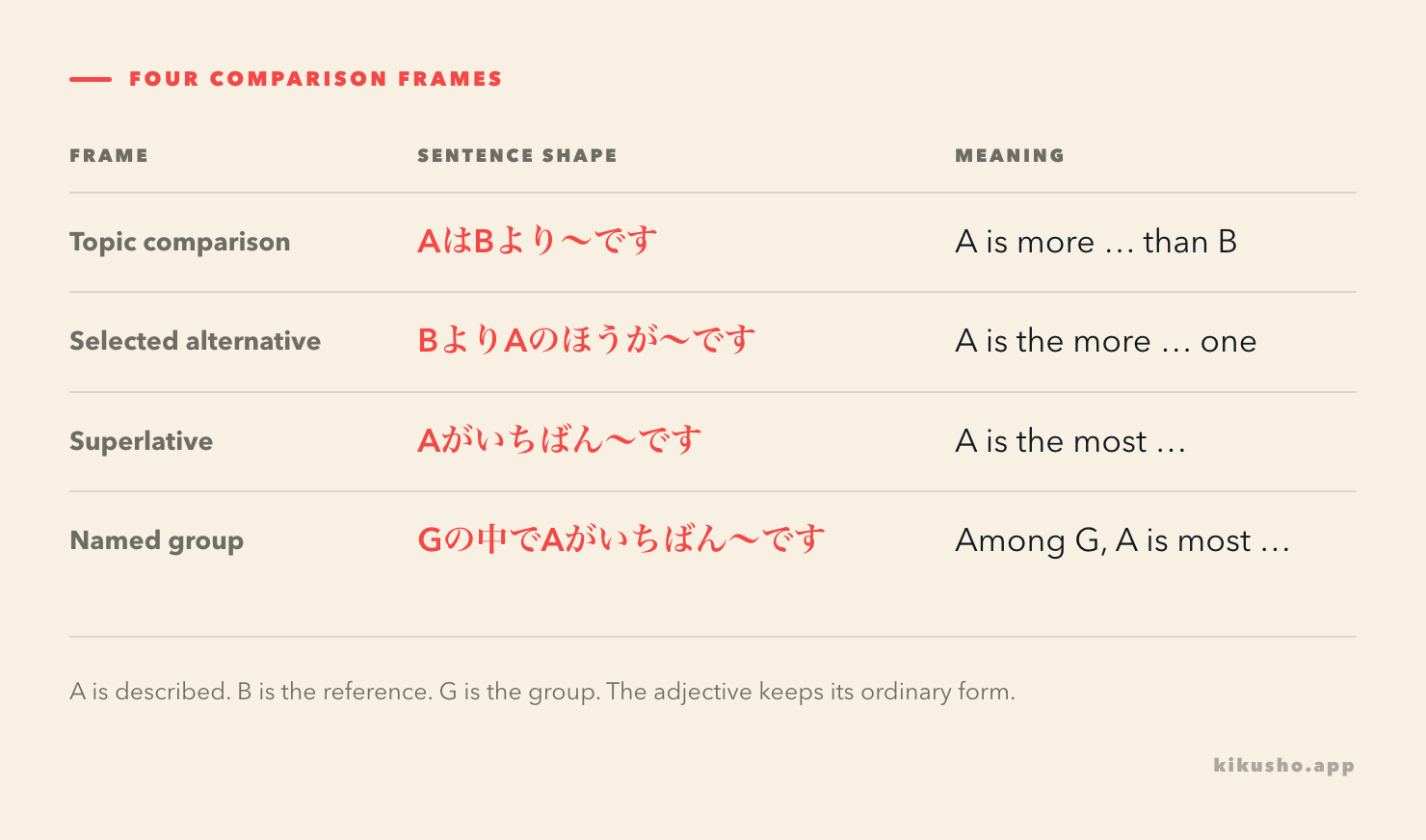
The adjective in all four sentences is 安い, never a special “cheaper” or “cheapest” conjugation. This holds for a な-adjective predicate too: この部屋はあの部屋より静かです, “This room is quieter than that room.” Read 部屋 as へや and 静か as しずか. There is no な immediately before the statement-ending です.
Comparison does not cancel ordinary tense rules. この傘はその傘より安かったです reports that this umbrella was cheaper; 安かった supplies the past. You changed the time of the description, not its comparative degree.
より marks the reference; のほうが picks out the alternative
この傘はその傘より安いです。
This umbrella is cheaper than that umbrella.
その傘よりこの傘のほうが安いです。
This umbrella is the cheaper one, compared with that umbrella.
Both compare the same two umbrellas in the same direction. In the second, この傘のほうが singles out this alternative. Japanese Professor's explanation checks both this noun attachment and the option to leave the reference unstated.
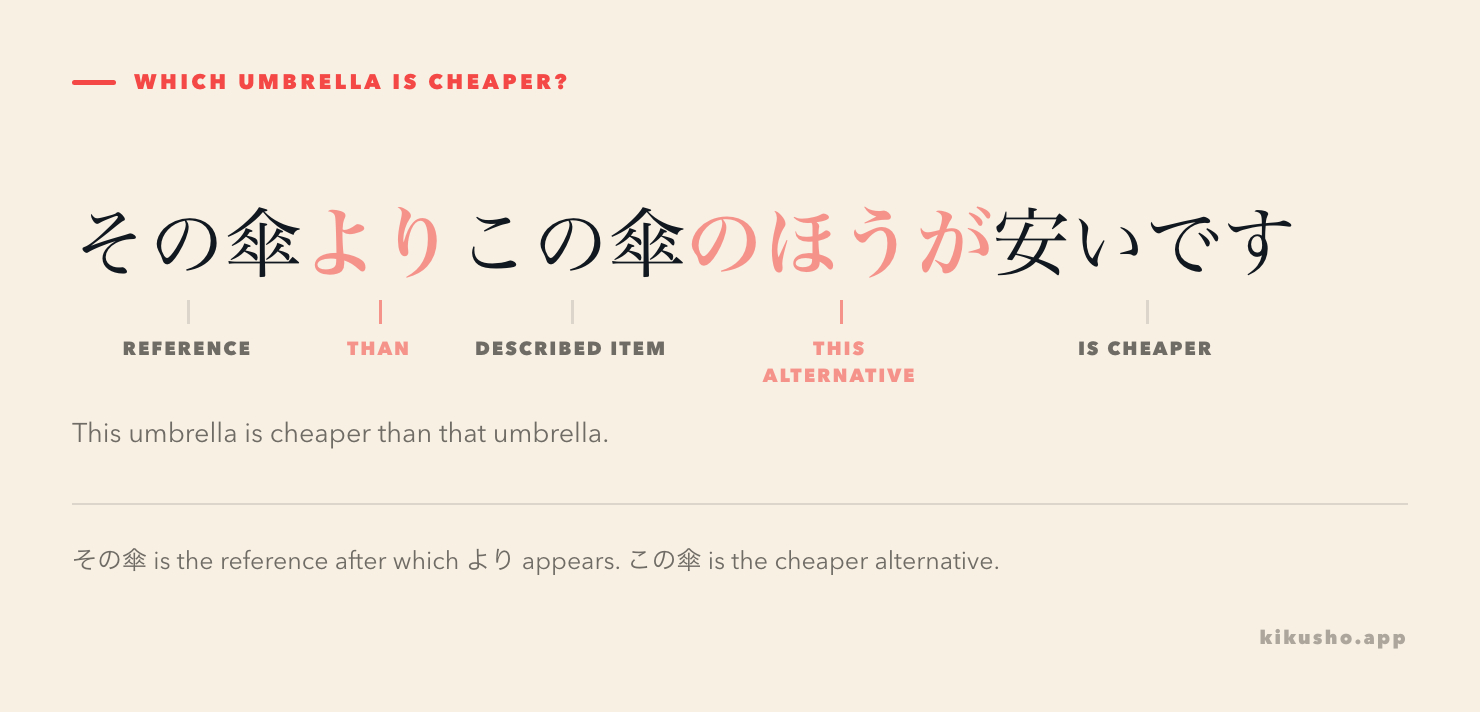
You can also put the selected item first: この傘のほうがその傘より安いです. Moving Bより later does not reverse the claim. Swapping the umbrellas attached to the particles does: この傘よりその傘のほうが安いです makes that umbrella cheaper.
When both umbrellas are in view, この傘のほうが安いです, “This umbrella is cheaper,” can be enough. The listener supplies the other option. Without that context, it leaves an unanswered question: cheaper than what?
For nouns, retain の before ほう: この傘のほう, not この傘ほう. JLPT Sensei's より~ほうが table and Bunpro both distinguish noun attachment from verb and adjective attachment. Giving advice with a verb and たほうがいい is a different construction and is outside this four-frame set.
いちばん ranks within a group, including a group left unsaid
これがいちばん安いです。
This is the cheapest.
With several umbrellas laid out, the options need not be repeated. いちばん modifies 安い and places this one at the cheapest end of the set under discussion. JLPT Sensei's 一番 page checks the reading and superlative use; its group-frame page makes the set explicit.
Imagine a shop with these three umbrellas. The prices are invented for this lesson.
| Umbrella | Reading | Price |
|---|---|---|
| 赤い傘, red umbrella | あかいかさ | ¥500 |
| 黄色い傘, yellow umbrella | きいろいかさ | ¥700 |
| 青い傘, blue umbrella | あおいかさ | ¥900 |
この店の傘の中で、赤い傘がいちばん安いです。
Among the umbrellas in this shop, the red umbrella is the cheapest.
Read 店 as みせ and 中 as なか. The first の joins “this shop” to “umbrellas”; the second introduces の中で, “among.” The red umbrella belongs to the group named before の中で. The sentence ranks it against that shop's umbrellas, without claiming anything about every umbrella sold elsewhere.
黄色い傘は青い傘より安いです is also true in this little shop, but it does not make the yellow umbrella cheapest. A pairwise comparison establishes one relationship; a superlative requires a ranking across the relevant group. You need the third price to know whether your two-item statement supports the larger claim.
Three boundaries keep the comparison from saying too much
First, “more” follows the adjective's meaning. With 安い, the described item has a lower price. With 重い(おもい), heavy, it has greater weight. There is no universal winner or better purchase: the heavier bag could be the one you would rather leave behind. The N5 adjective-pair lesson helps you identify which property an adjective measures.
Second, a preference is a speaker's preference. 水よりお茶のほうが好きです means “I like tea more than water,” with 水(みず)and お茶(おちゃ). 飲み物の中で、お茶がいちばん好きです means “Of drinks, I like tea best”; 飲み物 is のみもの. Neither announces an objectively superior drink. Bunpro's comparison examples independently check this use of 好き(すき).
Third, いちばん does not always need a named group, and の中で does not automatically produce a superlative. In the frames here, いちばん provides the ranking and の中で limits the set. Nor does いちばん mean “more than before”: the cheapest option might still be expensive for you.
Use the frames when the choice is in front of you
At a shop, a price tag gives you the evidence before you assemble the sentence. At home, you might compare two bags by weight or two rooms by how quiet they are. Keep the property fixed: a lower price says nothing about weight, and a quieter room says nothing about size. The menu-reading guide uses prices as the starting point for choosing food; these frames let you put such a choice into words.
If you save 安い in Kikusho, paste the phrase that made you need it, including the reference item when one was spoken. Check the drafted example before saving, so a card for “inexpensive” retains the difference between その傘より安い and いちばん安い. Capture and later review support remembering the language; they do not establish which item is cheapest in a changing shop.
Practice
Try all eight tasks before scrolling to the shared answers. The price table above applies wherever a question names those three shop umbrellas. These exercises are original and use the lesson's noun-based frames.
Question 1. Select the particle that names the yellow umbrella as the reference in “The red umbrella is cheaper than the yellow umbrella”: 赤い傘は黄色い傘__安いです。
- A. の
- B. より
- C. が
- D. で
Question 2. Complete the comparison with the required noun attachment: 青い傘より赤い傘__安いです。 Choose the phrase that picks out the red alternative.
- A. なほうが
- B. ほうの
- C. のほうが
- D. にほうが
Question 3. Arrange every piece to say “The yellow umbrella is cheaper than the blue umbrella.” Begin with 黄色い傘は: です / 青い傘より / 黄色い傘は / 安い.
Question 4. Build one polite sentence ranking the red umbrella as cheapest among this shop's umbrellas. Begin with この店の傘の中で and use every piece: 赤い傘が / です / この店の傘の中で / 安い / いちばん.
Question 5. Choose the sentence that follows from both comparisons in this short shop note: 赤い傘は黄色い傘より安いです。黄色い傘は青い傘より安いです。
- A. この店の傘の中で、青い傘がいちばん安いです。
- B. この店の傘の中で、黄色い傘がいちばん安いです。
- C. この店の傘の中で、赤い傘がいちばん高いです。
- D. この店の傘の中で、赤い傘がいちばん安いです。
Question 6. Complete both blanks so this text matches the three displayed prices: 黄色い傘は青い傘__安いです。でも、この店の傘の中で、__がいちばん安いです。
- A. より / 赤い傘
- B. が / 黄色い傘
- C. より / 黄色い傘
- D. の / 青い傘
Question 7. The adjective describes quietness, rather than price. Choose the normal polite predicate in この部屋はあの部屋より__, meaning “This room is quieter than that room.”
- A. 静かなです
- B. 静かいです
- C. 静かです
- D. 静かのです
Question 8. Write the equivalent comparison using のほうが: 赤い傘は黄色い傘より安いです。 Begin with 黄色い傘より and keep the same red umbrella cheaper.
Answers and explanations
Answer 1: B. より. 黄色い傘より supplies “than the yellow umbrella.” の joins nouns but does not make that comparison; が would give the second umbrella its own subject marking; で would not supply the price reference.
Answer 2: C. のほうが. 赤い傘 is a noun phrase and takes の before ほう. な is not its attachment, に does not connect these nouns, and ほうの reverses the particles without producing the required subject phrase.
Answer 3: 黄色い傘は青い傘より安いです。 The yellow umbrella is the topic, the blue one the reference, and 安いです the description. The specified beginning fixes the arrangement; the sentence agrees with ¥700 being below ¥900.
Answer 4: この店の傘の中で、赤い傘がいちばん安いです。 The group comes first as requested. 赤い傘が identifies its member, and いちばん directly modifies 安い. It does not attach to です or serve as a replacement for の中で.
Answer 5: D. Red costs less than yellow, and yellow less than blue, so red has the lowest price among the three. A and B rank the wrong member. C uses 高い(たかい), expensive, reversing the property established by the note.
Answer 6: A. より / 赤い傘. The first sentence compares yellow with blue. でも, “but,” then introduces the larger group: red, not yellow, is cheapest. C has a grammatical first comparison but an incorrect ranking; B and D also fail to form the intended first comparison.
Answer 7: C. 静かです. The comparative frame accepts the ordinary な-adjective predicate. な belongs before a modified noun, not before です; 静かい invents an い-adjective, and 静かのです does not provide the requested predicate.
Answer 8: 黄色い傘より赤い傘のほうが安いです。 Red still receives のほうが, while yellow keeps より. 赤い傘より黄色い傘のほうが安いです would be a well-formed sentence about the opposite price relationship, so changing the order without checking those particles changes the answer.
Common questions
Does a Japanese adjective change when it means cheaper or cheapest?
No special comparative or superlative ending is added. 安い stays 安い in AはBより安いです, A is cheaper than B, and Aがいちばん安いです, A is the cheapest. Tense and negation still follow the ordinary adjective rules.
Do nouns need の before ほうが?
Yes: この傘のほうが安いです means this umbrella is cheaper. The noun phrase この傘 connects to ほう with の. This noun attachment should not be copied onto every verb or adjective construction involving ほう.
Must every sentence with いちばん include の中で?
No. A speaker can say これがいちばん安いです when the options are already understood. Naming the group with a phrase such as この店の傘の中で makes the extent of the claim explicit; it does not create the superlative meaning by itself.