On this page
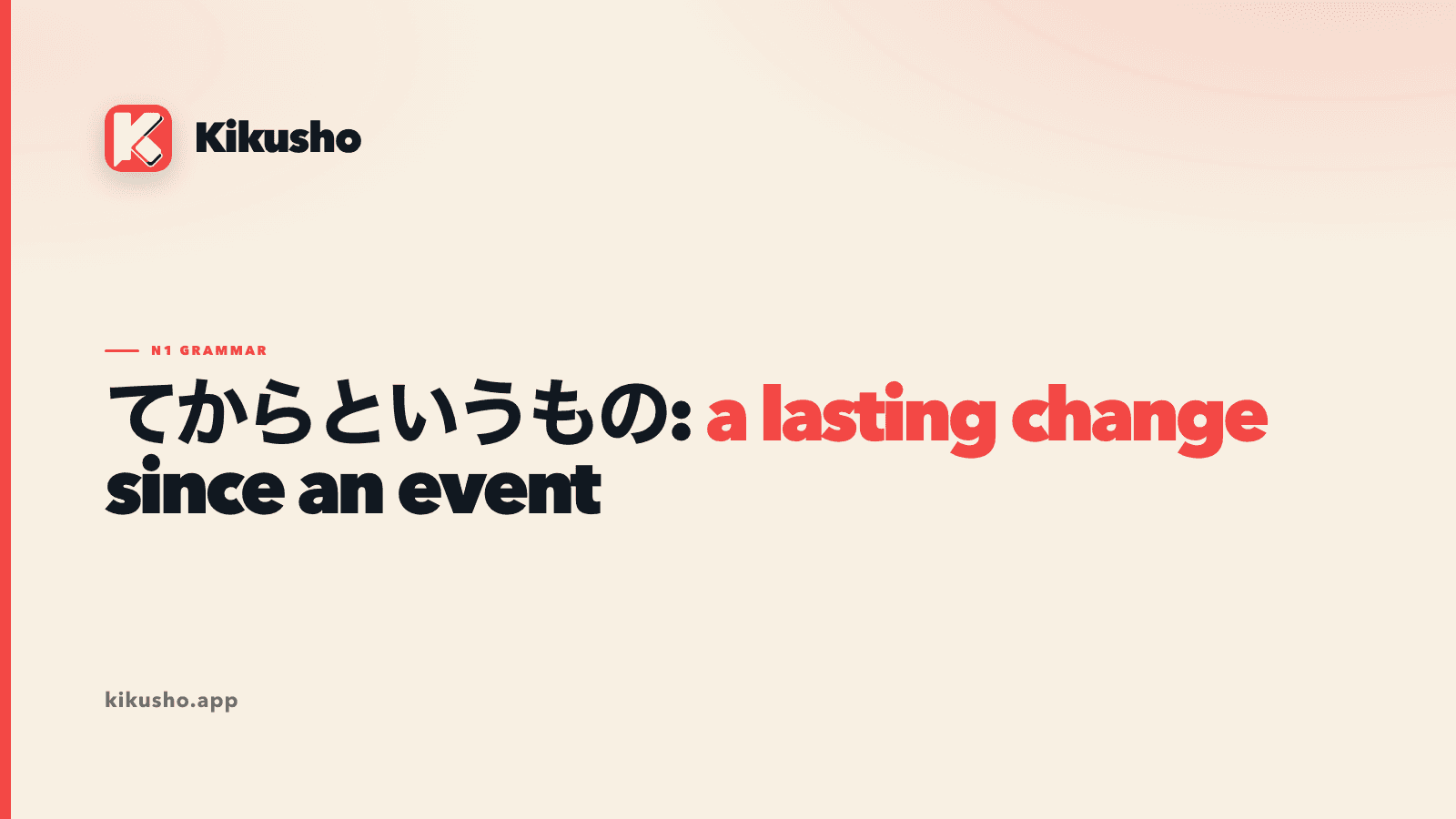
てからというもの means that one event became a turning point and a changed state or pattern has continued since then. It does more than place B after A: it asks the reader to feel the contrast between life before that event and life after it.
在宅勤務を始めてからというもの、昼休みに散歩するようになった。
ざいたくきんむを はじめてからというもの、ひるやすみに さんぽするように なった。
Ever since I started working from home, I have taken walks during my lunch break.
The start of remote work is not merely an earlier date. The speaker treats it as the cause or occasion for a durable new habit.
This lesson teaches inventory item g-6422bf7f466a, てからというもの. The Japan Foundation's comparison of time expressions describes it as an emphatic, somewhat heightened way to present a trigger, a major change and what has continued since. 日本語教師のまる得 independently confirms Vて + からというもの, the continuing consequence and its written, emotionally marked tendency. JLPT Sensei also places the form at N1. Their N1 label records agreement among study references; it is not an official item guarantee because the test maker does not expose a complete grammar syllabus.
One event divides the timeline into before and after
The construction has three parts:
| Part | Job | Example |
|---|---|---|
| Vて | names the completed event | 店を任されて |
| からというもの | marks that event as a consequential starting point | からというもの |
| following clause | gives the lasting change or repeated pattern | 帰宅が遅い日が増えた |
店を任されてからというもの、帰宅が遅い日が増えた。
みせを まかされてからというもの、きたくが おそい ひが ふえた。
Ever since I was put in charge of the shop, the number of days I get home late has increased.
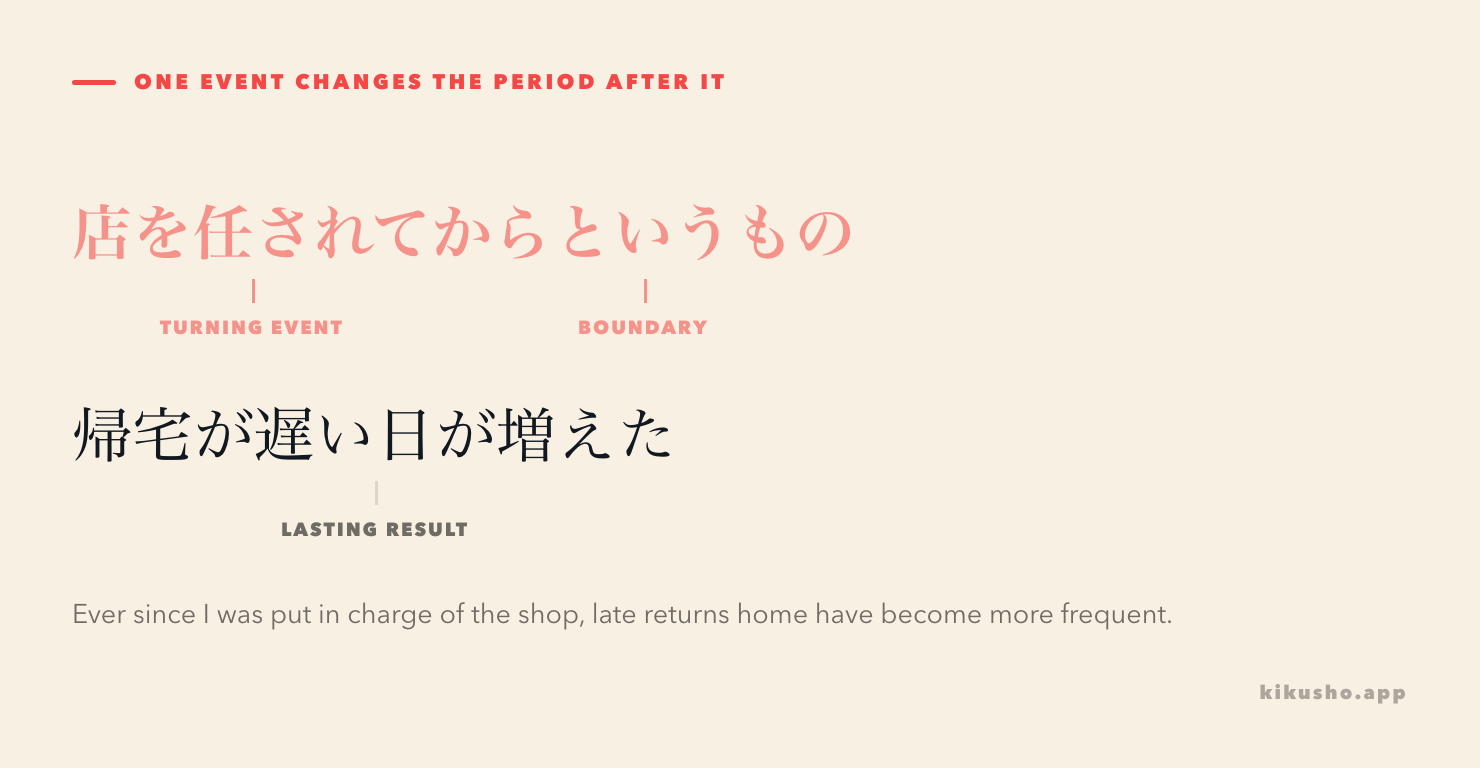
The second clause need not contain ずっと or a progressive verb. Continuity can come from a repeated habit, an ongoing state, an accumulating trend or an unbroken absence:
- 毎朝早く起きている: a continuing habit
- 人前で話すのが怖くなくなった: a changed state
- 相談を受ける機会が増えた: a recurring trend
- 一度も風邪をひいていない: an unbroken negative period
What matters is that the result spans the period after the event. One isolated later occurrence does not provide that span.
Attach からというもの to the complete て-form
The attachment is fixed: verb in the て-form + からというもの.
| Dictionary form | て-form | With the construction |
|---|---|---|
| 始める | 始めて | 始めてからというもの |
| 引っ越す | 引っ越して | 引っ越してからというもの |
| 読む | 読んで | 読んでからというもの |
| 辞める | 辞めて | 辞めてからというもの |
| 来る | 来て | 来てからというもの |
この小説を読んでからというもの、通勤中も物語のことを考えている。
この しょうせつを よんでからというもの、つうきんちゅうも ものがたりの ことを かんがえている。
Ever since I read this novel, I have been thinking about the story even on my commute.
Do not insert た, の or である before the pattern. 読んだからというもの belongs to a different analysis with causal から and quoted という; it is not this time expression. The target form preserves the full て-form boundary: 読んでからというもの.
The particle は may follow in some contexts as てからというものは, giving the post-event period a topic-like contrast. The shorter てからというもの is enough for the core pattern and is the safest form to produce.
The following clause must show a lasting consequence
The construction sounds natural when the first event explains why the later period feels different.
犬を飼い始めてからというもの、週末でも朝寝坊をしなくなった。
いぬを かいはじめてからというもの、しゅうまつでも あさねぼうを しなくなった。
Ever since I started keeping a dog, I have stopped sleeping late even on weekends.
The dog creates a new routine. The negative しなくなった identifies the change, while 週末でも shows that it now holds across repeated situations.
By contrast, this sentence only reports one later action:
駅に着いてから、友達に電話した。
After arriving at the station, I called my friend.
Adding というもの would make the listener wait for a continuing consequence that never arrives. For ordinary sequencing, the basic てから lesson gives the complete rule.
A very short interval can also feel weak unless the context makes the change striking. 五分前に連絡を受けてからというもの is hard to sustain because only five minutes have passed. The form becomes more plausible if those minutes contain an intense, continuous reaction, but ordinary speech would usually choose 連絡を受けてから.
て以来 gives the timeline; てからというもの gives it weight
Both forms can start at a past event and extend toward the present. The difference is how the speaker frames that span.
| Form | Main work | Speaker stance | Typical context |
|---|---|---|---|
| Vてから | places one thing after another or starts a period | usually unmarked | instructions, sequences, ordinary “since” |
| Vて以来 | measures continuity from a past boundary | relatively neutral | records, explanations, retrospective facts |
| Vてからというもの | casts the boundary as a consequential turning point | emphatic, evaluative | personal change, striking habit, marked contrast |
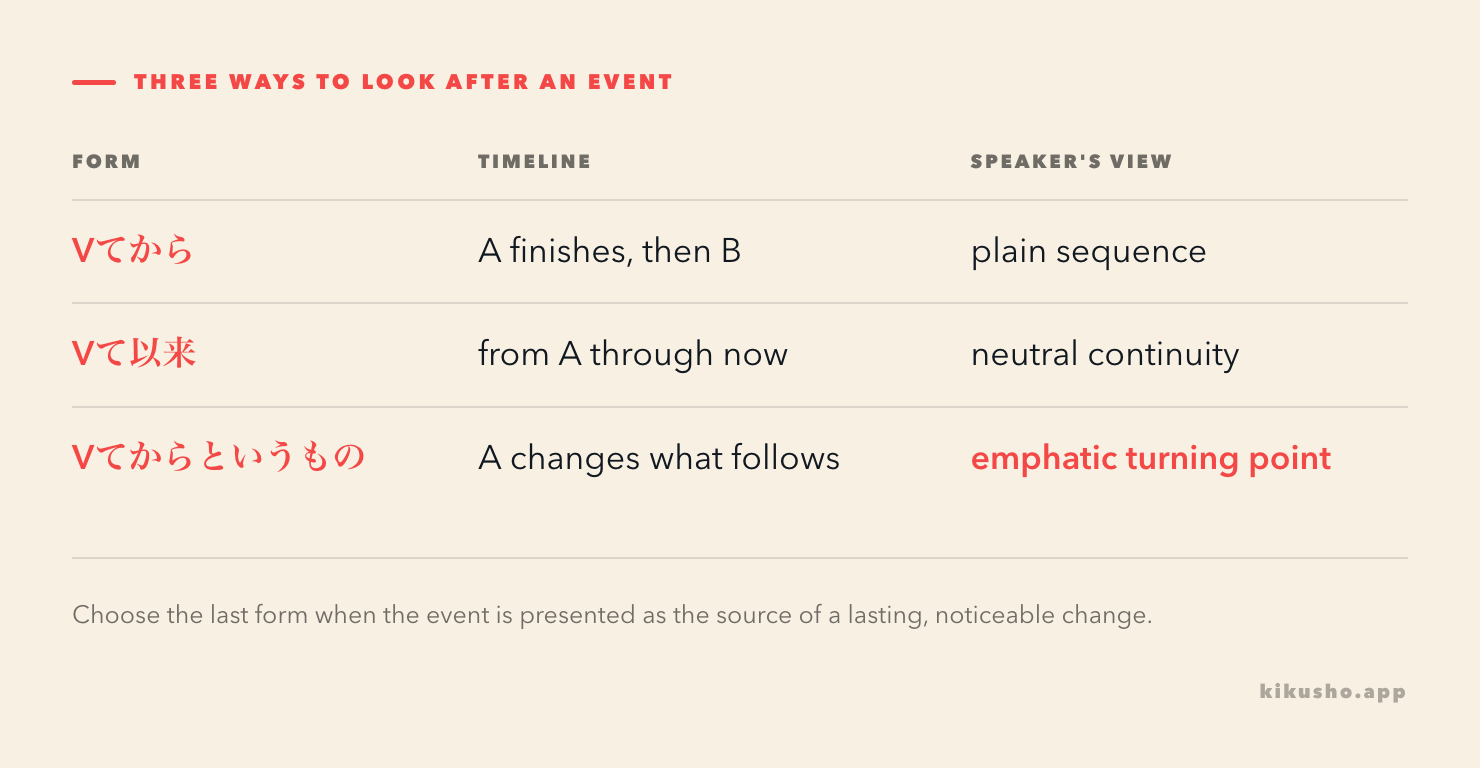
Compare one factual account with one marked account:
新しい制度が始まって以来、申請件数を毎月記録している。
Since the new system began, we have recorded the number of applications each month.
新しい制度が始まってからというもの、問い合わせが一日も途切れない。
Ever since the new system began, inquiries have not stopped for a single day.
The first sentence establishes a record-keeping period. The second presents a noticeable consequence and lets 一日も途切れない carry the speaker's sense of its intensity. The detailed て以来 comparison covers the neutral continuing frame.
This contrast is a tendency, not a mechanical ban. て以来 can appear in emotional writing, and てからというもの can report an undesirable or welcome result. The decisive question is whether the speaker wants to mark the event as a life-changing or situation-changing boundary.
The form can praise, complain or simply marvel
The construction often reveals attitude even without an explicit emotion word.
部長が交代してからというもの、会議が短くなった。
ぶちょうが こうたいしてからというもの、かいぎが みじかくなった。
Ever since the department head changed, meetings have become shorter.
This may be praise, relief or a dry observation; context supplies the evaluation. A negative consequence works just as well:
あの失敗を経験してからというもの、新しい提案を出すのが怖くなった。
あの しっぱいを けいけんしてからというもの、あたらしい ていあんを だすのが こわくなった。
Ever since that failure, I have become afraid to make new proposals.
The expression is common in reflective speech and writing. It is more deliberate than a plain conversational てから, but it is not limited to ceremonial prose. Its weight comes from the speaker's retrospective view of the change.
When you save an example in Kikusho, keep both sides of the boundary on the card. 犬を飼い始めてからというもの alone does not reveal whether life became healthier, busier or more expensive. The full sentence preserves the turning point, the lasting result and the tone you will need to recall the form.
Practice
1. Choose the natural continuation
転職してからというもの、__。
ア. 昨日、新しい名刺を一枚もらった
イ. 朝の時間に余裕ができた
ウ. 来週、同僚と昼食を食べる
2. Choose the form for one completed sequence
書類を確認し__、担当者に送りました。
ア. てから
イ. て以来
ウ. てからというもの
3. Choose the more neutral retrospective form
A report simply states that the laboratory has recorded the temperature every day since installing the device. Which form best avoids presenting the installation as a dramatic turning point?
ア. 設置して以来
イ. 設置してからというもの
ウ. 設置するに先立ち
4. Repair the attachment
Rewrite この町に引っ越したからというもの、車を使わなくなった with the target grammar.
5. Reconstruct the sentence
Arrange every segment to say “Ever since I began working from home, I have cooked lunch myself.”
ア. 昼食を自分で作っている
イ. 在宅勤務を始めてからというもの
ウ. 毎日
6. Read the speaker's stance
新しい監督が来てからというもの、選手たちは練習後も残って話し合っている。
What does てからというもの add beyond simple chronology?
ア. The coach's arrival is presented as a consequential boundary behind a continuing pattern.
イ. The players met only once after the coach arrived.
ウ. The coach has not arrived yet.
7. Follow the change across the passage
以前は人前で話すたびに緊張していた。ところが、地域の劇団に参加し( )、舞台に立つことが楽しみになり、会議でも落ち着いて話せるようになった。
ア. てからというもの
イ. たあとで一度
ウ. てからすぐ一回
Finish all seven questions before opening the review notes.
Answers and explanations
Each note checks both the time span and the speaker's reason for choosing the form.
Answer 1
イ. 朝の時間に余裕ができた. It describes a changed state that holds across the period after the job change. ア is one isolated past event, while ウ is a future plan; neither supplies a lasting consequence.
Answer 2
ア. てから. Checking the documents and sending them are two completed actions in sequence. て以来 and てからというもの would require a state or repeated pattern extending from the check onward.
Answer 3
ア. 設置して以来. The report needs a neutral boundary plus an ongoing daily record. てからというもの would add marked emphasis, and に先立ち would place an action before the installation.
Answer 4
この町に引っ越してからというもの、車を使わなくなった. The construction attaches to the verb's て-form, 引っ越して, not the past form 引っ越した.
Answer 5
イ–ウ–ア: 在宅勤務を始めてからというもの、毎日昼食を自分で作っている. The first segment establishes the turning point; 毎日 makes the repeated habit explicit, and the final segment states what continues.
Answer 6
ア. The coach's arrival is treated as the trigger for a sustained change in the players' behavior. The remaining sentence describes repeated post-practice discussions, not a single meeting or a future arrival.
Answer 7
ア. てからというもの. Joining the theater group becomes the turning point behind two continuing changes: enjoying the stage and speaking calmly in meetings. The other choices reduce the connection to a single later occasion and do not fit the continuing result.
Test the second clause before choosing the form
First locate the event in the Vて clause. Then ask whether the rest of the sentence describes what has remained different across the time since. If it does, decide whether you need a neutral boundary with て以来 or the speaker's marked sense of a turning point with てからというもの. That last choice is where the grammar becomes interpretation rather than translation.
The review for this lesson checked the assigned N1 inventory item, direct て-form attachment, continuing positive and negative results, the need for a meaningful span, and the boundaries with てから and て以来. An AI agent reviewed every original Japanese sentence, translation, distractor and answer mapping; the sources agree on the N1 study placement, and the inventory records no level disagreement.
Common questions
What does てからというもの mean in Japanese?
Vてからというもの presents an event as a turning point and emphasizes the state, habit or repeated pattern that has continued since it. It often corresponds to “ever since,” with more speaker involvement than a neutral date.
How do you form てからというもの?
Put からというもの directly after a verb in the て-form: 引っ越してからというもの. The clause that follows describes the lasting result or recurring pattern.
What is the difference between てからというもの and て以来?
Both look from a past event across a continuing period. て以来 is the more neutral timeline marker; てからというもの presents the event as a striking turning point and often conveys the speaker's feeling about the change.
Can てからというもの describe one action after another?
No. For a simple completed sequence, use てから. てからというもの needs a consequence that remains true, recurs or develops across a meaningful period.