On this page
Imagine a code of conduct beginning 通訳者たるもの、話者の意図を正確に伝えなければならない. The phrase means “anyone acting as an interpreter must convey the speaker's intent accurately”: Nたるもの names a role, then presents the conduct expected of whoever holds it.
This lesson covers inventory item g-9ffd5d2d1dcc, たるもの/たる. 日本語NET verifies N + たるもの, its N1 placement and the frequent judgment endings that follow. J-nihongo and 毎日のんびり日本語教師 independently distinguish Nたるもの from the attributive N1たるN2. All three give the same study placement. Since the JLPT authority supplies no item-by-item official grammar inventory, that agreement supports an N1 teaching label rather than a claim about a guaranteed test item.
たるもの turns a role into a standard of conduct
The form does more than say what someone is. It invokes a shared standard attached to that position and then states what such a person should do, must do or must avoid.
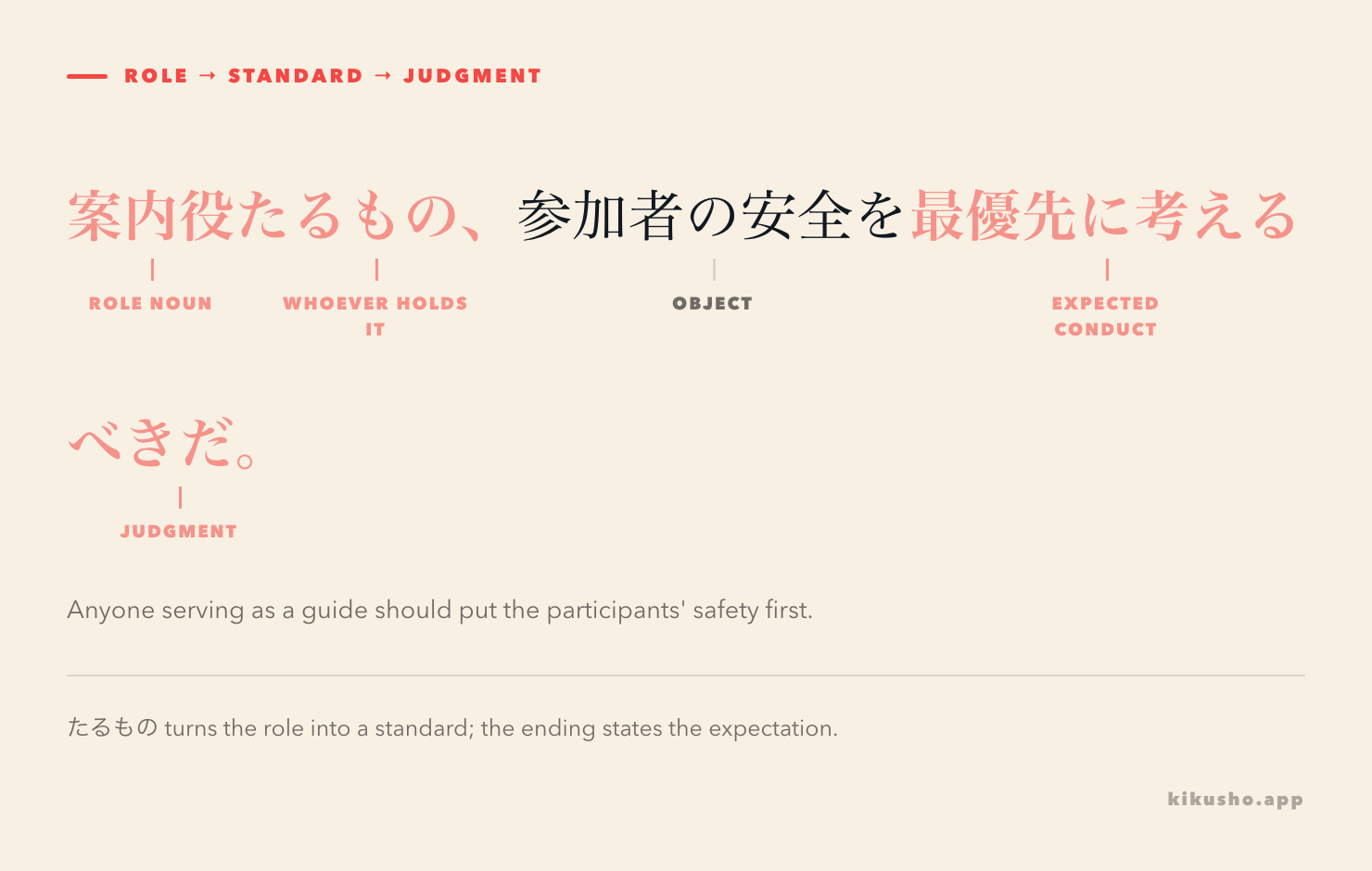
案内役たるもの、参加者の安全を最優先に考えるべきだ。
あんないやくたるもの、さんかしゃの あんぜんを さいゆうせんに かんがえるべきだ。
Anyone serving as a guide should put the participants' safety first.
The speaker is not describing one guide's present behavior. The sentence sets a norm for guides as a class. That is why the second half often contains an evaluative expression:
| Ending after Nたるもの | What it contributes |
|---|---|
| ~べきだ | what the role holder ought to do |
| ~なければならない | a duty or requirement |
| ~てはならない | conduct the role forbids |
| ~が求められる | a quality or action expected by others |
| ~責任がある | an explicit responsibility |
審査員たるもの、個人的な好みだけで評価してはならない。
しんさいんたるもの、こじんてきな このみだけで ひょうかしては ならない。
A judge must not evaluate solely according to personal taste.
管理者たるもの、問題が起きた経緯を説明する責任がある。
かんりしゃたるもの、もんだいが おきた けいいを せつめいする せきにんが ある。
Anyone in charge has a responsibility to explain how the problem arose.
The ending need not contain the word “must,” but the sentence still presents an ideal. 親たるもの、子どもの話を聞く姿勢が必要だ says that a parent needs a willingness to listen. The standard may be asserted by the speaker, quoted from an institution or used theatrically by a character.
Attach たる directly to a noun that can bear a role
The basic join is simple: noun + たるもの. No だ, である or の stands between them.
| Noun | Target form | Natural continuation |
|---|---|---|
| 指導者 | 指導者たるもの | 決定に責任を持つべきだ |
| 研究者 | 研究者たるもの | 資料を慎重に扱わなければならない |
| 代表 | 代表たるもの | 公正さが求められる |
| 専門家 | 専門家たるもの | 根拠を示す責任がある |
もの may be written 者 when it clearly means a person: 指導者たる者. The hiragana spelling is common in grammar explanations because the phrase refers generally to whoever occupies the role rather than one named individual.
The noun normally denotes a position, profession, qualification or social identity that can carry expectations. 医師, 教師, 責任者, 親 and 市民 fit that logic. A random object does not: 机たるもの would require a deliberately personified or comic context because a desk cannot ordinarily accept a duty.
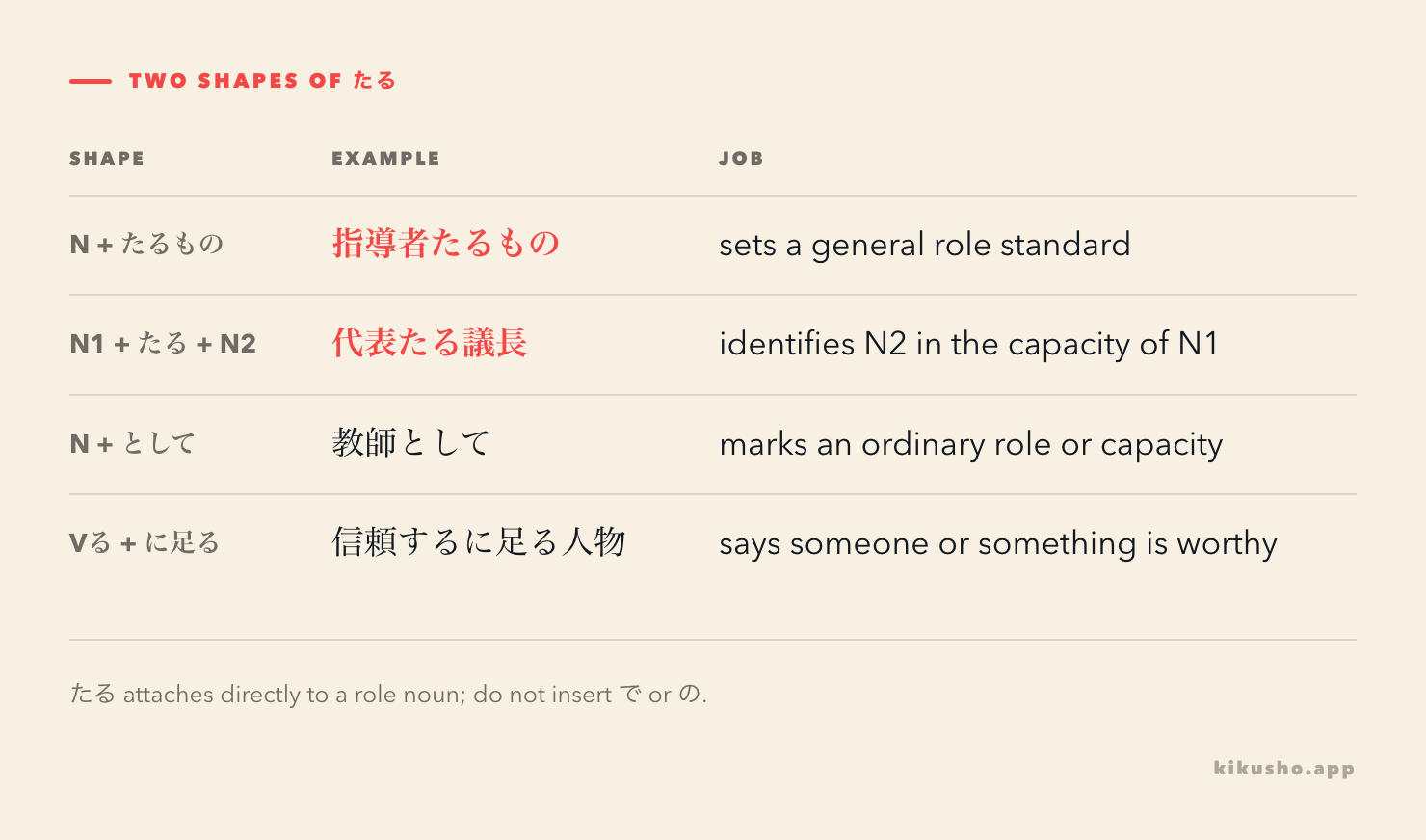
Do not conjugate たる as though it were the modern verb 足る, “to be sufficient.” In this pattern, it is a fixed formal connector after a noun. Negation and tense belong in the clause that follows: 責任者たるもの、事実を隠してはならない.
N1たるN2 identifies someone in a formal capacity
Without もの, N1たるN2 directly modifies a second noun. It means “N2 in the capacity of N1” or “N2 who holds the position N1.”
組織の代表たる議長が、会議の結果を発表した。
そしきの だいひょうたる ぎちょうが、かいぎの けっかを はっぴょうした。
The chair, as the organization's representative, announced the meeting's result.
専門家たる彼女の判断にも、十分な根拠が必要だ。
せんもんかたる かのじょの はんだんにも、じゅうぶんな こんきょが ひつようだ。
Even her judgment as an expert needs adequate grounds.
The second noun can name the particular person, office or quality being discussed. 代表たる議長 identifies the chair through the capacity of representative. 指導者たる資質 means “qualities proper to a leader,” extending the role standard into a noun phrase.
This attributive form can still carry evaluation, but it does not require a following べきだ or なければならない. Its immediate job is grammatical: it connects the role noun to the noun being identified. The wider sentence decides whether the tone is praise, criticism or neutral institutional description.
The register is formal, rhetorical and often prescriptive
たるもの sounds at home in codes, speeches, essays, historical dialogue and solemn declarations. It can lend weight to a principle. It can also sound pompous when the situation does not support that weight.
Compare these two requests:
教師として、学生の質問に答えます。
きょうしとして、がくせいの しつもんに こたえます。
As a teacher, I answer students' questions.
教師たるもの、学生の質問に誠実に答えるべきだ。
きょうしたるもの、がくせいの しつもんに せいじつに こたえるべきだ。
A teacher should answer students' questions sincerely.
The first simply marks the capacity in which the speaker acts. The として lesson covers that ordinary role marker. The second generalizes from the role and declares a standard. It speaks about what a teacher ought to be.
Because the construction claims that a role naturally entails certain conduct, it can smuggle in the speaker's assumptions. 親たるもの, 社会人たるもの or 日本人たるもの may sound moralizing if the standard is debatable. Read the phrase as a stance, not as proof that the stated duty is universally accepted.
In light conversation, speakers sometimes use the ceremonial tone jokingly: 甘党たるもの、デザートは別腹だ treats “being a sweets lover” as if it carried an official duty. The humor depends on knowing how grand the unmarked construction sounds.
Three nearby forms make different claims
Nたるもの sets the rule for a class. Nともあろうものが singles out someone whose behavior violates an expected standard.
責任者たるもの、問題を報告しなければならない。
A person in charge must report problems.
責任者ともあろうものが、問題を隠すとは信じられない。
I cannot believe that someone of all people who is in charge would hide the problem.
The first is a norm. The second is a reproach aimed at a surprising breach. The ともあろうものが comparison develops that reaction alongside ではあるまいし.
Do not merge N + たる with Vる + に足る. 指導者たる人物 means a person in the role of leader. 信頼するに足る人物 means a person worthy of trust. The に足る lesson covers that separate worth or sufficiency pattern.
Fixed descriptive expressions such as 堂々たる態度, “an imposing manner,” and 確固たる信念, “a firm conviction,” also end in たる. They belong to a small lexical class and do not freely create role-and-duty statements. Learn them as established combinations rather than treating any adjective as a candidate for たるもの.
The most revealing mistake is a merely factual ending
A sentence can be grammatically assembled and still miss the construction's purpose. 編集者たるもの、昨日は忙しかった joins a role to an unrelated fact: “editors were busy yesterday” expresses no standard. If you only need to describe what happened to an editor, use an ordinary subject or として.
The role must support the judgment that follows:
編集者たるもの、引用の出典を確認しなければならない。
へんしゅうしゃたるもの、いんようの しゅってんを かくにんしなければ ならない。
An editor must verify the sources of quotations.
When you encounter the form in a speech or novel, save the role together with its judgment. Kikusho can keep the full sentence and a short register note on one editable card; during review, ask whose standard is being asserted. That question preserves the rhetoric that an isolated translation such as “as a...” loses.
Practice
1. Choose the attachment
__、利用者の個人情報を守らなければならない。
ア. 管理者でたるもの イ. 管理者たるもの ウ. 管理者のたるもの
2. Choose the sentence that states a general role standard
ア. 代表ともあろうものが、連絡を忘れるとは驚いた。
イ. 代表たるもの、決定の理由を説明すべきだ。
ウ. 代表として、昨日の会議に出席した。
3. Identify the attributive form
Which sentence uses N1たるN2 to identify a person in a formal capacity?
ア. 専門家たる彼が最終案を確認した。
イ. 専門家たるもの、根拠を示すべきだ。
ウ. 専門家として働いている。
4. Match the form to its function
- 審判たるもの、公平でなければならない。
- 審判ともあろうものが、ルールを知らないとは驚いた。
ア. surprise and criticism at a particular breach
イ. a general standard attached to the role
5. Repair the sentence
Rewrite 案内役でたるもの、安全を確認すべきだ with the correct attachment.
6. Reconstruct the formal noun phrase
Arrange every segment to say “The chair, as the organization's representative, explained the decision.”
ア. 決定を説明した イ. 議長が ウ. 組織の代表たる
7. Choose the form in context
この報告書には未確認の数字が多い。研究者__、都合のいい数字だけを選んではならない。
ア. にとって イ. たるもの ウ. ともあろうものが
Answer all seven before revealing the review notes.
Answers and explanations
- イ. 管理者たるもの. Attach たるもの directly to the role noun. で and の do not intervene.
- イ. 代表たるもの、決定の理由を説明すべきだ. The sentence generalizes from the role and states a duty. Choice ア reacts to one surprising failure; choice ウ reports one person's capacity and attendance.
- ア. 専門家たる彼が最終案を確認した. 専門家 is N1 and 彼 is N2. Choice イ uses the generic standard pattern, while choice ウ uses ordinary として.
- 1–イ; 2–ア. たるもの sets the standard for all referees. ともあろうものが expresses surprise that a particular referee falls below it.
- 案内役たるもの、安全を確認すべきだ. Remove で. The role noun connects straight to たるもの.
- ウ–イ–ア: 組織の代表たる議長が、決定を説明した. 代表たる modifies 議長, identifying the chair through the formal capacity of representative.
- イ. たるもの. The next clause forbids conduct considered incompatible with a researcher's role. にとって would mean “for researchers,” and ともあろうものが would need a particular breach framed with surprise or reproach.
The inspected references consistently place Nたるもの/NたるN at N1, and the Kikusho inventory records no level disagreement. The review checked direct noun attachment, もの/者, the two syntactic shapes, formal register, prescriptive force, humorous marked use and the boundaries with として, ともあろうものが, Vるに足る and lexical 堂々たる expressions.
This lesson was reviewed by an AI agent for the assigned inventory item, every original Japanese example, readings, translations and all seven answer mappings. The answers remain together in one collapsed block after the complete question set.
Common questions
What does たるもの mean in Japanese?
Nたるもの introduces the conduct, responsibility or attitude considered proper for anyone who holds role N. It often corresponds to “anyone who is N should...”
How do you form たるもの?
Attach it directly to a noun naming a role, status or qualification: 指導者たるもの. もの may also be written 者 when it clearly refers to a person.
Is たるもの used in casual conversation?
It is formal, literary and often rhetorical. In ordinary conversation, Nとして or a direct sentence with べきだ usually sounds less ceremonial.
What is the difference between たるもの and ともあろうものが?
たるもの states the general standard attached to a role. ともあろうものが reacts with surprise or criticism when a particular high-status person violates that standard.