On this page
~ようになる describes a change: you come to be able to do something, or an action becomes part of your behaviour. Put a potential verb before it for acquired ability, as in 読めるようになった; an ordinary action verb can describe a new routine, as in 読むようになった.
One extra syllable changes what you are reporting. Reading a book each evening and becoming capable of reading it are separate achievements.
Attach ようになる to the state or action that has changed
This lesson teaches the ability, possibility and behaviour-change uses of ようになる, read ようになる (yō ni naru). It belongs to our N4 grammar sequence. Bunpro and JLPT Sensei label this construction N4; our reference inventory also retains an N3 observation from Tanos. Those placements are estimates, rather than an official complete JLPT syllabus.
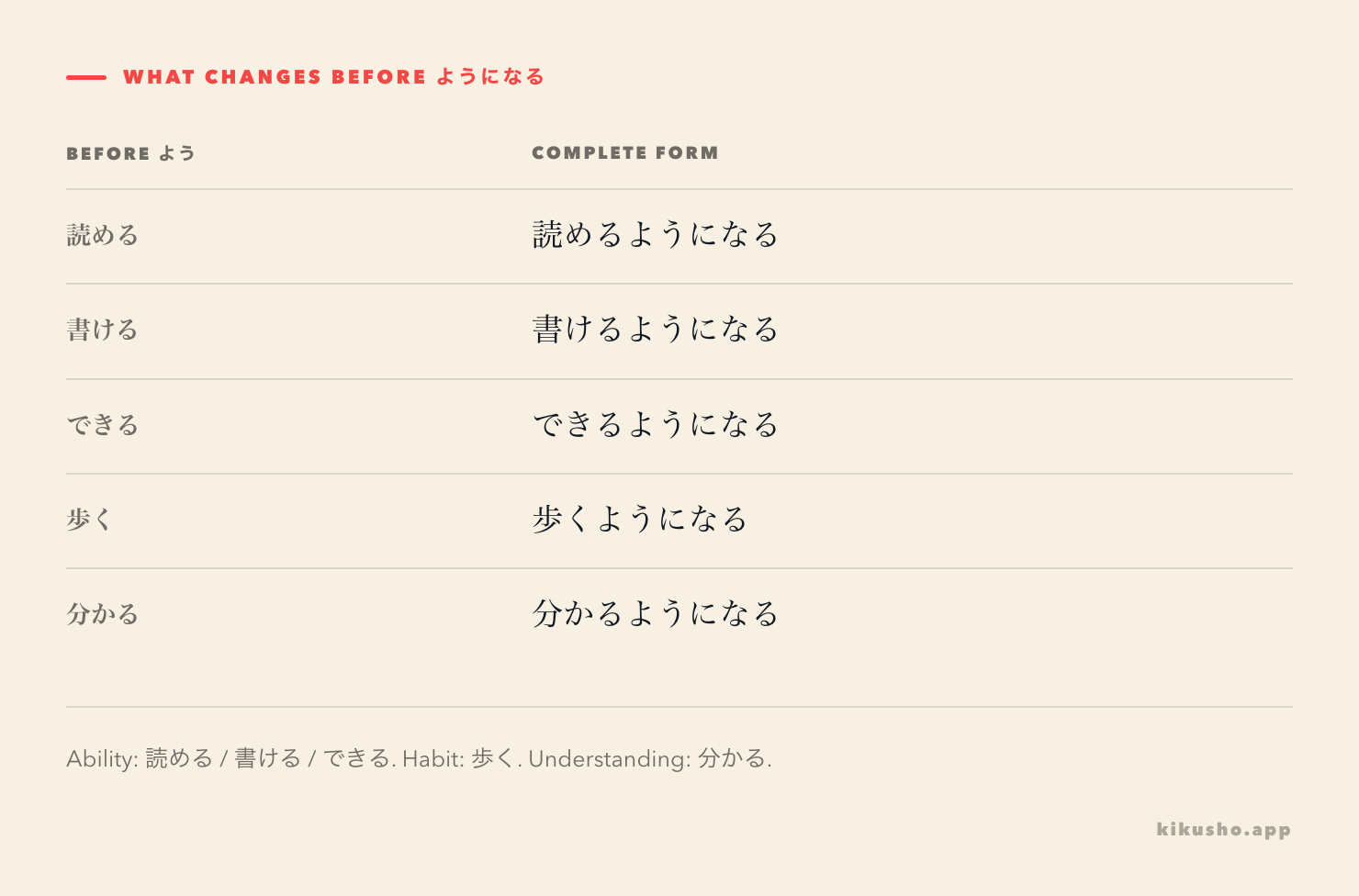
| Before ようになる | Resulting form | What changed |
|---|---|---|
| 読める, can read | 読めるようになる | reading becomes possible |
| 書ける, can write | 書けるようになる | writing becomes possible |
| できる, can do | できるようになる | an action becomes possible |
| 歩く, walk | 歩くようになる | walking becomes a new routine |
| 分かる, understand | 分かるようになる | understanding develops |
Use the plain non-past form immediately before よう: 読める, rather than 読めます or 読めた. The sentence's politeness and the time of the change belong on the final なる.
If the potential forms are unfamiliar, work through how Japanese expresses ability first. 読む becomes 読める, 書く becomes 書ける, and an action expressed with する uses できる for its potential. For example, 料理する, “cook,” gives 料理ができるようになる, “become able to cook.”
Potential verbs report something you can now do
An ability sentence carries an earlier limitation in the background:
練習して、名前を漢字で書けるようになりました。
れんしゅうして、なまえをかんじでかけるようになりました。
Through practice, I became able to write my name in kanji.
書ける names the ability. ようになりました says that the person reached it. The sentence does not promise that every kanji is now manageable: the object 名前 keeps the achievement specific.
Compare the present ability alone:
名前を漢字で書けます。
なまえをかんじでかけます。
I can write my name in kanji.
This reports what is possible now without telling the listener that it used to be impossible. Adding ようになりました supplies that history.
The change need not be a skill acquired through study. 行けるようになった, “became able to go,” can report that circumstances now permit a trip. The grammar identifies a newly possible action; context tells you whether practice, recovery, permission or another change made it possible. Bunpro's comparison explicitly allows internal or external factors in this ability use.
Ordinary action verbs report a changed routine
With a dictionary-form action, the change concerns what someone does:
引っ越してから、駅まで歩くようになりました。
ひっこしてから、えきまであるくようになりました。
Since moving, I have started walking to the station.
The speaker might always have been capable of walking. The new information is that walking to the station has entered their routine.
Keep these readings apart:
| Sentence | Reading | Meaning |
|---|---|---|
| 毎朝、歩くようになった。 | まいあさ、あるくようになった。 | I have started walking every morning. |
| 長い距離も歩けるようになった。 | ながいきょりもあるけるようになった。 | I became able to walk long distances too. |
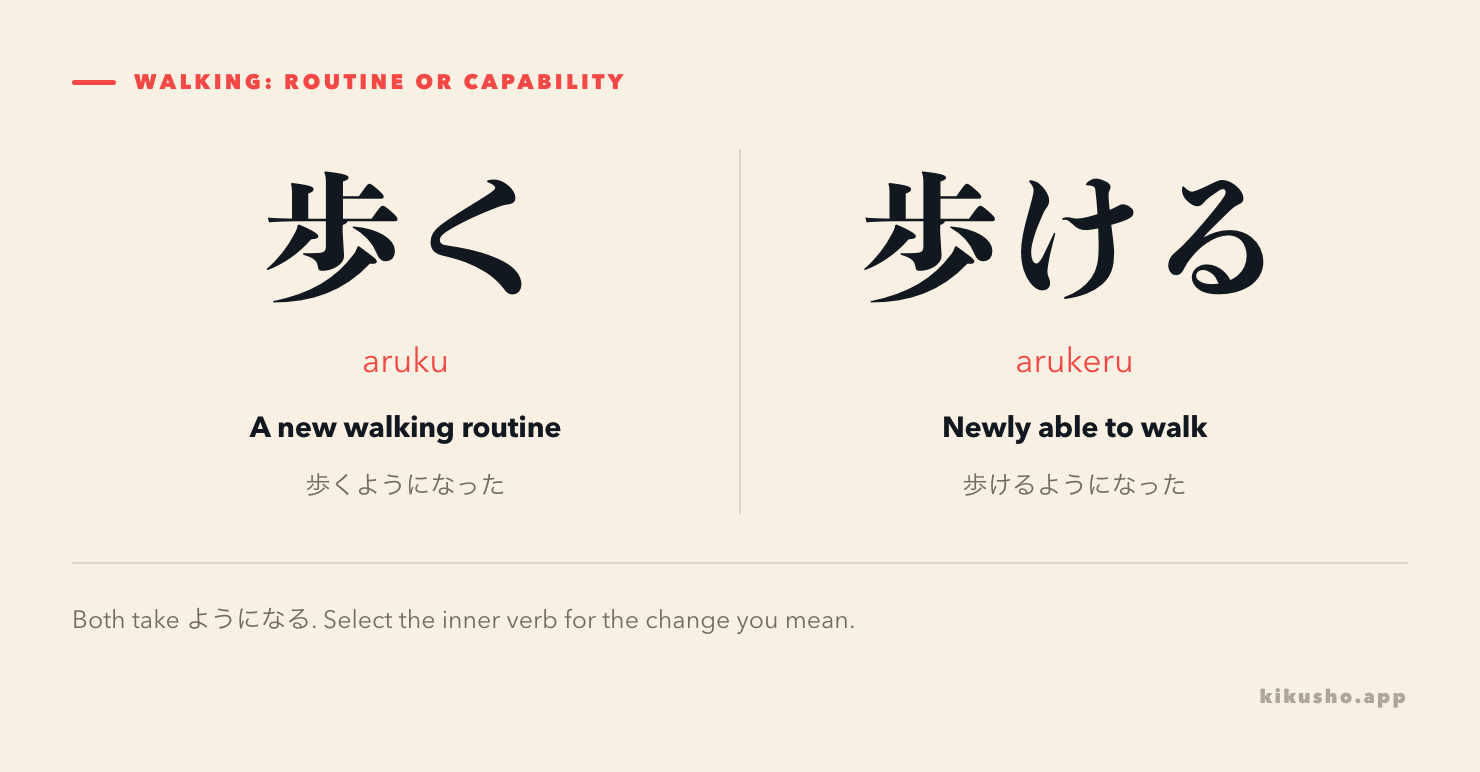
Learn Japanese Adventure separates dictionary-form changes in habitual action from potential-form changes in ability or possibility. Neither form tells you how frequently the action occurs by itself. 毎朝 supplies “every morning”; よく would supply “often.”
A new habit can result from a deliberate choice. Calling ようになる a change construction does not mean that you never intended the change or worked toward it. It reports the resulting behaviour, rather than announcing the decision that preceded it.
Non-volitional understanding does not need a potential ending
Some verbs already name a state outside direct voluntary control. 分かる, read わかる, means “understand.” It can describe newly developed understanding directly:
最近、駅のアナウンスが少し分かるようになりました。
さいきん、えきのアナウンスがすこしわかるようになりました。
Recently, I have come to understand a little of the station announcements.
There is no need to manufacture a potential form of 分かる here. The sentence says that understanding has begun to be available. 少し, “a little,” also prevents a small improvement from sounding like complete comprehension.
JLPT Sensei's lesson includes 分かる alongside potential verbs. The attachment rule therefore needs more than “always use a potential”: choose a verb that names the ability, state or recurring behaviour you actually mean.
Conjugate なる to place the change in time
The inner verb stays non-past even when the change has already occurred.
| Final form | Example | Meaning in an ability sentence |
|---|---|---|
| ようになる | 読めるようになる | will come to be able to read |
| ようになった | 読めるようになった | became able to read |
| ようになります | 読めるようになります | will become able to read, politely |
| ようになりました | 読めるようになりました | became able to read, politely |
| ようになりたい | 読めるようになりたい | want to become able to read |
The non-past form can express a future change; it does not guarantee that the change has already happened. 読めるようになりたいです, “I want to become able to read,” describes a goal still ahead. 読めるようになりました reports attainment.
In a straightforward report of your new ability, writing 読めたようになりました puts past tense in the wrong place. Prepare 読める, add ように, then choose the required ending of なる.
Polite なりました makes the report suitable for a teacher or colleague. Plain なった fits ordinary conversation with someone you address casually. The underlying achievement remains the same.
Losing an ability usually takes なくなる
For “no longer do” or “no longer can,” the usual expression changes ない to なく before なる:
| Earlier negative | Change expression | Meaning |
|---|---|---|
| 歩かない, do not walk | 歩かなくなった | stopped walking as a behaviour |
| 歩けない, cannot walk | 歩けなくなった | became unable to walk |
| 読めない, cannot read | 読めなくなった | became unable to read |
Do not treat ないようになる as categorically impossible. Maggie Sensei records it as a less common way to focus on a developing change. For the uncomplicated result “I can no longer read it,” choose 読めなくなった. This lesson does not ask you to produce subtle ないようになる contrasts.
Negating the final なる says something else. 読めるようになりませんでした means “I did not become able to read.” It denies reaching the new ability; 読めなくなりました reports losing an ability. Mango Languages' explanation of negation distinguishes stopping an action from failing to change.
Use simpler なる when a noun or adjective names the result
The result of a change can be a property or identity:
- 寒くなった, さむくなった: it became cold. An い-adjective changes its final い to く.
- 静かになった, しずかになった: it became quiet. A な-adjective takes に.
- 先生になった, せんせいになった: became a teacher. A noun takes に too.
Those results do not need the verb-plus-ようになる construction. Conversely, 読めるになる cannot replace 読めるようになる. An ordinary verb does not connect to なる as a noun does.
For one completed increase in quantity, 増えた, ふえた, already means “increased.” Adding ようになる merely to translate English “became” creates the wrong model. Verbs that express change can enter more elaborate recurring-event descriptions, but those are outside this basic lesson. The selection depends on what the sentence reports, rather than a ban on a particular verb in every context.
Two neighbouring constructions also deserve separate treatment. The ようにする lesson concerns deliberate effort or making sure; ことにする/ことになる concern a decision or arrangement. Use the decision and arrangement comparison when the news is that a plan has been settled. A settled plan does not establish a newly acquired skill.
The よう inside ようになる is also different from a volitional ending such as 読もう, “let's read.” The volitional form lesson handles that ending. Purpose ように, as in practising so that you can speak, belongs to the purpose comparison.
Practice
Question 1
After practice, you can write your name in kanji for the first time. Select the completed polite report of that acquired ability.
名前を漢字で__。
- A. 書くことにしました
- B. 書けるようになりました
- C. 書けるようになりたいです
- D. 書くようになりました
Question 2
You already knew how to cook. Since moving, cooking each evening has become your routine. Which expression reports that change without presenting it as a newly acquired ability or only a decision?
引っ越してから、毎晩、料理を__。
- A. するようになりたいです
- B. することにしました
- C. しなくなりました
- D. するようになりました
Question 3
Arrange the pieces to describe your new understanding of announcements. After 最近、 start with 駅のアナウンスが.
最近、__ __ __ __。
- ① 少し
- ② なりました
- ③ 駅のアナウンスが
- ④ 分かるように
Question 4
Build a polite sentence about becoming able to cook alone. 一人で must lead the sentence; the three remaining pieces complete the ability report.
__ __ __ __。
- ① できるように
- ② なりました
- ③ 一人で
- ④ 料理が
Question 5
Read this report. The last sentence should report attaining the ability described in the passage.
前は漢字で名前を書けませんでした。毎日、少しずつ練習しました。今は名前を漢字で( )。
- A. 書けるようになりたいです
- B. 書かなくなりました
- C. 書けるようになりました
- D. 書くことになりました
Question 6
Complete the passage with the ordinary expression for losing a previously available reading ability. The intended report is of the loss, rather than failure to acquire a new skill.
前は眼鏡なしで小さい字が読めました。最近、眼鏡なしでは小さい字が( )。
- A. 読めなくなりました
- B. 読めるようになりました
- C. 読めるようになりませんでした
- D. 読むことにしました
Leave your six responses on paper before moving into the explanations.
Answers and explanations
Answer 1
B: 書けるようになりました. Potential 書ける identifies capability, and なりました reports the change as attained. A announces a decision to write. C expresses a wish still to be fulfilled. D reports a new writing behaviour without specifically stating ability acquisition.
Answer 2
D: するようになりました. The full sentence is 引っ越してから、毎晩、料理をするようになりました: “Since moving, I have started cooking every evening.” A wishes to develop that routine, without reporting it as established. B reports choosing to cook; C says the cooking stopped. For a newly acquired cooking ability, the contrasting form would be 料理ができるようになりました.
Answer 3
③ → ① → ④ → ②. 最近、駅のアナウンスが少し分かるようになりました: “Recently, I have come to understand a little of the station announcements.” 分かる names understanding directly. 少し limits how much is understood; なりました closes the polite past report.
Answer 4
③ → ④ → ① → ②. 一人で料理ができるようになりました: “I became able to cook on my own.” 一人で says that you do it alone. 料理する uses できる for capability; 料理ができる names the acquired skill. Keep できる non-past and put the completed-change tense on なりました.
Answer 5
C: 書けるようになりました. The report moves from earlier inability through practice to a skill now attained. A leaves the skill as a wish. B would mean that writing stopped. D reports an arrangement to write and gives no evidence of becoming capable of it.
Answer 6
A: 読めなくなりました. The earlier 読めました explicitly establishes that reading without glasses was possible. Potential 読める gives 読めない, then 読めなく before なる. B reports gaining ability. C denies acquiring it, rather than reporting the loss of the earlier ability. D is a decision to read.
Keep the verb that measures your own change
On a message about progress, the unfamiliar word may be 書ける rather than the longer construction around it. Paste the sentence into Kikusho and check that the card preserves the reading かける and the capability sense before saving it. The surrounding 名前を漢字で gives you a concrete measure to recognise at the next review: one name, written in the script you could not use before.
Common questions
What does ようになる mean?
ようになる reports a change into a new state of ability, possibility or behaviour. 読めるようになった means became able to read; 読むようになった means started reading as a changed routine.
Can ようになる follow an ordinary dictionary-form verb?
Yes. A verb such as 歩く can describe a new habit in 歩くようになった. Non-volitional 分かる can describe newly acquired understanding. Use a potential form such as 読める when the intended change is ability.
How do you say no longer able to do something?
The usual construction changes the negative ending ない to なく before なる: 読めなくなった means became unable to read. ないようになる is also attested, especially for a developing change, but is less common and context-sensitive.
Is ようになる N4 grammar?
JLPT Sensei and Bunpro place the ability and behaviour-change construction at N4. Other editorial lists place it later. The JLPT supplies no exhaustive official grammar syllabus, so these levels are study estimates.