On this page
Put から after a verb's て-form when the first action must finish before the next one begins: 手を洗ってから、食べます means “I eat after washing my hands.” The same shape can make an earlier event the starting point for a later state, as in “since coming to Japan.”
Complete the first action, then cross the boundary
The basic design is AてからB. A happens first, reaches its endpoint, and B belongs on the other side of that endpoint.
| Pattern | Order | Example | Meaning |
|---|---|---|---|
| Vて + から、B | A finishes → B | 手を洗ってから、食べます | I eat after washing my hands |
| Vて + から、continuing state | A starts a period → state continues | 日本に来てから、毎日勉強しています | I have studied every day since coming to Japan |
The first relationship is easy to see in an instruction:
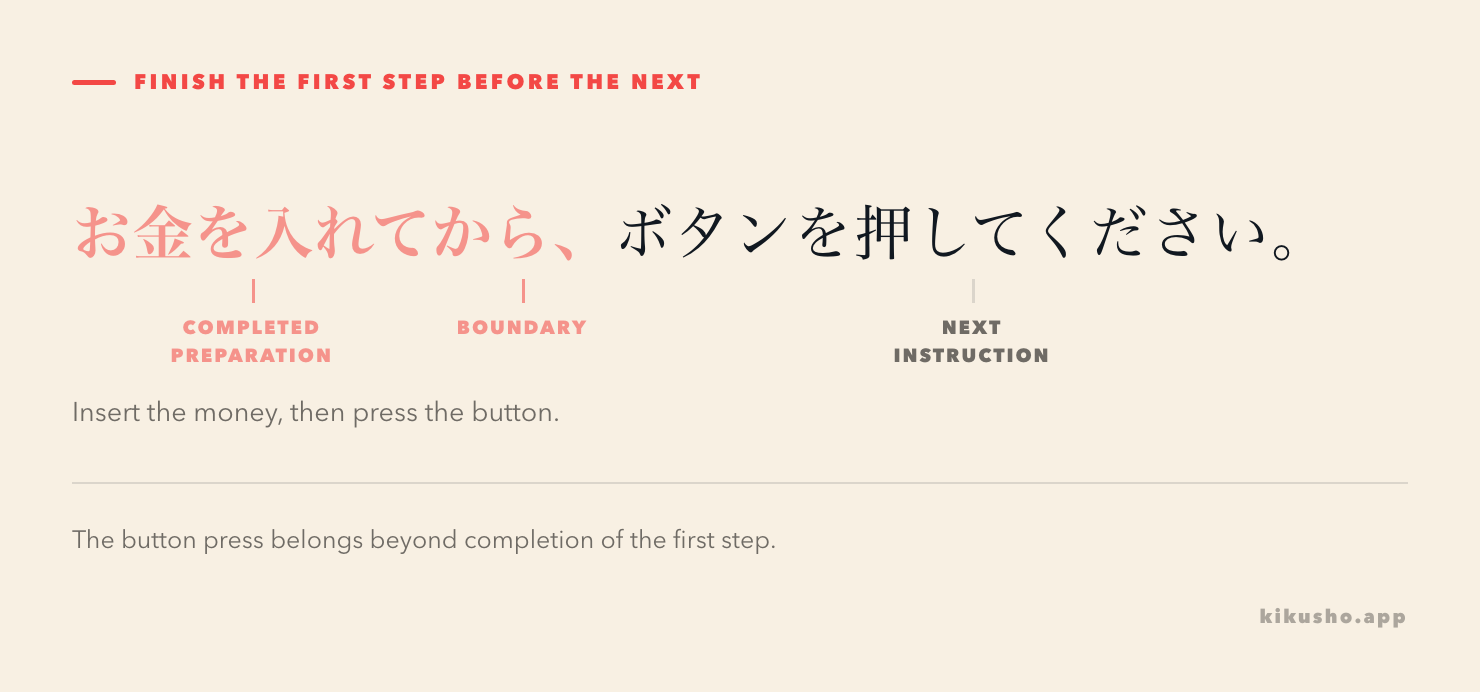
お金を入れてから、ボタンを押してください。
おかねを いれてから、ボタンを おしてください。
Please insert the money, then press the button.
Pressing the button belongs after the money has gone in. This is more than two verbs mentioned in chronological order: the first step prepares the second.
Attach から to the complete て-form
Build the first verb's ordinary て-form, including a voiced で ending where required, and then add から without a space.
| Dictionary form | て-form | With から |
|---|---|---|
| 食べる(たべる), eat | 食べて | 食べてから |
| 読む(よむ), read | 読んで | 読んでから |
| 書く(かく), write | 書いて | 書いてから |
| 話す(はなす), speak | 話して | 話してから |
| 行く(いく), go | 行って | 行ってから |
| する, do | して | してから |
| 来る(くる), come | 来て(きて) | 来てから(きてから) |
If those changes are not automatic yet, use the full て-form formation guide. 読む becomes 読んでから, not 読みてから; 行く keeps its exceptional 行ってから, not 行いてから.
Only a verb in its て-form can fill the A slot in this construction. Nouns and adjectives cannot be placed there unchanged. Use 九時から for “from nine” because 九時 is a time noun. Use 日本に来てから for “after/since coming to Japan” because the starting point is an event.
から makes the completion boundary explicit
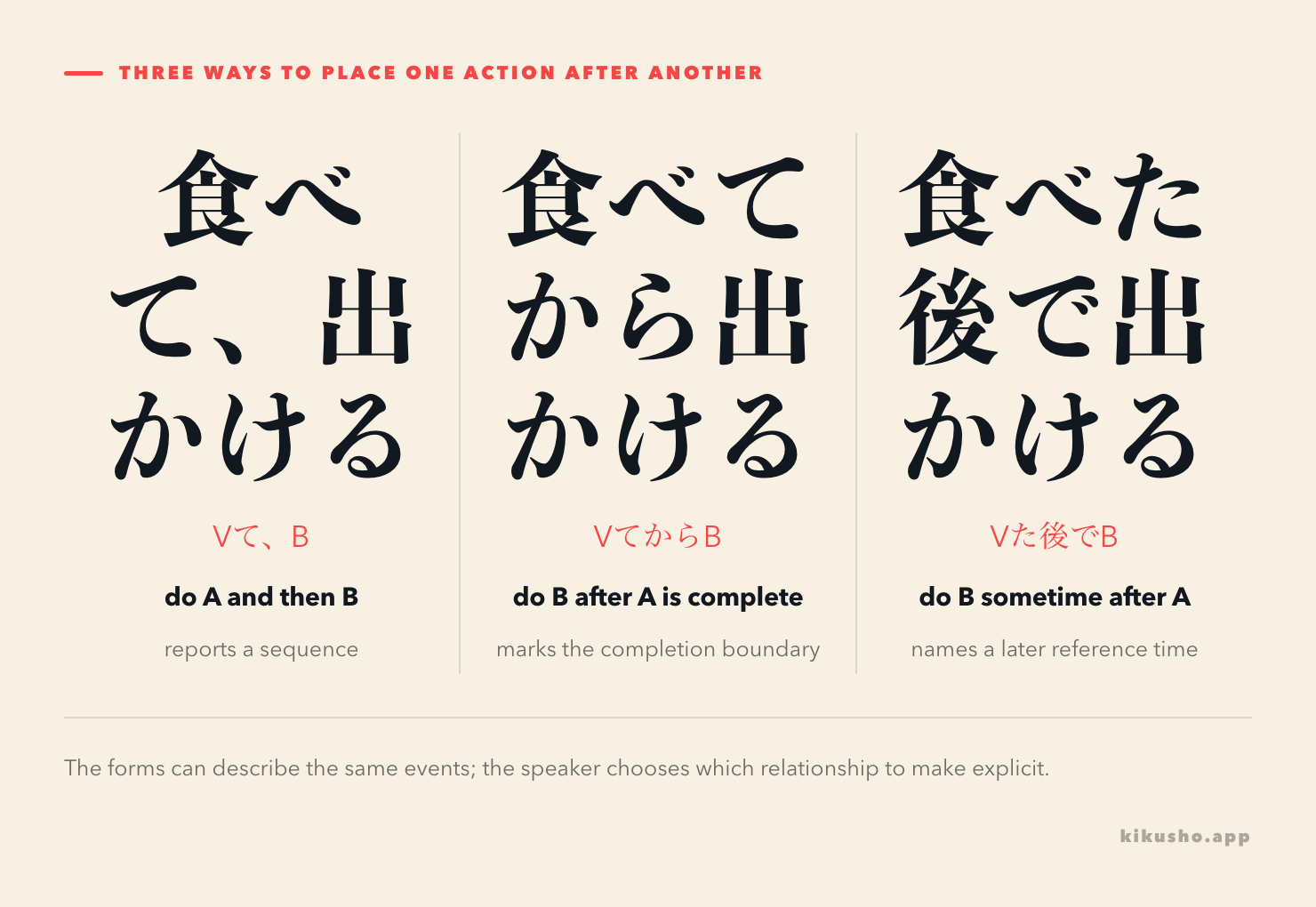
A bare て-form can also connect actions in order:
朝ごはんを食べて、学校へ行きました。
I ate breakfast and went to school.
Add から and the first action becomes the stated boundary for the second:
朝ごはんを食べてから、学校へ行きました。
I went to school after eating breakfast.
The two sentences may describe the same morning. The second explicitly asks you to understand the school trip as beginning only after breakfast was complete. That emphasis makes ~てから useful for procedures, permissions and promises:
宿題をしてから、ゲームをしてもいいです。
You may play games after doing your homework.
It does not mean “immediately.” You can add an interval when the context allows one. The point is the ordering boundary, not the number of minutes between the events.
~た後で names a later time more freely
Both ~てから and ~た後で can translate as “after doing,” and many everyday sentences allow either one:
ご飯を食べてから、散歩しました。
ご飯を食べた後で、散歩しました。
After eating, I took a walk.
The attachments differ. ~てから uses the て-form; ~た後で uses the plain た-form. The viewpoint differs too. ~てから presents completion of the meal as the point from which the next action proceeds. ~た後で locates the walk in the period after the meal and can sound less like the meal was a required first step.
Do not force a sharp distinction into every example. A Japanese teaching guide from 日本語NET notes that the two are often interchangeable while ~てから is especially natural when the first event must occur before the second. The dedicated 前に and 後で lesson covers the た-form and noun attachments in detail.
A following state turns “after” into “since”
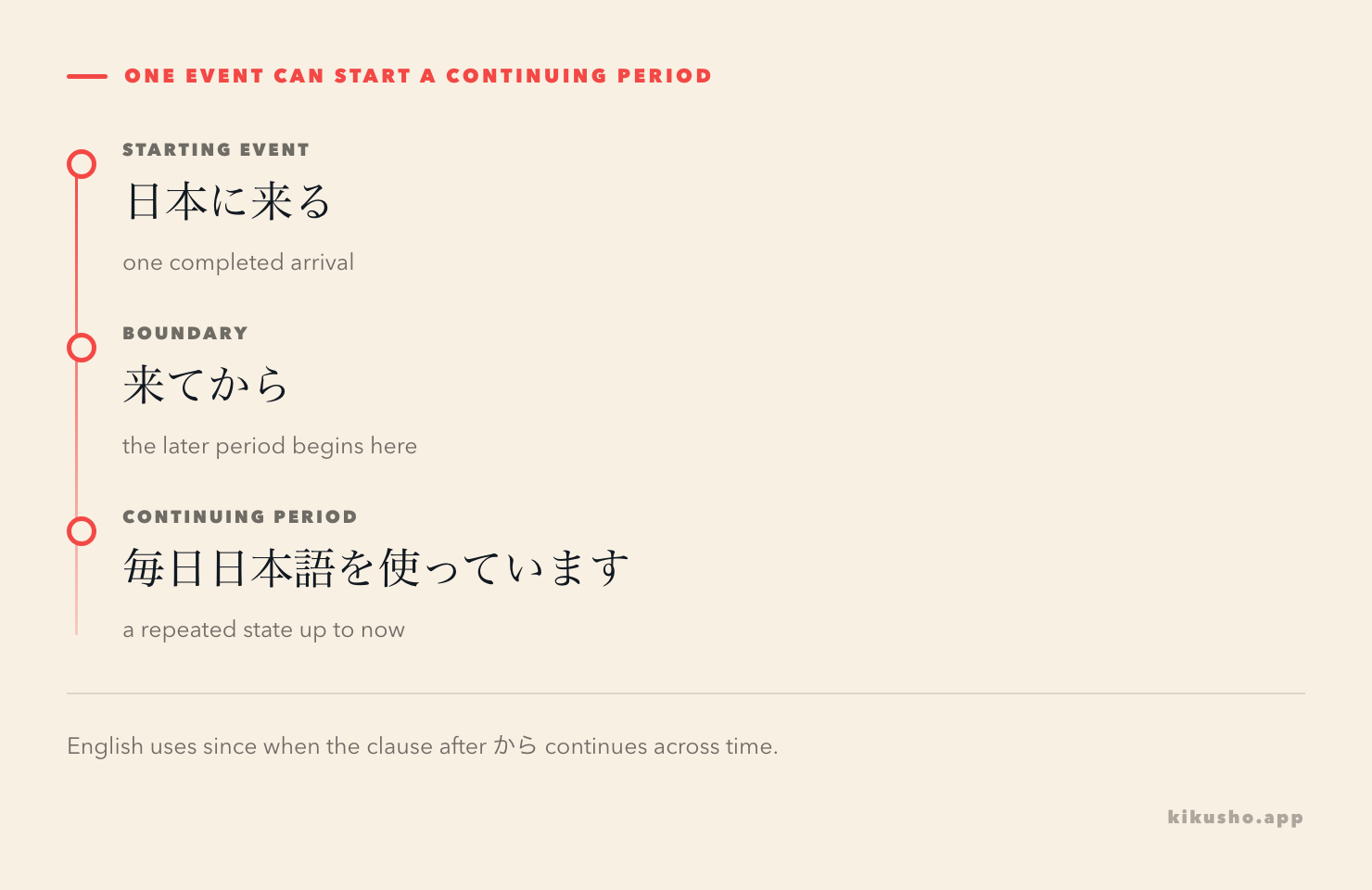
The endpoint of A can also be the beginning of a period. Look at what follows から:
日本に来てから、毎日日本語を使っています。
にほんに きてから、まいにち にほんごを つかっています。
I have used Japanese every day since coming to Japan.
The arrival happened once. 毎日 and 使っています describe the period that began then and continues to the present. A duration expression can measure the same span:
彼がたばこをやめてから、二か月たちました。
かれが たばこを やめてから、にかげつ たちました。
Two months have passed since he quit smoking.
This is still the starting-point logic of から. English happens to prefer “since” because the following clause describes a duration or an ongoing situation. The JLPT Sensei entry shows both one-action-after-another examples and this continuing-time reading.
The two clauses do not need the same actor
Often one person performs both actions because routines and instructions work that way. The grammar itself does not impose that rule:
雨がやんでから、私は散歩に行きました。
あめが やんでから、わたしは さんぽに いきました。
After the rain stopped, I went for a walk.
Rain is the subject of やむ; 私 is the subject of 行く. Completion and order still hold. This differs from the basic two-action use of ~ながら, which normally keeps one actor performing overlapping actions.
The final predicate carries the sentence's tense and politeness. 手を洗ってから食べます is polite nonpast; 手を洗ってから食べました is polite past. 洗ってから stays unchanged in both. In a command such as 座ってから話してください, the final ください supplies the request.
The construction is standard in conversation and writing. It is also different from causal から. 疲れたから寝ます means “I will sleep because I am tired”; シャワーを浴びてから寝ます means “I will sleep after taking a shower.” The form before から and the relationship between the clauses tell you which one you have.
The Japan Foundation's Irodori worksheet practises turning それから sequences into ~てから sentences. Tofugu's account of から independently explains the form as a starting boundary and contrasts it with a bare て-form. JLPT Sensei, Bunpro and Tanos all place the assigned construction at N5, with no recorded disagreement. The JLPT itself does not publish an exhaustive grammar list, so N5 is a reference-list placement rather than an official syllabus guarantee.
When you save a procedure in Kikusho, keep both steps on the editable card. A card that contains only てから = after loses the condition that makes the phrase useful. The whole line お金を入れてからボタンを押す gives the review a visible order and lets the generated audio preserve the clause boundary.
Try all seven before reading the explanations
Question 1
Choose the correct attachment for “After reading the book, I wrote a memo.”
本を( )、メモを書きました。
- ア. 読むから
- イ. 読んでから
- ウ. 読みから
- エ. 読んだから
Question 2
Which sentence most clearly says that inserting the card must happen before pressing the button?
- ア. カードを入れて、ボタンを押してください。
- イ. カードを入れてから、ボタンを押してください。
- ウ. カードを入れながら、ボタンを押してください。
- エ. カードを入れたから、ボタンを押してください。
Question 3
Which sentence means “I will sleep because I am tired,” rather than “after becoming tired”?
- ア. 疲れてから寝ます。
- イ. 疲れたから寝ます。
- ウ. 疲れながら寝ます。
- エ. 疲れた後でから寝ます。
Question 4
Write “After taking a shower, I will study” with シャワーを浴びる, ~てから, and polite 勉強します. Put the time clause first.
Question 5
Read the account:
去年日本に来ました。それから、毎日日本語を使っています。
I came to Japan last year. Since then, I have used Japanese every day.
Join the two sentences with ~てから. Which English time word best fits the resulting sentence: after for one later event, or since for a continuing period?
Question 6
Read 雨がやんでから、子どもたちは外で遊びました。 Does ~てから require the rain and the children to be the same subject? Explain the order.
Question 7
A message says:
会議が終わってから、三十分休みました。
かいぎが おわってから、さんじゅっぷん やすみました。
Which claim is supported?
- ア. The break began before the meeting ended.
- イ. The sentence says the break began immediately, with no possible delay.
- ウ. The meeting ended before the thirty-minute break.
- エ. The meeting and break overlapped for thirty minutes.
Answers and explanations
Answer 1
イ. 読んでから. Begin from 読む. Its final む puts it in the group that changes to んで, then から follows that complete form. 読んだから contains plain-past 読んだ plus causal から and would mean “because [someone] read,” not the intended sequence.
Answer 2
イ. カードを入れてから、ボタンを押してください. ~てから explicitly puts the button press beyond completion of the first step. A can report the same order but leaves the boundary less emphatic. C describes overlapping actions with ~ながら, and D gives reading the card insertion as a reason.
Answer 3
イ. 疲れたから寝ます. Plain past 疲れた plus causal から gives the reason for sleeping. A uses the て-form and starting-point から, so it presents sleeping as later than becoming tired. C uses simultaneous ~ながら, and D combines incompatible attachments.
Answer 4
One answer is シャワーを浴びてから、勉強します。 浴びる is a る-verb, so it becomes 浴びて; から follows directly. The final 勉強します makes the complete sentence polite and nonpast.
Answer 5
去年日本に来てから、毎日日本語を使っています。 English since fits because the arrival starts a period described by 毎日 and the continuing 使っています. The Japanese form itself has not changed; the following clause creates the continuing-time reading.
Answer 6
No. 雨がやむ has rain as its subject, and 子どもたちが遊ぶ has the children as its subject. The rain stops first; the children play outside afterward. ~てから orders the clauses without requiring one actor.
Answer 7
ウ. The meeting ended before the thirty-minute break. ~てから guarantees the order and makes the meeting's completion the boundary. It does not by itself say that the break started in the very next second. A and エ reverse or overlap the events, while イ adds an immediacy claim the sentence does not contain.
Common questions
What does ~てから mean in Japanese?
Put から after a verb's て-form to make the completed first action the starting point for what follows. 手を洗ってから食べます means “I eat after washing my hands” or “I wash my hands, then eat.”
What is the difference between Vて and Vてから?
Both can connect actions in order. Vてから explicitly places the next action after completion of the first and often presents that first action as a necessary step. A bare Vて sequence reports the actions with less emphasis on that boundary and can have other relationships in context.
What is the difference between ~てから and ~た後で?
Both can mean “after doing.” ~てから highlights completion of the first action before the next step; ~た後で locates something later than a completed event and can leave the interval looser. They often overlap.
Can ~てから mean “since”?
Yes. When the following clause describes a continuing state, repeated habit or elapsed duration, the first event becomes a starting point: 日本に来てから毎日日本語を使っています means “I have used Japanese every day since coming to Japan.”