On this page
に先立ち places an advance action before an important event, usually as preparation. て以来 looks in the other direction: a past event becomes the starting point for a state or pattern that has continued since then.
One move makes the timeline visible:
引っ越しに先立ち、不要な家具を処分した。
ひっこしに さきだち、ふような かぐを しょぶんした。
Before moving, I disposed of furniture I did not need.
引っ越して以来、毎朝この公園を歩いている。
ひっこして いらい、まいあさ この こうえんを あるいている。
Since moving, I have walked in this park every morning.
The disposal happens before the move and helps prepare for it. The walks begin after the move and continue across the period up to now.
Ask which side of the reference event matters
Both expressions organize two times around one important event, but they point away from it in opposite directions.
| Timeline question | Choose | Shape |
|---|---|---|
| What was done in advance of event E? | Eに先立ち/Eに先立って | advance action → E |
| What has continued from event E onward? | Vて以来/N以来 | E → continuing state or pattern |
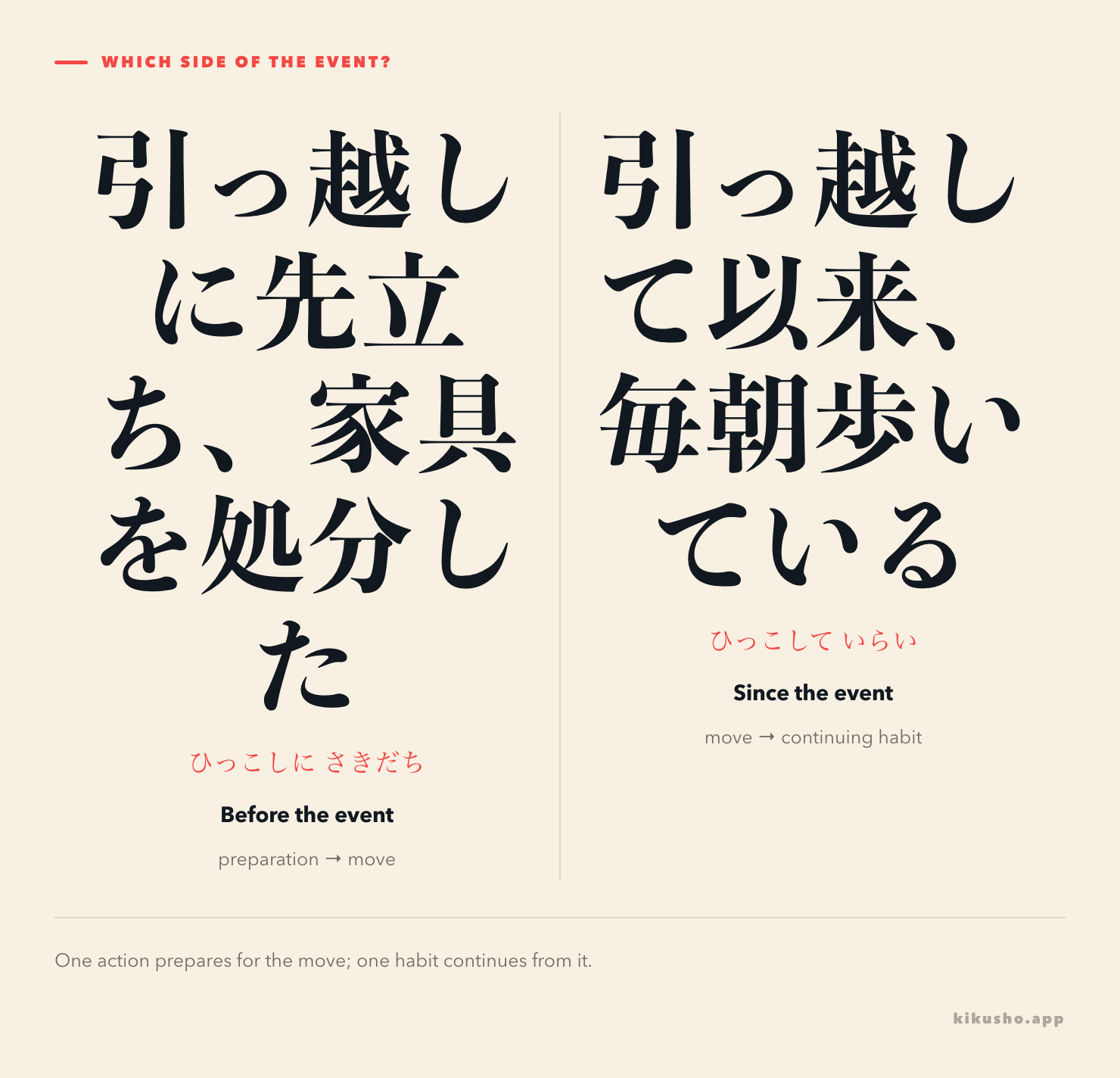
This is more than choosing the English word “before” or “since.” に先立ち foregrounds ordered preparation for a significant event. て以来 requires a meaningful stretch of time after a starting point.
に先立ち marks a formal advance action
に先立ち(にさきだち, ni sakidachi) and に先立って(にさきだって, ni sakidatte) follow a noun or a dictionary-form verb. Both mean “prior to,” with a formal tone and a clear sequence.
会議に先立って、資料を配布した。
かいぎに さきだって、しりょうを はいふした。
Before the meeting, we distributed the materials.
新しい制度を導入するに先立ち、職員への研修を行った。
あたらしい せいどを どうにゅうするに さきだち、しょくいんへの けんしゅうを おこなった。
Before introducing the new system, we trained the staff.
The later event is usually important enough to call for an announcement, check, survey, ceremony or other preparation. For ordinary sequences such as brushing your teeth before sleeping, 前に is the natural choice.
Bunpro's に先立ち entry records noun and dictionary-form verb attachment and the formal “prior to” relationship. 日本語NET independently describes the following action as preparation performed before the named event. Both place the form at N2.
Before a noun, use に先立つ:
開会に先立つ説明
かいかいに さきだつ せつめい
an explanation preceding the opening
The polite ceremonial form に先立ちまして is common in announcements: 開演に先立ちまして、お願いがございます, “Before the performance begins, we have a request.”
て以来 starts a period that still matters
て以来(ていらい, te irai) follows a verb in the て-form. A noun can take 以来 directly. The first event establishes a past boundary, and the following clause describes what has remained true or recurred since that point.
日本に来て以来、毎日日記を書いている。
にほんに きて いらい、まいにち にっきを かいている。
Since coming to Japan, I have written a diary every day.
卒業以来、彼とは一度も会っていない。
そつぎょう いらい、かれとは いちども あっていない。
I have not met him even once since graduation.
The continuation can be affirmative or negative. 書いている describes a repeated habit; 会っていない describes an unbroken absence.
JLPT Sensei's て以来 lesson gives Vて + 以来 and an N2 placement. 日本語NET independently stresses continuation from a past point and excludes a single isolated later action. These are study labels, since the JLPT does not publish an exhaustive official grammar syllabus.
The boundary must already have occurred. 来年卒業して以来 cannot normally mean “from next year's graduation onward.” Use 卒業してから or 卒業後 for a future plan.
One expression needs preparation, the other continuation
The surface forms also attach differently:
| Starting expression | に先立ち | て以来 |
|---|---|---|
| noun | 開会に先立ち | 開会以来 |
| verb | 開会するに先立ち | 開会して以来 |
| following clause | one advance action | a continuing state, habit or repeated event |
| register | formal, planned sequence | neutral to formal retrospective account |
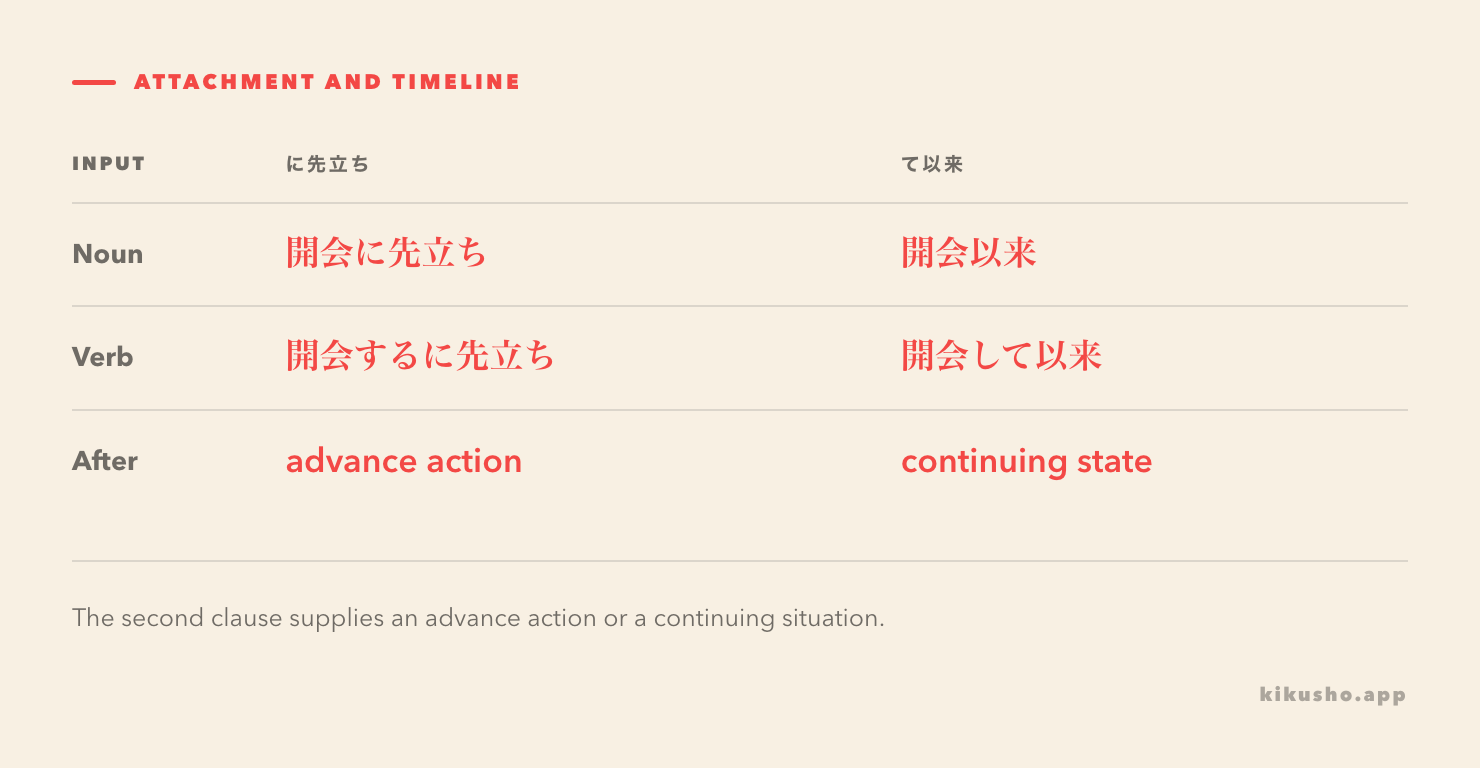
The pair cannot be swapped while preserving meaning:
- 開会に先立ち、避難経路を確認した。 The check occurred before the opening.
- 開会して以来、毎週イベントを行っている。 The weekly events began after the opening and have continued.
For one ordinary action followed by another, use てから: 夕食を食べてから、風呂に入った. 夕食を食べて以来、風呂に入った is wrong for one bath later that evening because no continuing period is described.
The existing lesson on にあたって and に際して explains the nearby “on the occasion of” frame. に先立ち is narrower in time: its action stands before the reference event rather than at or around it.
When saving a sentence in Kikusho, preserve the full time span. A card ending at 日本に来て以来 hides what continued. Keeping 日本に来て以来、毎日日記を書いている makes the starting point, recurrence and present relevance reviewable together.
Practice: place each clause on the timeline
Question 1 · advance preparation
Complete: 新店舗の開店( )、近隣住民への説明会を開いた。
- A. て以来
- B. に先立ち
- C. 以来に
- D. て先立ち
Question 2 · continuing habit
Complete: この町に引っ越して( )、自転車で通勤している。
- A. に先立ち
- B. 前に
- C. 以来
- D. に際し
Question 3 · verb attachment
Which sentence correctly means “Before launching the service, the company conducted a trial”?
- A. サービスを開始して以来、会社は試験を行った。
- B. サービスを開始するに先立って、会社は試験を行った。
- C. サービスを開始した以来、会社は試験を行った。
- D. サービスを開始する以来、会社は試験を行った。
Question 4 · noun attachment
Complete: 卒業( )、一度も母校を訪れていない。
- A. に先立つ
- B. して先立ち
- C. 以来
- D. て以来に
Question 5 · modifier form
Which phrase means “the briefing before the opening ceremony”?
- A. 開会式に先立つ説明
- B. 開会式て以来の説明
- C. 開会式に先立って説明するの
- D. 開会式以来に先立ち説明
Question 6 · one later event
Which sentence naturally describes two ordinary actions on one evening?
- A. 夕食を食べて以来、風呂に入った。
- B. 夕食に先立ち、毎日風呂に入っている。
- C. 夕食を食べてから、風呂に入った。
- D. 夕食以来、風呂に一度入った。
Answers and explanations
Answer 1
B. に先立ち. The residents' meeting is an advance step before the significant opening event. 開店 is a noun and attaches directly. The other options do not form the required before-event relationship.
Answer 2
C. 以来. 引っ越して supplies the て-form, and the bicycle commute is a habit continuing from that move onward. に先立ち would place the commute before the move.
Answer 3
B. サービスを開始するに先立って、会社は試験を行った. A dictionary-form verb can precede に先立って, and the trial prepares for the later launch. て以来 would require continuation after launch; C and D use the wrong form before 以来.
Answer 4
C. 以来. A noun can take 以来 directly, and 一度も訪れていない describes an unbroken negative state since graduation. に先立つ would need a following noun and would point before graduation.
Answer 5
A. 開会式に先立つ説明. に先立つ is the noun-modifying form, so it directly describes 説明. The other choices do not form a grammatical modifier with the requested meaning.
Answer 6
C. 夕食を食べてから、風呂に入った. This is a simple completed sequence: dinner, then a bath. て以来 asks for a state or pattern extending through a period, while B invents a formal preparatory relation and a habitual second clause.
Make the duration visible before choosing 以来
If the second clause can answer “what has kept happening or remained true?”, 以来 has a period to cover. If it names one action completed before a ceremony, launch or major change, に先立ち orders that preparation. For a plain pair of everyday actions, neither formal frame is needed.
Common questions
What is the difference between に先立ち and て以来?
に先立ち places an advance action before an important event, often as preparation. て以来 sets a past event as the starting point of a state or repeated pattern that has continued since then.
What comes before に先立ち?
A noun or a dictionary-form verb can precede に先立ち or に先立って. Before a noun, use に先立つ, as in 開会に先立つ説明.
Can て以来 describe one later action?
Usually no. て以来 looks across the period from the past starting point onward, so the following clause normally describes a continuing state, habit or repeated situation rather than one isolated action.