On this page
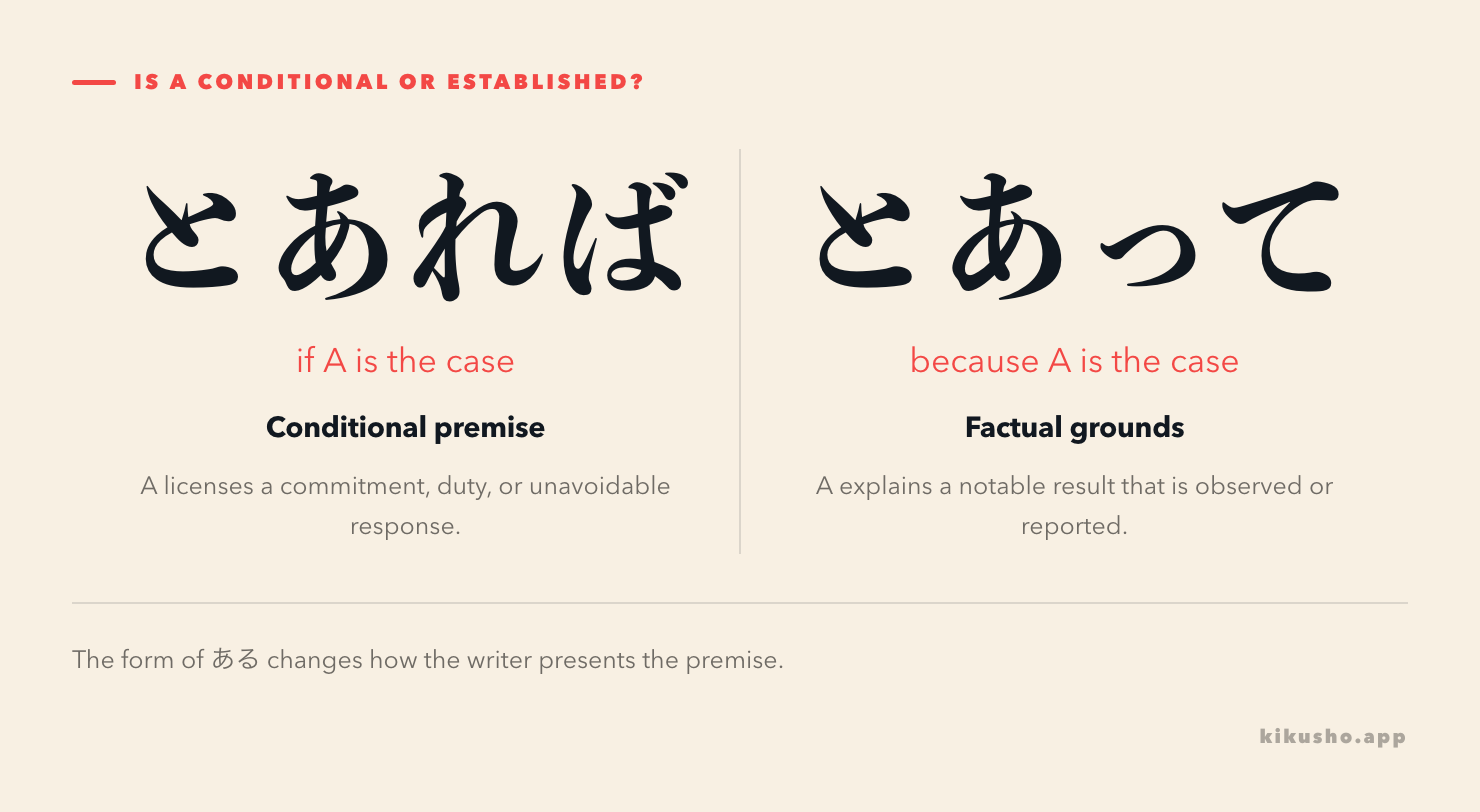
Use ~とあれば when a special circumstance is still being considered as a condition: “if that is really the case, then this response follows.” Use ~とあって when the circumstance is treated as a fact and explains a notable result.
必要とあれば、計画を最初から見直します。
ひつようと あれば、けいかくを さいしょから みなおします。
If necessary, we will review the plan from the beginning.
緊急の見直しとあって、会議には全員が出席した。
きんきゅうの みなおしと あって、かいぎには ぜんいんが しゅっせきした。
Because it was an emergency review, everyone attended the meeting.
The first speaker has not asserted that a review is necessary; they promise what they will do if it is. The second speaker presents the emergency review as real and uses it to explain the attendance.
This lesson covers inventory item g-b3f86d54e885, とあれば, and g-88c70935e675, とあって.
Ask whether A is conditional or established
| Form | Status of A | Typical B | Core reading |
|---|---|---|---|
| Aとあれば、B | A is a special condition under consideration | a decision, willingness, duty or unavoidable response | if A is the case |
| Aとあって、B | A is presented as an actual special circumstance | an observable or understandable result | because A is the case |
The single syllable difference comes from ある. あれば is hypothetical; あって links an existing circumstance onward. Yet these are more marked than ordinary なら and ので. A usually deserves special attention, and B shows why it matters.
とあれば licenses a serious response
The most common pattern is noun + とあれば:
| Condition | Natural continuation |
|---|---|
| 必要とあれば | 追加の調査も行います |
| 家族のためとあれば | どんな苦労も惜しまない |
| 社長の指示とあれば | 従わざるを得ない |
利用者の安全のためとあれば、サービスの一時停止もやむを得ない。
りようしゃの あんぜんの ためと あれば、サービスの いちじていしも やむを えない。
If it is for users' safety, even a temporary suspension of the service is unavoidable.
Bunpro's とあれば entry describes it as an emphatic formal counterpart of なら and notes that the following clause often contains something that must be done or cannot be avoided. PassJapanese's supervised explanation likewise emphasizes a special circumstance or purpose and the speaker's resolve.
The pattern is not a decorative replacement for every conditional. 雨が降るとあれば、傘を持つ sounds oversized for the routine prediction “if it rains, I will take an umbrella.” Ordinary 雨が降ったら is enough. The marked form becomes natural when the premise changes the speaker's readiness or makes a weighty response reasonable.
その技術で事故を防げるとあれば、導入を検討する価値がある。
その ぎじゅつで じこを ふせげると あれば、どうにゅうを けんとうする かちが ある。
If that technology can prevent accidents, it is worth considering its adoption.
Here the verb phrase 事故を防げる is quoted as the condition. Nouns are most typical, but plain predicates can occur when the whole proposition is what the speaker accepts conditionally.
とあって explains a notable factual result
とあって follows nouns and plain predicates:
| Before とあって | Example |
|---|---|
| noun | 決勝戦とあって |
| verb, plain form | 人気作家が来るとあって |
| い-adjective | 価格が安いとあって |
| な-adjective | 交通が便利であるとあって |
人気作家の講演とあって、会場は開場前から満員になった。
にんきさっかの こうえんと あって、かいじょうは かいじょうまえから まんいんに なった。
Because it was a lecture by a popular author, the venue filled up before the doors opened.
The lecture is not hypothetical. Its special status makes the crowd understandable. J-nihongo defines the form through a special circumstance producing a result different from normal and gives the full verb, adjective and noun attachment patterns. Tanosuke's teacher reference also describes objective facts whose cause-result relationship is readily understandable and notes the form's frequent use in writing and news.
初めての海外公演とあって、出演者たちは緊張しているようだった。
はじめての かいがいこうえんと あって、しゅつえんしゃたちは きんちょうしている ようだった。
Since it was their first overseas performance, the performers seemed nervous.
The form often reports other people's behavior or a public situation. It is poorly suited to a plain personal excuse such as “I was tired, so I went home.” In that setting, 疲れたので帰った is direct and natural. With とあって, writers usually stand outside the scene and connect a noteworthy circumstance to the result it produced.
The second clause exposes the answer
Compare these two continuations:
専門家の依頼とあれば、断るわけにはいかない。
If it is a request from the specialist, I cannot refuse.
専門家の依頼とあって、多くの研究者が協力した。
Because it was a request from the specialist, many researchers cooperated.
断るわけにはいかない expresses the response that will apply if the premise holds. 多くの研究者が協力した reports what actually happened and treats the specialist's request as its grounds.
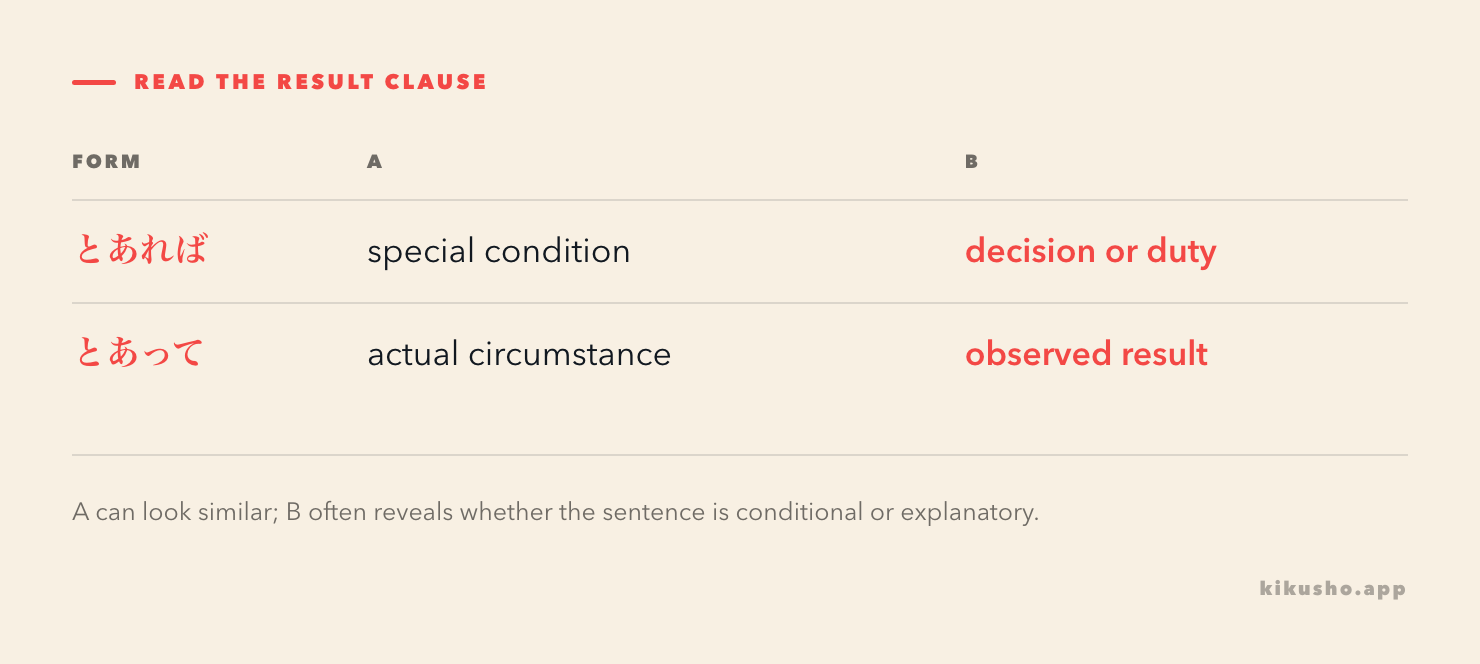
Tense alone is not a perfect shortcut. とあって may explain a present crowd or a predictable future-looking public result. とあれば may lead to a statement of necessity rather than a first-person promise. The stronger diagnostic is whether the writer accepts A conditionally or presents A as the factual explanation.
The similar-looking と相まって needs two interacting factors, so it belongs to a different structure. For less marked conditions, the ば and なら comparison shows how ordinary advice and hypothetical statements work.
Level and register
JLPT Sensei labels both とあれば and とあって N1. Bunpro and the Tanos N1 comparison list agree, and the independent references above also teach the forms as N1 grammar.
These placements are study estimates. The official JLPT FAQ states that the post-2010 test does not publish an exhaustive vocabulary, kanji or grammar list. Both forms are formal enough that reading reports, news-style prose and literary dialogue is more useful than forcing them into every casual conversation.
Keep the premise and result together
In Kikusho, save 必要とあれば、追加調査も行う as a condition-response pair and 決勝戦とあって、会場は満員だった as a fact-result pair. A card containing only “if” or “because” erases the contrast that makes the forms learnable.
Answer all seven questions before opening the explanations.
Practice
Question 1 — condition or fact. The company has not decided whether an extra audit is necessary. Which sentence promises action if it becomes necessary?
- A. 必要とあれば、追加の監査を行います。
- B. 必要とあって、追加の監査を行いました。
- C. 必要と相まって、追加の監査を行います。
- D. 必要であってもあれば、追加の監査を行います。
Question 2 — observed result. Complete the report.
人気歌手の最後の公演( )、会場の外にも大勢のファンが集まった。
- A. とあれば
- B. とあって
- C. であればこそ
- D. としてあれば
Question 3 — identify the stance. In 子供のためとあれば、どんな苦労も惜しまない, what does the second clause reveal about the speaker?
Question 4 — ordinary conditional. Which sentence is the natural choice for a routine plan with no special resolve?
- A. 明日雨が降ったら、傘を持っていく。
- B. 明日雨が降るとあって、傘を持っていく。
- C. 明日雨が降るとあれば、必ず傘だ。
- D. 明日雨とあって、傘を持っていく。
Question 5 — repair the report. Rewrite this sentence so the special event is presented as an actual reason for the crowd:
× 初日の公演とあれば、劇場は観客でいっぱいだった。
Question 6 — two blanks. Choose the pair that preserves the change from a conditional offer to a factual report.
必要( 1 )、私も現地へ行きます。実際、その日は緊急対応( 2 )、担当者全員が集まりました。
- A. とあって/とあれば
- B. とあれば/とあって
- C. とあれば/と相まって
- D. とあって/ゆえに
Question 7 — explain the minimal pair. Contrast the role of each form in these sentences: 社長の指示とあれば従います and 社長の指示とあって全員が従った.
Answers and explanations
1
A. 必要とあれば keeps necessity conditional and the following clause commits the company to an action. B reports a past audit as the result of an established circumstance.
2
B, とあって. The final performance is presented as a real special event, and the crowd is the understandable observed result. とあれば would frame the event as a condition and normally invite a response or judgment.
3
The speaker declares strong willingness: if the action is for the child's sake, no hardship will be withheld or avoided. とあれば makes that special purpose the condition that licenses an unusually broad commitment.
4
A. 雨が降ったら handles an ordinary practical condition. The other choices misuse the marked forms or create unnatural attachments without a special premise and fitting result.
5
Write 初日の公演とあって、劇場は観客でいっぱいだった。 The performance actually took place, and its being the opening performance explains the full theater. Changing あれば to あって fixes the status of the premise.
6
B, とあれば/とあって. The first sentence offers to travel if necessary. The second reports that an emergency response really occurred and explains why all staff gathered.
7
社長の指示とあれば従います considers the instruction as a condition and states the speaker's response if that condition holds. 社長の指示とあって全員が従った treats the instruction as an actual fact and explains the group's observed behavior.
Look beyond the shared とあ: あれば opens a consequential condition, while あって supplies the factual grounds for the result already in view.
The conditional and factual readings, every translation, both diagrams and all seven tasks were checked by OpenAI Codex. This was an AI review rather than a human language review.
Common questions
What is the difference between とあれば and とあって?
とあれば means if that special circumstance is the case and often leads to a commitment, duty or unavoidable response. とあって treats the circumstance as actual and explains the notable result that follows from it.
How does とあれば attach?
It most typically follows a noun directly, as in 必要とあれば and 家族のためとあれば. It can also follow a plain verb or adjective when the preceding proposition is treated as the condition under consideration.
How does とあって attach?
It follows nouns and plain predicates: 決勝戦とあって, 安いとあって, or 有名な俳優が来るとあって. Nouns and na-adjectives can also appear with である.
Are とあれば and とあって both JLPT N1 grammar?
JLPT Sensei, Bunpro and the Tanos comparison list place both at N1. These are study-resource labels because the official JLPT does not publish an exhaustive grammar list.