On this page
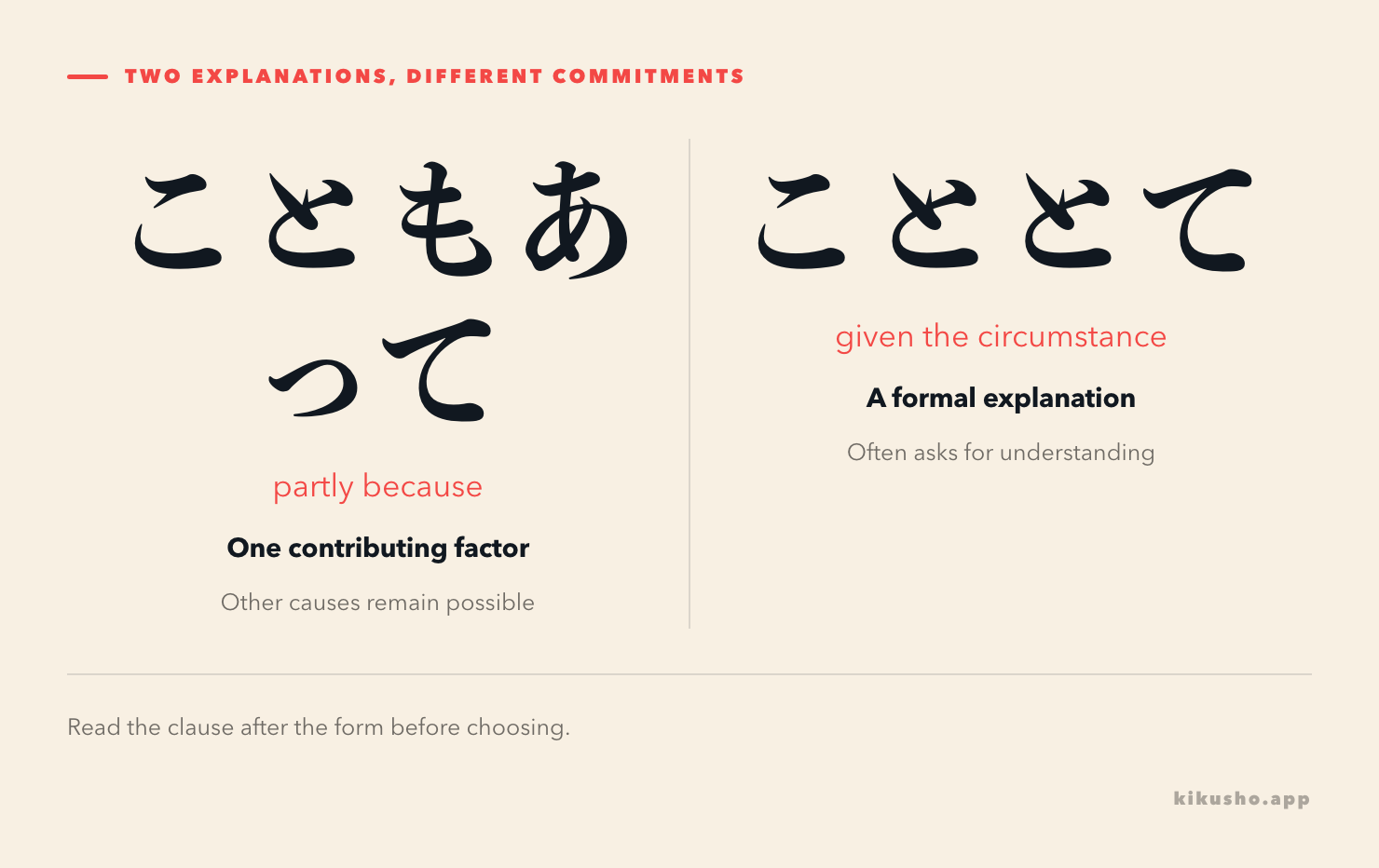
Use こともあって when you are naming one factor among several. Use こととて when formal writing presents a circumstance as understandable or difficult to avoid, often before an apology, limitation or request for patience.
駅から近いこともあって、この店は昼になると混んでいる。
えきから ちかい こともあって、この みせは ひるに なると こんでいる。
Partly because it is close to the station, this restaurant gets crowded at lunchtime.
不慣れなこととて、行き届かぬ点はご容赦ください。
ふなれな こととて、ゆきとどかぬ てんは ごようしゃ ください。
As we are inexperienced, please forgive any shortcomings.
Both expressions answer “why,” but they make different promises. こともあって says the named fact contributed to the result. こととて asks the reader to view the result through a special circumstance. That difference matters more than their shared English translations “because” and “since.”
This lesson reviews g-1302dc0966ce, こともあって, and g-9fd980f244b9, こととて. Kikusho's reference inventory, JLPT Sensei and Bunpro place the assigned forms at N1 with no recorded level disagreement. This is a study-source placement because the JLPT does not publish a complete grammar syllabus.
First decide whether the reason is partial or justificatory
| Form | Core relation | Typical setting | Natural translation |
|---|---|---|---|
| A + こともあって、B | A is one factor behind B | explanation in speech or writing | partly because A; also because A |
| A + こととて、B | A makes B understandable or hard to avoid | formal letters, apologies, literary narration | because of A; given A |
The も in こともあって is not decorative. It leaves other reasons in the background. The restaurant may also be popular and inexpensive; proximity is one contributor to the lunchtime crowd.
With こととて, the writer does not normally invite you to count causes. The circumstance is offered as a frame for judging what follows: inexperience explains an omission, distance explains a delay, or the period explains conditions in a story. In modern use, the form often carries an implicit “please understand.”
こともあって leaves other causes in view
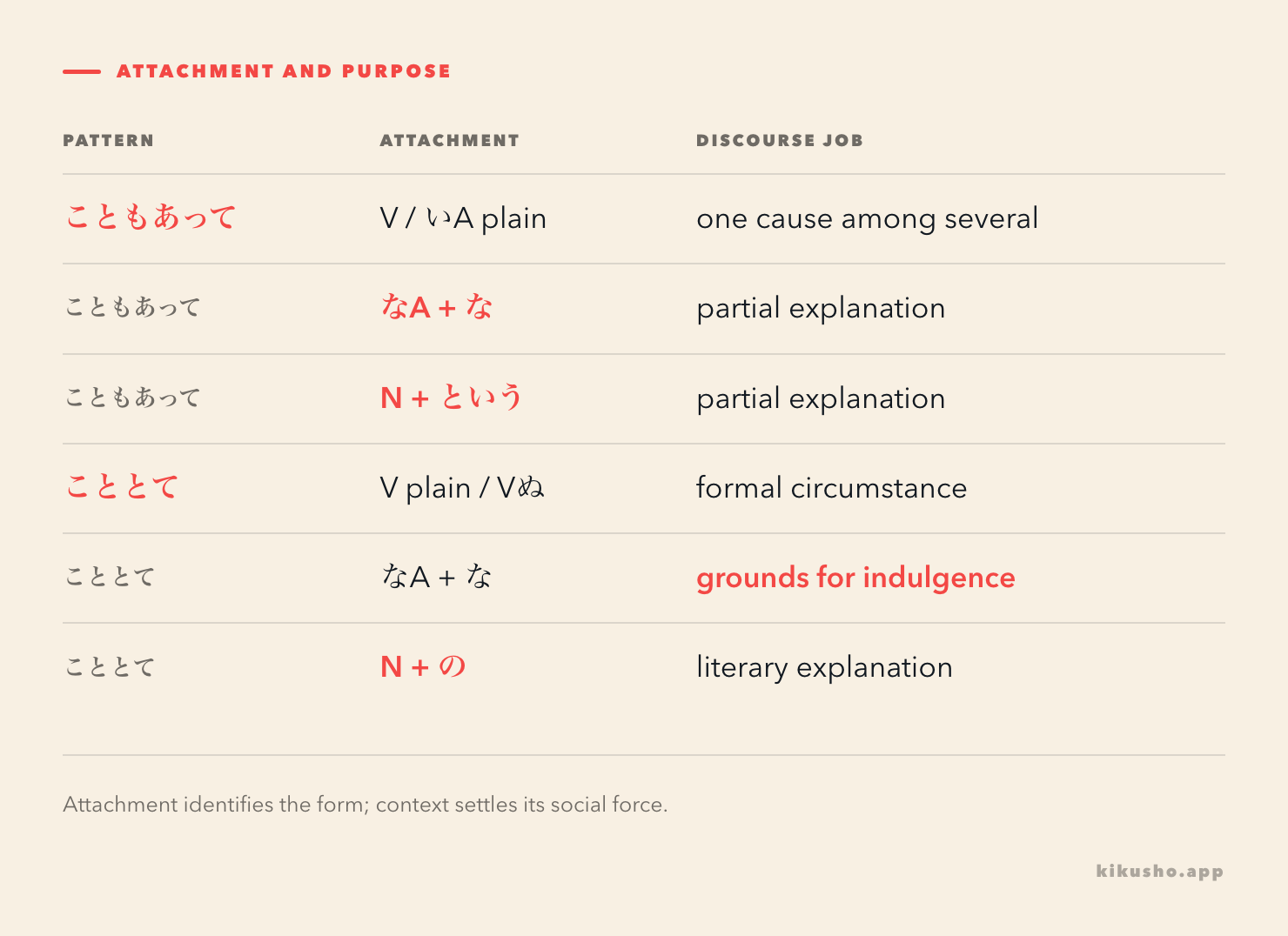
Attach こともあって to a plain clause. Verbs and i-adjectives go directly before it. A na-adjective takes な. A noun is commonly framed with という.
| Before the form | Pattern | Example |
|---|---|---|
| verb | plain verb + こともあって | 忙しかったこともあって |
| i-adjective | plain adjective + こともあって | 近いこともあって |
| na-adjective | stem + な + こともあって | 静かなこともあって |
| noun | noun + という + こともあって | 連休中ということもあって |
新しい仕事に慣れていないこともあって、今週は帰宅が遅かった。
あたらしい しごとに なれていない こともあって、こんしゅうは きたくが おそかった。
Partly because I am not used to the new job, I got home late this week.
平日の午前で静かなこともあって、ここでは集中して読める。
へいじつの ごぜんで しずかな こともあって、ここでは しゅうちゅうして よめる。
Also because it is quiet on weekday mornings, I can concentrate on reading here.
ちょうど連休中ということもあって、どの列車も混んでいた。
ちょうど れんきゅうちゅう という こともあって、どの れっしゃも こんでいた。
Partly because it was during a holiday period, every train was crowded.
絵でわかる日本語 defines the form as choosing one reason from several and gives the same verb, adjective and noun-with-という attachment. JLPT Sensei also glosses it as “partly because” and shows both favorable and unfavorable results. Nothing in the form requires B to be negative.
Do not automatically infer that the named factor is weak. It may be important. The grammar only avoids claiming it is the sole explanation. If you want to present one decisive reason, からこそ or a plain から/ので sentence may fit better, depending on emphasis and register.
こととて asks for understanding
The central patterns are V plain + こととて, na-adjective + なこととて, and N + のこととて. Older or ceremonious prose often replaces negative ない with ぬ: 知らぬこととて, “because I did not know,” or 慣れぬこととて, “because I am unaccustomed.”
| Before the form | Pattern | Example |
|---|---|---|
| verb | plain verb + こととて | 初めて担当することとて |
| negative verb | ない/ぬ + こととて | 知らぬこととて |
| na-adjective | stem + な + こととて | 急なこととて |
| noun | noun + の + こととて | 遠方のこととて |
初めて担当することとて、説明に不足がございましたらお許しください。
はじめて たんとうする こととて、せつめいに ふそくが ございましたら おゆるし ください。
As this is my first time handling the matter, please forgive any gaps in my explanation.
遠方のこととて、すぐに伺うことができません。
えんぽうの こととて、すぐに うかがう ことが できません。
Given the distance, I cannot visit immediately.
知らぬこととて、失礼をいたしました。
しらぬ こととて、しつれいを いたしました。
I acted rudely because I did not know.
Bunpro describes こととて as old-fashioned and almost entirely written in modern Japanese, with forgiveness as a frequent context. Hedgehog Japanese likewise records the literary register, V plain and Nの attachments, and the older ぬ negative. Its historical examples also show an important limit: apology is typical, not compulsory. A narrator can use 昔のこととて to explain why a memory is unclear without asking anyone's forgiveness.
The result after こととて is often a shortcoming, inconvenience or unavoidable restriction. A bright neutral result such as “because the weather was nice, we had a picnic” would sound needlessly antique unless the whole passage deliberately adopts that voice.
The same circumstance can lead to a different choice
Compare two sentences about a new employee:
新入社員だということもあって、会議ではあまり発言しなかった。
しんにゅうしゃいんだ という こともあって、かいぎでは あまり はつげんしなかった。
Partly because they were a new employee, they did not say much in the meeting.
新入社員で不慣れなこととて、失礼があればご容赦ください。
しんにゅうしゃいんで ふなれな こととて、しつれいが あれば ごようしゃ ください。
As they are a new employee and inexperienced, please forgive any discourtesy.
The first is an observer's causal account. Being new is one factor behind limited participation. The second belongs to a formal appeal. Inexperience is offered as grounds for tolerance.
This is why replacing one form with the other changes more than style. 新入社員のこととて、発言しなかった can sound as though the writer is justifying or asking acceptance of the silence. 新入社員だということもあって simply contributes a reason and leaves other causes open.
Keep neighboring reason forms separate
Plain から and ので cover everyday reasons. The から and ので comparison shows how speaker ownership and explanatory tone differ without adding the specialized implications here.
ことだし also supports a decision by citing a circumstance, often one both speakers can accept: 雨も降っていることだし、今日は帰ろう, “Since it is raining too, let's go home.” It is much more conversational than こととて, and it commonly leads to a proposal or decision rather than a formal plea for understanding.
ものだから/ものですから can introduce an excuse in conversation: 道に迷ったものですから、遅くなりました. It shares the explanatory stance of こととて, but not its antique written tone. In a modern spoken apology, this is often the more plausible neighbor.
ことから can point from observable evidence to an inference or explain the origin of a name. The ことから and なぜなら lesson separates that evidence relation from ordinary explanation. Neither こともあって nor こととて is primarily an inference marker.
A useful Kikusho card needs the result clause as well as the reason. 不慣れなこととて by itself shows the attachment, but it hides the appeal that makes the expression recognizable. Saving 不慣れなこととて、行き届かぬ点はご容赦ください preserves both the grammar and its social purpose for later FSRS reviews.
Practice: identify what the writer is doing with the cause
Question 1 · contributing factor. Complete: 駅から近い__、この店は昼になると混んでいる。
① こととて
② こともあって
③ ことからして
④ ことなしに
Question 2 · formal indulgence. Which completion best fits a formal letter? 不慣れな__、不行き届きの点はご容赦ください。
① こともあって
② ことだし
③ こととて
④ ことから
Question 3 · noun attachment. Choose the natural form for “Given the distance, I cannot visit immediately.”
① 遠方ということとて
② 遠方なこととて
③ 遠方のこととて
④ 遠方こともあって
Question 4 · text grammar. In 連休中ということもあって、どの列車も混んでいた, does the writer claim that the holiday was the only cause of the crowding?
Question 5 · repair. Correct the attachment in 急ということとて、十分な準備ができませんでした while keeping こととて.
Question 6 · sentence composition. Use 知らぬ, こととて, 失礼, and お許しください to make a formal apology.
Question 7 · compare the speech acts. Why is 天気がよかったこともあって、公園はにぎわっていた more natural than replacing its form with こととて in an ordinary report?
Answers and explanations
Reasoning 1
② こともあって. Proximity is presented as one contributor to the lunchtime crowd. The sentence does not ask the reader to excuse an unavoidable result.
Reasoning 2
③ こととて. 不慣れな gives the correct na-adjective attachment, and the request ご容赦ください creates the formal appeal for understanding that strongly favors こととて.
Reasoning 3
③ 遠方のこととて. A noun normally takes の before こととて. という is the common noun bridge before こともあって, not the required pattern here.
Reasoning 4
No. The particle も presents the holiday period as one relevant cause among possible others. The trains may also have been crowded because of the time of day, an event or reduced service.
Reasoning 5
急なこととて、十分な準備ができませんでした。 急 is a na-adjective here, so it needs な before こととて.
Reasoning 6
知らぬこととて、失礼をいたしました。どうかお許しください。 The literary negative ぬ matches the formal register, and the following apology makes the reason's social function explicit.
Reasoning 7
The sentence is a neutral causal report, and good weather is one factor behind the busy park. こととて would impose a literary, justificatory frame that the context does not need. It becomes plausible only if the whole passage intentionally uses old-fashioned narration.
The final editorial pass covered every verb, adjective and noun attachment, the partial-cause work done by も, the apologetic and literary ranges of こととて, each neighboring reason form, and the reasoning supplied for all seven tasks. The reviewer was an AI language editor; no human or native-speaker review is claimed.
Common questions
What is the difference between こともあって and こととて?
こともあって identifies one contributing cause among others. こととて gives a circumstance as an understandable or unavoidable reason in formal, old-fashioned writing, often before an apology or request for indulgence.
Does こともあって mean that there are other reasons?
Yes. The particle も leaves room for other causes, even when the sentence names only one. Translate it as “partly because” or “also because” when that nuance matters.
Is こととて used in everyday conversation?
Rarely. It belongs mainly to formal letters, set apologies, historical narration and deliberately old-fashioned prose. ので or ものですから is usually more natural in speech.
Can こととて express an ordinary neutral cause?
It can introduce a cause in literary narration, but modern formal use often frames a limitation, mistake or inconvenience as something the reader should understand.