On this page
なら and ば both come out as "if" in English, and the choice between them turns on one question: is the condition already on the table, or are you the one putting it there? なら takes up a condition that is already in play — something said, something assumed, or the topic you have raised — and gives your response to it. ば supplies a condition of its own: a general "if this, then that" that stands whether or not anyone brought it up.
So the same clause can take either particle and stop meaning the same thing. Both are N4 grammar, both attach cleanly to almost any word, and the seam between them is easy to miss until a sentence goes quietly wrong.
The test is whose condition it is
Before you reach for a particle, ask where the condition came from. If you are picking up something the other person just said, or a situation you both already see, or a subject you have named in order to comment on it, the sentence wants なら. If you are introducing a fresh condition — a rule, a hypothetical, a general truth — and stating what follows, it wants ば.
Someone says 「京都に行きます」and you reply 「京都なら、新幹線が速いですよ」(Kyoto? then the bullet train's quick). That is なら, because 京都 was just put on the table by someone else; you are not proposing a condition, you are answering one. Compare 練習すれば、上手になります (if you practise, you improve), where nobody raised practising. You are asserting the general link yourself, and that is ば's home ground.
How ば and なら attach
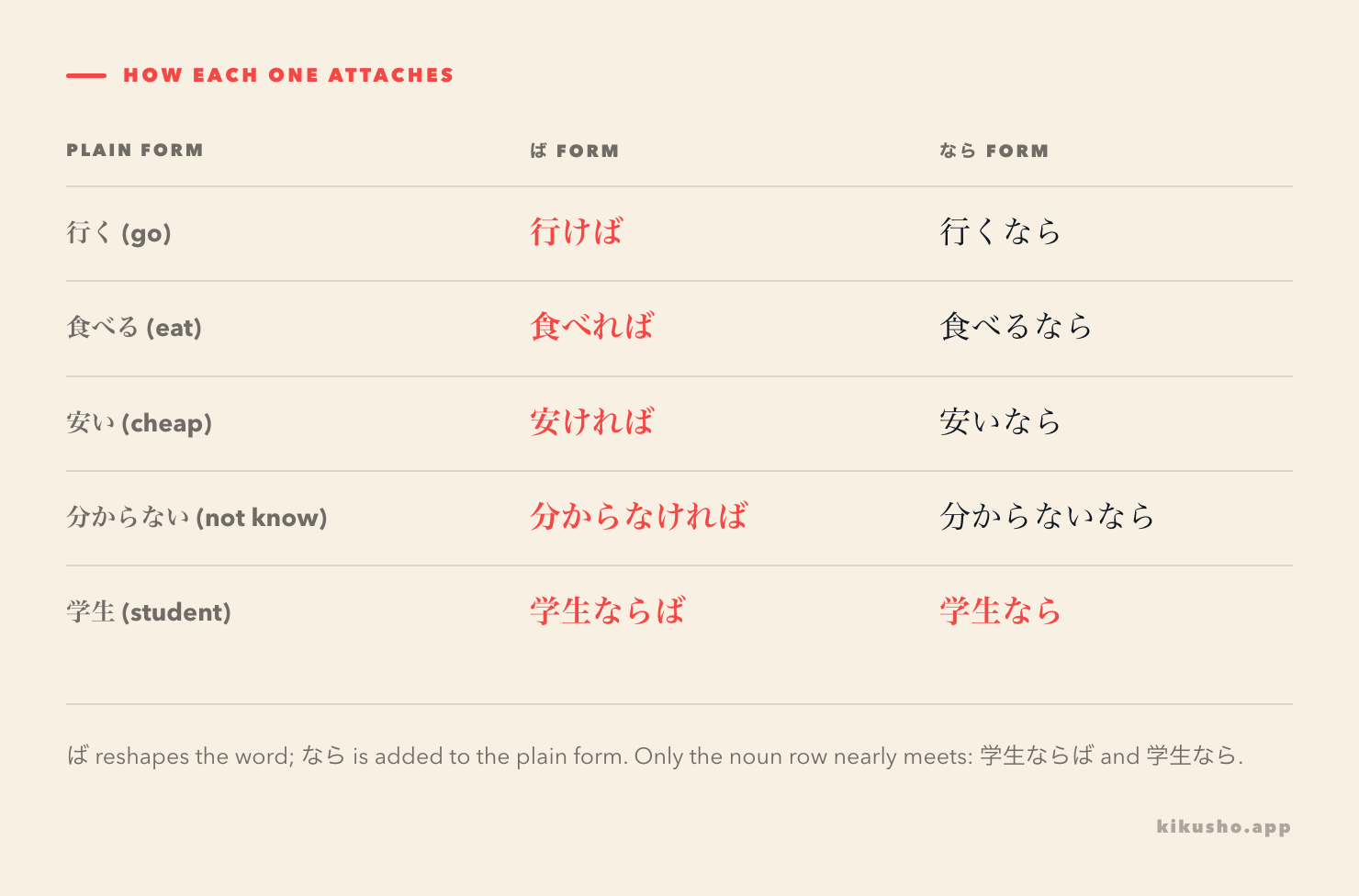
ば reshapes the word; なら is added to the plain form and leaves it intact. That difference is visible on the page before you even reach the meaning.
| plain form | ば form | なら form |
|---|---|---|
| 行く iku (go) | 行けば | 行くなら |
| 食べる taberu (eat) | 食べれば | 食べるなら |
| 安い yasui (cheap) | 安ければ | 安いなら |
| 分からない wakaranai (not know) | 分からなければ | 分からないなら |
| 学生 gakusei (student) | 学生ならば | 学生なら |
For a う-verb the final -u becomes -e and ば follows: 押す → 押せば, 飲む → 飲めば. A る-verb swaps る for れば: 食べる → 食べれば. An い-adjective drops い for ければ: 高い → 高ければ. A negative ending in ない becomes なければ: 行かない → 行かなければ. Only with a noun or な-adjective do the two forms almost coincide, because ば's noun form is built on なら itself, and dropping the ば is what gives you the なら form.
ば states a condition you are supplying
ば is the particle for a link you assert: do this, and that follows. It carries the general truths and the proverbs, where the condition belongs to nobody in particular. 塵も積もれば山となる (ちりもつもればやまとなる), even dust, piled up, becomes a mountain. 住めば都 (すめばみやこ), live somewhere long enough and it becomes home.
It carries the hypothetical you raise yourself: 時間があれば、映画を見ます (if there's time, I watch a film), 安ければ、買います (if it's cheap, I'll buy it). And it carries the question a learner reaches for constantly, どうすればいいですか, literally "if I do how, is it good?" The condition, how, is exactly the blank you are asking to have filled.
One shape is worth keeping whole: 〜ば〜ほど, "the more … the more." 練習すればするほど、上手になります (the more you practise, the better you get). The verb appears twice, once in the ば form and once plain before ほど, and the sentence claims a sliding link between the two. Nothing states a bare condition more purely.
なら answers a condition already raised
なら reaches back to context. Its plainest use is the reply that starts from what was just said: 「疲れました」「疲れたなら、休んでください」(tired? then rest). それなら問題ありません (if that's so, there's no problem) does nothing but point at the previous sentence and build on it.
From there なら becomes the particle of recommendation, because a recommendation is always an answer to a topic. 日本語を勉強するなら、この辞書がいいですよ (if you're going to study Japanese, this is the dictionary). 寿司なら、あの店がおいしい (for sushi, that place is the one). The condition is the subject you are commenting on, marked as given so that your advice can follow it.
It also carries a note of trust about a person: 君なら必ずできる (if it's you, you'll manage it). And it does one thing the others cannot: it lets the main clause happen before the condition. 買い物なら、卵を買ってきて (if you're going shopping, get some eggs) has you buying the eggs during a trip you have not left on yet. The shopping is the premise, not an event that must finish first, which is the opposite of how と and たら sequence a plan.
ば will not carry a request when its condition is an action
Here is the restriction the overview pages skate past. When the second half is a request, an order, an invitation or your own intention, ば only works if its condition is a state: an adjective, a negative, "there is," "can." If the condition is a controllable action, ば is out, and the sentence has to reach for なら or たら.
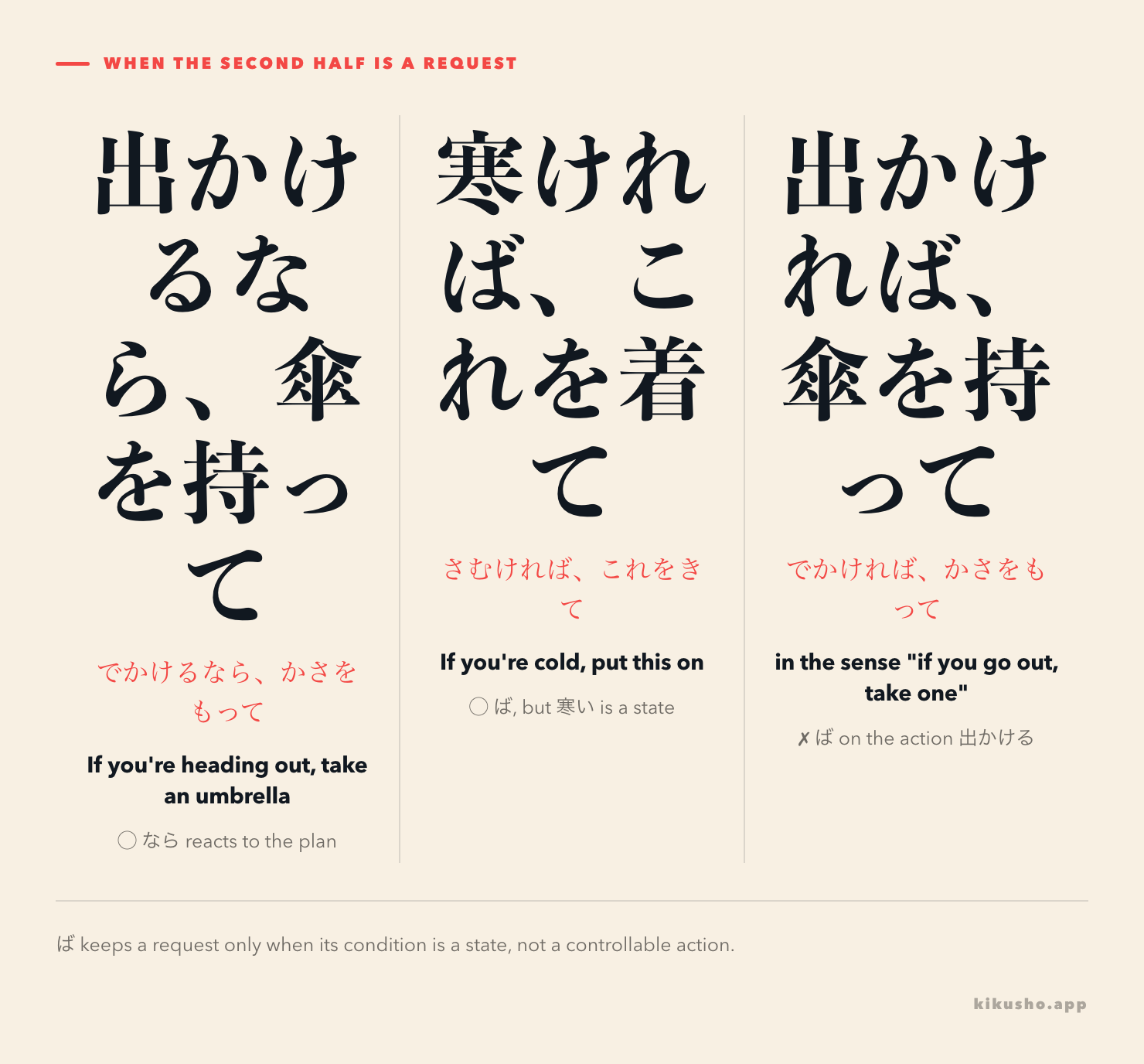
分からなければ、聞いてください (if you don't understand, ask) is fine: 分からない is a state, not something you do on purpose. 寒ければ、これを着てください (if you're cold, put this on) passes for the same reason. But 出かければ、傘を持って行って, "if you go out, take an umbrella," is not said, because 出かける is a deliberate action and 持って行って is a request. Switch to なら and it recovers at once: 出かけるなら、傘を持って行って. The going-out is now a premise you are responding to rather than a trigger, and the request has somewhere to sit.
This is why so much advice surfaces with なら. Advice is a suggestion built on something the listener is about to do, and "something you are about to do" is a controllable action, precisely the case ば turns away.
Swap them and the sentence answers a different question
Take one clause and try both particles. 日本に行くなら、円を用意したほうがいい (if you're going to Japan, you'd better get some yen ready) is advice keyed to a plan, and the yen gets readied before departure. Force ば onto it, 日本に行けば, and two things break together: the action-plus-suggestion runs straight into the restriction above, and even setting that aside, ば would frame going to Japan as a general condition with an automatic result, which is not what "you'd better" is doing.
Now the other direction. 練習すれば上手になる states a general law. Rewrite it as 練習するなら上手になる and it turns strange, because なら insists that practising was already the topic and then offers "you'll improve" as a comment on it. Improvement is a consequence, though, not a reaction, so there is nothing there for なら to answer.
The particle that decides a sentence like this is rarely the hardest word in it, and it is the first thing a bare vocabulary card throws away. なら only makes sense beside the line it was answering; ば only makes sense once you know whether you or the room supplied the condition. A card holding 円を用意する and its reading has lost the 日本に行くなら that made なら the right choice. Kikusho keeps the sentence you met whole, particle and context together, so the reason a なら was a なら is still legible the next time the card comes up, captured from the sign, the message or the subtitle where you first ran into it.
Three sentences that turn on the choice
Question 1. Choose the natural form: 「明日、映画を見に___、この割引券を使ってください。」(If you're going to see a film tomorrow, please use this discount ticket.)
a) 行けば b) 行くなら c) 行くと d) 行かなければ
Answer 1: 行くなら. The second half is a request, 使ってください, built on a controllable action, 行く, which is exactly where ば (a) is barred. なら fits because it treats "going to see a film" as the premise the speaker is responding to. Option (c) と states an automatic result and cannot head a request either; (d) means "if you don't go," reversing the sense.
Question 2. Put these parts into a natural sentence meaning "the more you read, the better you understand": 読む ・ 分かる ・ ほど ・ ば
Answer 2: 読めば読むほど、分かります。 The 〜ば〜ほど pattern needs the same verb twice, 読めば in the ば form and then 読む plain before ほど, and it describes a general, sliding link. That is ば's territory, and it is not something なら can express, because なら would need a topic already raised rather than a rule you are stating.
Question 3. Complete the exchange: 「週末、山に登ります。」「___、いい靴を持って行ったほうがいいですよ。」(This weekend I'm climbing a mountain. / In that case, you'd better bring good shoes.)
a) 登れば b) 登るなら c) それなら d) both b and c
Answer 3: d, both 登るなら and それなら are natural. The climb was just announced by the other person, so the reply reacts to a condition already on the table: それなら points straight back at it, and 登るなら restates it as the premise. 登れば (a) fails twice over, a suggestion resting on the controllable action 登る, and it would in any case sound like a general claim instead of a reply to what was said.
なら is really the copula's own conditional, だ bent into "if it is so," and that is the whole difference in one word. ば sets a condition loose in the world and waits for it to be met; なら takes the world as it has just been handed to you and tells you what to do about it.
Common questions
Do ば and なら ever share the same form?
With a noun or a な-adjective they nearly do. ば's noun form is 学生ならば, and なら is that same form with ば dropped: 学生なら. The split only bites with verbs and い-adjectives, where 行けば and 行くなら, or 安ければ and 安いなら, attach differently and are never interchangeable.
Why is 日本へ行けば、切符を買ってきてください wrong?
Because ば cannot head a request when its own condition is a controllable action like 行く. Use なら to react to the plan (日本へ行くなら) or たら for a plain sequence (日本へ行ったら). ば keeps a request only when its condition is a state: 分からなければ、聞いてください is fine, because 分からない is not something you do on purpose.
Does なら always react to something the other person said?
Usually, but the thing it reacts to can be unspoken: a situation you both see, or a topic you raise yourself in order to comment on it. 日本語を勉強するなら、 この辞書がいい works even if nobody mentioned studying, because you are still treating "studying Japanese" as the premise and giving your take on it.
Is the なら in 学生なら the same word as だ?
Yes. なら is the conditional form of the copula だ, so 学生なら means "if it is the case that someone is a student." That is why なら reads as "if that's true" rather than "if that happens": it conditions a state of affairs, not an event.