On this page
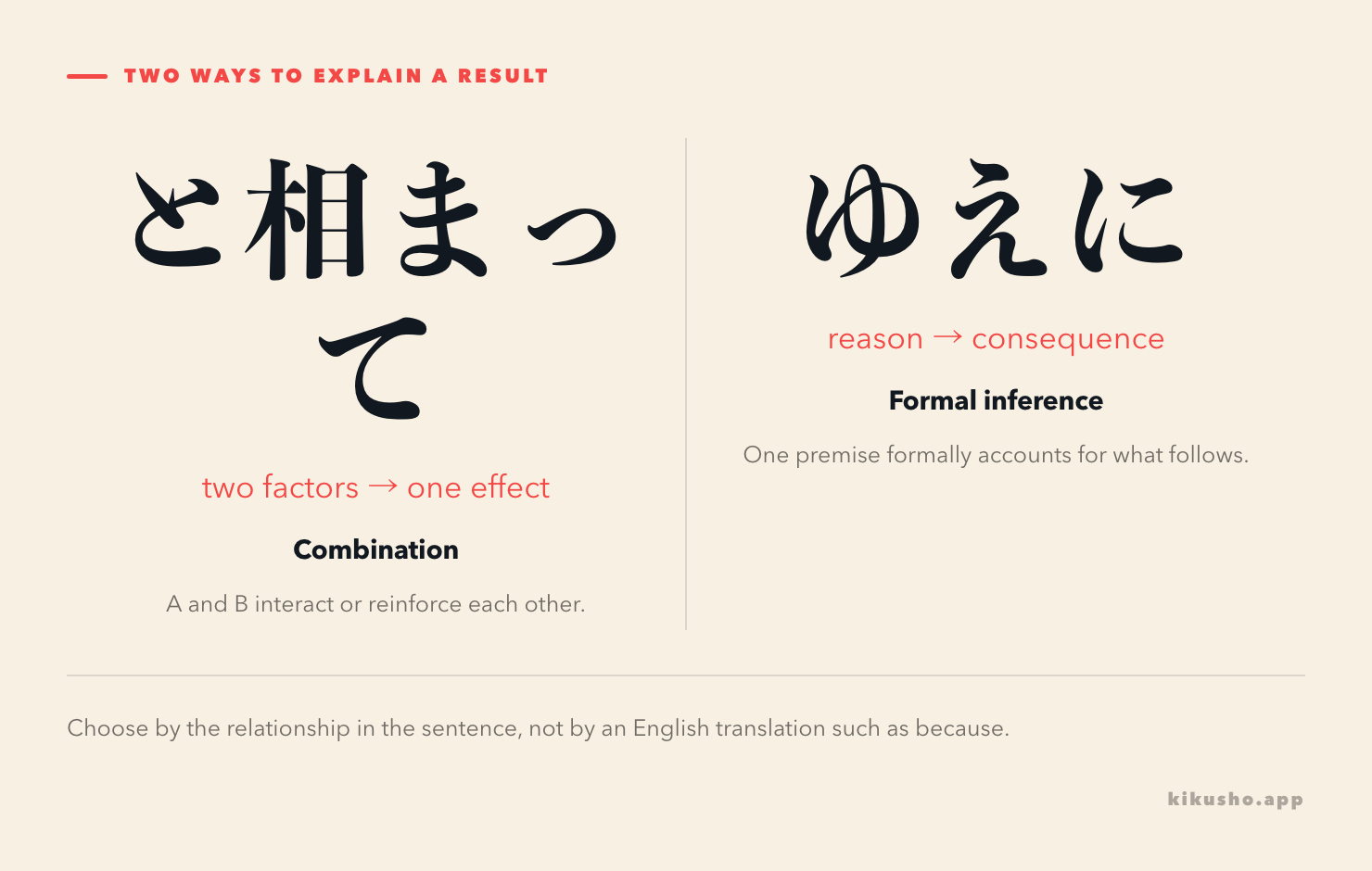
Use Nと相まって when two or more factors work together and produce one result. Use ~ゆえに when a formal sentence presents a reason or premise and then states its consequence.
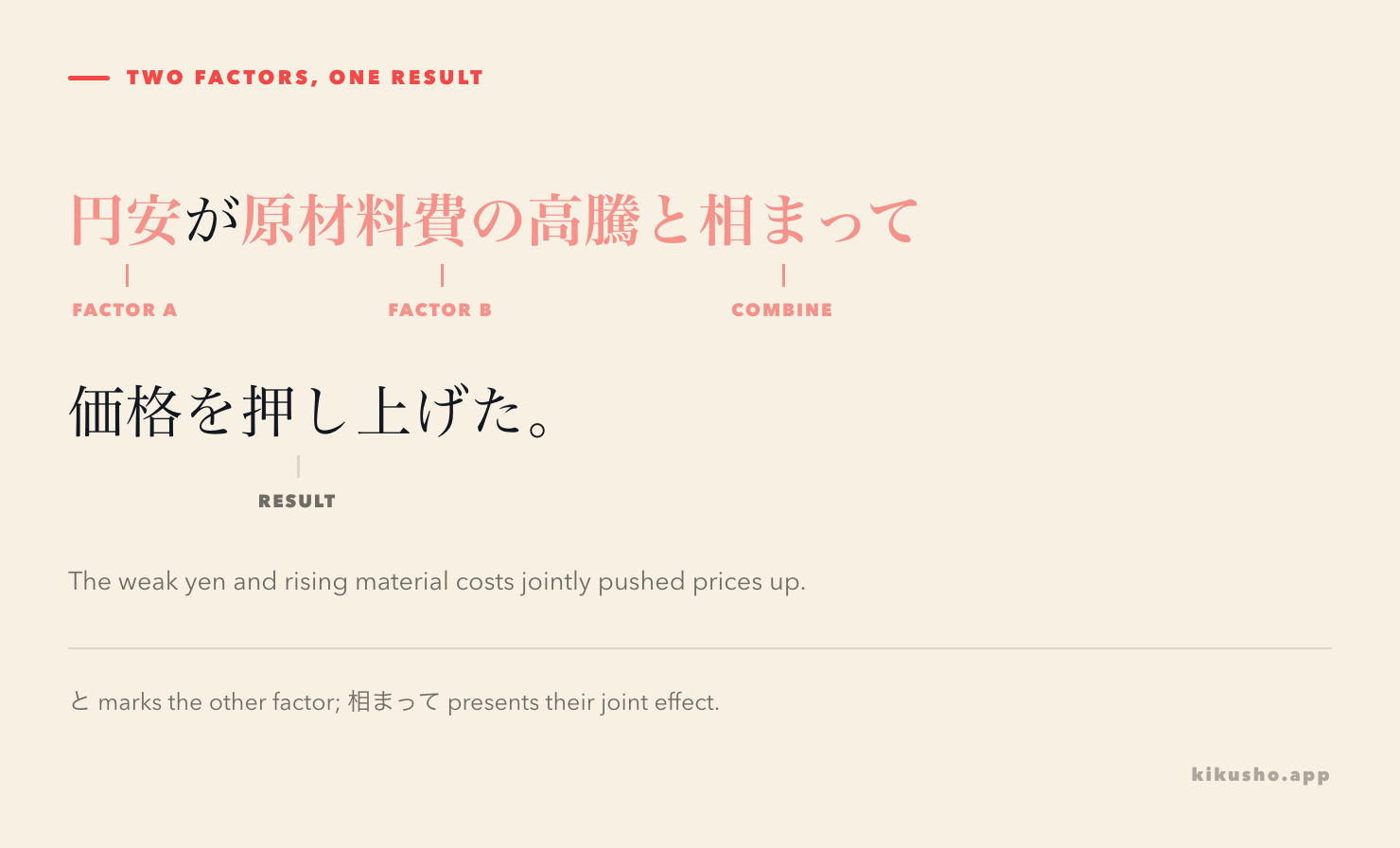
円安が原材料費の高騰と相まって、商品の価格を押し上げた。
えんやすが げんざいりょうひの こうとうと あいまって、しょうひんの かかくを おしあげた。
The weak yen, combined with rising raw-material costs, pushed up product prices.
原材料費が高騰したがゆえに、商品の価格を改定せざるを得なかった。
げんざいりょうひが こうとうしたが ゆえに、しょうひんの かかくを かいていせざるを えなかった。
Because raw-material costs rose, the company had no choice but to revise product prices.
Both sentences explain a result, but their internal diagrams differ. The first has factor A + factor B → combined effect. The second has reason → consequence. That distinction matters more than choosing the same English translation for both.
This lesson covers inventory item g-85e79a3ddb26, と相まって(とあいまって), and g-2d2d360d64c1, ゆえに.
Choose by the number and role of the causes
| Form | What comes before it | Relationship | Typical register |
|---|---|---|---|
| Nと相まって | another factor, stated or understood | factors interact and jointly create or intensify a result | reports, analysis, careful speech |
| ~(が)ゆえに | a reason, property or premise | that reason accounts for the following result | formal, literary or argumentative writing |
| sentence-initial ゆえに | a complete preceding statement | therefore; consequently | formal reasoning |
The quickest test is to ask whether the writer wants you to see combination or inference. If two influences reinforce one another, と相まって fits. If the sentence advances from a reason to what follows from it, ゆえに fits.
と相まって makes the interaction visible
The core attachment is noun + と相まって. Two common frames make both factors easy to see:
| Frame | Example |
|---|---|
| XがYと相まって、result | 丁寧な説明が図の分かりやすさと相まって、理解を助けた。 |
| XとYが相まって、result | 丁寧な説明と分かりやすい図が相まって、理解を助けた。 |
| Xと相まったY | 実用性と相まった美しさ |
落ち着いた照明と静かな音楽が相まって、店内に心地よい雰囲気が生まれている。
おちついた しょうめいと しずかな おんがくが あいまって、てんないに ここちよい ふんいきが うまれている。
The subdued lighting and quiet music work together to create a pleasant atmosphere inside the shop.
日本語NET's explanation describes one thing being added to another so that a stronger effect results. Bunpro's Japanese entry likewise analyzes an A and a B combining to produce C. That means a bare sequence of independent events is insufficient: the sentence should make the joint contribution plausible.
The result is often favorable because synergy is easy to notice in talent, support, design or atmosphere. It can also be harmful:
人手不足が予算の削減と相まって、調査の遅れを招いた。
ひとでぶそくが よさんの さくげんと あいまって、ちょうさの おくれを まねいた。
Staff shortages, combined with budget cuts, caused the investigation to fall behind.
The negativity does not block と相まって. The important condition is that the factors operate together. A Japanese usage overview from マイナビニュース notes that positive outcomes are common while negative factors can also combine into a worse result.
The form comes from the verb 相俟つ(あいまつ), but contemporary learners normally meet its connective form 相まって and attributive form 相まった. Do not invent 相まる as the dictionary form.
ゆえに turns a reason into a formal consequence
ゆえ is a noun meaning a reason or cause. The particle に lets the reason clause lead into its consequence. 故に is the kanji spelling; hiragana ゆえに is also standard.
Useful attachment patterns are:
| Before ゆえに | Pattern | Example |
|---|---|---|
| noun | Nゆえに | 未経験ゆえに判断を誤った |
| noun | Nであるがゆえに | 責任者であるがゆえに厳しい判断を求められた |
| な-adjective | Nであるがゆえに | 慎重であるがゆえに決断が遅れた |
| い-adjective | plain form + がゆえに | 難しいがゆえに挑戦する価値がある |
| verb | plain form + がゆえに | 信じたがゆえに待ち続けた |
小さな組織であるがゆえに、方針を素早く変更できる。
ちいさな そしきで あるが ゆえに、ほうしんを すばやく へんこうできる。
Because it is a small organization, it can change direction quickly.
証拠が十分ではない。ゆえに、現時点で結論を出すべきではない。
しょうこが じゅうぶんでは ない。ゆえに、げんじてんで けつろんを だすべきでは ない。
The evidence is insufficient. Therefore, we should not reach a conclusion at this point.
Kotobank's dictionary entry defines sentence-initial 故に as marking that the later event occurs because of the preceding matter. 日本語NET identifies the form as literary and formal, records plain-form attachment, and also notes its use as a connector at the start of a sentence.
Ordinary conversation usually chooses から or ので. Saying 電車が遅れたゆえに遅刻しました in a casual apology sounds deliberately grand or stiff. The form is at home in essays, reports, formal explanations, solemn declarations and stylized dialogue.
One English because can hide two Japanese structures
English translations such as “because of” can blur the difference:
好天と宣伝効果が相まって、来場者数は過去最高となった。
Fine weather and effective publicity combined to produce record attendance.
宣伝が広く届いたがゆえに、来場者数は過去最高となった。
Because the publicity reached a wide audience, attendance reached a record high.
In the first sentence, neither 好天 nor 宣伝効果 is presented as the whole explanation. The sentence asks the reader to view their interaction. In the second, the reach of the publicity is the stated reason.
This makes the following sentence awkward:
× 好天ゆえに宣伝効果と、来場者数は増えた。
The chunks do not form either licensed pattern. To show two factors, write 好天が宣伝効果と相まって、来場者数は増えた. To present one reason, write 好天であったがゆえに、来場者数は増えた.
The nearby form ~に伴って can describe one change accompanying another, while と相まって emphasizes their joint effect. The に伴って, に応じて and につれて comparison separates those change relationships. For evidence and explanation structure in less formal prose, see ことから and なぜなら.
Level labels are study estimates
JLPT Sensei places と相まって and ゆえに at N1, as does 日本語NET. The Tanos comparison data places と相まって in its N1 grammar list but ゆえに in its N2 grammar list. The teaching contrast stays the same even though the labels differ.
The official JLPT FAQ explains why there is no definitive item label: the organizers no longer publish an exhaustive list of vocabulary, kanji and grammar. Treat both forms as advanced reading and writing tools, and learn the contrast rather than relying on the number alone.
Save the relationship, not only the translation
In Kikusho, save 人手不足が予算削減と相まって、遅れを招いた as a complete unit. A card containing only “combined with” loses the two-factor structure. For ゆえに, keep a formal cause-consequence pair such as 証拠が不十分である。ゆえに、断定できない.
Answer all eight questions before opening the explanation block.
Practice
Question 1 — choose the relationship. Two conditions jointly made a town popular. Which sentence expresses that combination?
- A. 便利な交通が豊かな自然と相まって、この町を人気の移住先にした。
- B. 便利な交通ゆえに豊かな自然と、この町を人気の移住先にした。
- C. 便利な交通が豊かな自然ゆえに相まった。
- D. 便利な交通であるが相まって、この町は人気だ。
Question 2 — formal reason. Complete the sentence.
彼は責任者である( )、最終的な判断を任された。
- A. と相まって
- B. がゆえに
- C. に伴って
- D. さもないと
Question 3 — identify the two factors. In the following sentence, what are the two factors and what result do they produce?
原材料費の高騰と円安が相まって、製品価格が上昇した。
Question 4 — sentence connector. Choose the expression that presents a formal conclusion from the previous sentence.
この仮説を裏付ける証拠はない。( )、現段階では採用できない。
- A. と相まって
- B. その一方で
- C. ゆえに
- D. それにもかかわらず
Question 5 — repair the attachment. Rewrite this sentence so that two factors combine naturally:
× 好天ゆえに広告の効果と、客が増えた。
Question 6 — choose the register. You are casually telling a friend why you were late. Which version is least marked?
- A. 電車が遅れたから、遅刻した。
- B. 電車が遅れたがゆえに、遅刻した。
- C. 電車の遅れと相まって、遅刻した。
- D. ゆえに、電車が遅れた。
Question 7 — negative combined result. Write one sentence with と相まって in which two problems produce a worse outcome.
Question 8 — explain the contrast. Why does 努力が才能と相まって成功につながった use と相まって, while 努力を続けたがゆえに成功した uses ゆえに?
Answers and explanations
1
A. 便利な交通 and 豊かな自然 are two factors that work together, so XがYと相まって fits. The other choices splice ゆえに or 相まって into incomplete attachment patterns.
2
B, がゆえに. 責任者である is the formal reason for being entrusted with the final decision. と相まって would require another factor with と.
3
The factors are 原材料費の高騰, rising raw-material costs, and 円安, the weak yen. Their combined result is 製品価格が上昇した, product prices rose.
4
C, ゆえに. The absence of supporting evidence is the premise, and inability to adopt the hypothesis is the formal conclusion. The other connectors express combination, contrast or concession.
5
One natural repair is 好天が広告の効果と相まって、客が増えた。 You could also write 好天と広告の効果が相まって、客が増えた。 Both versions show the two factors before the result.
6
A. から gives an ordinary conversational reason. がゆえに is grammatically possible but conspicuously formal in a casual explanation. C lacks a second factor, and D reverses the reason and result.
7
One natural answer is 人手不足が設備の老朽化と相まって、生産の遅れを招いた。 (ひとでぶそくが せつびの ろうきゅうかと あいまって、せいさんの おくれを まねいた). Staff shortages and aging equipment jointly caused the production delay.
8
The first sentence treats 努力 and 才能 as factors whose interaction leads to success. The second presents one proposition, continuing to make an effort, as the formal reason for success. English may translate both with “because,” but the Japanese sentences organize causation differently.
The reliable distinction is structural: と相まって makes factors meet, while ゆえに makes an argument advance from reason to result.
OpenAI Codex checked the Japanese, translations, diagrams and eight exercises against the cited references. No human language reviewer has checked this lesson.
Common questions
What is the difference between と相まって and ゆえに?
と相まって presents two or more factors working together to produce or strengthen a result. ゆえに presents a reason or premise and links it to a result or conclusion in formal, often written Japanese.
How does と相まって attach?
Attach it to a noun with と: Nと相まって. Common frames are XがYと相まって and XとYが相まって. Before a noun, use と相まった, as in 機能性と相まった美しさ.
How does ゆえに attach?
Safe formal patterns include noun + ゆえに, noun or na-adjective + であるがゆえに, and a plain verb or i-adjective + がゆえに. ゆえに can also begin a new sentence with the meaning therefore.
Are と相まって and ゆえに both JLPT N1 grammar?
JLPT Sensei and 日本語NET place both at N1, while the Tanos comparison list places ゆえに at N2. The JLPT itself does not publish an exhaustive grammar syllabus, so these levels are study-resource estimates.