On this page
というわけではない means “it is not that…” or “that does not mean…”. It rejects the conclusion a listener might draw from the facts, while leaving those facts in place and making room for a more accurate explanation.
毎朝早く出社しているが、仕事が好きだというわけではない。電車が混む前に移動したいだけだ。
まいあさ はやく しゅっしゃしているが、しごとが すきだというわけではない。でんしゃが こむ まえに いどうしたいだけだ。
I arrive at work early every morning, but that does not mean I like my job. I only want to travel before the trains get crowded.
The early arrival is true. The rejected proposition is 仕事が好きだ, and the final sentence supplies the actual reason. Treating the construction as a plain negative would lose this three-part movement: fact, tempting interpretation, correction.
This lesson teaches inventory item g-c5148746ae6e, というわけではない. JLPT Sensei lists the exact form at N1. Bunpro places it at N2, while MIT's Japanese VI grammar notes and several teacher references group (という)わけではない with intermediate わけ grammar. The sources agree on the corrective meaning despite that level disagreement.
The construction denies an inference, not the evidence
The positive というわけだ presents a proposition as the result of a calculation or explanation. The negative というわけではない blocks that move.
日本に十年住んでいる。
He has lived in Japan for ten years.
だから、日本語に不自由しないというわけだ。
So that means he has no difficulty with Japanese.
日本に十年住んでいるからといって、日本語に不自由しないというわけではない。
Living in Japan for ten years does not necessarily mean that he has no difficulty with Japanese.
The third sentence keeps the ten-year residence and rejects the conclusion built from it. からといって often introduces the premise whose expected consequence is being challenged. The previous lesson on というわけだ develops the affirmative reasoning pattern.
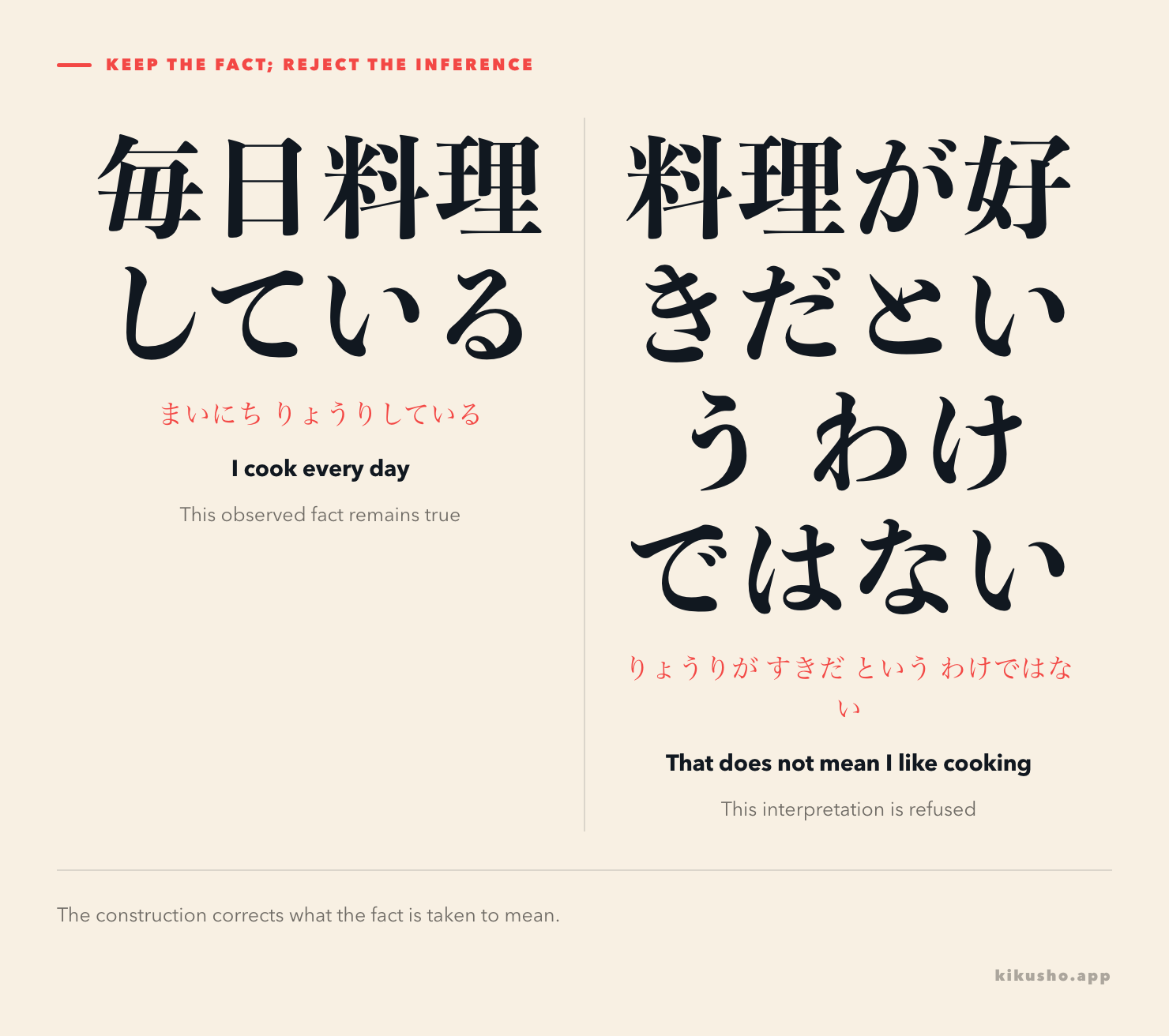
This is why the construction usually needs context. 日本語が話せるというわけではない sounds as if someone has suggested that the person can speak Japanese. A bare 日本語が話せない simply reports inability. The longer form spends its extra words on correcting another reading.
Put the proposition being rejected before という
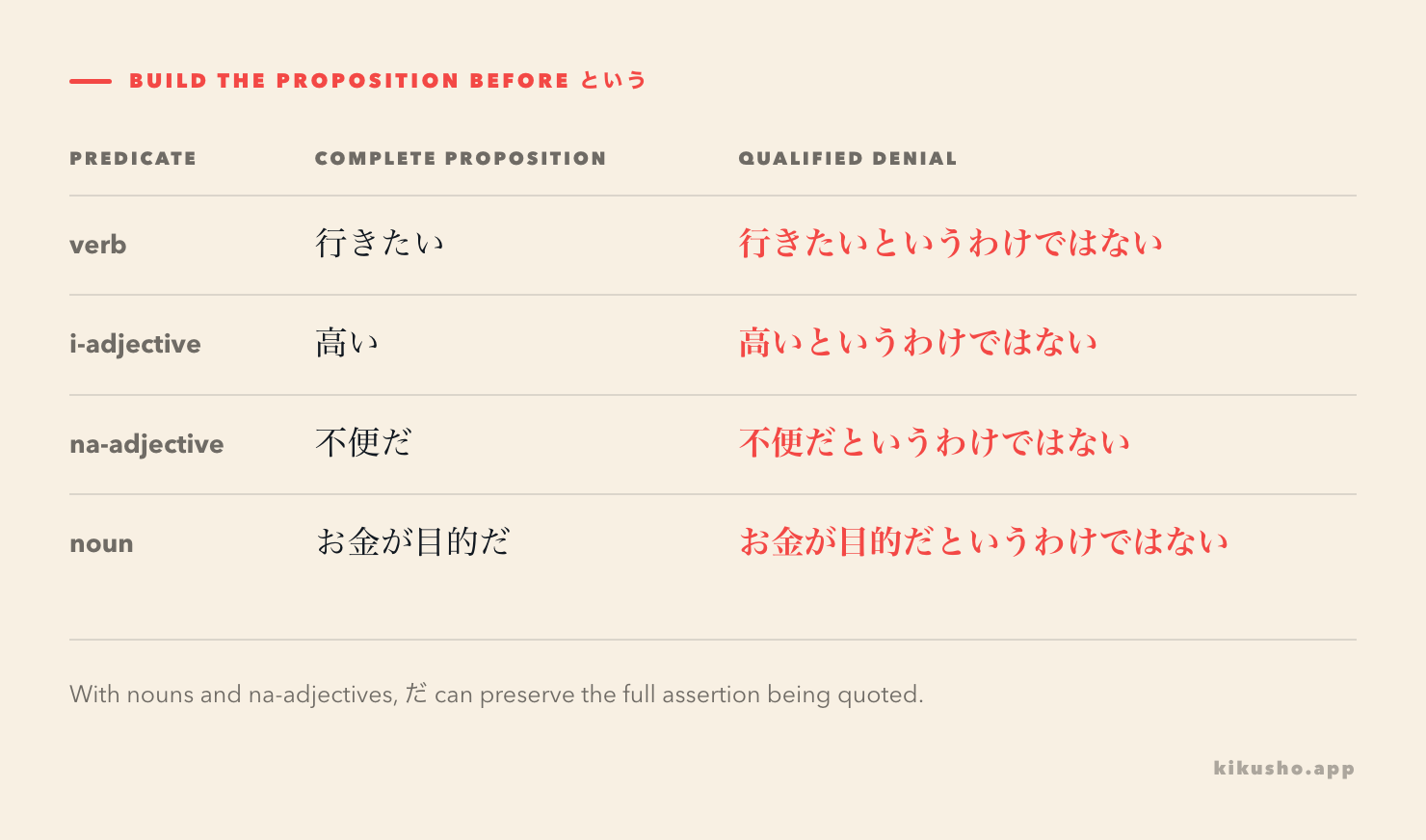
Verbs and i-adjectives use their plain forms. With noun and na-adjective predicates, だ may remain when the full assertion is explicitly quoted; teaching references also show it omitted in compact noun conclusions.
| Predicate | Full form | Rejected interpretation |
|---|---|---|
| verb | 行きたいというわけではない | “I want to go” |
| i-adjective | 高いというわけではない | “it is expensive” |
| na-adjective | 不便だというわけではない | “it is inconvenient” |
| noun | お金が目的だというわけではない | “money is the purpose” |
旅行に行きたいというわけではない。ただ、少し仕事を休みたい。
りょこうに いきたいというわけではない。ただ、すこし しごとを やすみたい。
It is not that I want to take a trip. I just want a short break from work.
この町が不便だというわけではないが、夜はバスが少ない。
この まちが ふべんだというわけではないが、よるは バスが すくない。
It is not that this town is inconvenient, but buses are infrequent at night.
The material before という must be the proposition you intend to correct. Moving the scope produces a different denial. 全部読んだというわけではない denies having read all of it; it does not deny having read any of it.
Totalizing words reveal the remaining truth
The description “partial negation” is useful only when you can identify which part loses its force. Words such as 必ず, 全部, いつも, 完全に, 全く and 誰でも make that scope visible.
高い商品が必ず長持ちするというわけではない。
たかい しょうひんが かならず ながもちするというわけではない。
Expensive products do not necessarily last a long time.
資料を全部読んだというわけではないが、要点は確認した。
しりょうを ぜんぶ よんだというわけではないが、ようてんは かくにんした。
I did not read all the material, but I checked the main points.
この薬は全く副作用がないというわけではない。
この くすりは まったく ふくさようが ないというわけではない。
It is not that this medicine has absolutely no side effects.
In the first sentence, some expensive products may last. In the second, some of the material was read. In the third, side effects remain possible. A corpus-based study in the Taiwan Journal of Japanese Language Education argues that labels such as “partial negation” are insufficient without this context and co-occurrence information. The useful question is not “Is the sentence negative?” but “Which overstrong conclusion is being reduced?”
The next clause often supplies the replacement
Common continuations include が, けど, ただ, むしろ, ~だけだ and ~というより. They turn the unspoken remainder into a visible correction.
反対だというわけではありませんが、もう少し資料が必要です。
はんたいだというわけではありませんが、もうすこし しりょうが ひつようです。
I am not saying I oppose it, but we need a little more information.
値段だけで選んだというわけではない。むしろ、修理しやすさを重視した。
ねだんだけで えらんだというわけではない。むしろ、しゅうりしやすさを じゅうしした。
It is not that I chose it on price alone. I placed more importance on ease of repair.
The correction need not follow in the same sentence, but it should be recoverable. If the speaker says only 反対だというわけではない, the listener naturally waits to hear what the hesitation is. That open space is part of the form's politeness: it can soften disagreement before the speaker gives the limitation.
Speech contracts ではない, while formal prose keeps it visible
The neutral written form is というわけではない. Polite speech uses というわけではありません. Conversation normally contracts ではない to じゃない:
君を責めているというわけじゃないよ。状況を確認したいだけだ。
きみを せめているというわけじゃないよ。じょうきょうを かくにんしたいだけだ。
I am not blaming you. I only want to confirm what happened.
The contraction changes the register, not the scope. というわけでもない is another related softening, close to “not exactly,” but it is not required to form the assigned construction.
The shorter わけではない can perform the same broad job. Adding という helps frame the preceding material as the exact claim under discussion, especially when that claim is long or explicitly attributed. The forms overlap; do not invent a rule that every short proposition must omit という. The earlier わけ comparison focuses on the difference between qualified denial and impossibility.
わけがない leaves no corrective remainder
Compare two replies to the same suggestion:
A:田中さんが資料を隠したのですか。
A: Did Tanaka hide the document?
B:田中さんが隠したというわけではありません。置き場所を変えただけです。
B: It is not that Tanaka hid it. He only moved where it was kept.
B:田中さんが隠すわけがありません。昨日は出張中でした。
B: There is no way Tanaka hid it. He was away on business yesterday.
The first B corrects the interpretation of Tanaka's action: moving is true, hiding is the wrong label. The second B rules out the event itself. というわけではない invites a more accurate account; わけがない presents the proposition as impossible.
Practice: find the interpretation being refused
Question 1 — grammar choice. Complete the correction: 毎日料理するが、料理が好きだ__。外食は高いから自炊している。
① というわけではない
② というわけだ
③ わけがない
④ というものだ
Question 2 — scope. In 本を全部読んだというわけではない, what remains possible: reading none of it, reading some but not all of it, or reading every page?
Question 3 — attachment. Complete the formal sentence with the full noun proposition: お金が目的__。地域の役に立ちたいのです。
① というわけではありません
② だというわけではありません
③ なというわけではありません
④ のというわけではありません
Question 4 — connected text. Read 料金が安いからといって、サービスが悪いというわけではない。対応は速く、説明も丁寧だ. Which inference is rejected, and which facts replace it?
Question 5 — register. Change あなたに反対しているというわけではない into an ordinary casual spoken form without changing its meaning.
Question 6 — contrast. Which form fits when evidence proves Tanaka was overseas: 田中さんが犯人だというわけではない or 田中さんが犯人であるわけがない? Explain the strength of the choice.
Question 7 — production. Write a two-sentence correction: first reject the interpretation that someone studies Japanese only for an exam with というわけではない; then state their broader reason.
Answers and explanations
Resolution 1
Use ① というわけではない. Cooking every day is the fact; enjoying cooking is the tempting interpretation; avoiding restaurant prices is the correction.
Resolution 2
Reading some but not all of the book remains possible. 全部 is the overstrong part placed inside the proposition, so the construction denies completeness rather than asserting zero reading.
Resolution 3
Use ② だというわけではありません: お金が目的だというわけではありません. 目的だ is the complete noun predicate quoted before という. The next sentence gives service to the community as the stronger motive.
Resolution 4
The sentence rejects the inference “low price means poor service.” 対応は速い and 説明も丁寧だ replace that inference with observed qualities of the service.
Resolution 5
Use あなたに反対しているというわけじゃない. ではない contracts to じゃない in ordinary conversation; the proposition and the qualified denial stay the same.
Resolution 6
Choose 田中さんが犯人であるわけがない. Proof that Tanaka was overseas supports an impossibility claim. というわけではない would only correct one interpretation and leave room for a qualified alternative, which is weaker than the evidence described.
Resolution 7
One model is 試験に合格するためだけに日本語を勉強しているというわけではない。日本の小説を原文で読みたいのだ. The first sentence rejects “exam success is the only reason”; the second supplies the broader aim.
Let the correction determine the negative
Before choosing the construction, finish the speaker's unspoken second sentence. If it begins “rather…,” “but some…,” or “only…,” というわけではない can hold the first interpretation open long enough to replace it. If there is no remainder because the proposition is impossible, another negative belongs there. That test turns a vague gloss into a discourse choice.
An AI agent reviewed the assigned item, the quoted-proposition attachment, the two denial functions, conversational contraction, every Japanese example and each exercise explanation against the cited references. No human Japanese review is claimed.
Common questions
What does というわけではない mean?
It means “it is not that…” or “that does not mean…”. The speaker rejects an interpretation or a conclusion suggested by the context while leaving the underlying facts, and often part of the proposition, intact.
Is というわけではない a complete denial?
Usually it is a qualified denial. The sentence often rejects words such as always, everyone, completely or necessarily, or corrects one proposed reason before giving the real one.
What is the spoken form of というわけではない?
Conversation normally contracts ではない to じゃない, producing というわけじゃない. Polite speech uses というわけではありません.
How is というわけではない different from わけがない?
というわけではない rejects a particular interpretation but leaves room for a more accurate account. わけがない says the proposition is impossible or cannot reasonably be true.