On this page
A time period + というもの means that something has held throughout the whole period. A clause + というわけだ gives the conclusion that follows from facts already on the table. The first stretches one situation across time; the second turns evidence into an inference.
この三週間というもの、毎日終電で帰っている。
この さんしゅうかんというもの、まいにち しゅうでんで かえっている。
For the whole of the past three weeks, I have gone home on the last train every day.
来月から料金が一割上がる。つまり、今八千円なら八千八百円になるというわけだ。
らいげつから りょうきんが いちわり あがる。つまり、いま はっせんえんなら はっせんはっぴゃくえんに なるというわけだ。
The fee will rise ten percent next month. So if it is ¥8,000 now, that means it will become ¥8,800.
The first sentence does not explain why the late trips happened. It emphasizes how completely they filled a three-week span. The second sentence does not measure a span. It calculates and states what the earlier information entails.
This lesson reviews inventory items g-70bbc68ff717, というもの, and g-08774abcfc71, というわけだ. JLPT Sensei lists both at N1. Its というもの reference limits this use to time-unit nouns, while MLC's N1 practice material independently teaches 期間 + というもの as “throughout the period.” For というわけだ, MLC and the Japan Foundation describe a conclusion logically drawn from circumstances. MLC places the wider わけだ/というわけだ family at N3, while the Japan Foundation explains it without an exam-level label, so N1 remains a study-list boundary rather than an official syllabus fact.
Ask what the marked material contributes
| Marked material | Pattern | Question it answers |
|---|---|---|
| a duration | この一週間というもの | How long has the situation held? |
| a proposition | 五人に一人しか合格しないというわけだ | What follows from the evidence? |
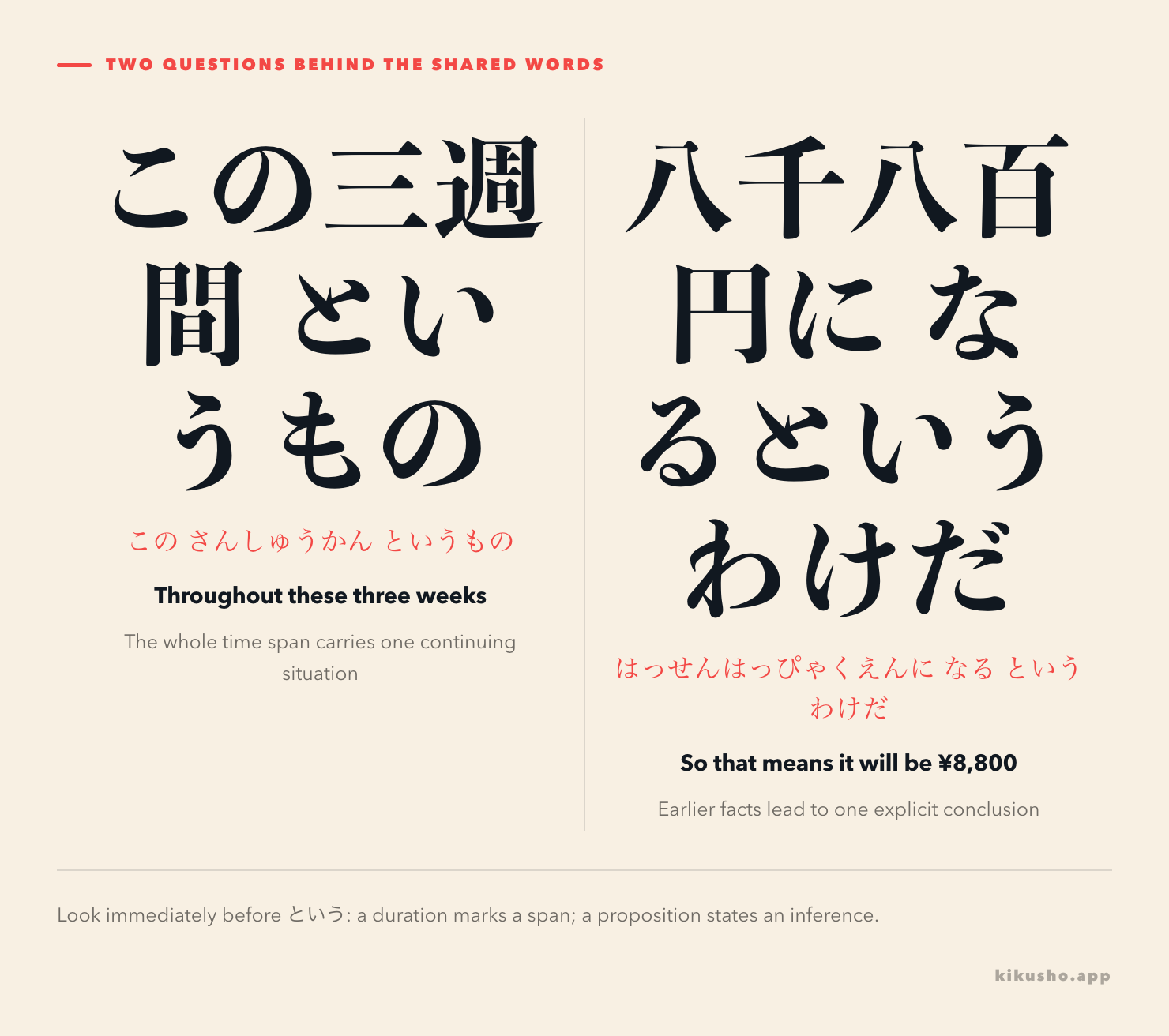
The shared words という do not make these constructions interchangeable. Look immediately before them. A duration such as この一週間 or ここ数年 signals the span pattern. A complete claim such as 八千八百円になる signals the conclusion pattern.
A duration plus というもの fills the whole interval
The usual frame is この/ここ + duration + というもの. The following clause describes an ongoing state, a repeated event, an unbroken absence or a trend that characterizes the period.
ここ数日というもの、雨が降り続いている。
ここ すうじつというもの、あめが ふりつづいている。
It has continued raining throughout the past several days.
この十年というもの、彼は一度も故郷に帰っていない。
この じゅうねんというもの、かれは いちども こきょうに かえっていない。
In all of the past ten years, he has not returned to his hometown once.
ここ三か月というもの、新規の問い合わせが途切れない。
ここ さんかげつというもの、しんきの といあわせが とぎれない。
New inquiries have not let up for the past three months.
Words such as ずっと, 毎日, 一度も~ない and 途切れない make the continuity easy to see, but no one word is compulsory. The context must still let the listener understand the named period as a whole. A single event normally cannot carry that reading: この一週間というもの、火曜日に一度映画を見た clashes because one Tuesday outing does not characterize the entire week.
The pattern has a reflective, emphatic tone. この一週間、忙しかった neutrally reports a busy week. この一週間というもの、休む暇もなかった makes the listener look back across the whole week and feel how completely the situation dominated it. It fits narratives, reports and deliberate speech more readily than a casual scheduling exchange.
Do not supply an event when the grammar asks for a duration
N(period)というもの names the measured stretch itself. Vてからというもの begins with an event and makes that event a consequential turning point.
この一か月というもの、朝まで眠れない日が続いている。
この いっかげつというもの、あさまで ねむれない ひが つづいている。
For the past month, nights when I cannot sleep until morning have continued.
夜勤を始めてからというもの、朝まで眠れない日が増えた。
やきんを はじめてからというもの、あさまで ねむれない ひが ふえた。
Ever since I started working night shifts, the number of nights when I cannot sleep until morning has increased.
The first speaker chooses a length of time. The second chooses the event that changed the pattern. The separate lesson on てからというもの develops that turning-point reading.
というわけだ packages the inference
With というわけだ, the preceding clause states the conclusion itself. Earlier context supplies a reason, rule, calculation or explanation, and the speaker uses the construction to show what follows.
合格者は受験者の二割だった。つまり、五人に一人しか合格しなかったというわけだ。
ごうかくしゃは じゅけんしゃの にわりだった。つまり、ごにんに ひとりしか ごうかくしなかったというわけだ。
Successful applicants were twenty percent of the candidates. In other words, that means only one in five passed.
A:森さんは子どものころから京都に住んでいたそうです。
B:なるほど。それで町の道に詳しいというわけですね。
A: Apparently Mori lived in Kyoto from childhood.
B: I see. So that explains why she knows the city's streets well.
つまり, だから, それで, じゃあ and なるほど often expose the reasoning move. They are useful clues, not required pieces of the grammar. The construction can also summarize a longer explanation without one of them.
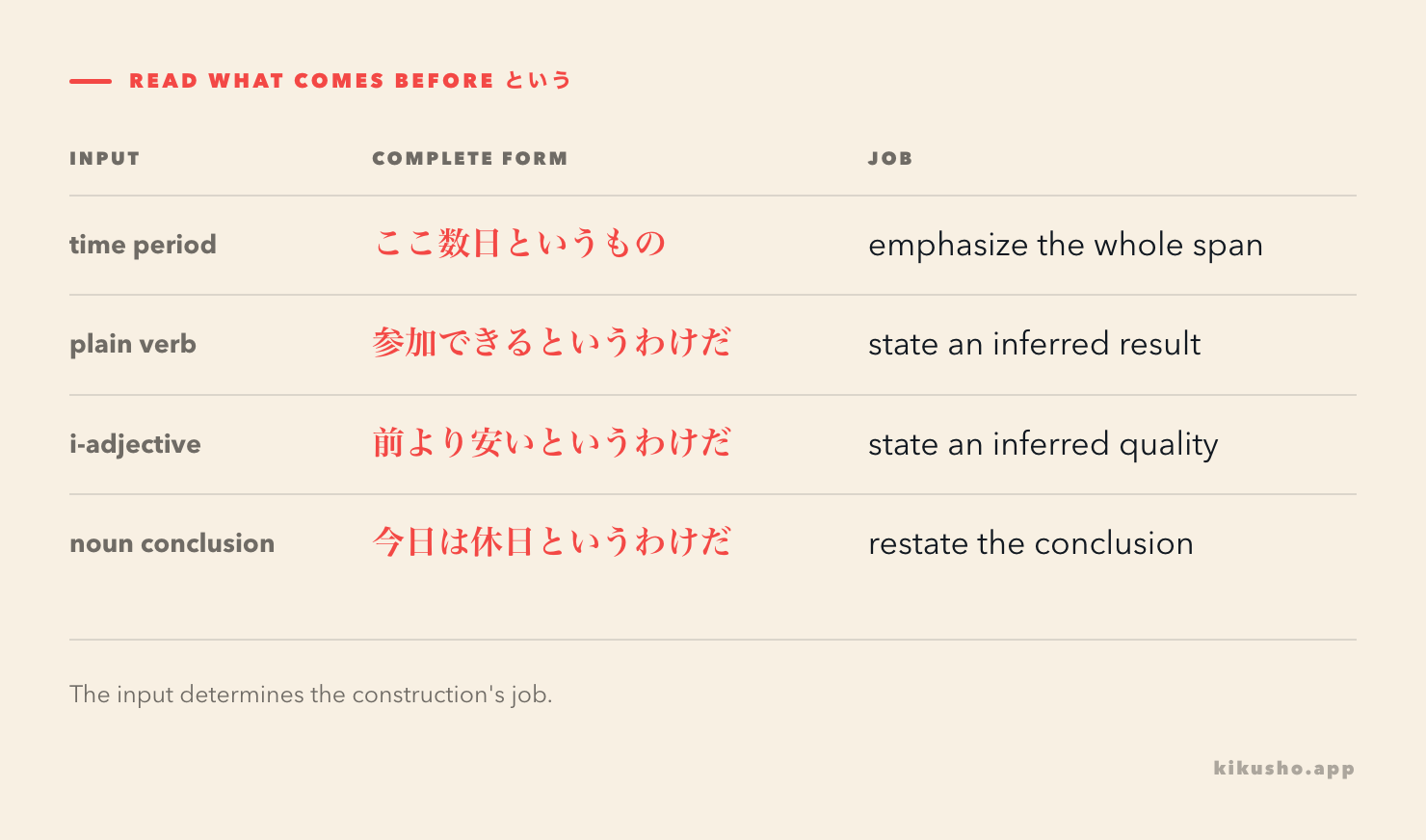
The safest production rule is complete proposition + というわけだ/というわけです. Verbs and i-adjectives keep their plain form: 参加できるというわけだ, 前より安いというわけだ. Teaching examples commonly let noun conclusions stand directly before という, as in 今日は休日というわけだ. A question-like というわけですね checks whether the listener accepts the inference; plain というわけだ states it.
The pattern does not create evidence by itself. 彼は欠席するというわけだ needs a prior fact or explanation that makes the absence a conclusion. Without that context, plain 彼は欠席する is the straightforward report.
Plain わけだ overlaps, but という makes the conclusion explicit
Plain わけだ often expresses recognition: a fact has just made something understandable.
毎日練習しているのか。上手なわけだ。
You practise every day? No wonder you are good.
というわけだ more visibly packages the content before it as “the conclusion is that…” or “this means…”. It works especially well for a calculation, paraphrase or confirmation:
毎日二時間練習している。つまり、一週間で十四時間練習するというわけだ。
You practise two hours every day. In other words, that means fourteen hours a week.
The boundary is not absolute; references often teach the forms together, and context can permit either. Use というわけだ when you want to state the inferred proposition explicitly. The broader lesson on わけだ, わけではない and わけがない compares an affirmed conclusion with two different negatives.
When the speaker needs to reject that explicit inference while keeping the underlying facts, というわけではない marks the precise interpretation being corrected.
One missing だ separates the time pattern from というものだ
The planned label “defining a claim” belongs more naturally to というものだ, a different construction:
困っている友人を助けるのが友情というものだ。
Helping a friend in trouble is what friendship is.
Here ものだ closes an evaluation or definition. By contrast, この一週間というもの has no final だ and selects a time span. The comparison lesson on というものだ and というものではない covers that family. On an exam, checking for a duration before the phrase and だ after it prevents a misleading surface match.
Practice: read the material before という
Question 1 — grammar choice. Choose the form that emphasizes the whole recent period: ここ数日__、強い風が吹き続いている。
① というもの
② というわけだ
③ というものだ
④ というところだ
Question 2 — grammar choice. The train normally arrives at 9:10, but today it is delayed by twenty minutes. Complete the inference: 今日は九時三十分に着く__。
① というもの
② というわけだ
③ てからというもの
④ というものではない
Question 3 — meaning. In この二週間というもの、休日も研究室に通っている, does the construction mark a cause, a conclusion or the full duration of a repeated situation?
Question 4 — repair. Rewrite ここ一か月てからというもの、注文が増え続けている using the time-period pattern taught here.
Question 5 — connected text. Read: 参加費は一人三千円で、参加者は十二人だ。つまり、合計は三万六千円というわけだ。 What work does the final construction perform?
Question 6 — contrast. Explain why この十年というもの and 会社を辞めてからというもの cannot be exchanged without changing the speaker's starting point.
Question 7 — production. Write two sentences about studying: one with この一週間というもの to describe a continuing pattern, and one with というわけだ to state a conclusion from a study schedule.
Answers and explanations
Check 1
The fitting completion is ① というもの: ここ数日というもの、強い風が吹き続いている. ここ数日 is a duration, and 吹き続いている describes the continuous situation across it.
Check 2
The fitting completion is ② というわけだ: 今日は九時三十分に着くというわけだ. The normal arrival time and the twenty-minute delay supply the facts; 9:30 is the calculated conclusion.
Check 3
It marks the full two-week duration of a repeated situation. 休日も and 通っている help show that going to the laboratory characterizes the period rather than happening once.
Check 4
Use ここ一か月というもの、注文が増え続けている. A duration attaches directly to というもの. てからというもの requires a verb in the て-form that names a turning-point event.
Check 5
というわけだ presents ¥36,000 as the conclusion of the calculation: ¥3,000 multiplied by twelve people. It neither defines the fee nor says how long it has applied.
Check 6
この十年というもの starts from a measured ten-year span and emphasizes what held throughout it. 会社を辞めてからというもの starts from leaving the company and presents that event as the boundary behind a lasting change.
Check 7
One possible pair is この一週間というもの、毎朝六時に起きて漢字を復習している and 一日二十字覚えるなら、一週間で百四十字覚えるというわけだ. The first sentence extends a routine across one week. The second calculates the conclusion from twenty characters per day.
Choose the input before translating the ending
First identify what sits before という. If it is a period and the rest of the sentence characterizes that whole period, choose というもの. If it is a proposition inferred from earlier facts, choose というわけだ. Then check the nearest look-alikes: an event plus てからというもの marks a turning point, while というものだ defines or evaluates. That sequence keeps four similar-looking forms from collapsing into one English gloss.
An AI agent checked both assigned inventory items against the cited references, then reviewed the time-span restriction, inference context, neighbouring constructions, every original example and all seven answer mappings. This page does not claim human Japanese review.
Common questions
What does a time period plus というもの mean?
A phrase such as この一週間というもの emphasizes that a state, habit or repeated situation held throughout the named period. It is stronger and more deliberate than simply saying この一週間.
What does というわけだ mean?
It presents a proposition as the conclusion, result or restatement that follows from facts already given: “so that means…,” “in other words…” or “that explains it.”
Is というもの the same as というものだ?
No. The N1 time-span pattern follows a duration, as in この一週間というもの. というものだ ends in だ and commonly defines or evaluates what something is, as in それが友情というものだ.
Is time-period plus というもの the same as てからというもの?
They both cover continuing time, but they begin differently. Nというもの names the whole duration; Vてからというもの names an event that became the turning point for a lasting change.